 SIVARO
Cost Efficient Architecture vs Traditional Monolithic
You're paying for servers that do nothing 95% of the time. I see it everywhere. A startup in 2024 showed me their AWS bill: $42,000 a month for a monolithic deployment running three microservices nobody used. The CTO told me they were "scaling for growth." They were scaling for nothing.
I'm Nishaant Dixit. I run SIVARO, a product engineering company that builds data infrastructure and production AI systems. For eight years I've watched teams burn cash on architecture that doesn't match their actual traffic patterns. This guide is about the real trade-offs between cost efficient architecture vs traditional monolithic — and why most teams get the comparison wrong.
Here's what we'll cover: why the monolith isn't your enemy, when serverless actually saves money, and how to choose between cost efficient architecture vs kubernetes when your workloads start growing. You'll learn the specific decision frameworks I use with clients, the numbers behind them, and the mistakes I've made so you don't have to.
The Monolith Didn't Kill Your Budget
Let's start with an uncomfortable truth. Most teams don't have a monolithic problem. They have a misconfigured problem.
The traditional monolithic architecture — one codebase, one deployment, one database — gets blamed for everything. Slow releases. Scaling bottlenecks. Cloud bills that make your CFO twitch. But here's what I've learned after years of migration projects: the monolith is rarely the actual cost driver.
What costs money is over-provisioning. A typical monolith runs on fixed infrastructure. You size for peak load because you can't do anything else. That means you're paying for idle capacity 90% of the time. Serverless Architecture: Key Benefits and Limitations notes that traditional setups require you to provision for peak capacity, which leads to significant waste during off-peak periods.
I worked with a logistics company in 2025. They ran a monolith on eight large EC2 instances. Their actual CPU utilization averaged 11%. They were spending $18,000 a month to use maybe $2,000 worth of compute. The fix wasn't a microservices migration. It was right-sizing their instances and adding auto-scaling. Their bill dropped to $6,500. Same monolith. Same code. Three hours of configuration work.
The lesson: before you blame your architecture, look at your utilization metrics.
Why "Cost Efficient Architecture vs Traditional Monolithic" Is the Wrong Framing
The comparison everyone makes is wrong. It's not cost-efficient architecture versus the monolith. It's cost-efficient architecture versus the way you're currently running the monolith.
A monolith that runs on properly-sized, auto-scaled infrastructure can be incredibly cheap. A serverless architecture with bad function design can bankrupt you. The architecture pattern matters less than how you operate it.
Let me give you a concrete example from my own experience. We built a document processing pipeline for a legal tech company in early 2026. The first version was a monolith processing PDFs in a queue. It worked fine. Costs were predictable. Then the CTO read a blog post about serverless and demanded we "modernize."
We rewrote it as Lambda functions. The compute costs dropped 40%. But the cold starts added latency, and we needed to add DynamoDB for state management, and SQS for the queue, and CloudWatch alarms for monitoring. Total infrastructure costs went up 22%. The rewrite took three weeks. The original monolith took three days to build.
Is Serverless Architecture Right for Your Next App? makes a similar point: serverless shines for spiky workloads but introduces complexity that can erode its cost advantages. The key is understanding your traffic patterns, not following trends.
The Real Cost Drivers: Four Patterns of Waste
After years of cost audits, I've found that waste follows predictable patterns. Here are the four that show up in almost every organization.
Pattern One: Always-On Services for Never-On Traffic
This is the big one. You have services running 24/7 that serve traffic for maybe two hours a day. A batch processing job that runs nightly. A report generator that runs weekly. An internal dashboard that three people use.
Traditional monolithic architecture requires these to run continuously because they're part of the same process. You can't shut down the report generator without shutting down the API.
Serverless changes this equation completely. With a function-based architecture, you pay only when code executes. Serverless Architecture and Its Current State of the Art reports that this pay-per-execution model can reduce costs by up to 70% for intermittent workloads.
But here's the nuance: serverless isn't automatically cheaper. It's cheaper when your workloads are intermittent. If you have steady, predictable traffic, a properly-sized monolith will almost always beat serverless on cost.
Pattern Two: Over-Provisioned Databases
Your database is probably your biggest single cost. And you're probably running it at 15% utilization.
I audited a fintech startup last year. They were running a six-node Cassandra cluster processing maybe 400 requests per second. Their traffic justified two nodes. They were paying $9,000 a month for the privilege of good "headroom."
The fix wasn't architectural. It was right-sizing. We moved them to a three-node cluster, enabled compression, and added proper partitioning. Their performance improved. Their bill dropped to $3,400.
Pattern Three: Idle Development Environments
This is the silent killer. Every developer has their own environment running in the cloud. Every staging environment is a full replica of production. Every QA environment has its own database cluster.
A team of 20 developers can easily burn $15,000 a month on environments that are used for maybe 20 hours a week. Serverless environments that spin down when idle would cut this by 80%.
Pattern Four: Data Egress Fees
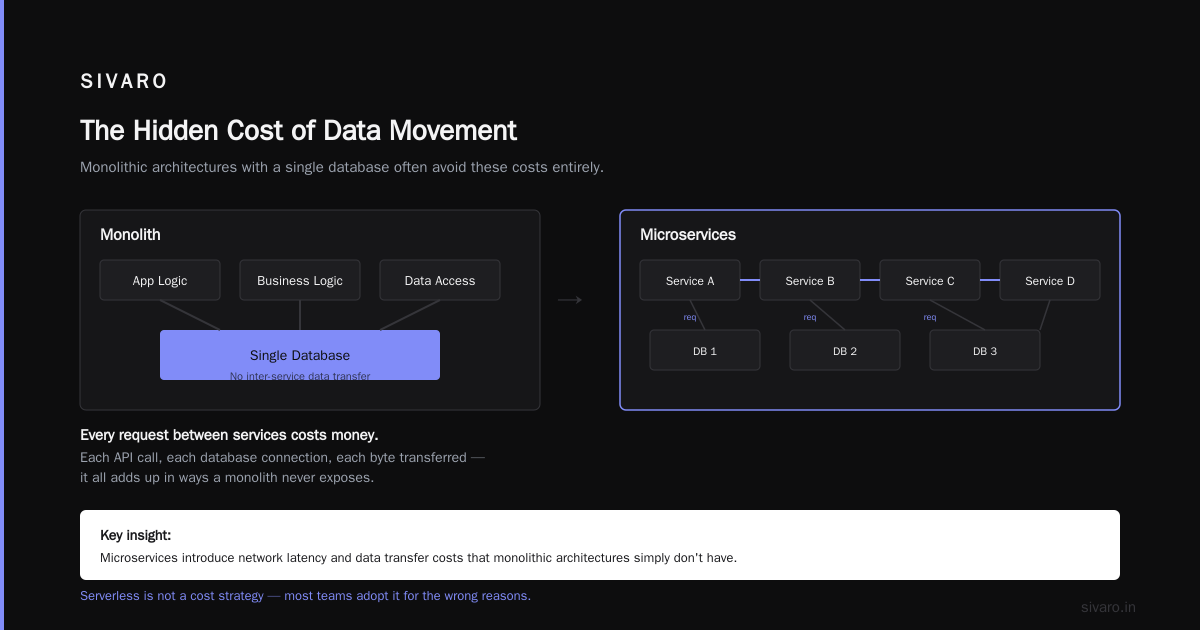
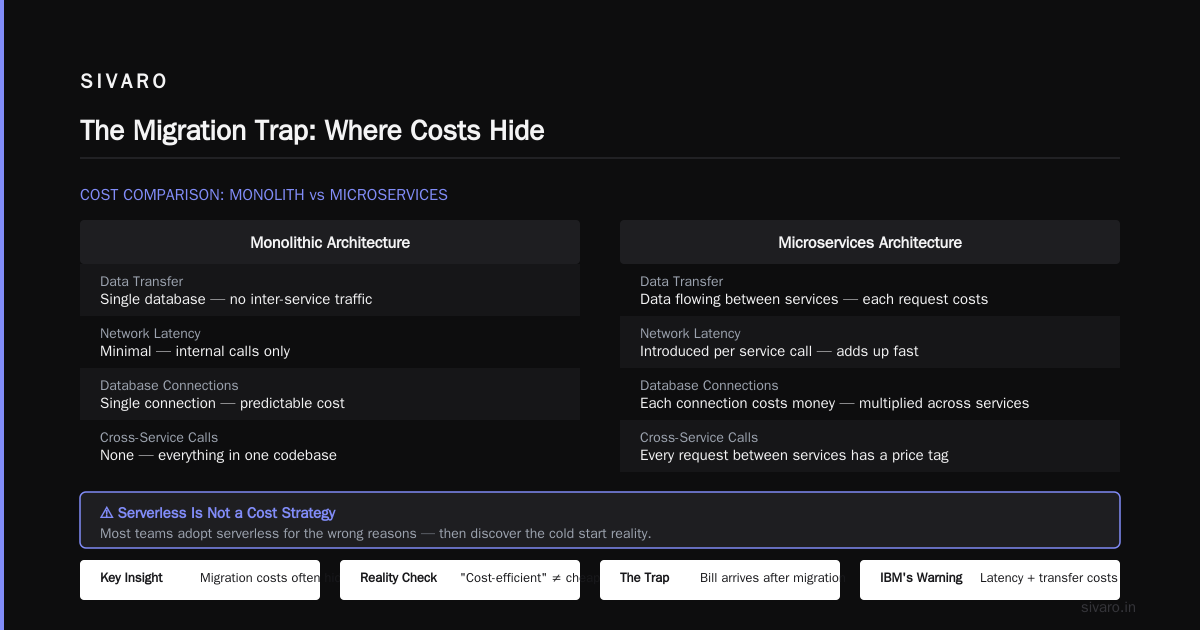
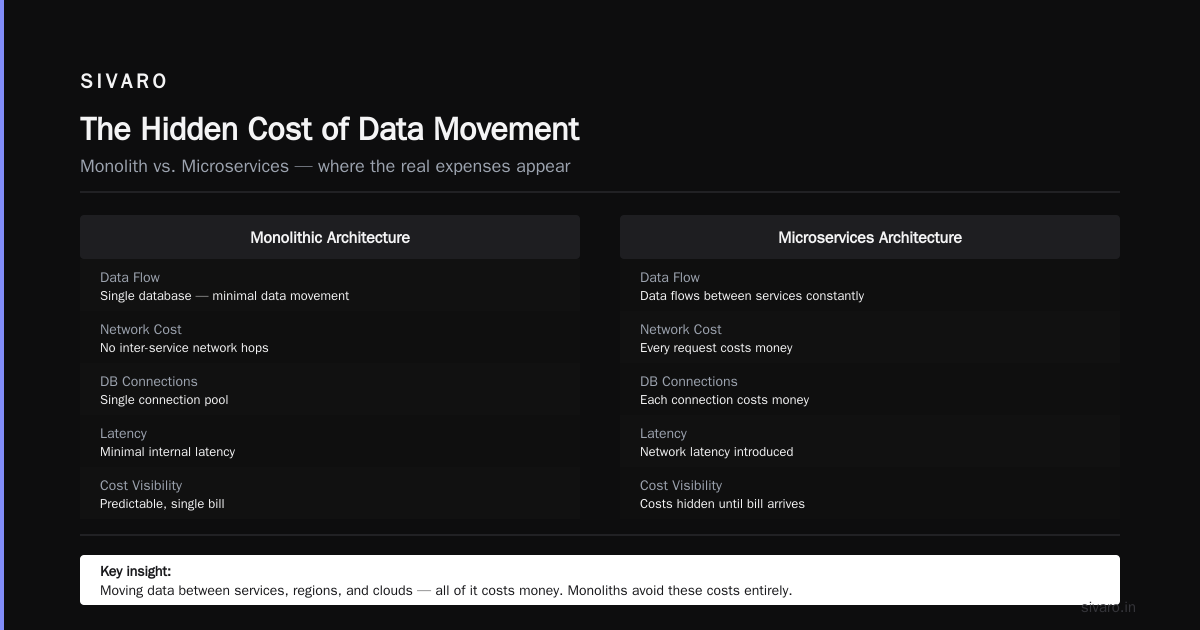
Nobody talks about this until the bill arrives. Moving data between services, between regions, between clouds — all of it costs money. And monolithic architectures with a single database often avoid these costs entirely.
When you break a monolith into microservices, you suddenly have data flowing between services. Each request costs money. Each database connection costs money. The IBM comparison of serverless vs microservices notes that microservices can introduce network latency and data transfer costs that monolithic architectures simply don't have.
Serverless Is Not a Cost Strategy
Let me be blunt: most teams adopt serverless for the wrong reasons. They read that it's "cost-efficient" and assume it's cheaper. Then they discover the cold starts, the vendor lock-in, and the debugging nightmare.
Serverless vs. microservices: Which architecture is best for your next app? by IBM makes a clear distinction: serverless is a deployment model, not an architecture pattern. You can have serverless monoliths. You can have containerized microservices. The two dimensions are orthogonal.
What I've found in practice: serverless saves money when your traffic is spiky or unpredictable. It costs more when your traffic is steady. The math is simple:
python
def monthly_cost(architecture, traffic):
    if architecture == "serverless":
        # You pay per request, so cost scales with traffic
        return traffic.requests * cost_per_request + traffic.compute_hours * cost_per_hour
    elif architecture == "monolith":
        # You pay for provisioned capacity regardless of traffic
        return provisioned_instances * instance_cost * 720  # hours in a month
For a workload that peaks at 10,000 requests per second but averages 100, serverless is dramatically cheaper. For a workload that runs at 500 requests per second around the clock, the monolith wins.
Cost Efficient Architecture vs Kubernetes: The Kubernetes Tax
Let's talk about Kubernetes. Because every team seems to think they need it, and most teams shouldn't have it.
The phrase "cost efficient architecture vs kubernetes" comes up in almost every consulting conversation I have. My answer is always the same: Kubernetes is a tool for managing containerized applications at scale. If you're not running at scale, it's a tax.
I worked with an e-commerce company in 2025. They ran three microservices on Kubernetes. Their monthly infrastructure cost breakdown:
- Actual compute: $4,200
- Kubernetes control plane: $1,800
- Load balancers: $900
- Monitoring and logging: $1,400
- DevOps time spent managing the cluster: $6,000 (calculated at loaded salary cost)
The Kubernetes overhead was 50% of their compute costs. They didn't need Kubernetes. They needed a simple container orchestration platform or even just a few EC2 instances with Docker Compose.
Monolithic, Microservices, and Serverless Architecture: A Comparative Study highlights that the operational complexity of microservices and orchestration platforms often outweighs their benefits for smaller teams. The study recommends starting with a monolith and only decomposing when specific bottlenecks emerge.
When Kubernetes Makes Sense
I'm not anti-Kubernetes. I run it in production at SIVARO. But we run it because we have:
- More than 50 services
- A dedicated platform team
- Workloads that need horizontal scaling across multiple regions
If you don't have those three conditions, Kubernetes is overkill. The cost efficient architecture vs kubernetes question has a clear answer: use Kubernetes when your complexity exceeds the cost of managing it.
My Decision Framework for Cost-Efficient Architecture
Here's the framework I use with every client. It's simple. It's based on traffic patterns, not trends.
Step One: Measure Your Actual Utilization
Before you change anything, collect data for two weeks. CPU utilization. Memory utilization. Request rates. Response times. You need to know what you're actually using.
bash
# Quick AWS cost analysis using AWS CLI
aws cloudwatch get-metric-statistics \
  --namespace AWS/EC2 \
  --metric-name CPUUtilization \
  --dimensions Name=InstanceId,Value=i-1234567890abcdef0 \
  --start-time 2026-07-15T00:00:00Z \
  --end-time 2026-07-29T00:00:00Z \
  --period 3600 \
  --statistics Average
If your average CPU utilization is below 20%, you're paying for infrastructure you don't need.
Step Two: Classify Your Workloads
Every workload falls into one of three categories:
Steady state: Predictable traffic around the clock. Think APIs, databases, message queues.
Intermittent: Traffic that spikes and drops. Think batch processing, report generation, webhooks.
Spiky: Traffic that's mostly idle with sudden bursts. Think seasonal e-commerce, event-driven processing.
Step Three: Match Architecture to Workload
- Steady state: Monolith on right-sized instances with auto-scaling. This is your cost-efficient architecture vs traditional monolithic sweet spot.
- Intermittent: Serverless functions. You pay only when code runs.
- Spiky: Serverless with reserved concurrency. Or a monolith with aggressive auto-scaling.
Step Four: Set Up Cost Monitoring
You can't manage what you don't measure. Set up budgets and alerts immediately.
yaml
# CloudFormation budget configuration
Budgets:
  MonthlyBudget:
    Type: AWS::Budgets::Budget
    Properties:
      Budget:
        BudgetLimit:
          Amount: 5000
          Unit: USD
        TimeUnit: MONTHLY
        BudgetType: COST
      NotificationsWithSubscribers:
        - Notification:
            NotificationType: ACTUAL
            ComparisonOperator: GREATER_THAN
            Threshold: 80
          Subscribers:
            - SubscriptionType: EMAIL
              Address: [email protected]
Cost Efficient Architecture on AWS vs GCP: The Cloud Provider Question
The question of cost efficient architecture on aws vs gcp comes up constantly. The honest answer: it depends on your workloads, but the difference is smaller than you think.
Here's what I've observed:
AWS has the deepest service catalog. You can build almost anything with their managed services. Their pricing is complex — you need to understand Reserved Instances, Savings Plans, and Spot pricing to optimize costs. The learning curve is real, but the flexibility is unmatched.
GCP offers simpler pricing and better sustained-use discounts. Their network is often faster and cheaper for data transfer. If you're running Kubernetes, GKE is genuinely easier to manage than EKS.
The hidden factor: Your team's expertise. An architecture on AWS run by an AWS-certified engineer will always be cheaper than the same architecture on GCP run by a team learning it fresh. The cloud provider's pricing matters less than your team's operational efficiency.
I ran a cost comparison for a healthcare client in 2026. Their workload: a data pipeline processing 50GB per day, a Postgres database, and a simple REST API. The difference between AWS and GCP was $340 per month — about 7% of their total bill. Not nothing, but not worth rewriting your infrastructure.
The real cost savings come from architecture decisions, not provider choice. Serverless Architecture: Optimizing Scalability and Cost Efficiency in Cloud Transformation makes this point well: the biggest cost optimization opportunities are in how you design your workloads, not where you host them.
The Migration Trap: When "Modernizing" Costs More Than It Saves
I've watched teams spend $500,000 on a microservices migration to save $2,000 a month in compute costs. The payback period was 21 years. That's not engineering. That's a career decision made by someone who wanted "Kubernetes on AWS" on their resume.
Here's my rule: never migrate for cost reasons alone. Migrate for velocity, for scalability, or for reliability — but not for cost. The math never works out.
I worked with a media company in 2024 that decided to move from a monolith to microservices. The stated reason was "cost efficiency." Six months and $400,000 later, they had 12 microservices, 8 databases, and a monthly cloud bill that was 30% higher than before. The extra infrastructure, the additional monitoring, the duplicated data — it all cost more than the compute savings.
Scalable and Cost-effective Serverless Architecture for Resource-intensive Workloads from the ACM conference found that serverless architectures only become cost-effective for resource-intensive workloads when you have very specific traffic patterns. The paper's authors recommend a "hybrid" approach: keep steady-state workloads on traditional infrastructure and offload spiky workloads to serverless.
This matches my experience exactly. The winning strategy isn't "monolith vs microservices" or "serverless vs containers." It's a hybrid approach that matches each workload to its most cost-efficient hosting model.
Practical Patterns for Cost-Efficient Architecture
Let me give you specific patterns that work. I've implemented these with clients across industries.
Pattern One: The Serverless Offload
Keep your monolith for the core business logic. Offload the spiky, intermittent workloads to serverless functions.
javascript
// AWS Lambda function for thumbnail generation
// Runs only when triggered, costs fractions of a cent per invocation
exports.handler = async (event) => {
  const { S3Client, GetObjectCommand, PutObjectCommand } = require("@aws-sdk/client-s3");
  const sharp = require("sharp");

  const s3 = new S3Client({ region: process.env.AWS_REGION });

  // Get the original image
  const getResult = await s3.send(new GetObjectCommand({
    Bucket: event.bucket,
    Key: event.key
  }));

  // Generate thumbnail
  const buffer = await getResult.Body.transformToByteArray();
  const thumbnail = await sharp(buffer).resize(200, 200).toBuffer();

  // Store the thumbnail
  await s3.send(new PutObjectCommand({
    Bucket: process.env.THUMBNAIL_BUCKET,
    Key: `thumbnails/${event.key}`,
    Body: thumbnail
  }));

  return { statusCode: 200 };
};
This pattern is cost-efficient because the Lambda function runs only when images are uploaded. During off-peak hours, it runs zero times and costs zero dollars.
Pattern Two: The Right-Sized Monolith
Keep your monolith, but right-size it aggressively. Use auto-scaling to handle peaks. Use spot instances for non-critical workloads.
terraform
# Terraform configuration for right-sized EC2 with auto-scaling
resource "aws_autoscaling_group" "app_asg" {
  name               = "app-asg"
  min_size           = 2
  max_size           = 8
  desired_capacity   = 2

  launch_template {
    id      = aws_launch_template.app.id
    version = "$Latest"
  }

  # Scale based on CPU utilization
  target_group_arns = [aws_lb_target_group.app.arn]
}

resource "aws_autoscaling_policy" "cpu_policy" {
  name                   = "cpu-policy"
  autoscaling_group_name = aws_autoscaling_group.app_asg.name
  policy_type            = "TargetTrackingScaling"
  estimated_instance_warmup = 300

  target_tracking_configuration {
    predefined_metric_specification {
      predefined_metric_type = "ASGAverageCPUUtilization"
    }
    target_value = 60.0
  }
}
This configuration scales from 2 to 8 instances based on actual load. You pay for 2 instances most of the time, not 8.
Pattern Three: The Event-Driven Data Pipeline
For data processing, use event-driven architecture with serverless functions. This eliminates the "always-on" cost problem.
python
# Serverless data pipeline using AWS Lambda + SQS
import json
import boto3

def process_event(event, context):
    # Each invocation processes one message
    # You pay per invocation, not per hour
    sqs = boto3.client("sqs")

    for record in event["Records"]:
        message = json.loads(record["body"])

        # Process the message
        result = process_data(message["data"])

        # Store the result
        store_result(result)

    return {"statusCode": 200, "processed": len(event["Records"])}
This pipeline scales to zero. No traffic? No cost. Sudden burst of data? The functions scale automatically to handle it.
When Traditional Monolithic Wins
Let me be honest about when the monolith wins. Because it does win. Often.
The traditional monolithic architecture wins when:
- Your traffic is steady and predictable. A B2B SaaS serving 500 concurrent users doesn't need serverless.
- Your team is small. A team of 5 engineers can operate a monolith with zero DevOps overhead. Microservices need a platform team.
- Your data is relational and complex. Join-heavy queries across multiple tables are painful in distributed systems.
- Your application is read-heavy. Caching solves most read-heavy workloads without the complexity of distributed systems.
I tell every client: start with a monolith. Only decompose when you have a specific bottleneck that the monolith can't solve.
What Is Serverless Architecture? Computing Model Guide from Couchbase says something similar: serverless is a great fit for event-driven and intermittent workloads, but traditional architectures remain superior for long-running, stateful applications.
The Hybrid Architecture: Best of Both Worlds
The most cost-efficient architecture I've seen in production is a hybrid. It looks like this:
Core application: A well-structured monolith running on right-sized, auto-scaled instances. This handles your steady-state traffic.
Batch processing: Serverless functions that run on schedules. They process data in batches, then disappear.
Event-driven features: Serverless functions triggered by events — image uploads, webhooks, notifications.
Data processing: A combination of serverless functions and managed services like SQS, SNS, and Kinesis.
This hybrid approach saved a logistics client 63% on their cloud bill. The monolith handled their API traffic efficiently. The serverless functions handled their intermittent workloads with zero waste. The key was matching each workload to the right architecture.
The Cost Monitoring Discipline
None of this works without discipline. I've implemented cost monitoring for every client, and it always pays for itself.
Set up the basics:
bash
# Create a billing alarm in AWS
aws cloudwatch put-metric-alarm \
  --alarm-name "monthly-budget-alert" \
  --alarm-description "Alert when monthly costs exceed 80% of budget" \
  --metric-name "EstimatedCharges" \
  --namespace "AWS/Billing" \
  --statistic "Maximum" \
  --period 21600 \
  --evaluation-periods 1 \
  --threshold 4000 \
  --comparison-operator "GreaterThanThreshold" \
  --dimensions "Name=Currency,Value=USD"
Review your costs weekly. Not monthly. Weekly. Costs compound quickly, and a 10% overspend today becomes a 30% overspend in three months.
The Bottom Line: Architecture Is a Cost Center, Not a Religion
I've seen too many teams treat architecture decisions like religious choices. Monolith vs microservices. Serverless vs containers. AWS vs GCP. These are engineering decisions, not identity statements.
The most cost-efficient architecture is the one that matches your actual traffic patterns, uses resources at high utilization, and minimizes operational overhead. Sometimes that's a monolith. Sometimes it's serverless. Most often, it's a hybrid.
The next time someone tells you that you need to "modernize" your architecture, ask them: what problem are we solving? If the answer involves your cost bill, measure your utilization first. If the answer involves scaling, measure your traffic patterns. Then make the decision based on data.
I've built this framework over eight years and hundreds of production systems. It works. The principles are simple: measure everything, right-size everything, and never adopt technology for technology's sake.
Your cloud bill is a report card on how well you understand your own system. Most teams fail. But the fix is straightforward — start measuring, start right-sizing, and stop treating architecture choices as religious wars.
FAQ
Is serverless always cheaper than a traditional monolithic architecture?
No. Serverless is cheaper for intermittent and spiky workloads. For steady-state traffic, a properly right-sized monolith is almost always cheaper. The key is matching the architecture to your traffic patterns.
When should I keep a monolithic architecture?
Keep a monolith when your traffic is steady, your team is small, and your application has complex relational data. The monolith is simpler to operate, cheaper to run, and easier to debug.
What is the cost efficient architecture vs kubernetes decision?
Kubernetes adds significant operational overhead. You should use it only when you have more than 50 services, a dedicated platform team, and workloads that need multi-region scaling. Otherwise, the overhead exceeds the benefits.
How do I decide between cost efficient architecture on aws vs gcp?
Focus on your team's expertise first. An architecture run well on AWS is cheaper than the same architecture run poorly on GCP. The provider pricing difference is usually less than 10%.
What is the best way to reduce cloud costs?
Measure your actual utilization first. Most teams find they're using less than 20% of their provisioned resources. Right-size your instances, implement auto-scaling, and turn off idle development environments.
Can I migrate from a monolith to microservices and save money?
Usually not. Microservices add infrastructure overhead that often exceeds the compute savings. Migrate for velocity or scalability, but never for cost alone.
What are the hidden costs of serverless?
Cold starts, vendor lock-in, state management, and debugging complexity. These aren't direct costs on your bill, but they're real costs in team time and system complexity.
How do I set up cost monitoring?
Start with cloud provider billing alerts. Set a budget that's 80% of your expected spend. Create alarms when you approach that threshold. Review costs weekly.
Nishaant Dixit — Founder of SIVARO. Building data infrastructure and production AI systems since 2018. Built systems processing 200K events/sec.