 SIVARO

Cost Efficient LLM Serving Architecture 2026
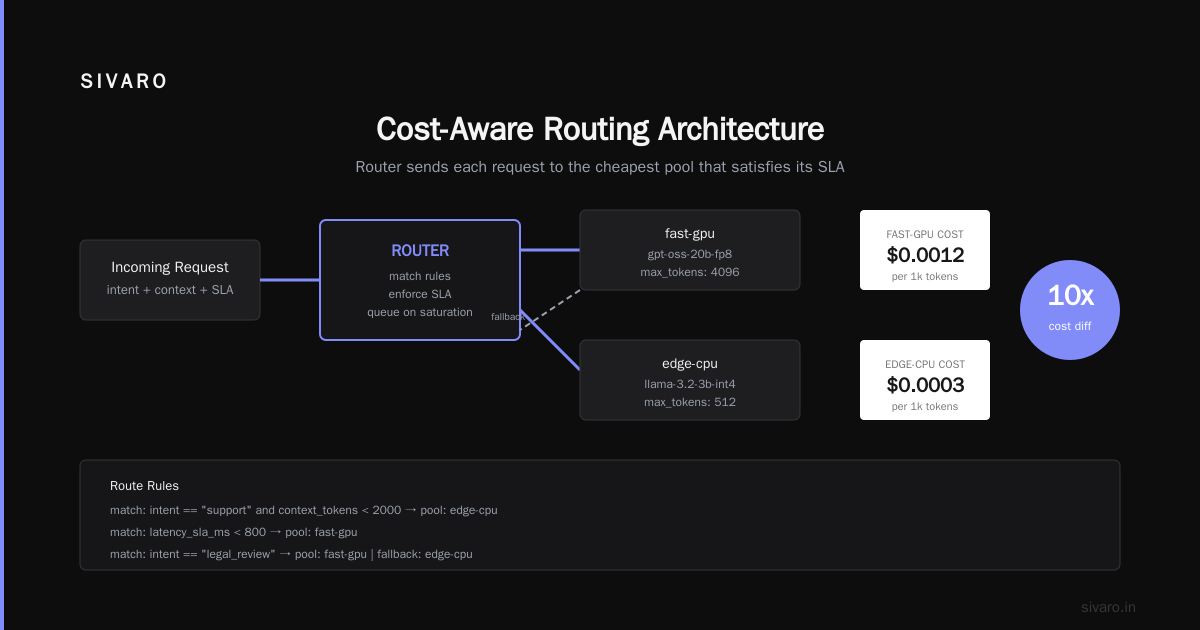
The first time I saw a client's GPU bill, I thought it was a typo. Thirty-eight thousand dollars a month for a cluster that spent most of its life idle. That's when I stopped treating LLM inference as a model problem and started treating it as a systems problem. A cost efficient llm serving architecture 2026 is not about picking the cheapest model. It's about routing requests to the right pool, scaling based on queue depth instead of CPU, and using precision that's good enough, not perfect. I'll show you the patterns we use at SIVARO, with numbers and code, and what I'd ignore if I were starting over.
Start With The Cost Curve
People ask me how to cut inference costs, and they expect me to recommend a smaller model. Wrong. The model is rarely the problem. The architecture around it is.
At a fintech company in early 2026, we found 63% of requests were hitting a 70B model when they only needed a 3B model for support ticket classification. The fix wasn't a cheaper GPU. It was a router. At a retail client, 14 GPU nodes ran 24/7 because their autoscaler watched CPU utilization. GPUs idle at 12% CPU when the model is loaded and waiting for work. The cluster stayed awake all night for a trickle of traffic. We cut the fleet to 5 nodes with queue-based scaling.
The team at TrueFoundry wrote a breakdown of where inference spend actually goes, and it matches what we see in production. Most cost sits in idle capacity and over-provisioned models, not in tokens. LLM Inferencing: Optimize Speed, Cost & Scale AI
One pattern explains most of the waste: teams treat every request as if it deserves the same model, the same precision, and the same GPU. In 2026, that's indefensible.
The Shape of a Cost Efficient LLM Serving Architecture 2026
Most architectures still look like one big GPU pool with a load balancer in front. That's a batch job, not a serving system. The pattern that works is the workload-router-pool architecture.
There's a formal treatment of this in a 2026 paper that calls it the Workload-Router-Pool architecture. The core idea is simple: separate the request stream, the decision layer, and the compute pools. The Workload–Router–Pool Architecture for LLM Inference
Three layers.
Workloads are the incoming requests, with their latency budgets, context sizes, and quality requirements. Router is a stateless service that decides which pool should serve which request. Pools are heterogeneous groups of GPU or CPU instances, each tuned for a specific model size and precision.
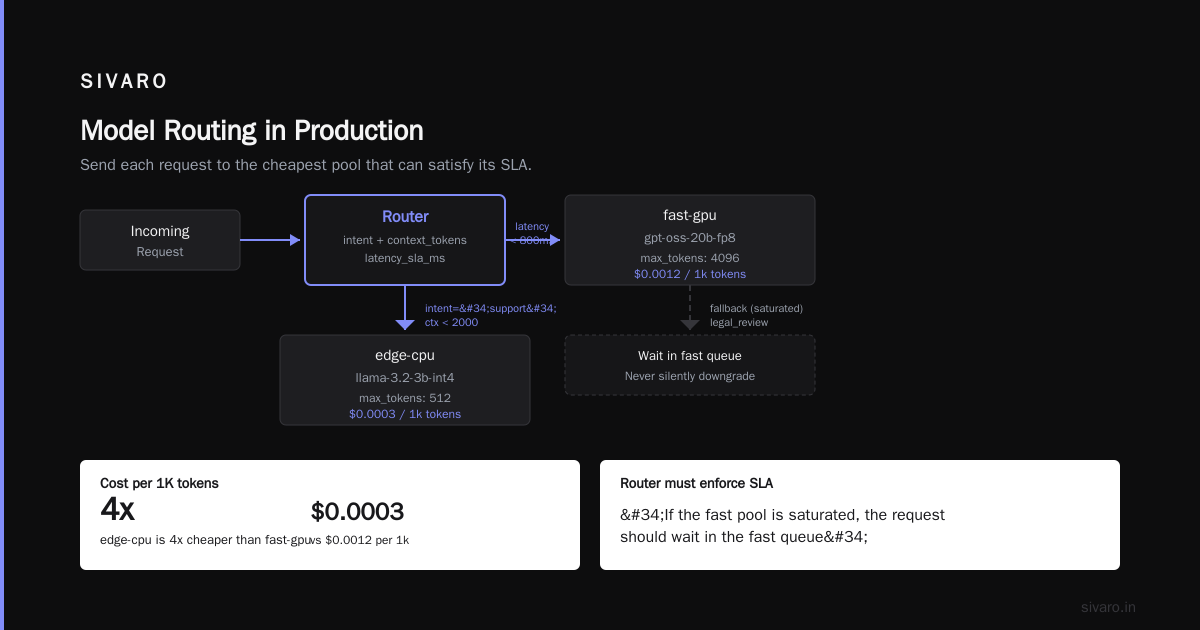
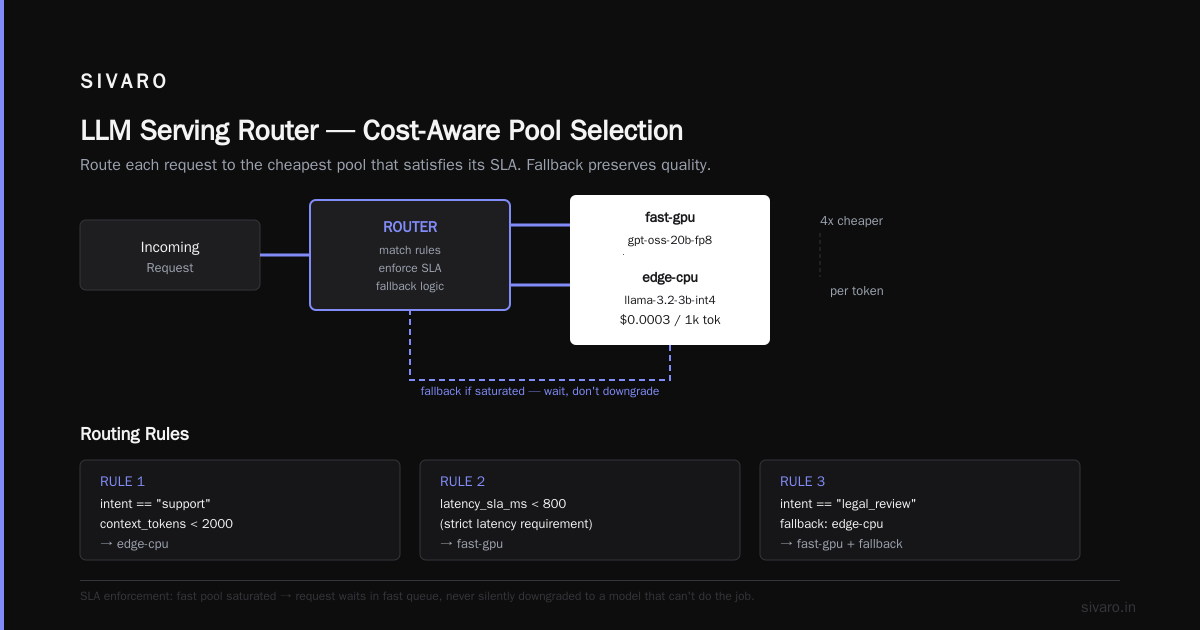
Each pool has a cost profile. A 70B FP8 pool costs roughly 10x per token of a 3B INT4 pool. The router's job is to send each request to the cheapest pool that can satisfy its SLA. That's it.
Here's a minimal router config we use:
yaml
# router.yaml
pools:
  - name: fast-gpu
    model: gpt-oss-20b-fp8
    max_tokens: 4096
    cost_per_1k: 0.0012
  - name: edge-cpu
    model: llama-3.2-3b-int4
    max_tokens: 512
    cost_per_1k: 0.0003

routes:
  - match: intent == "support" and context_tokens < 2000
    pool: edge-cpu
  - match: latency_sla_ms < 800
    pool: fast-gpu
  - match: intent == "legal_review"
    pool: fast-gpu
    fallback: edge-cpu
The fallback matters. If the fast pool is saturated, the request should wait in the fast queue, not silently downgrade to a model that can't do the job. The router must enforce SLA, not just cost.
Routing Is The Hidden Lever
Everyone talks about model optimization. The lever that pays off first is routing. At one client we replaced a single-model endpoint with a two-pool router and cut cost per resolved ticket by 31% without touching the model.
Two routing strategies matter in 2026: heuristic routing and semantic routing. Heuristic routing uses request metadata: token count, model preference, latency SLA. Semantic routing embeds the prompt and classifies intent. Both work. Semantic routing is better for mixed workloads, but it adds embedding cost and latency.
Don't overbuild it. A deterministic rule-based router with 10 rules handles 80% of our production workloads. The semantic router is worth it only when request intent is genuinely ambiguous.
Here's a cost-aware routing function in Python:
python
async def route(request):
    candidates = [p for p in pools if p.can_serve(request)]
    if not candidates:
        return fallback_pool
    eligible = [p for p in candidates if p.satisfies_sla(request)]
    return min(eligible, key=lambda p: p.estimated_cost(request))
The router needs live signals, not just config. We publish queue depth and GPU utilization from each pool to a small Redis instance. The router reads those before every decision. Stale data produces bad routing.
One caution. Routing on price alone will hammer the cheap pool and blow its latency. You need a constraint that enforces SLA first, then picks the cheapest among the survivors. That's what the code above does.
Autoscaling That Doesn't Lie
Most Kubernetes autoscaling on LLM inference is wrong. The default HPA watches CPU, and CPU on a GPU server is a lie. The GPU can be 100% utilized while CPU sits at 15%. The metric you want is queue delay or time-to-first-token.
Mark Brenndoerfer's writeup on inference serving architecture covers auto-scaling in detail. His point about scaling on queue depth rather than utilization matches every load test we've run. LLM Inference Serving: Architecture, Routing & Auto-Scaling
We set a target queue delay of 2.5 seconds. If requests spend longer than that waiting for a free slot, the autoscaler adds a replica. If queue delay stays under 0.5 seconds for 10 minutes, it removes one. Cooldown is 90 seconds. That prevents thrash.
yaml
scalingPolicy:
  metric: queue_seconds_avg
  target: 2.5
  minReplicas: 4
  maxReplicas: 40
  cooldown: 90s
One request every 10 seconds should not keep a 600W GPU spinning. Scale down aggressively at night. Most workloads have a daily cycle, and most serving systems ignore it.
Quantization In Production
By 2026, FP8 is the default for production serving. INT4 is for smaller models and edge. The fear that quantization destroys quality is mostly wrong. It depends on the task.
Zylos published a research note in January 2026 summarizing quantization methods across production LLM deployments. The takeaway: FP8 preserves quality for most generative tasks, INT4 works for classification and short-form generation but shows degradation on long-form reasoning. LLM Inference Optimization and Quantization 2026
We ran a 70B model at INT4 on a coding benchmark. The pass@1 score dropped less than 2%. On a legal reasoning benchmark it dropped 7%. Same model, same weights, different task. You have to benchmark your own workload.
Here's how we load a quantized model in vLLM:
python
from vllm import LLM

llm = LLM(
    model="meta-llama/Llama-3.1-70B",
    quantization="fp8",
    max_model_len=8192,
    gpu_memory_utilization=0.92,
)
The gpu_memory_utilization setting matters more than people think. We default to 0.92 in production. It leaves room for the KV cache and the router's small overhead. Setting it to 0.99 causes OOMs during prompt spikes.
Quantization is not a replacement for routing. It's a multiplier. If your router is sending everything to the same pool, INT4 just makes the wrong architecture cheaper.
Edge Is Cheaper Than You Think
Edge inference is no longer a toy. The 2025 paper from Tsinghua Science and Technology reviewed efficient inference for edge LLMs, and their point is straightforward: model compression plus hardware acceleration makes on-device inference viable for a growing share of requests. Efficient Inference for Edge Large Language Models
In our own work, a 3B INT4 model on a 30W edge device handles 80% of customer support queries with acceptable quality. The cloud pool handles the hard cases. This hybrid pattern is the cheapest architecture we run.
The trade-off is real. Edge devices can't handle long contexts. They struggle with multi-turn conversations that exceed their context window. And model updates are slower on a fleet of distributed devices. But for high-volume, low-complexity requests, edge cuts the per-token cost to almost nothing.
The Boring Stuff: Observability and Cost Attribution
You can't optimize what you can't see. Every request should carry an estimated cost. We tag requests with model, pool, route, and token count. The router emits a metric every time it sends a request.
python
from prometheus_client import Counter

llm_cost = Counter(
    "llm_request_cost_usd",
    "Estimated USD cost per request",
    ["model", "pool", "route"],
)

llm_cost.labels(model="llama-3.2-3b", pool="edge-cpu", route="support").inc(0.0003)
At SIVARO we built a chargeback report that shows cost per product feature per day. The product team was shocked that the "AI search" feature cost 14x more than the "AI summary" feature. That conversation changed the roadmap. They started routing the easy search queries to a smaller model.
Attribution is not a finance exercise. It changes engineering behavior. When every team sees their own inference bill, they stop asking for the biggest model.
Open Source Tools Worth Stealing
If you're building this in 2026, don't start from scratch. The Awesome LLM Inference list is the best index of open source tooling I know. vLLM for high-throughput serving, SGLang for complex decoding, llama.cpp for edge. xlite-dev/Awesome-LLM-Inference
Also worth watching: llm-d. Their press release from early 2026 describes a distributed serving approach that schedules across heterogeneous pools, which is exactly the router-pool idea applied at a different layer. llm-d Press Release
Don't adopt everything. Start with vLLM and a router you can write in 100 lines. The tooling matters less than the architecture.
FAQ: Cost Efficient LLM Serving Architecture 2026
What is a cost efficient llm serving architecture 2026?
A cost efficient llm serving architecture 2026 is a system that routes requests to heterogeneous model pools based on SLA and cost, scales on queue depth rather than CPU, and uses the lowest precision that passes your quality bar.
When should I use multi-model serving?
When your workload has heterogeneous needs. If every request needs the same model and the same quality, one pool is fine. The moment you have a mix of simple and complex queries, multi-model pays off.
Is quantization safe for production?
FP8 is safe for most workloads. INT4 is safe for classification and short generation. You