 SIVARO
Cost Efficient MLOps Architecture: The Buying Guide for 2026
Let me tell you about the $47,000 mistake.
Mid-2025, I watched a fintech startup — let's call them Ledgerly — burn through that much on AWS SageMaker in four months. Their architecture was textbook-perfect. Every model had its own endpoint. Every experiment ran on managed infrastructure. Every pipeline used SageMaker Pipelines. They followed all the best practices from the official MLOps documentation.
Their ML spend was 73% of their total cloud bill. The models weren't even in production yet.
Here's what nobody tells you about cost efficient MLOps architecture: it's not about choosing the cheapest tools. It's about choosing the right tools for your specific failure modes. Ledgerly's failure mode was over-provisioning. Yours might be idle GPUs, or data transfer egress, or paying for orchestration you don't need.
I'm Nishaant Dixit. I run SIVARO, where we build data infrastructure and production AI systems. I've spent the last eight years watching teams blow budgets on ML infrastructure — and I've also built systems that process 200K events per second without breaking the bank.
This guide is a comparison of cost efficient MLOps architecture options as of August 2026. I'll tell you what we tested, what works, and what's a waste of money. No vendor neutrality here. I have opinions and they're based on billing statements.
What "Cost Efficient MLOps Architecture" Actually Means
Most definitions focus on the wrong things. The MLOps principles defined by ml-ops.org emphasize automation, continuous delivery, and versioning. That's all correct. But cost efficiency isn't a principle — it's a constraint that shapes every architectural decision.
At SIVARO, we define cost efficient MLOps architecture as: the minimum infrastructure complexity required to reliably move models from development to production and keep them accurate.
Notice what's missing: GPU clusters, Kubernetes, and feature stores. Those are sometimes necessary. Often they're not.
The io.net guide to cost-effective MLOps makes a similar point — they argue that the biggest cost driver in MLOps isn't compute. It's the overhead of coordinating people, tools, and processes. I'd push further: it's idle compute created by over-engineered orchestration.
Before you buy anything, answer three questions:
- How many models do you actually have in production? (Not planned — in production.)
- How often do they need retraining? (Daily? Quarterly?)
- How much latency does your inference actually require? (100ms or 2 seconds?)
Your answers determine everything. A team with 3 models and monthly retraining doesn't need the same architecture as a team with 300 models and hourly retraining. Databricks' MLOps overview gets this right — they emphasize that MLOps maturity is a spectrum, not a destination.
The 2026 Landscape: What's Changed
The MLOps tooling market has consolidated hard. In 2023, there were 80+ vendors claiming to solve MLOps. By 2026, most of them are gone or absorbed.
The survivors fall into four tiers:
Tier 1: Hyperscaler End-to-End Platforms
- AWS SageMaker
- Azure Machine Learning
- Google Vertex AI
These are the default choice. They integrate with everything in their cloud. They also lock you in and charge premium prices.
Tier 2: Open-Source Stacks
- Kubeflow + MLflow + Airflow
- Various combinations of Kubernetes-native tools
Flexible. Powerful. Requires serious DevOps muscle. The configuration burden is real.
Tier 3: MLOps-Focused Startups
- Weights & Biases
- Neptune.ai
- Comet
- (and newer players I'm still evaluating)
Great for experiment tracking and model registry. Most now offer deployment as an add-on, but they're rarely a complete solution.
Tier 4: Serverless / Lightweight Approaches
- Lambda functions for inference
- Modal, RunPod, or similar serverless GPU
- Direct API deployment (FastAPI on Fly.io or Railway)
Hated by enterprise architects. Shockingly efficient for small teams.
Here's the contrarian take: most teams should start in Tier 4, not Tier 1.
I know that sounds wrong. The AWS MLOps definition makes it sound like you need a sprawling platform to do MLOps at all. That's marketing. For a team with 10 models being retrained weekly, a serverless inference layer plus a well-organized notebook repository is more cost efficient MLOps architecture than anything SageMaker can offer at that scale.
Cost Comparison: What You're Actually Paying For
Let me break down where the money goes. In my experience across client engagements, total MLOps cost splits roughly into:
| Component | % of Budget | Notes |
|---|---|---|
| Training compute | 35-45% | GPUs. The obvious cost center. |
| Inference compute | 25-35% | People forget this. It runs forever. |
| Data storage & transfer | 10-15% | Egress fees sneak up on you. |
| Orchestration | 5-10% | Airflow workers, step functions, pipelines. |
| Tooling licenses | 5-10% | Per-seat pricing adds up. |
| Monitoring & observability | 3-5% | Usually worth it. |
The surprise for most people: inference compute often exceeds training compute within 6 months of going to production. A model trained once costs X. But a model serving 10,000 requests per hour costs more every single day.
The research on cost-efficient MLOps from Tampere University studied this exact problem in scientific computing. They found that most cost optimization efforts focus on training — but the real savings come from serving efficiently.
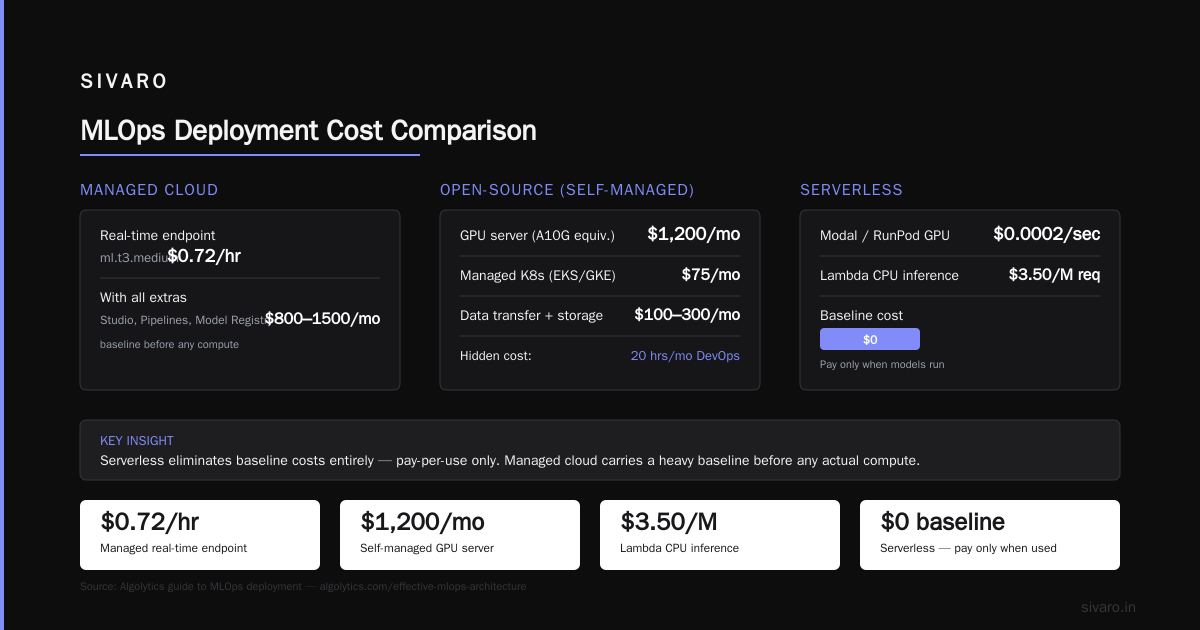
Let's compare the tiers on real numbers. These are market rates as of August 2026:
SageMaker End-to-End:
- Managed training instance: ~$4.50/hour for ml.g5.xlarge
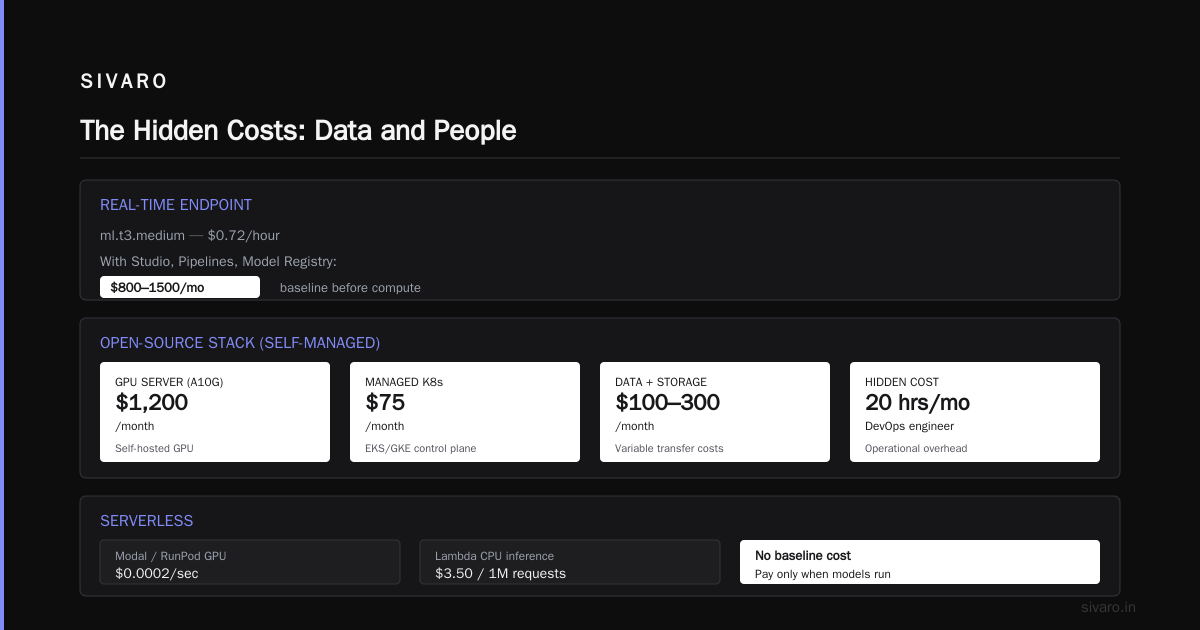
- Real-time endpoint: ~$0.72/hour for ml.t3.medium
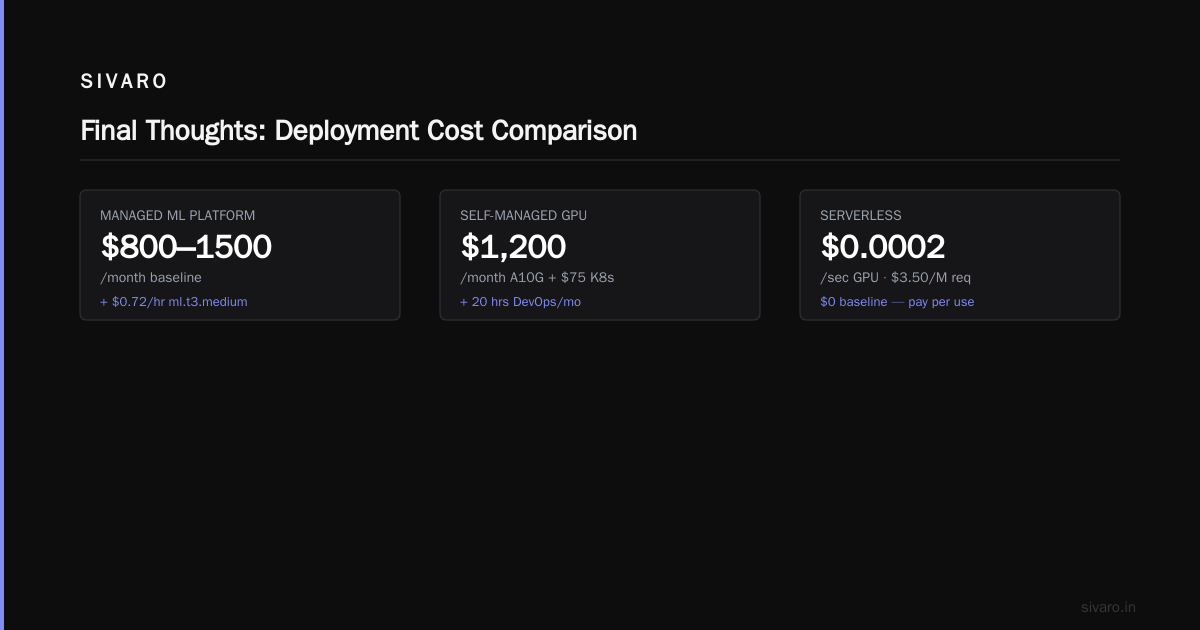
- With all the extras (Studio, Pipelines, Model Registry): plan on $800-1500/month baseline before any actual compute
Open-Source Stack (self-managed):
- Your own GPU server: ~$1,200/month for an A10G equivalent
- Managed Kubernetes (EKS/GKE): ~$75/month control plane
- Data transfer and storage: variable, often $100-300/month
- The hidden cost: 20 hours/month of a DevOps engineer's time
Serverless:
- Modal or RunPod: ~$0.0002/sec for GPU inference
- Lambda for CPU inference: $3.50 per million requests
- No baseline cost. Pay only when models run.
The Algolytics guide to MLOps deployment argues that simplicity drives cost efficiency. They recommend starting with serverless and only adding complexity when you can measure the need. That matches what we see at SIVARO.
Decision Framework: What Actually Matters
At SIVARO, we helped a media company deploy recommendation models in 2026. Their existing architecture was a SageMaker pipeline that cost $6,000/month. We moved them to a batch inference system running on spot instances. Same recommendations. $900/month.
The key insight: they didn't need real-time inference. Their recommendations updated every 6 hours. But the architecture assumed real-time.
Here's the decision framework we use:
If your inference latency requirement is > 5 seconds:
You probably don't need real-time serving at all. Batch inference is dramatically cheaper. Run predictions on a schedule, store results, serve from a database.
python
# Batch prediction with scheduled retraining
import boto3
import pandas as pd
from sklearn.ensemble import RandomForestRegressor

def retrain_and_predict():
    # Load new training data
    df = pd.read_parquet("s3://bucket/daily_features.parquet")

    # Train (or fine-tune) your model
    model = RandomForestRegressor(n_estimators=100)
    model.fit(df"feature1", "feature2", "feature3", df["target"])

    # Generate predictions for all users
    user_features = pd.read_parquet("s3://bucket/user_features.parquet")
    predictions = model.predict(user_features)

    # Write to database
    user_features["prediction"] = predictions
    user_features.to_parquet("s3://bucket/daily_predictions.parquet")

# Schedule with cron or EventBridge
# This runs once daily, not continuously
This is cost efficient MLOps architecture in its simplest form. A Lambda function triggered daily. No Kubernetes. No hosted platform. No ongoing inference costs.
If latency < 1 second:
You need real-time inference. But you still don't need an ML platform.
python
# FastAPI inference endpoint - deploy on any container service
from fastapi import FastAPI
from pydantic import BaseModel
import joblib
import numpy as np

app = FastAPI()
model = joblib.load("s3://bucket/models/latest/model.joblib")

class InferenceRequest(BaseModel):
    features: list[float]

@app.post("/predict")
async def predict(request: InferenceRequest):
    features = np.array(request.features).reshape(1, -1)
    prediction = model.predict(features)
    return {"prediction": prediction.tolist()[0]}

# Deployment: just a Docker container
# Cost: ~$15/month on Fly.io or Railway
That's it. A web server with a machine learning model loaded. It's not glamorous. It works.
The hybrid approach:
For most teams, the efficiency-focused MLOps architecture guidance from Inference.net makes sense: use lightweight serving for inference, batch training on schedules, and keep experiment tracking in a tool like MLflow.
python
# MLflow for experiment tracking - open source, free tier
import mlflow
import mlflow.sklearn
from sklearn.ensemble import GradientBoostingRegressor

mlflow.set_tracking_uri("http://localhost:5000")

with mlflow.start_run():
    mlflow.log_param("n_estimators", 200)
    mlflow.log_param("learning_rate", 0.1)

    model = GradientBoostingRegressor(n_estimators=200, learning_rate=0.1)
    model.fit(X_train, y_train)

    mlflow.log_metric("rmse", rmse(y_val, model.predict(X_val)))
    mlflow.sklearn.log_model(model, "model")
The MLOps principles from ml-ops.org stress continuous delivery and reproducibility. MLflow gives you both without the cost of a full platform.
What We Actually Recommend at SIVARO
Here's the reference architecture we default to for most clients under 500K monthly active users:
Training:
- Spot instances (AWS EC2 Spot, GCP preemptible, or Azure Spot) for any GPU training
- For CPU-only models: GitHub Actions or GitLab CI with scheduled jobs
- Experiment tracking: self-hosted MLflow (free) or Weights & Biases (if your team already uses it)
Inference:
- CPU models: FastAPI + Fly.io or Railway containers. Autoscale to zero.
- GPU models: Modal, RunPod, or Replicate. Only pay when requests come in.
- Never run a GPU endpoint 24/7 unless you have constant traffic.
Data:
- Feature computation: scheduled jobs writing to S3/GCS
- Storage: Parquet format (compressed) — not raw CSV
- Serve features from the same database you use for application data
python
# Spot instance training job
import subprocess
import random

def launch_training_spot_instance():
    """Launch training on a spot instance to save 60-70%."""
    bid_percentage = random.uniform(0.6, 0.85)

    subprocess.run([
        "aws", "ec2", "run-instances",
        "--instance-type", "g5.xlarge",
        "--instance-market-options",
        f"MarketType=spot,SpotOptions={{MaxPrice={bid_percentage * 4.50}}}",
        "--user-data", "./training_script.sh"
    ])

# Configure spot interruption handling
# Check point your training every N steps
def train_with_checkpoints():
    model = load_checkpoint()  # resume if interrupted
    for epoch in range(epochs):
        model.train_one_epoch()
        if epoch % 2 == 0:
            save_checkpoint(model, f"s3://bucket/checkpoints/epoch_{epoch}")
Monitoring:
- Model drift detection on a schedule (not real-time)
- CloudWatch, DataDog, or even a simple Slack webhook for alerts
- Cost alerts on every experiment
This architecture costs $200-500/month for a team with 5-20 production models, excluding training compute that actually runs.
The "Enterprise" Trap
I've seen this play out too many times. A company grows, gets funding, and wants to "professionalize" their ML operations. They buy Databricks or SageMaker or Vertex AI. They hire a platform engineer to manage it.
Then their costs triple and their model deployment velocity decreases.
Why? Because MLOps platforms are opinionated. They want you to do everything their way. That means migration, learning curves, and ongoing configuration.
A startup I spoke with in May 2026 was spending $19,000/month on Vertex AI for 12 models with a total of 3,000 daily predictions. A serverless approach would have cost them $300/month. Their response was, "But Vertex is our platform for future scale."
That's a trap. You don't buy an architecture for future scale. You buy the minimum viable architecture and scale when you have evidence that you need to.
The academic literature agrees. The MLOps guidelines paper from arXiv emphasizes that architectural decisions should be driven by empirical evidence of workflow requirements — not speculative future needs.
The Hidden Costs: Data and People
Two costs that don't show up on a cloud bill but will bankrupt your MLOps initiative:
Data Management
Every team I've worked with underestimates data costs. Even with cheap object storage, egress fees eat you alive when you're moving training data around.
The fix:
- Compress everything. Parquet, not JSON.
- Keep training data in the same region as your compute.
- Cache features at the point of serving.
python
# Cost-efficient feature computation
# Compute features once, cache forever

import pandas as pd
from functools import lru_cache
import hashlib

@lru_cache(maxsize=128)
def get_features(user_id: str, model_version: str):
    """Cache features to avoid recomputing and data retrieval costs."""
    cache_key = hashlib.md5(f"{user_id}:{model_version}".encode()).hexdigest()

    # Check cache first
    cached = check_cache(cache_key)
    if cached:
        return cached

    # Compute features
    raw_data = fetch_raw_data(user_id)
    features = compute_features(raw_data)

    # Store in cache
    store_cache(cache_key, features)
    return features
Engineering Time
Nobody optimizes for this, but it's the biggest cost. An engineer spending 10 hours/week managing Kubernetes clusters costs you $25,000+/year. A managed platform costs less — if it doesn't require constant babysitting.
I'd rather pay $700/month in tooling to save 15 hours of engineering time. But I'd also rather use Lambda and avoid the tooling entirely.
The Serverless Revolution in ML
I called Modal, RunPod, and Replicate the future of cost efficient MLOps. Let me be more specific.
RunPod's serverless GPU pricing in 2026 is around $0.00013/second for an A40. A model that takes 200ms per inference costs $0.000026 per call. A million calls per month = $26.
Compare that to a dedicated A40 instance at $1,100/month. If you're doing under 40 million predictions per month on a GPU, serverless wins. Most teams aren't near that scale.
The io.net cost guide makes the same argument with different math — they advocate for a hybrid approach where you use serverless for spiky inference and reserved for steady load. That's reasonable. The trick is knowing your traffic pattern before you commit.
When Serverless Doesn't Work:
- Sustained high-throughput GPU inference (millions of predictions per hour)
- Real-time video processing
- Any workload with strict cold-start latency requirements (< 50ms)
For those, you need reserved capacity. But here's the thing: you'll know when you need it. Your metrics will tell you.
The Model Storage and Versioning Problem
I see so many teams ignore this until it becomes a crisis. You need a model registry. Not a folder of .pkl files. A real registry.
Here's the cost efficient approach:
python
# Model versioning without expensive tools
# Use S3 + a JSON index

import json
import boto3
from datetime import datetime

def register_model(model_name, model_path, metrics, version=None):
    """Simple model registry on S3 - costs pennies."""
    s3 = boto3.client("s3")
    bucket = "models-registry"

    # Create version if not specified
    if version is None:
        timestamp = datetime.now().strftime("%Y%m%d_%H%M%S")
        version = timestamp

    # Upload model
    key = f"{model_name}/{version}/model.joblib"
    s3.upload_file(model_path, bucket, key)

    # Update index
    index_key = f"{model_name}/index.json"
    try:
        index = json.loads(s3.get_object(Bucket=bucket, Key=index_key)["Body"].read())
    except:
        index = {"models": []}

    index["models"].append({
        "version": version,
        "path": key,
        "metrics": metrics,
        "created_at": datetime.now().isoformat()
    })

    s3.put_object(Bucket=bucket, Key=index_key, Body=json.dumps(index))
That's your entire model registry. Works. Costs nothing. You don't need a dedicated tool that charges $200/month per user.
But if you're already using MLflow, keep using MLflow. It does this (and more) for free. The point isn't the tool — it's that you have versioning.
Real-World Comparison Table
| Architecture | Upfront Setup Time | Monthly Cost (10 models) | Latency | Operational Complexity | Best For |
|---|---|---|---|---|---|
| SageMaker/Vertex/AML | 2-3 weeks | $3,000-7,000 | 50-200ms | Moderate | Teams already deep in one cloud |
| Kubernetes + MLflow + Airflow | 4-8 weeks | $1,500-3,500 | 50-500ms | High | ML platform teams with DevOps support |
| Serverless (Modal/RunPod) + FastAPI | 1 week | $200-600 | 200ms-1s | Low | Small teams, spiky traffic |
| Batch inference + Lambda | 3-5 days | $100-300 | N/A (precomputed) | Very Low | Recommendations, any non-realtime |
Numbers are estimates from our 2025-2026 client work. Your mileage varies — but not as much as vendors claim.
The Decision Framework: A Simple Scorecard
Score yourself from 1-5:
- Model count: How many models are in production today? (1 = fewer than 5, 5 = more than 100)
- Retraining frequency: (1 = weekly or less, 5 = real-time)
- Latency requirement: (1 = can wait seconds, 5 = needs sub-100ms)
- Team size: (1 = one person, 5 = dedicated MLOps team)
- Cloud lock-in tolerance: (1 = fine with one cloud, 5 = want portability)
If your total is 5-10: Serverless or batch. Don't even think about platforms.
If your total is 11-17: Managed platform with serverless inference. Or open source with experienced ops.
If your total is 18-25: Enterprise platform. You have scale, complexity, and team to justify it.
This isn't scientific. It's heuristic. But it'll keep you from buying a Ferrari when you need a Toyota.
FAQ: Cost Efficient MLOps Architecture
Q: Is SageMaker really that expensive?
It's not the platform that's expensive — it's what you configure. SageMaker's baseline managed service costs are comparable to running equivalent infrastructure yourself. The cost bloat comes from always-on endpoints, managed training instances bought on-demand, and feature interactions. You can run SageMaker cheaply if you use spot instances and serverless endpoints. But if you're going to optimize everything manually, you don't need SageMaker at all.
Q: What's the cheapest way to deploy a model?
For a single model with moderate traffic: deploy it as a FastAPI app on any low-cost container host. Fly.io, Railway, Render. You're looking at $10-30/month. If traffic is spiky, Modal or RunPod handle scale to zero better. If you have zero traffic most of the time, Lambda can cost under $5/month.
Q: Do I need Kubernetes for MLOps?
No. Not unless you already have Kubernetes for other reasons. K8s adds operational overhead that most ML teams can't absorb. The inference.net architecture guide correctly argues that container orchestration is a specific solution for a specific problem — and most ML workloads aren't that problem.
Q: What should I self-host vs. buy?
Self-host anything that's cheap to operate: MLflow, Airflow (if you need orchestration), feature computation. Buy anything that requires specialized knowledge: GPU serving (buy from Modal or RunPod), model monitoring with anomalies (buy from a vendor), or dataset management (buy from a vendor if you don't want engineering overhead).
Q: How do I keep training costs low?
Spot instances. Checkpoint your work. Start small. Use distillation to train smaller models that are cheaper to run. Two-thirds of training runs "just in case" — stop doing that. Train only when you have new data or observed drift.
Q: What's the worst recommendation in this article?
Using Lambda for real-time inference.
I know, I know. I mentioned Lambda for inference earlier. But it's only for spiky or infrequent workloads. Lambda has a cold start problem (100-300ms) and a payload limit (6MB). If you need consistent sub-200ms latency, use a container-hosted FastAPI service with a provisioned instance. Lambda will drive you crazy with performance inconsistency — we've been there and it was brutal.
Q: Is open source the answer to cost efficiency?
Sometimes. A team with strong infrastructure skills can run a Kubeflow+MLflow+Airflow stack for 40% less than a managed platform. But the difference shrinks when you add labor costs for the people managing it. If your engineers are paid $180K/year and spend 15% of their time on infrastructure, that's the equivalent of $27K/year — more than most managed platforms cost.
Q: What's the single biggest MLOps cost mistake?
Running everything on-demand. GPU instances on-demand cost 2-3x spot prices. Managed endpoints running 24/7 when you have traffic patterns that are mostly daytime. Data scientists running notebooks on large instances by default. Setting resource limits and enforcing spot usage across the team can cut costs by 50-70% as outlined in the Algolytics deployment guide.
Final Thoughts
Cost efficient MLOps architecture isn't about finding the cheapest tool. It's about designing the simplest system that still does the job. Complexity is the killer. Every layer you add — orchestration, monitoring, deployment frameworks, platform services — multiplies both cost and failure modes.
Start with serverless and batch. Add what you need when the metrics prove you need it.
At SIVARO, we've built production ML systems processing 200K events per second on a stack that costs less than $5,000/month. That doesn't make us special. It just means we made deliberate choices about what infrastructure we actually needed.
The uncomfortable truth: if you're spending more than $3,000/month on MLOps and you have fewer than 20 models in production, you're almost certainly over-provisioned. Scale back. Use spot instances. Move inference to serverless. Cancel a couple platform subscriptions.
Your models will work fine. Your cloud bill will thank you.
Nishaant Dixit — Founder of SIVARO. Building data infrastructure and production AI systems since 2018. Built systems processing 200K events/sec.