 SIVARO
Cost of Fine Tuning a Large Language Model (2026 Guide)
A year ago, a fintech CEO walked into my office. He had already spent $47,000 on fine-tuning a 70B parameter model. The result? Worse than GPT-4 zero-shot on his own data. He asked me what went wrong.
I told him the truth: he never should have fine-tuned in the first place.
Fine-tuning a large language model can cost anywhere from $500 to over $200,000. Most people get the math wrong. They think it's just compute. It's not. It's data, labeling, experimentation, evaluation, and ongoing maintenance. This guide breaks down every dollar—and every trade-off—so you don't burn cash the way he did.
You'll learn what drives the cost of fine-tuning, how much data you actually need, how long it takes, and when you should walk away and use RAG or prompt engineering instead.
What Actually Drives the Cost?
Three buckets: data, compute, people.
Let me be direct: people cost more than GPUs. I’ve seen teams spend 80% of their budget on data labeling and prompt iteration, not on the actual training run. The GPU hours are the flashy number. But labeling 10,000 examples at $0.50 per label? That’s $5,000. Hiring a domain expert for quality review? Another $15,000. Running 12 experiments to find the right hyperparameters? That’s compute, yes, but also hours of your ML engineer’s time at $200/hour.
So when I say "cost of fine tuning a large language model," I mean the total cost of ownership from ideation to deployment. Not just the spot price on AWS.
Data: How Much Data Needed to Fine Tune an LLM?
This is the number one question I get. And the answer still surprises people.
In 2025, Meta published results showing that as few as 100 high-quality examples can shift a model’s behavior measurably. But meaningful domain adaptation? You typically need 500-5,000 examples. Not millions. Not hundreds of thousands.
The catch: quality crushes quantity. I’ve seen a client spend $30,000 curating 50,000 noisy examples—and get worse results than another team that hand-crafted 800 perfect ones.
How much data needed to fine tune an llm depends on three factors:
- Task specificity – A narrow classification (e.g., flagging compliance violations) needs less data than open-ended generation (e.g., writing software documentation).
- Model size – A 7B parameter model can converge faster on less data than a 70B model, purely because the smaller model has fewer degrees of freedom to overfit.
- Baseline performance – If the pretrained model already does 70% of what you need, you only need examples that teach the gap.
Here’s a rule of thumb from our work at SIVARO:
- Classification or extraction: 200–1,000 examples
- Structured output (JSON, code): 500–3,000 examples
- Creative or conversational: 2,000–10,000 examples
- Full domain rewrite (e.g., medical diagnosis): 5,000–20,000 examples
Anything above 20,000? You’re probably using too much compute for diminishing returns. Fine-tuning turns into pre-training at that scale. You’d be better off with continued pre-training (which is a different cost model).
Code: Quick data quality filter
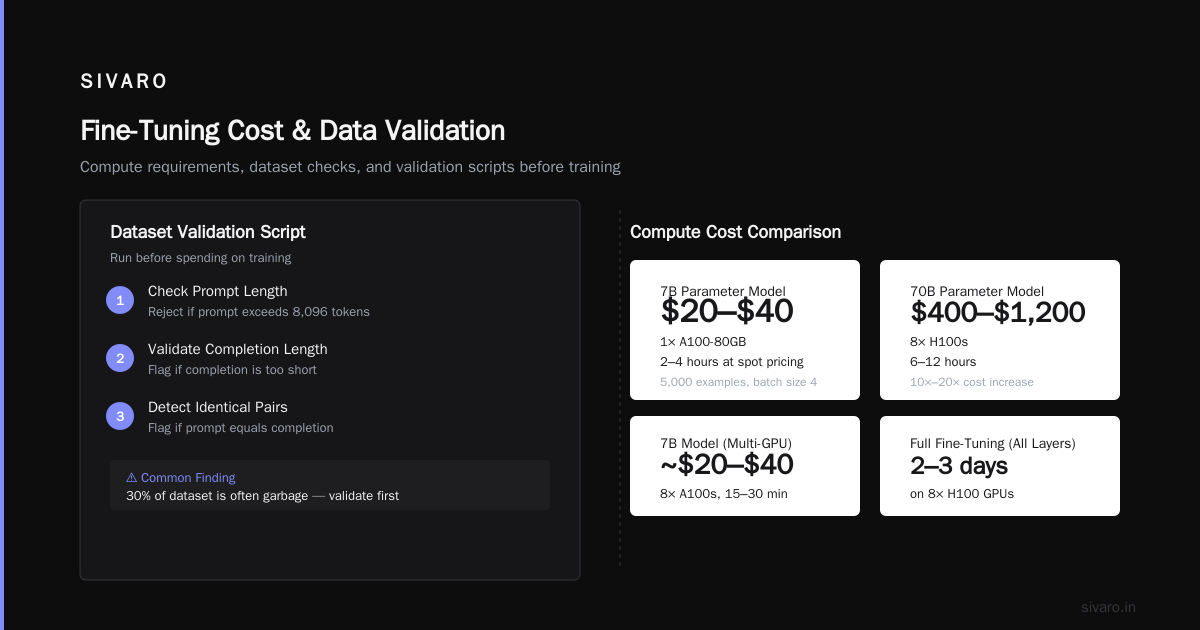
Here’s a minimal Python script we use to catch garbage examples before they waste GPU time:
python
import json

def validate_finetuning_data(path, label_field="completion"):
    issues = []
    with open(path) as f:
        for i, line in enumerate(f):
            example = json.loads(line)
            if len(example[label_field]) < 10:
                issues.append(f"Line {i}: completion too short")
            if len(example["prompt"]) > 8096:
                issues.append(f"Line {i}: prompt exceeds context")
            if example[label_field] == example["prompt"]:
                issues.append(f"Line {i}: identical prompt/completion")
    return issues
Run this before you spend a dollar on training. You’d be shocked how often I find 30% of a dataset is garbage.
Compute: The Biggest Line Item
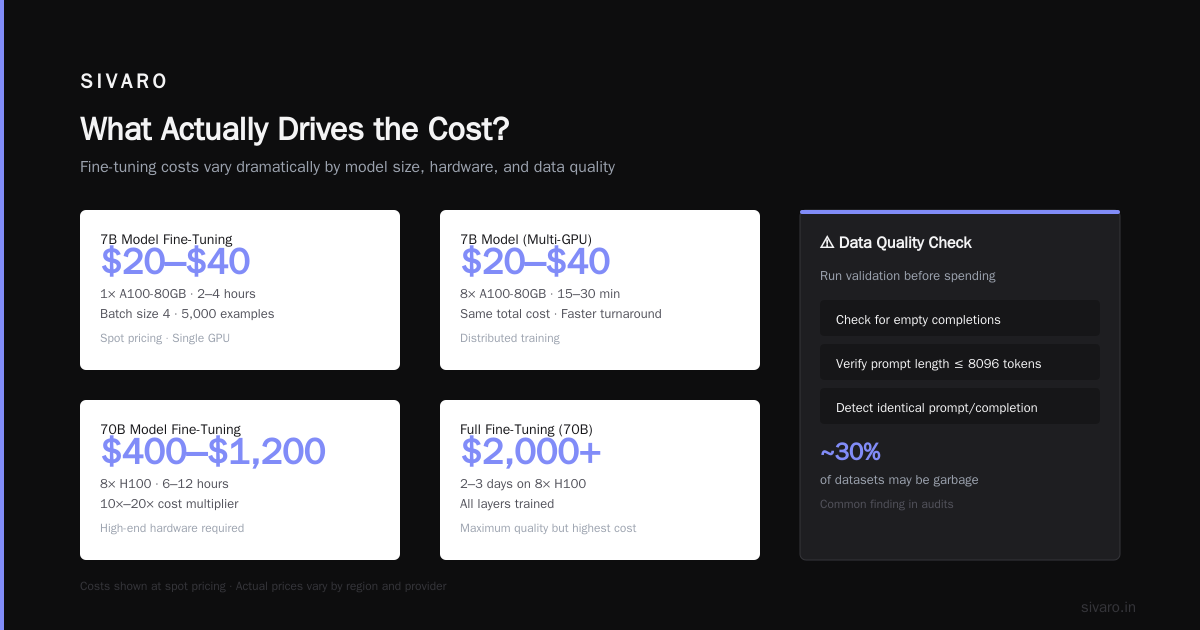
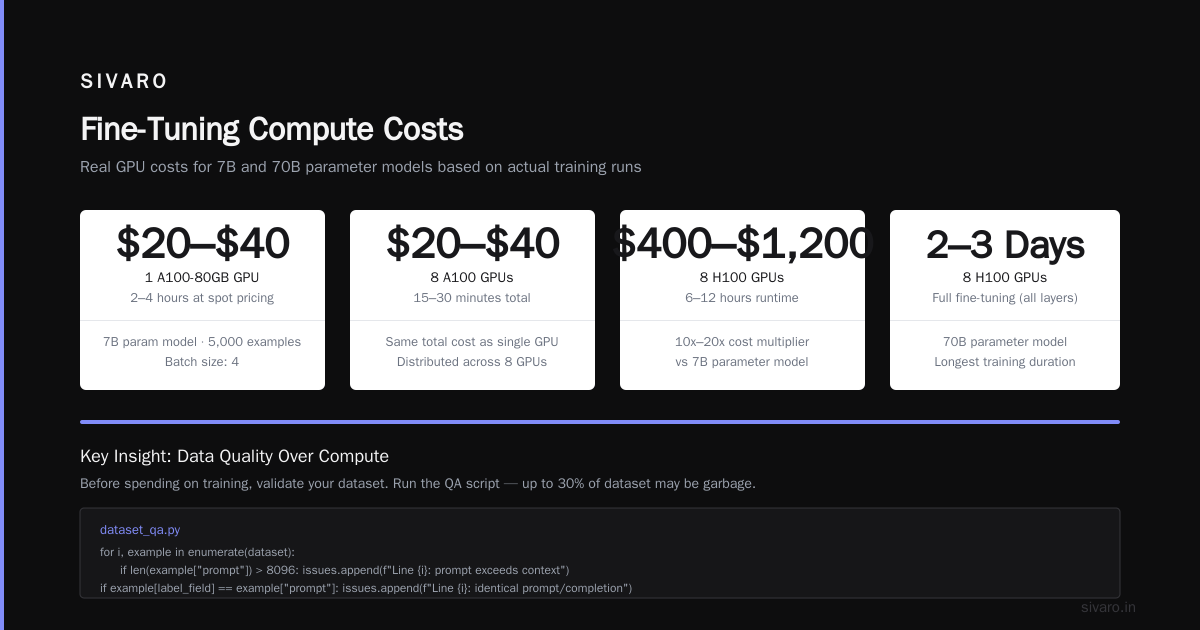
Fine-tuning a 7B parameter model on 5,000 examples with a batch size of 4 costs roughly:
- 1 A100-80GB GPU for 2–4 hours → ~$20–$40 at spot pricing
- 8 A100s for 15–30 minutes → similar total cost
For a 70B model, the numbers jump 10x to 20x:
- 8 H100s for 6–12 hours → $400–$1,200
- Full fine-tuning (all layers) can take 2–3 days on 8 H100s → $2,000–$4,000
But here’s where it gets tricky. You rarely run one training run. You run 10, 20, 30 experiments tweaking learning rate, rank (if LoRA), target modules, dataset composition. Each run costs. I’ve seen a fintech client burn $18,000 in a week just exploring hyperparameter space.
The industry is moving toward smaller models with smarter fine-tuning. Parameter-efficient methods like LoRA or DoRA reduce compute costs by 70-90%. In 2026, almost nobody does full fine-tuning for proprietary fine-tuning anymore. The exceptions are when you need to change the model’s fundamental behavior—like teaching it a new language or a completely new domain.
Code: Estimating compute cost before you run
python
def estimate_finetune_cost(model_size_b, num_examples, epochs=3, gpu_type="A100", spot=True):
    # Rough cost per GPU hour (Q3 2026 cloud spot prices)
    cost_table = {"A100": 1.50, "H100": 3.00, "L40S": 0.80}
    tokens_per_example_avg = 2000  # adjust
    total_tokens = num_examples * tokens_per_example_avg * epochs

    tokens_per_sec = 5000 if gpu_type == "H100" else 2500  # for 7B model
    gpu_time_hours = total_tokens / (tokens_per_sec * 3600)

    gpu_cost = gpu_time_hours * cost_table[gpu_type]
    num_gpus = 4  # typical for 7B
    total = gpu_cost * num_gpus
    return round(total, 2)

print(estimate_finetune_cost(7, 5000, epochs=3))  # Example
That function is rough, but it’s honest. Use it before you convince yourself fine-tuning is cheap.
Time: How Long Does It Take to Fine Tune an LLM?
Short answer: anywhere from 30 minutes to 3 weeks.
The question “how long does it take to fine tune an llm” depends on:
- Model size – 7B? 70B? 400B (if you have access)?
- Parameter efficiency – LoRA trains 5x faster than full fine-tune
- Data size – 500 examples vs 20,000 examples
- Hardware – 1 GPU vs 64 GPUs
- Experiments – Are you training once or iterating?
A typical LoRA fine-tune on a 7B model with 2,000 examples takes about 1 hour on 4 A100s. A full fine-tune on a 70B model with 20,000 examples can take 3 days on 8 H100s.
But the time that kills projects isn’t training—it’s data preparation and evaluation. I’ve seen teams spend 3 weeks collecting and cleaning data, then 2 days training, then 2 weeks evaluating and realizing they need to redo the dataset. That 2-day training? Cheap. That 5-week data loop? That’s where the real cost is.
Pro tip: Start with a tiny dataset—100 examples—and confirm the training infrastructure works end-to-end before you scale. This alone saves days of debugging mid-pipeline.
RAG vs Fine-Tuning vs Prompt Engineering: When to Fine-Tune
Most people think you need fine-tuning for everything. You don’t.
In 2026, the smartest teams use a hybrid approach. Here’s how we decide at SIVARO:
| Task Type | Best Approach | Why |
|---|---|---|
| Factual Q&A over private documents | RAG | No training cost; update documents anytime |
| Format control (e.g., always output JSON) | Prompt engineering + grammar constraints | Costs $0.001 per call vs $5,000+ to fine-tune |
| Domain-specific tone/style | Fine-tuning | RAG can’t change the model’s personality |
| Real-time classification | Fine-tuning | Faster than RAG, no retrieval latency |
| One-shot instruction following | Prompt engineering | Cheapest, fastest to iterate |
I’m not against fine-tuning. I’m against fine-tuning when RAG or prompt engineering would work better. The IBM article on RAG vs fine-tuning vs prompt engineering lays this out cleanly.
Consider a use case: a medical chatbot that needs to answer from a 10,000-page drug handbook. If you fine-tune, you bake that knowledge into weights. Then the handbook gets updated—and your model is wrong. With RAG, you update the vector database in 10 minutes for free.
We had a logistics client last year. They wanted to fine-tune a model to extract shipping addresses from messy PDFs. I talked them into starting with prompt engineering + a regex fallback. It worked for 85% of cases. The remaining 15%? Then we fine-tuned a small 1.5B model on 200 edge cases. Total cost: $47. Not $47,000. They were grateful.
Hidden Costs: Labeling, Evaluation, and Maintenance
Let’s talk about the expenses nobody mentions.
Labeling. If you don’t have labeled data, you pay humans or base models. GPT-4 labeling a dataset of 10,000 examples? That’s about $500–$1,000 in API costs. Human labeling? $3,000–$15,000 depending on domain expertise.
Evaluation. You need a test set. You need to measure accuracy, toxicity, hallucination rate. That means running evaluations on every candidate model. If you evaluate on 500 examples across 20 candidate checkpoints, that’s 10,000 model calls. If each call costs $0.01 (for a local 7B model on cloud), that’s only $100. But if you’re evaluating with GPT-4 as a judge (common in RLHF today), that adds up quickly.
Maintenance. Fine-tuned models drift. New data arrives. Business requirements change. Every 3-6 months you may need to re-fine-tune. That’s not one cost—it’s a recurring subscription.
Context window limits. Fine-tuning doesn’t expand context. If you need longer inputs, you pay with compute at inference time. Many teams fine-tune on 4K context, then deploy queries with 32K tokens—and wonder why performance degrades.
A Real-World Cost Breakdown (Spring 2026)
Here’s a real project from last month. A B2B SaaS company wanted to fine-tune a 7B open-weight model to generate personalized email follow-ups.
Phase 1: Data
- 2,000 examples of previous successful emails (already clean) → $0
- Augmented with GPT-4 generation of 800 synthetic variations → $120
- Human review of synthetic data (5 hours at $75/hr) → $375
Phase 2: Training
- 12 LoRA experiments (varying rank, target modules)
- 6 hours total on 4 L40S GPUs (spot) → $120
Phase 3: Evaluation
- 500 test prompts, graded by domain expert (8 hours) → $600
- Automated metrics (BLEU, ROUGE, embedding cosine similarity) → $0
Phase 4: Production
- Deploy on 2 L40S (infinitely cheaper than API calls for high volume)
- Monthly inference cost for 50,000 emails → $200
Total one-time cost: $1,215.
Total monthly inference: $200.
That’s the right way to fine-tune: small, focused, cheap.
Compare that to a company that wants a custom 70B model for legal document drafting. Data: 200,000 examples (mostly scraped). Labeling: 3 lawyers at $200/hr for 80 hours = $48,000. Training: full fine-tune on 8 H100s for 3 days = $3,600. Evaluation: $5,000. Total: $56,600. And the model still doesn’t beat GPT-4 zero-shot because the data wasn’t curated.
Deciding If Fine-Tuning Is Worth It
Ask yourself five questions before you spend a dollar:
- Can I solve this with 5 well-crafted prompts? If yes, stop.
- Do I have ≥500 clean, task-specific examples? If not, collect more before training.
- Is the task something the base model almost gets right? Fine-tuning works best for small shifts, not rewrites.
- Will the underlying data change often? If yes, use RAG.
- Do I have a rigorous evaluation pipeline? If no, your fine-tuning will be blind.
The Monte Carlo blog on RAG vs fine-tuning has a great decision framework. I’d also recommend the ResearchGate paper on RAG vs fine-tuning vs prompt engineering for a deeper academic view—though I find it a bit dense.
FAQ
Q: How much does it cost to fine-tune a large language model in 2026?
Between $100 (small LoRA on a 7B model) and $200,000 (full fine-tune on a 405B model with thousands of hours of human labeling). The average enterprise project I see costs $5,000–$30,000.
Q: How much data needed to fine tune an llm?
500–5,000 examples for most tasks. More for open-ended generation, less for classification. Quality > quantity.
Q: How long does it take to fine tune an llm?
1 hour to 3 days for training. Data preparation and evaluation typically take 2-5x longer than training.
Q: Should I fine-tune or use RAG?
Use RAG when your knowledge base changes frequently or is too large to fit in context. Use fine-tuning when you need a consistent style, behavior, or output format that prompting can’t reliably achieve.
Q: Is fine-tuning worth it for small startups?
Not usually—unless you have highly specialized data. Start with prompt engineering. Upgrade to RAG if needed. Only fine-tune when you’ve validated the value.
Q: Does fine-tuning reduce hallucination?
It can, but not reliably. Fine-tuning shifts the model’s distribution—it may hallucinate less in the training domain but more in others. RAG + good retrieval is a more robust fix.
Q: Can I fine-tune on my laptop?
For small models (≤1.5B parameters), yes—with quantization and LoRA. Anything larger needs cloud GPUs.
Q: What’s the biggest mistake companies make?
Fine-tuning without a clear benchmark. If you can’t measure improvement, you’re just burning money.
The cost of fine tuning a large language model isn’t just a line item on an AWS bill. It’s the sum of every bad decision that leads you to fine-tune when you shouldn’t. It’s the six-week detour into labeling garbage data. It’s the 30 GPU-days spent on a model that never outperforms a good prompt.
At SIVARO, we’ve learned to ask the hard questions first. That’s how you keep costs low and outcomes high.
Nishaant Dixit — Founder of SIVARO. Building data infrastructure and production AI systems since 2018. Built systems processing 200K events/sec.