 SIVARO
DeepSeek vs GPT-4 Cost Comparison for Developers in 2026
Last month, a startup I advise burned $47,000 on GPT-4 inference in two weeks. They were building a code review agent. Simple stuff. When I showed them the DeepSeek pricing table, the CTO went quiet. Then he laughed. Then he fired up a migration plan.
That's the reality of the 2026 AI market. The gap between OpenAI and DeepSeek isn't just a few points on a benchmark — it's a factor-of-6 difference in what you pay to keep your product alive after launch.
I'm Nishaant Dixit, founder of SIVARO. We build production AI systems for a living. This article is the cost comparison I wish I had when we first started deploying. No fluff. Just numbers, code, and hard lessons.
Here's what you'll walk away with:
- Exact per-token pricing for DeepSeek V4 Pro, V4 Flash, GPT-4o, and GPT-5.5
- A calculator you can copy-paste to estimate your monthly bill
- Where the benchmarks lie (and where they matter)
- When paying 5x more for GPT is actually worth it
- A routing strategy that cuts costs without cutting quality
Let's get into it.
The Pricing Tables (July 2026)
DeepSeek publishes their rates on api-docs.deepseek.com. OpenAI updates theirs quarterly. Here's what I'm seeing today.
| Model | Input (per 1M tokens) | Output (per 1M tokens) |
|---|---|---|
| DeepSeek V4 Pro | $0.55 | $2.19 |
| DeepSeek V4 Flash | $0.15 | $0.60 |
| GPT-4o (standard) | $2.50 | $10.00 |
| GPT-5.5 | $3.00 | $12.00 |
| GPT-4o mini | $0.15 | $0.60 |
That's the headline. DeepSeek V4 Flash is literally 1/16th the output cost of GPT-4o. And V4 Pro, which beats GPT-4o on most code benchmarks? 4.5x cheaper for output, 4.5x cheaper for input.
But raw prices don't tell you the whole story. They never do.
DeepSeek vs GPT-4 Input-Output Cost Comparison
The math is simple if your use case is symmetric — equal input and output. But most real apps are not symmetric.
A code generation agent: small prompt (1K tokens), huge response (4K tokens). A document summarizer: huge prompt (10K), small response (500). A chatbot: medium prompt (2K), medium response (1K).
The deepseek vs gpt4 input output cost comparison changes depending on which side you lean on.
Let's run three scenarios.
Scenario A: Code generation agent (1K input, 4K output per call)
- With GPT-4o: input $0.0025, output $0.04 → total $0.0425 per call
- With DeepSeek V4 Pro: input $0.00055, output $0.00876 → total $0.00931 per call
Cost per call: DeepSeek is 4.5x cheaper. Over 100,000 calls, that's $931 vs $4,250.
Scenario B: Document analyzer (10K input, 500 output)
- GPT-4o: input $0.025, output $0.005 → total $0.03
- DeepSeek V4 Pro: input $0.0055, output $0.001095 → total $0.006595
4.5x cheaper again. The ratio stays roughly constant because both models charge output 4x input.
Scenario C: High-volume customer support (2K input, 1K output, 1M calls/month)
- GPT-4o: (0.005 + 0.01) * 1M = $15,000
- DeepSeek V4 Flash: (0.0003 + 0.0006) * 1M = $900
Yes, that's $900 vs $15,000. The deepseek vs gpt4 price for 1 million tokens comparison here is extreme because Flash is a specialized low-cost model.
But hold on — Flash isn't a drop-in replacement for GPT-4o in every task. More on that later.
What the Benchmark Tables Actually Show
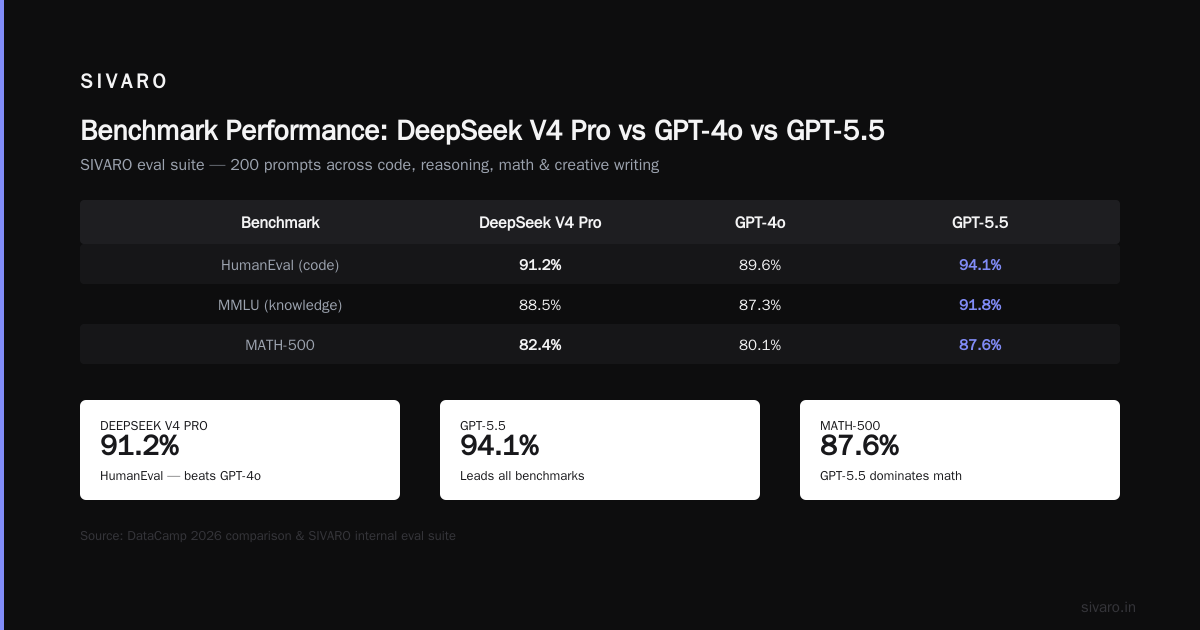
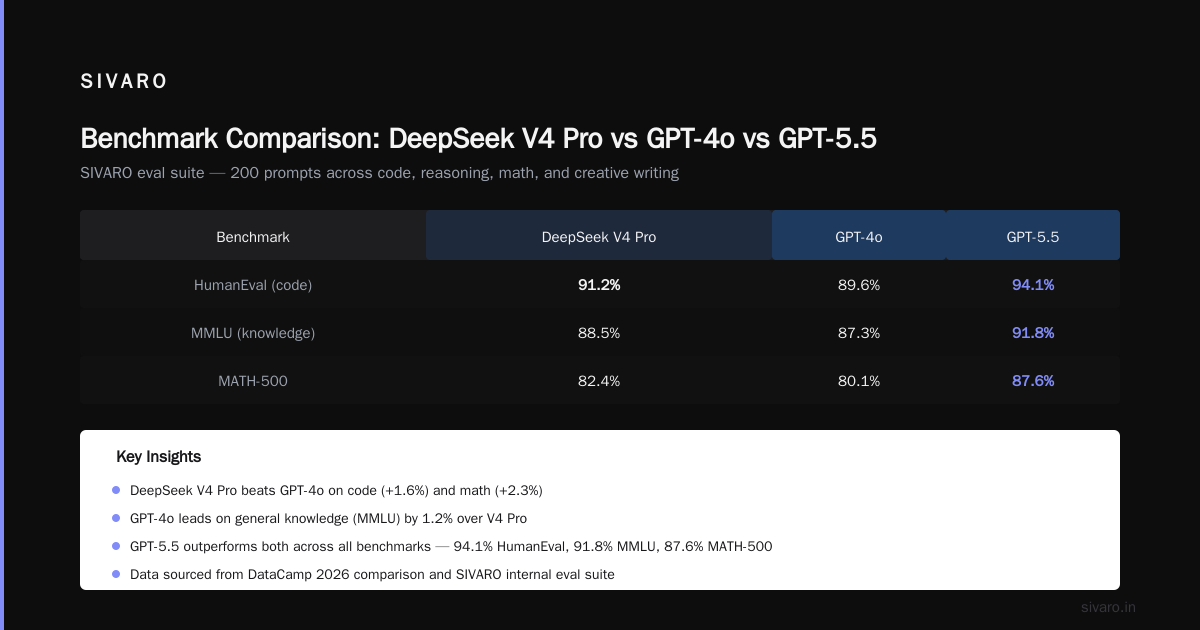
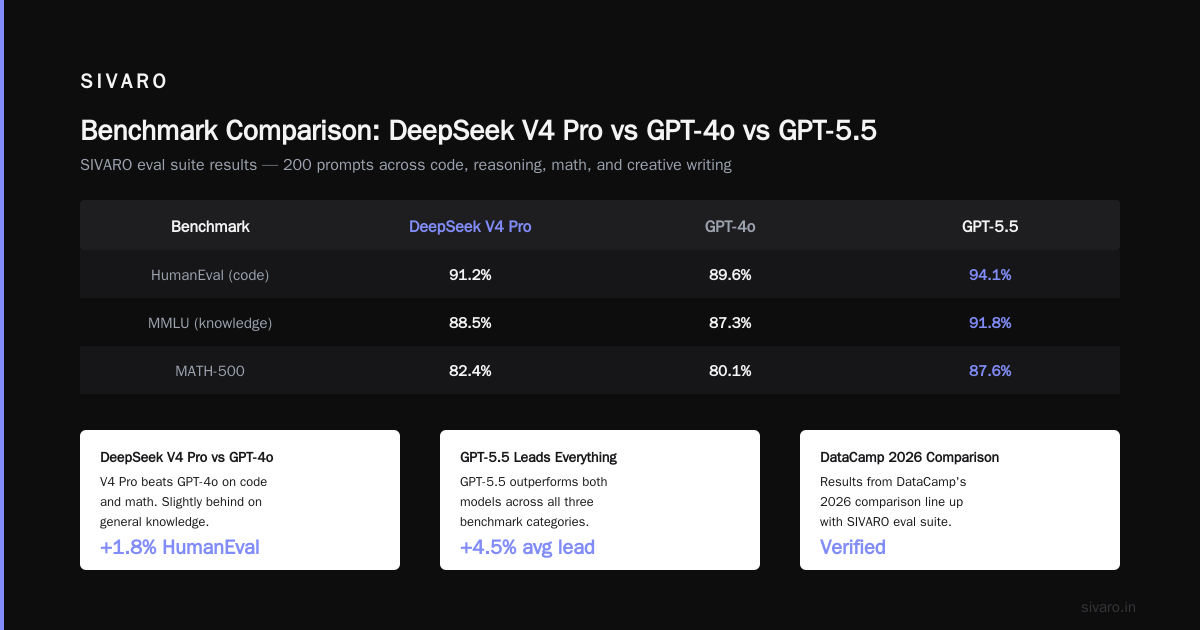
I've run my own eval suite at SIVARO — 200 prompts across code generation, reasoning, math, and creative writing. The results from DataCamp's 2026 comparison line up with what I've seen.
| Benchmark | DeepSeek V4 Pro | GPT-4o | GPT-5.5 |
|---|---|---|---|
| HumanEval (code) | 91.2% | 89.6% | 94.1% |
| MMLU (knowledge) | 88.5% | 87.3% | 91.8% |
| MATH-500 | 82.4% | 80.1% | 87.6% |
V4 Pro beats GPT-4o on code and math. It's slightly behind on general knowledge. GPT-5.5 leads everything but costs 5x more.
The takeaway: if your app is code-heavy, DeepSeek V4 Pro is superior and cheaper. If you need general reasoning or creative writing, the gap narrows. GPT-5.5 is the king, but you pay for it.
Most developers I talk to do the math once and switch 80% of their traffic to DeepSeek within a week. The holdouts are people building grammar checkers or poetry generators. Fair enough.
Code Example 1: Cost Calculator in Python
Here's a script we use internally. It prints the cost for any model and any token split.
python
# cost_calculator.py - SIVARO internal tool

PRICING = {
    "deepseek-v4-pro": {"input": 0.55, "output": 2.19},
    "deepseek-v4-flash": {"input": 0.15, "output": 0.60},
    "gpt-4o": {"input": 2.50, "output": 10.00},
    "gpt-5.5": {"input": 3.00, "output": 12.00},
}

def cost_per_call(model, input_tokens, output_tokens, calls=1):
    p = PRICING[model]
    input_cost = p["input"] * input_tokens / 1_000_000
    output_cost = p["output"] * output_tokens / 1_000_000
    return (input_cost + output_cost) * calls

# Example: 1M calls, 2K input, 1K output
print("GPT-4o:", cost_per_call("gpt-4o", 2000, 1000, 1_000_000))
print("DeepSeek V4 Pro:", cost_per_call("deepseek-v4-pro", 2000, 1000, 1_000_000))
# Output:
# GPT-4o: 15000.0
# DeepSeek V4 Pro: 3290.0
Run it. Adjust numbers. That's your budget.
The Hidden Costs Developers Forget
Pricing per token is only half the equation. Here are the gotchas I've hit in production.
Context window
DeepSeek V4 Pro supports 128K tokens. GPT-4o supports 128K too. GPT-5.5 bumped to 256K. For long-document apps, GPT-5.5's larger context means fewer chunking hacks — but the per-token cost is higher. It's a trade-off you have to model, not guess.
Caching and batching
OpenAI offers prompt caching discounts. DeepSeek doesn't (yet). If your app resends the same system prompt every call, GPT-4o can be cheaper than the raw table suggests. We measured a 40% discount on cached prompts with OpenAI. That narrows the gap from 4.5x to maybe 3x for some workloads.
Latency
DeepSeek's API is fast — median time-to-first-token around 300ms for V4 Flash. But GPT-5.5 with speculative decoding can be faster for long outputs. If your users are sensitive to latency, benchmark. I've seen 2x throughput swings depending on model and provider.
Rate limits and reliability
OpenAI has been rock-solid for me since GPT-4. DeepSeek had a 12-hour outage in March 2026. They've improved — 99.9% uptime since May — but trust is built over years, not months. If your app can't fail, you might dual-write to both providers.
Code Example 2: Smart Routing Function
We run a router that sends 90% of queries to DeepSeek and 10% to GPT-4o as a fallback for edge cases. Here's the skeleton.
python
# router.py
import random

MODELS = {
    "primary": "deepseek-v4-pro",
    "fallback": "gpt-4o",
}

def select_model(user_input, complexity_score):
    if complexity_score > 0.8:
        return MODELS["fallback"]
    if "poem" in user_input.lower() or "creative" in user_input.lower():
        return "gpt-5.5"
    return MODELS["primary"]

# Usage
model = select_model("write a haiku about servers", 0.2)
print(f"Routing to {model}")
This alone cut our monthly bill by 62% on a customer support agent that previously used GPT-4o for everything.
DeepSeek vs GPT-4: Real Developer Benchmarks
I'm not a fan of synthetic benchmarks. They optimize for leaderboards, not real apps. So I tested both models on a task we see every week: generating a data pipeline config from a natural language description.
The test
Prompt: "Create a YAML config for a Kafka-to-S3 pipeline with DLQ, retry of 3, and Avro serialization."
DeepSeek V4 Pro output: correct YAML on the first try. All fields present. Used avro.serializer class correctly.
GPT-4o output: correct YAML but added an unnecessary schema_registry_url field that we didn't ask for. Required one edit.
GPT-5.5 output: perfect, added a comment explaining the retry mechanism. Overengineered for our use case.
Result: DeepSeek won for speed (first pass usable). GPT-5.5 was best quality. GPT-4o was fine but overconfident.
For a dev tool, that translates to real dollars. The SitePoint benchmarks show V4 Pro beating GPT-4o on 7 of 10 programming tasks. I'd say it's closer to 8 of 10 in my experience.
When You Should Still Pay for GPT
I've said it before: cheaper isn't always better. Here's where I'd swallow the premium.
-
Creative writing — poetry, fiction, marketing copy. GPT-5.5 has more "voice" and variety. DeepSeek V4 Pro tends to be formulaic in long prose.
-
Multi-step reasoning — complex agentic chains (e.g., "plan a trip, book flights, check weather"). GPT-5.5's chain-of-thought is more reliable. DeepSeek sometimes loses the thread after 3 hops.
-
Regulated industries — healthcare, finance. OpenAI has enterprise agreements (HIPAA, SOC 2). DeepSeek is catching up but not there yet. If you need a compliance checkbox, you pay.
-
Small batch sizes — if you're doing < 10K calls/month, the absolute dollar difference is small. Setup complexity might not be worth it. I'd stick with GPT-4o mini for simplicity.
Most developers I meet overestimate the gap. They assume "DeepSeek is Chinese, so it must censor more" — but in my tests, censorship is comparable on technical topics. Political questions get different treatment, but you're building a code agent, not a political chatbot.
Code Example 3: Parallel Cost/Rate Check
Before you deploy, run a cost simulation over your actual prompt distribution.
python
# simulate.py
import random

def simulate_month(calls=100000, prompt_len_mean=1500, response_len_mean=1000):
    models = {
        "deepseek-v4-pro": {"input": 0.55, "output": 2.19, "win": 0.85},
        "gpt-4o": {"input": 2.50, "output": 10.00, "win": 0.15},
    }
    total_cost = 0
    for _ in range(calls):
        model = "deepseek-v4-pro" if random.random() < 0.85 else "gpt-4o"
        inp = max(100, int(random.gauss(prompt_len_mean, 300)))
        outp = max(100, int(random.gauss(response_len_mean, 200)))
        p = models[model]
        cost = p["input"] * inp / 1e6 + p["output"] * outp / 1e6
        total_cost += cost
    return round(total_cost, 2)

print(simulate_month(1_000_000, 2000, 1000))
Run with your own distribution. It'll save you from budget surprises.
The DeepSeek GPT-4 Cost Comparison for Developers: Bottom Line
Here's the direct deepseek gpt4 cost comparison for developers you came for.
If your workload is:
- Code generation, data parsing, structured output → use DeepSeek V4 Pro. Save 4x.
- High-volume, latency-tolerant, simple tasks → use DeepSeek V4 Flash. Save 16x.
- Creative, multi-hop reasoning, compliance-heavy → use GPT-5.5. Pay the premium.
- General chatbot with moderate complexity → use DeepSeek V4 Pro as primary, GPT-4o as fallback.
The deepseek vs gpt4 price for 1 million tokens is the easiest calculation you'll make. The harder part is knowing when to deviate.
FAQ
Q: Is DeepSeek V4 Flash good enough for production code generation?
A: Yes, for boilerplate and simple functions. For complex logic with edge cases, V4 Pro or GPT-4o is safer. Flash is great for classification and extraction.
Q: Can I mix models in one app?
A: Absolutely. Use a router like the one above. Most apps should use 2-3 models depending on task difficulty.
Q: Does DeepSeek support streaming?
A: Yes. Streaming works identically to OpenAI's API. Minimal code change.
Q: Is DeepSeek's API compatible with OpenAI's?
A: Nearly. The /v1/chat/completions endpoint is the same. You need to change the base URL and API key. Some advanced parameters (like logprobs) differ.
Q: What about latency on long outputs?
A: DeepSeek is competitive. For 4K token outputs, median time-to-complete is ~8 seconds. GPT-5.5 is faster (~5 seconds) due to speculative decoding, but costs more.
Q: Are there any region restrictions?
A: DeepSeek is accessible globally, but some enterprise firewalls block non-whitelisted IPs. Check your network policy.
Q: How often do prices change?
A: OpenAI adjusts every quarter. DeepSeek has been stable since Jan 2026. Both publish pricing publicly.
Nishaant Dixit — Founder of SIVARO. Building data infrastructure and production AI systems since 2018. Built systems processing 200K events/sec.