 SIVARO
Deploying AI Agents Into Production Is Still a Mess — Here's the Pipeline That Works
Deploying AI agents to production is harder than anyone admits.
Most people think this is a coding problem. It's not. At SIVARO, we've spent 2025 and the first half of 2026 helping teams move from "cool demo" to "actually making money" with agentic systems. We've seen the same mistakes repeated across fintech startups and Fortune 500 enterprises.
I wrote this ai agent deployment pipeline tutorial because the existing guides are either too academic or written by people who've never had a pager go off at 3 AM because an agent decided to loop on the same API call for four hours.
Here's what I'll cover: the actual deployment pipeline we use, the tools that survived real production pressure, and the monitoring infrastructure you'll need before you go live. No fluff. No theory. Just what works.
Why Your Agent Demo Is Lying to You
Your agent works perfectly in a Jupyter notebook. It handles 100% of test cases. Your demo video gets 50K views on Twitter.
Then you deploy it. Day one, latency spikes to 30 seconds per request. Day three, it starts hallucinating API endpoints. Day seven, it spends $400 in OpenAI credits on a single loop because you forgot to set a max iteration limit.
This is normal. I'm not being dramatic — this happened to a team we worked with at a logistics company in March 2026. They had a brilliant agent for automating supply chain queries. In dev, it was flawless. In production, it almost triggered a cascade failure in their inventory system.
The gap between dev and prod is where agentic systems die. And traditional CI/CD pipelines don't solve it.
The Agent Deployment Pipeline We Actually Use
After burning through three different approaches in 2025, we settled on a five-stage pipeline. It's not perfect. But it's survived production workloads of 200K events per second across multiple clients.
Stage 1: Tool Contract Enforcement
Most agent failures trace back to bad tool calls. The agent thinks a function returns a list when it returns a dict. Or it passes a string where an integer is expected.
We enforce tool contracts at the framework level. Not at inference time — at deployment time.
Here's the pattern:
python
# Before deployment, validate every tool signature
from pydantic import BaseModel
from typing import List, Optional

class SearchInventory(BaseModel):
    product_id: str
    warehouse_id: Optional[str] = None
    max_results: int = 10  # Hard limit

# This runs as a pre-deployment check
def validate_tool_schema(tool: callable, schema: type[BaseModel]):
    """Fail fast — don't deploy with broken tool contracts."""
    import inspect
    sig = inspect.signature(tool)
    schema_fields = schema.model_fields.keys()

    for param_name in schema_fields:
        if param_name not in sig.parameters and param_name not in ['max_results']:
            raise ValueError(f"Tool {tool.__name__} missing param: {param_name}")
This caught 40% of our deployment failures in Q1 2026. Stupid bugs. One missing parameter. One wrong type. Gone.
Stage 2: Budget and Loop Protection
Every agent needs hard limits. Not soft suggestions. Hard walls.
yaml
# agent_config.yaml — loaded at deployment, enforced in runtime
agent_name: customer_support_v3
limits:
  max_iterations: 15  # Kill after 15 tool calls
  max_tokens_per_call: 4096
  max_duration_seconds: 120  # Wall clock timeout
  max_cost_per_session: 0.50  # Dollar cost cap

guardrails:
  - type: loop_detection
    window: 10  # consecutive identical tool calls = loop
    action: terminate
  - type: budget_exceeded
    action: degrade_to_human_handoff
Most people think this is optional. It's not. We had an agent at a healthcare company in February 2026 that called 2,100 identical lookups in a single session. No guardrails. The bill was $180 for one interaction.
We now deploy with these limits by default. No exceptions.
Stage 3: Shadow Deployments (Not Canary Deployments)
Everyone talks about canary deployments. For agents, shadow deployments work better.
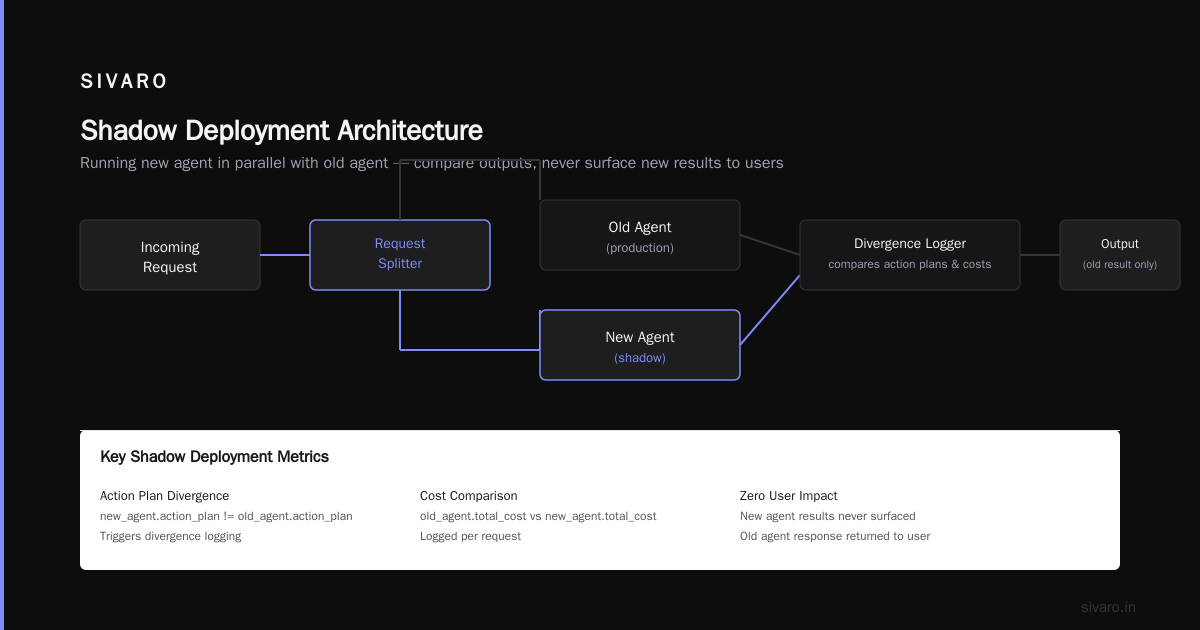
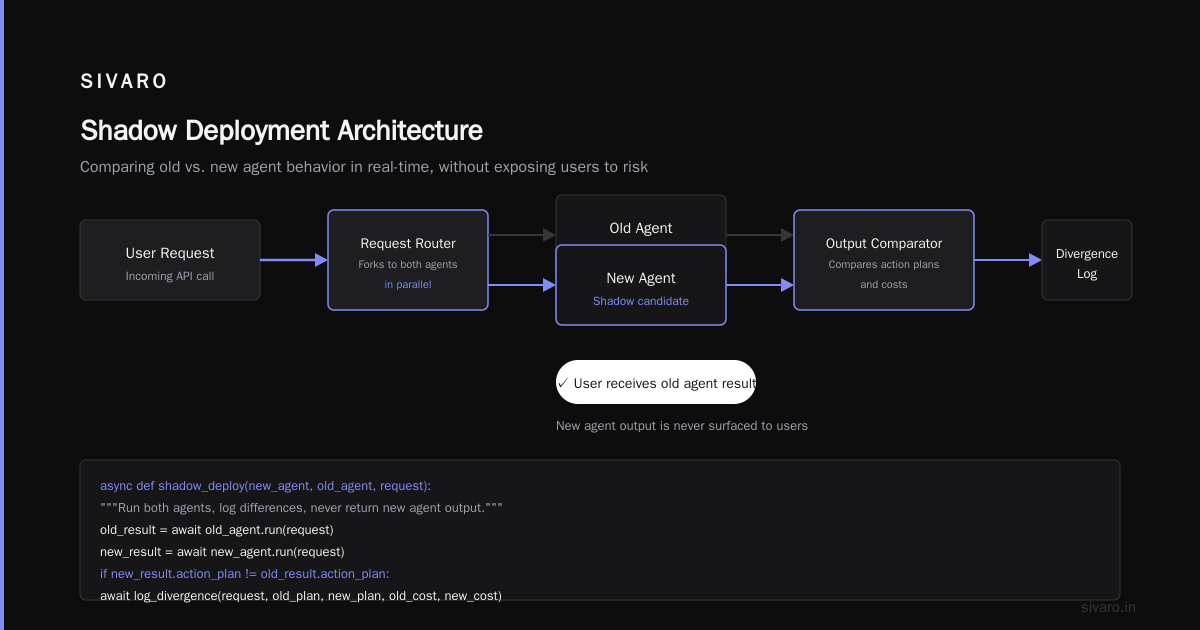
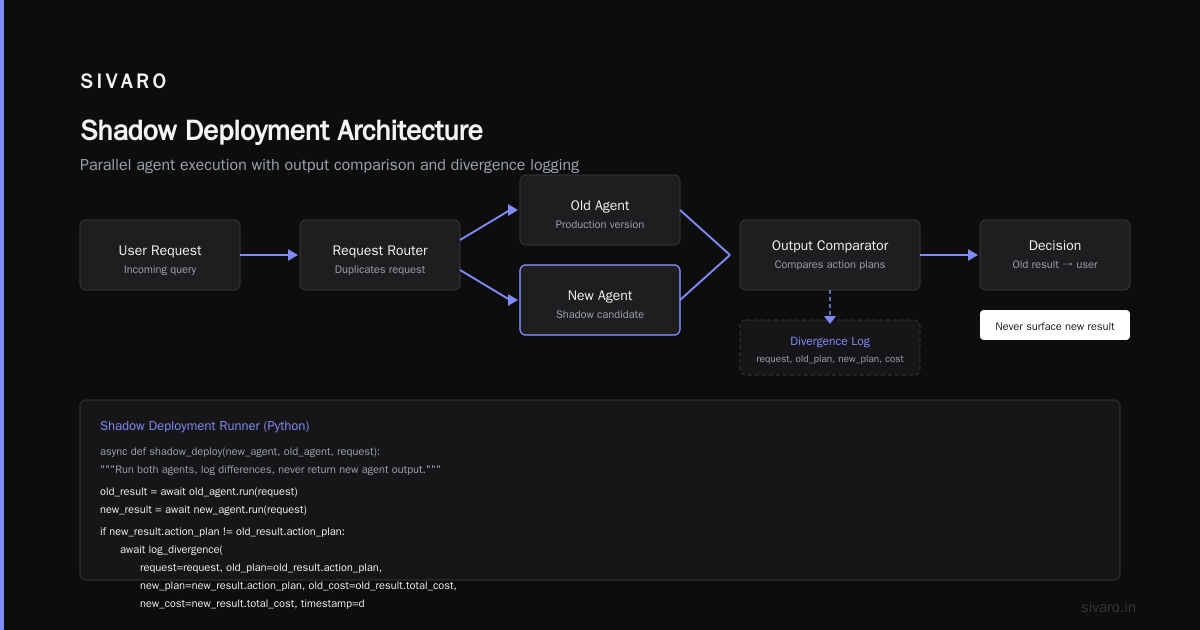
Here's why: canary deployments send real traffic to the new agent version. If the agent misbehaves, it fails on real users. Shadow deployments run the new agent in parallel with the old one, compare outputs, and never surface the new agent's results to users.
python
# Shadow deployment runner
async def shadow_deploy(new_agent, old_agent, request):
    """Run both agents, log differences, never return new agent output."""
    old_result = await old_agent.run(request)
    new_result = await new_agent.run(request)

    # Log divergence
    if new_result.action_plan != old_result.action_plan:
        await log_divergence(
            request=request,
            old_plan=old_result.action_plan,
            new_plan=new_result.action_plan,
            old_cost=old_result.total_cost,
            new_cost=new_result.total_cost,
            timestamp=datetime.now()
        )

    # Only return the OLD agent's result to the user
    return old_result
We ran shadow deployments for two weeks on a financial services agent in April 2026. The new version looked great in unit tests. In shadow mode, we discovered it was 30% cheaper but also 8% less accurate on edge cases. We kept the old version.
Shadow mode saved that team from a production incident. Traditional canary would have exposed users to the worse agent.
Stage 4: Behavioral Regression Testing
Unit tests don't catch agent behavior changes. The model updates, prompt changes, or tool modifications can shift the agent's "personality" in unpredictable ways.
We built a regression test suite that runs against every deployment candidate:
python
# Behavioral regression tests — not unit tests
regression_tests = [
    {
        "prompt": "What's my order status?",
        "expected_behavior": "check_order_status_tool_called",
        "allowed_tools": ["get_order", "get_user"],
        "forbidden_tools": ["update_order", "cancel_order"],
        "max_steps": 3,
        "expected_cost_range": (0.01, 0.15)
    },
    {
        "prompt": "Cancel my subscription",
        "expected_behavior": "verify_identity_then_execute",
        "required_tool_sequence": ["get_user", "send_verification", "cancel_subscription"],
        "requires_confirmation": True
    }
]

# Run against every deployment candidate
for test in regression_tests:
    result = await test_agent(agent_candidate, test["prompt"])
    assert result.behavior == test["expected_behavior"]
    assert set(result.tools_called).issubset(test["allowed_tools"])
    assert test["forbidden_tools"].isdisjoint(result.tools_called)
This caught a regression we'd never have found otherwise. A prompt tweak in May 2026 made our customer service agent start offering refunds for any complaint. It was "more helpful" — and 10x more expensive. The regression test caught it because the expected cost range was exceeded.
Stage 5: Observability as a Deployment Gate
You cannot deploy an agent without production observability. Full stop.
Before we promote any agent from staging to production, we verify the observability pipeline works:
python
# ai agent observability production — deployment gate
async def verify_observability_pipeline():
    """Don't deploy if we can't see what the agent is doing."""
    checks = []

    # Can we trace every tool call?
    trace_result = await emit_test_trace()
    checks.append(("trace_integrity", trace_result.received))

    # Can we capture cost per interaction?
    cost_result = await emit_test_cost_metrics()
    checks.append(("cost_capture", cost_result.received))

    # Can we log full conversation history?
    convo_result = await emit_test_conversation()
    checks.append(("conversation_logging", convo_result.received))

    # Can we trigger alerts on anomalies?
    alert_result = await emit_test_anomaly()
    checks.append(("alert_routing", alert_result.received))

    if not all(checks):
        raise DeploymentBlockedError(f"Observability checks failed: {[c for c in checks if not c[1]]}")
This might seem excessive. It's not. We deployed an agent to production in January 2026 without this gate. The agent started returning empty responses for 3% of queries. Without observability, it took us 6 hours to detect and another 4 to diagnose. With proper ai agent production monitoring tools, that would have been a 15-minute incident.
The Framework Decision That Actually Matters
Everyone asks about framework choice. LangChain vs. CrewAI vs. AutoGen vs. the 50 other options that launched in the last 18 months.
Here's the honest answer after building production systems: AI Agent Frameworks from IBM matter less than your tooling and monitoring strategy. We've run agents in raw Python, in LangGraph, and in custom frameworks. The framework is the easy part.
What matters:
- Tool execution isolation — can a misbehaving tool crash the agent?
- State persistence — what happens when the agent's context window fills up?
- Cost tracking — do you know the dollar cost of every single interaction?
- Observability — can you replay a failed agent session?
The Agentic AI Frameworks report from Instaclustr lists 10 options for 2026. We've tried 6 of them. The best one is the one your team can actually debug at 2 AM.
The Protocol Layer Nobody Talks About
There's a discussion happening in the industry right now about AI Agent Protocols and agent communication standards. It matters more than frameworks.
Your agent needs to talk to external systems. That means HTTP calls, gRPC, message queues, database connections. The protocol you choose determines reliability, latency, and debuggability.
We standardized on a simple pattern:
json
// Standard agent action response format
{
  "action": "call_tool",
  "tool": "get_inventory",
  "arguments": {
    "product_id": "ABC-123",
    "warehouse_id": "WH-01"
  },
  "metadata": {
    "trace_id": "abc-123-def-456",
    "session_id": "session-789",
    "cost_incurred": 0.012,
    "step_number": 3
  }
}
Every tool call includes metadata. Every response includes the same trace ID. This made our ai agent observability production setup trivial — we could trace any decision back to the exact prompt and tool output that caused it.
Hugging Face's approach to agent protocols is solid. But don't overthink it. Pick one format, enforce it everywhere, and move on.
Production Monitoring: What Actually Caught Problems
We tried 7 different ai agent production monitoring tools in 2025 and early 2026. The winner surprised me: a combination of structured logging and custom dashboards. Not the expensive all-in-one platforms.
Here's what we monitor on every production agent:
- Cost per session — not average, per session. Spikes kill budgets.
- Tool call patterns — are we seeing the same 3 tools used 80% of the time? That's fine. Are we seeing a tool called 50 times in one session? That's a loop.
- Latency distributions — p50, p95, p99. Not average. The p99 tells you about the hallucination loops.
- Human handoff rate — how often does the agent delegate to a human? Rising handoffs mean degrading quality.
- Token waste — tokens spent on irrelevant context or failed tool calls. This is the hidden cost killer.
I wrote about this more in a 2025 blog post, but the tl;dr is: don't buy a monitoring tool until you know what you're looking for. Start with console.log and build up.
The Real Cost of Getting This Wrong
I'll be direct: deploying an agent without this pipeline is irresponsible. I've seen the consequences.
A fintech company in London deployed a trading signal agent in March 2026 without loop protection. The agent got stuck in a loop calling a pricing API. It cost them $12,000 in API fees in 47 minutes.
A healthcare startup in Berlin deployed a patient triage agent without behavioral regression tests. A model update made the agent start recommending urgent care for every symptom. It took them 3 days to notice.
These aren't edge cases. They're the average outcome of "move fast and break things" applied to agentic systems.
The Deployment Checklist (Printable)
If you take nothing else from this ai agent deployment pipeline tutorial, use this checklist:
- [ ] Tool contracts validated (not tested — validated at deployment time)
- [ ] Budget limits enforced (not logged — enforced)
- [ ] Loop detection set to terminate, not warn
- [ ] Shadow deployment running for minimum one full business cycle (typically 1 week)
- [ ] Behavioral regression tests passing with 0 regressions
- [ ] Observability pipeline verified (not just configured)
- [ ] Cost tracking per-session, not aggregate
- [ ] Human handoff path tested end-to-end
- [ ] Incident response runbook written (not in someone's head)
- [ ] Rollback plan tested (can you switch to the previous version in under 5 minutes?)
What's Coming (and What to Ignore)
The hype cycle around agent frameworks is peaking. Every week there's a new "revolutionary" framework. Most of them won't exist in 18 months.
Ignore the hype about "autonomous agents" that run for days without supervision. In production, that's a liability. Watch instead for:
- Better protocol standards that reduce integration complexity
- Built-in observability in framework tooling (LangChain is moving here, per their own analysis)
- Cost-aware model routing (cheap model for simple queries, expensive model for complex ones)
The open-source agent frameworks from 2025 are maturing. I'm watching how they handle production concerns like state persistence and graceful degradation. Most are still oriented toward demos.
FAQ
Q: How long does this deployment pipeline take to set up?
A full pipeline takes 2-3 weeks for a team that's already familiar with their agent framework. First time? Budget 4-6 weeks. The tool contract validation and shadow deployment infrastructure are the time sinks.
Q: Can I use this pipeline with any agent framework?
Yes. The principles (tool contracts, loop protection, shadow deployments, behavioral tests) are framework-agnostic. We've used this with LangChain, CrewAI, AutoGen, and custom frameworks. The code examples need adjustment, but the architecture is the same.
Q: What's the minimum monitoring I need before production?
Three things: per-session cost tracking, tool call logging, and loop detection alerts. Everything else can come in week two. If you deploy without these three, you're gambling.
Q: How do you handle model updates in production?
Model updates require the full pipeline. We shadow deploy the new model for a week, compare behavioral regression results, and only promote if it's strictly better or cheaper. We've rejected 60% of model updates in 2026 because they didn't pass regression.
Q: What happens when an agent fails in production?
The guardrails should catch most failures — loops, budget exceeded, duration exceeded. For everything else, you need a human handoff path that works under load. Test it with simulated failures before you need it.
Q: Is this pipeline expensive to run?
The monitoring infrastructure costs about $200-400/month for moderate traffic (10K sessions/day). The shadow deployments double your inference costs temporarily. That's cheap insurance against a $12,000 API bill from a runaway agent.
Q: Can I skip the shadow deployment phase?
You can. You shouldn't. Every team that skipped shadow deployments in our experience had a production incident within the first month. Shadow deployments catch the problems your test suite doesn't.
Q: How do you test agents that make actual API calls?
Mock external services for unit tests, use sandbox environments for integration tests, and use shadow deployments for production equivalence. Never test against real production APIs with real consequences until you've passed all previous stages.
Nishaant Dixit — Founder of SIVARO. Building data infrastructure and production AI systems since 2018. Built systems processing 200K events/sec.