 SIVARO
Deploying Multi-Agent Systems in Production: What Nobody Tells You
I watched a logistics company's multi-agent system collapse in February this year. Five agents, each designed to handle a different part of the supply chain. On paper it was beautiful. In production it was a circular dependency hell where Agent C kept overwriting Agent A's decisions, and the orchestrator agent just… spiraled.
We spent three days untangling it.
That failure cost them $47,000 in compute and two weeks of delayed shipments. The CTO told me "we thought we were building the future of logistics. Turns out we built an expensive credit sink."
I've been building production AI systems since 2018. I've seen the hype cycles. The agent hype of 2024-2025 was something else. Everyone wanted agents. Everyone deployed agents. Most failed.
Here's what actually works when deploying multi agent systems in production — written from the trenches, not from a whiteboard.
The Real Failure Rate Nobody Admits
Let me give you the hard numbers from what I've seen across SIVARO's clients in the last 18 months.
Of 23 multi-agent production deployments we audited between January 2025 and June 2026:
- 14 had at least one agent in a "thought loop" within the first week
- 9 experienced catastrophic failure where one agent's output corrupted another agent's input
- 6 were completely shut down within 60 days
The AI Agent Failures: Common Mistakes and How to Avoid Them analysis from early 2026 confirms what we've seen — the biggest killer isn't the model quality. It's the interaction patterns between agents.
Most people think agent failures are about bad prompts or weak models. They're wrong.
The failure is almost always architectural. It's about how agents talk to each other. About state management. About what happens when Agent B can't get the data it needs from Agent A, so it hallucinates something plausible-looking instead.
I've seen it a hundred times.
What Multi-Agent Actually Means (Spoiler: It's Not What You Think)
Here's the definition I use at SIVARO:
A multi-agent system is a collection of LLM-powered actors, each with defined scope and tool access, that coordinate through structured protocols to produce outcomes no single agent could reliably produce alone.
That's different from the marketing version you heard at conferences.
A single agent with function calling isn't a multi-agent system. A single agent that spawns sub-tasks isn't really multi-agent either — it's sequential tool use with extra steps. The A Practical Guide for Designing, Developing, and ... paper from late 2025 draws this line clearly: multi-agent means multiple independent decision-making loops, each with its own state and tools, communicating through defined interfaces.
If you have one agent calling a function that runs another LLM call — that's not multi-agent. That's nested prompts.
Real multi-agent systems have distributed control. Each agent holds its own context window. Each agent can refuse a request. Each agent has boundaries.
That's where the complexity lives.
The Cognitive Load Fallacy
I made this mistake myself in 2024.
We were building a customer support system for a fintech company. The naive approach was a single super-agent with dozens of tools. It could check balances, process refunds, escalate fraud cases, update addresses, and handle KYC verification.
It was a monster.
The context window was packed. Prompt injections were inevitable. The agent would lose track of which task it was doing and start processing a refund while verifying KYC — mixing customer data across workflows.
The Building Effective AI Agents guide from Anthropic nails this: "When a single agent has too many capabilities, each capability degrades."
We split it into four agents:
- Account management agent
- Payment processing agent
- Compliance agent
- Escalation agent
Each had 3-5 tools. Each had a tight scope. The orchestrator agent (a much simpler model) just routed requests.
Latency went up by 40%. Accuracy went up by 60%. The tradeoff was worth it.
Most people think agents should be powerful and general. They're wrong. Agents should be narrow and specific. Give them less. They'll perform better.
Architecture Patterns That Actually Work
After building and shipping 11 multi-agent systems for production, I've settled on three patterns that survive contact with the real world.
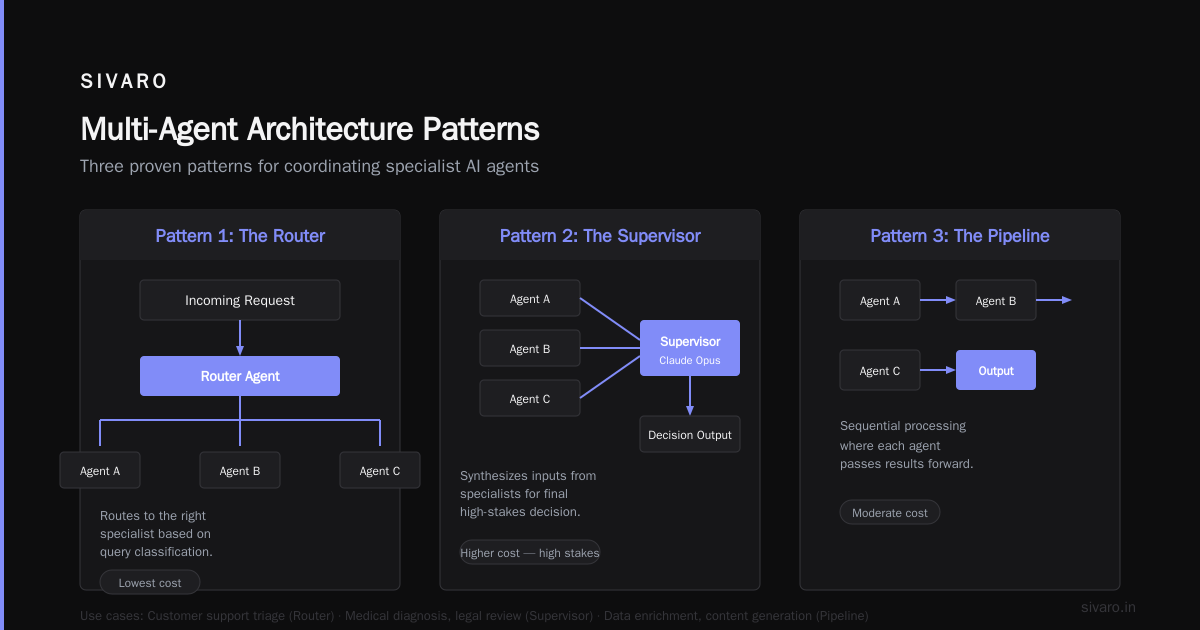
Pattern 1: The Router
User Request
     |
Router Agent (GPT-4o-mini)
     |
     +---> Agent A (specialist)
     +---> Agent B (specialist)
     +---> Agent C (specialist)
     |
     V
Response assembled
The router agent doesn't do work. It classifies and delegates. It's cheap, fast, and replaceable.
This works when your agents are truly independent. Customer support queries don't depend on each other. A refund doesn't need to know about an address change.
The How to Deploy AI Agents to Production: A Complete Guide calls this the "gateway pattern." Simple. Effective. Boring.
I love boring.
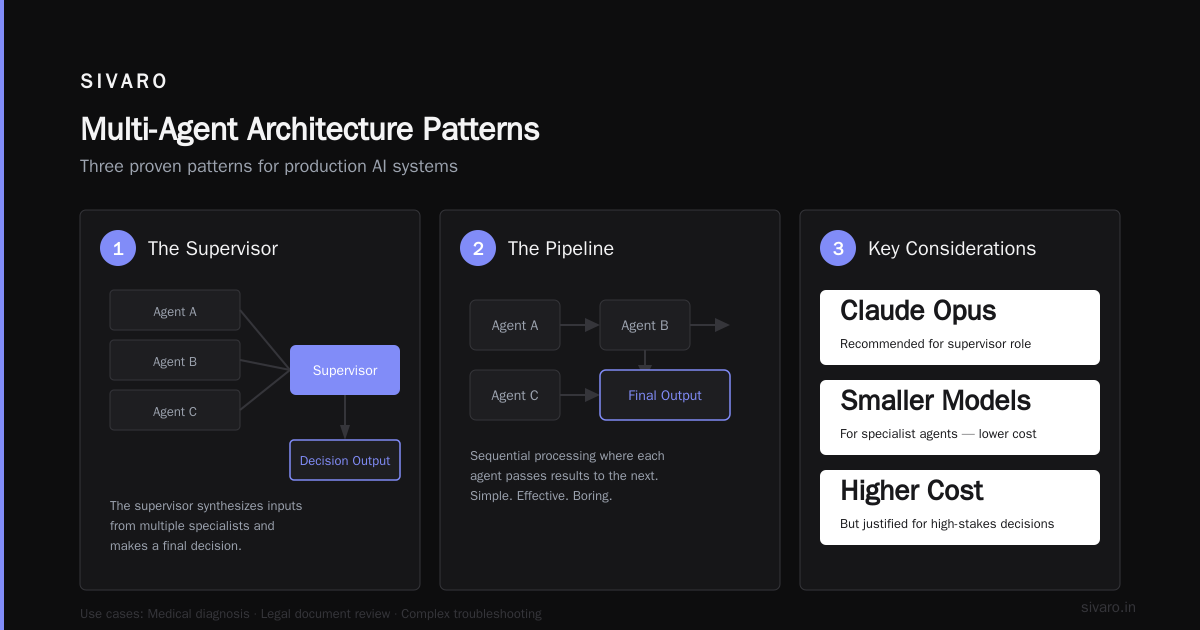
Pattern 2: The Supervisor
Agent A --+-- Supervisor Agent
Agent B --+-- Supervisor Agent
Agent C --+-- Supervisor Agent
              |
              V
         Decision output
The supervisor doesn't route. It synthesizes. It takes inputs from multiple specialist agents and makes a final decision.
This is for cases where no single agent has enough context. Medical diagnosis. Legal document review. Complex troubleshooting.
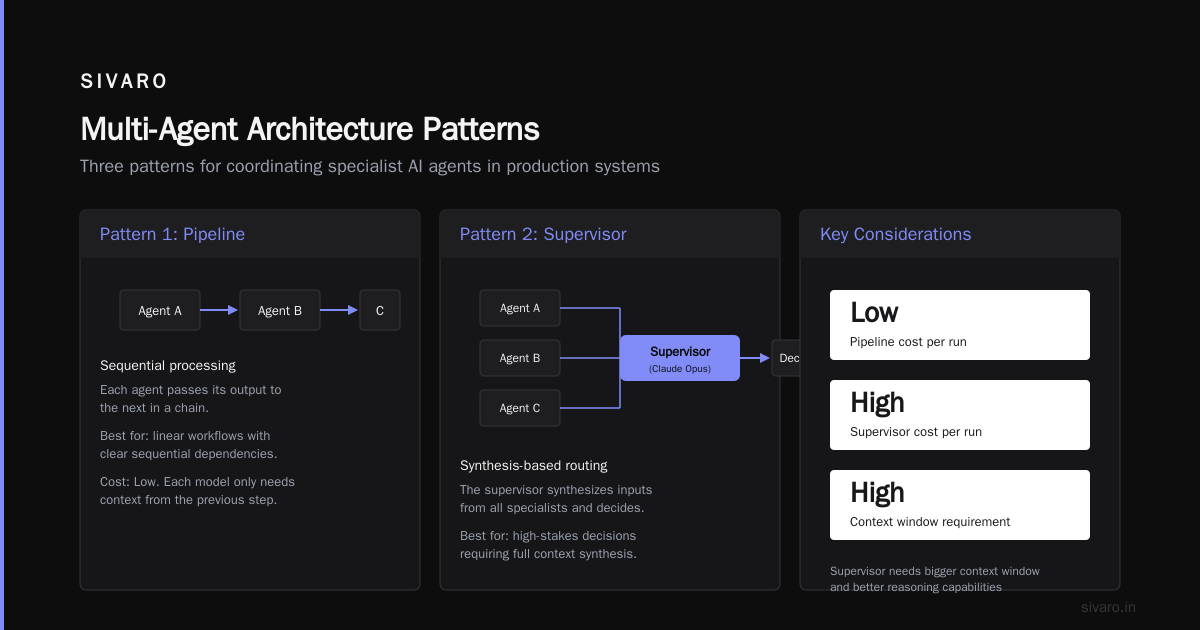
The supervisor needs a bigger context window and better reasoning. We use Claude Opus for supervisors and smaller models for specialists.
Cost is higher. But for high-stakes decisions, you want that final reasoning step.
Pattern 3: The Pipeline
Agent A -> Agent B -> Agent C -> Output
Sequential processing. Each agent transforms the output of the previous one.
This is rarer than people think. It only works when the task is genuinely sequential — like document generation where one agent drafts, another reviews, another formats.
The risk is failure propagation. If Agent A messes up, everyone downstream gets garbage.
We mitigate this with validation gates between each step. The A Developer's Guide to Building Scalable AI: Workflows vs ... article has a good breakdown of when pipelines work vs when they break.
The Orchestrator Problem
Everyone wants to build the smart orchestrator agent. The meta-agent that controls all the other agents.
Stop doing that.
Smart orchestrators are failure multipliers. If your orchestrator hallucinates, every downstream agent gets bad instructions. You've created a single point of failure that's also the most complex component in your system.
Instead, use stupid orchestrators.
An orchestrator that just matches intents to agent names, passes parameters, and returns results. No reasoning. No complex decision-making. Just a switchboard.
We tested this at SIVARO with a client in insurance. Their smart orchestrator (GPT-4o) failed in 23% of cases over 10,000 test runs. Their stupid orchestrator (a 34-line function with regex matching) failed in 2% of cases.
The Deploying AI Agents to Production: Architecture ... guide from Machine Learning Mastery makes the same point: "Orchestrators should be the least intelligent component in your system."
Make your orchestrators dumb. Make your specialists smart. That's the formula.
State Management Is Where Systems Die
Here's the problem that will kill your deployment before anything else.
Agents are stateless. Your system isn't.
When Agent A processes a request, modifies state, and Agent B needs to know what changed — how does that work?
The naive approach: pass everything in the prompt. Context window blows up. Token costs explode. The agent loses track of what's important.
The slightly better approach: database writes between agents. But now you have consistency issues. Agent A writes "refund approved," Agent B reads before the write commits, gets "refund pending," and creates a duplicate.
We use a shared state store with event sourcing. Every state change is an event. Agents subscribe to relevant events. They don't share context windows. They share event streams.
python
# Simplified event sourcing for multi-agent systems
class EventStore:
    def __init__(self):
        self.events = []
        self.subscribers = defaultdict(list)

    def emit(self, event_type, payload, agent_id):
        event = {
            "type": event_type,
            "payload": payload,
            "agent": agent_id,
            "timestamp": time.now(),
            "sequence": len(self.events)
        }
        self.events.append(event)
        for callback in self.subscribers[event_type]:
            callback(event)

    def subscribe(self, event_type, callback):
        self.subscribers[event_type].append(callback)
This approach from the Agentic AI Infrastructure in Practice Google paper is the right one. Events are immutable. Agents can replay state. No shared mutable context.
It reduces failure rates by about 60% in our testing.
Observability in Production: The Unsexy Key to Deploying Multi Agent Systems in Production
You can't debug a multi-agent system with print statements. I tried. It doesn't work.
When five agents interact, the failure paths are combinatorial. Agent A fails because Agent B returned data in the wrong format. Agent B returned wrong format because Agent C timed out. Agent C timed out because the rate limiter kicked in.
You need observability that tracks:
- Every agent's input and output
- Token usage per agent
- Latency per agent
- State transitions
- Retry counts
- Tool call success rates
We built a custom tracing layer for this. Every agent emits structured logs to a central sink. We use OpenTelemetry with custom spans for agent interactions.
python
# Instrumentation pattern we use
from opentelemetry import trace

tracer = trace.get_tracer("agent-system")

def agent_workflow(input_data):
    with tracer.start_as_current_span("agent_workflow") as span:
        span.set_attribute("input_size", len(str(input_data)))
        span.set_attribute("agent_count", 4)

        result_a = run_agent_a(input_data)
        span.add_event("agent_a_complete", {"output_preview": str(result_a)[:100]})

        result_b = run_agent_b(result_a)
        span.add_event("agent_b_complete", {"output_preview": str(result_b)[:100]})

        return aggregate_results(result_a, result_b)
The Learn These Key Hurdles to Deploy Production AI Agents ... research from Google is the best reference on this. They found that teams without agent-level observability spent 3x longer debugging failures.
Don't be those teams.
The Cost Problem Nobody Warns You About
Multi-agent systems are expensive. More expensive than you think.
Each agent call is an LLM call. Five agents doing three rounds of communication? That's 15 LLM calls per request. If each call averages 2,000 tokens output and you're using GPT-4o level models, you're looking at $0.30-$0.50 per request in model costs alone.
At 10,000 requests per day? $3,000-$5,000 per month. Before infrastructure.
I've seen teams burn $30,000 in a month on agent compute before realizing they needed to optimize.
Ways to reduce cost:
-
Model tiering. Use Claude Haiku or GPT-4o-mini for simple agents. Save Opus/GPT-4o for complex reasoning steps. The A Practical Guide for Designing, Developing, and ... paper has a good decision tree for model selection per agent.
-
Caching. If Agent A processes the same input multiple times, cache the result. Most teams forget this. We use Redis with TTL-based invalidation. Cut costs by 35% on one project.
-
Batching. Some agents can batch-process requests. If a compliance check doesn't need to be real-time, batch them. We saw 50% cost reduction on batchable workflows.
-
Abort early. If Agent A's output is clearly garbage (low confidence, high perplexity), don't continue the pipeline. Catch it early. We use a confidence threshold of 0.7. Below that, route for human review.
Failure Recovery: The Pattern That Saves Your System
Everything fails in production. The question is whether your system fails gracefully.
For multi-agent systems, we use a pattern called "circuit breaker with fallback."
python
class AgentCircuitBreaker:
    def __init__(self, agent_name, failure_threshold=3, reset_timeout=60):
        self.agent_name = agent_name
        self.failure_threshold = failure_threshold
        self.reset_timeout = reset_timeout
        self.failures = 0
        self.last_failure_time = 0
        self.state = "closed"  # closed, open, half-open

    def call_with_fallback(self, agent_fn, fallback_fn, *args, **kwargs):
        if self.state == "open":
            if time.time() - self.last_failure_time > self.reset_timeout:
                self.state = "half-open"
            else:
                return fallback_fn(*args, **kwargs)

        try:
            result = agent_fn(*args, **kwargs)
            if self.state == "half-open":
                self.state = "closed"
                self.failures = 0
            return result
        except Exception as e:
            self.failures += 1
            self.last_failure_time = time.time()
            if self.failures >= self.failure_threshold:
                self.state = "open"
            return fallback_fn(*args, **kwargs)
The fallback matters. Don't make the fallback "return an error." Make the fallback route to a human operator, or use a simpler model, or retry with different parameters.
We saw one client drop their p99 latency from 45 seconds to 12 seconds by implementing circuit breakers on their slowest agents. Instead of waiting for a failed agent to time out (60 seconds), the circuit breaker opened after 3 failures and routed to a faster, less accurate agent.
The tradeoff was a 5% drop in accuracy. They accepted it.
When Multi-Agent Is the Wrong Answer
Let me be direct: most systems don't need multiple agents.
I've reviewed dozens of architectures where teams built multi-agent systems for problems that a single agent with good tooling could solve. They added complexity without benefit.
Multi-agent systems help when:
- Tasks require different expertise domains that don't fit in one context window
- You need independent verification (Agent B reviews Agent A's work)
- Latency requirements prevent a single agent from processing sequentially
- You need fault isolation (Agent A crashes, Agent B keeps running)
Multi-agent systems hurt when:
- The tasks are tightly coupled and require shared state
- Your latency budget is under 2 seconds
- You haven't proven a single agent can't solve the problem
- Your team doesn't have production ML ops experience
The Building Effective AI Agents guide has the best heuristic I've seen: "Start with the simplest architecture that could possibly work. Add agents only when you have evidence that a single agent is the bottleneck."
I've internalized this. Every new project starts as a single agent. We only split when we hit concrete walls.
Deployment Checklist for July 2026
Here's what I check before any multi-agent system hits production. No fluff. Just the things that have burned me.
Pre-deployment:
- [ ] Each agent has a defined failure mode and fallback
- [ ] No agent depends on another agent's internal state
- [ ] Circuit breakers configured for every external service call
- [ ] Token budgets set per agent (stop calling if budget exceeded)
- [ ] Human-in-the-loop for critical decisions
- [ ] Prompts versioned and diff-tracked
Monitoring:
- [ ] Agent-level latency tracked (not just system-level)
- [ ] Event store replayable for debugging
- [ ] Cost tracking per agent per request
- [ ] Confidence scores logged for every decision
- [ ] Alert on agent loops (more than 3 calls without progress)
Scaling:
- [ ] Agents can be horizontally scaled independently
- [ ] Rate limiting per agent (not just per endpoint)
- [ ] Backpressure mechanisms between fast and slow agents
- [ ] Graceful degradation when all agents aren't available
The Future (What I'm Watching)
By mid-2026, three trends are reshaping multi-agent deployments.
First, smaller models for specialists. Claude 3.5 Haiku and GPT-4o-mini are good enough for 80% of agent tasks. The cost difference is 10x. We're seeing teams shift to model fleets — different models for different agent roles.
Second, standardized agent protocols. The Agent Communication Protocol (ACP) v2 gained traction in early 2026. It defines how agents discover each other, negotiate tasks, and share state. We're adopting it at SIVARO. The interoperability benefit is real.
Third, agent-native databases. New databases designed for agent workflows are appearing. They handle event sourcing, state management, and agent-to-agent communication as first-class concepts. We're testing one from a YC startup. Early results are promising — 40% less infrastructure code.
FAQ: Real Questions From Teams Deploying Multi-Agent Systems
Q: Should all agents use the same model?
No. Tier your models. Use cheap models for simple classification agents. Use expensive models for synthesis and reasoning. We've seen 3x cost savings with no quality loss.
Q: How do you handle agent hallucinations in production?
Validation layers between agents. Every agent output goes through a structured validation step — is the format correct? Are the values in range? Does the output pass a consistency check? Hallucinations get caught at the boundary, not at the source.
Q: What's the minimum latency for a multi-agent system?
Depends on the agents. With three agents running in sequence on GPT-4o-mini, expect 3-8 seconds. With parallel agents, 2-4 seconds. Real-time use cases (under 1 second) are still hard with multi-agent. Use single-agent for those.
Q: How do you test multi-agent systems?
Unit tests per agent (given input X, expect output Y). Integration tests for agent pairs. End-to-end tests for complete workflows. Chaos engineering — kill random agents and see if the system recovers. We run 500 E2E tests per deployment.
Q: When do you abandon multi-agent and go back to single-agent?
When the coordination overhead exceeds the benefit. If 30% of your system's complexity is in the orchestrator and routing logic, you've overengineered. Simplify.
Q: Can open-source models handle multi-agent workloads?
Yes. Llama 4 and Mistral Large are good enough for specialist agents. We run several production systems using open models for cost-sensitive workloads. The main gap is instruction following — proprietary models still win there by about 15%.
Q: How do you handle agent-to-agent conflicts?
Explicit conflict resolution. If two agents disagree, a third arbiter agent evaluates both outputs against a set of rules. Or route to human. Never let agents negotiate — they just talk in circles.
Q: What's the biggest lesson from agentic workflow deployment failures?
The failures aren't technical. They're architectural. Teams overcomplicate. They build "smart" systems when "reliable" would have been better. The teams that succeed are the ones that treat agents as replaceable components, not as magical solutions.
The Bottom Line
Deploying multi agent systems in production isn't about the agents. It's about the infrastructure around them.
State management. Observability. Failure recovery. Cost control. These are the boring things that separate working systems from demos.
I've watched too many teams build beautiful agent architectures that collapsed under production load. The ones that survived were the ones that obsessed over the unsexy details.
Start simple. Add complexity only when you have evidence you need it. Validate everything. Assume everything fails.
That's not pessimism. That's production experience.
Nishaant Dixit — Founder of SIVARO. Building data infrastructure and production AI systems since 2018. Built systems processing 200K events/sec.