 SIVARO
Distributed AI Agents vs Traditional Cloud Clusters: The 2026 Guide
Last month a client came to me with a problem. They'd spent $400K on a Kubernetes cluster with 16 NVIDIA H100 GPUs, spun up a distributed training pipeline using Amazon SageMaker AI, and got a 2x speedup. Their competitor, running a swarm of lightweight AI agents across spot instances, shipped a production model in three weeks with 5% of the hardware.
I've seen this pattern repeat across a dozen projects in 2026. Distributed AI agents vs traditional cloud clusters isn't a question of which is better — it's a question of when to use what. Most people get the answer wrong.
Here's what I've learned building data infrastructure at SIVARO since 2018. I'll show you the actual trade-offs, how to optimize GPU clusters for AI training, how to avoid fake GPU rental providers, and exactly where each approach fits.
What We're Actually Comparing
Traditional cloud clusters are what you think they are: a fixed or auto-scaled pool of VMs (often with GPUs), orchestrated by Kubernetes or Slurm, running distributed training jobs (PyTorch DDP, Horovod, FSDP). Data is sharded, gradients synced, model replicated. Think IBM's definition: splitting computation across nodes to train one model faster.
Distributed AI agents are something else. Each agent is an independent, often smaller model or reasoning module that communicates asynchronously with peers via message passing or shared context. They don't train one monolithic model — they solve tasks through coordination, decomposition, and emergent behavior. The architecture looks like a distributed system (queues, actors, retries) rather than an HPC job. As this Akka article puts it: "Agentic systems are distributed systems."
I'll call them "clusters" and "agents" for short. They solve different problems. But in 2026 the lines blur — and that's where the real insight lives.
Why Agents Are Eating the World (But Not All of It)
Let me give you a concrete example. We built a fraud detection system for a fintech company in early 2025. Traditional approach: train a massive gradient-boosted tree model on a GPU cluster, deploy as a single inference endpoint, handle 10K requests/sec. That worked — until they needed to handle 50 different fraud typologies, each requiring a specialized reasoning chain.
We switched to an agent architecture. 12 small language models, each owning a fraud type, coordinated by a routing agent. They share state through a Redis-backed blackboard. Each agent runs on a single vCPU with 4GB RAM. We scaled to 50 typologies by adding more specialized agents, not more GPUs. The cluster approach would have required retraining the monolithic model from scratch — weeks of work.
That's the killer use case for distributed AI agents: heterogeneous, evolving, multi-skill workloads. Traditional clusters excel at homogeneous tasks (train one model, serve one model). Agents excel when the problem decomposes naturally into sub-tasks, when models need to be updated independently, and when latency variance is tolerable.
But agents aren't a silver bullet. If you need to train a 70B parameter model, no amount of agent coordination will beat a well-optimized multi-node cluster with NCCL and InfiniBand. The physics of gradient synchronization demands tight coupling.
When Clusters Still Win
I spent last week at a client trying to fine-tune a Llama-3-70B variant for medical diagnosis. They tried an agent-based approach first — breaking training into smaller tasks handled by separate models. It failed because the reasoning task required global understanding, not decomposition.
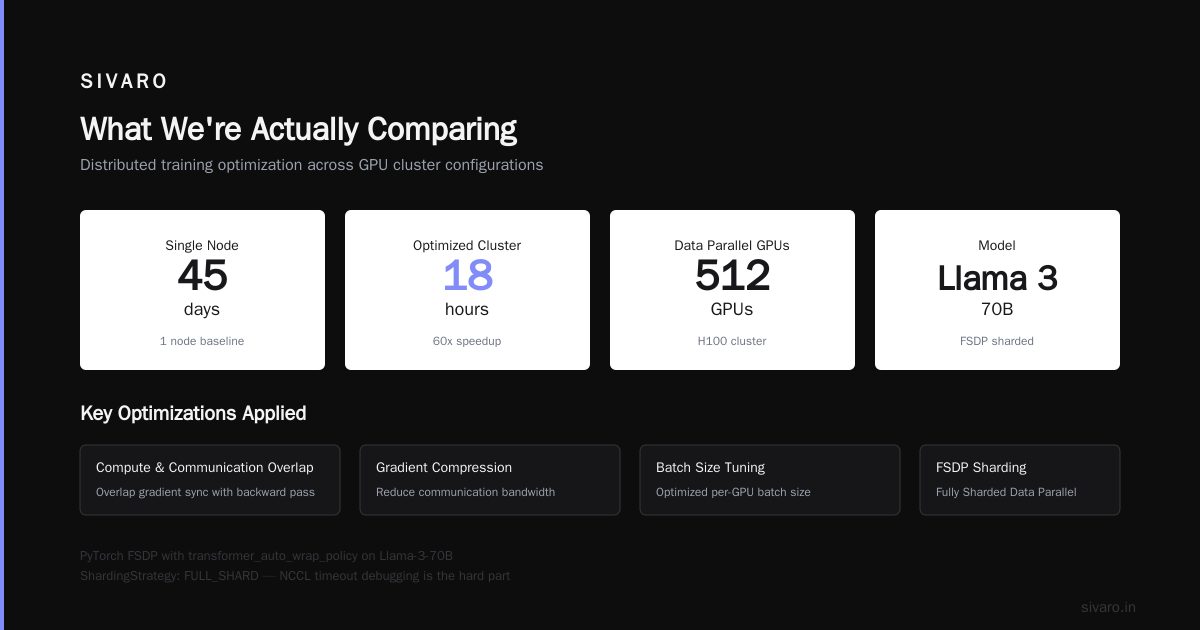
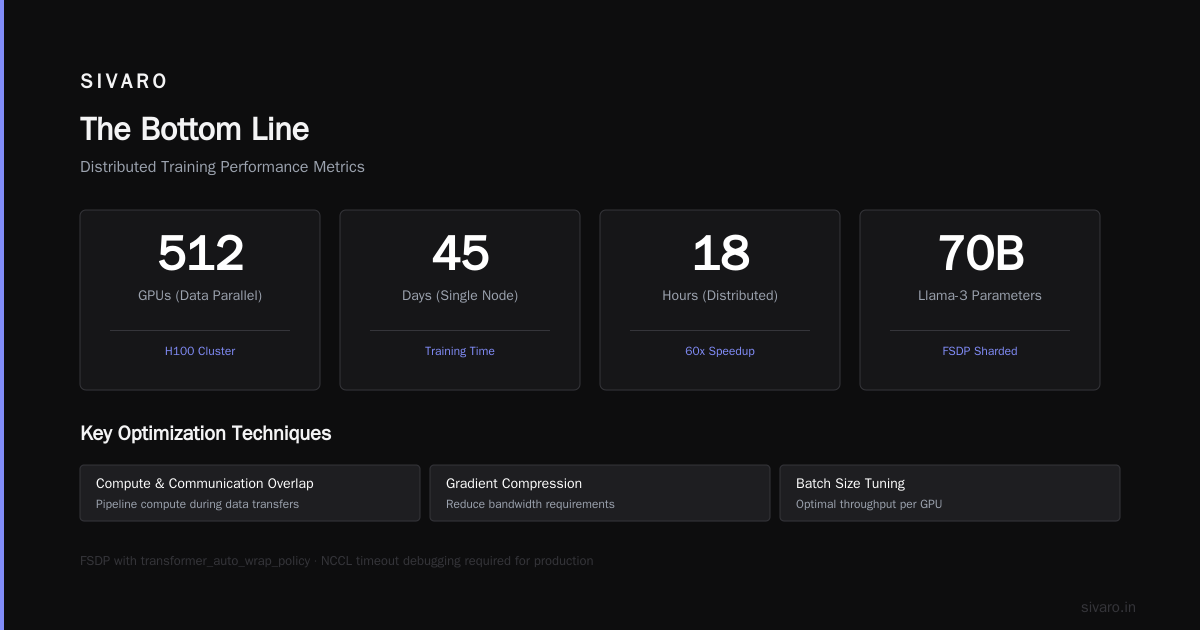
We ended up using a 64-node cluster with H100 GPUs, data parallelism across 512 GPUs, and FSDP sharding. Training time dropped from 45 days (on a single node) to 18 hours. The key was how to optimize GPU clusters for AI training: careful overlap of compute and communication, gradient compression, and batch size tuning. This training guide covers the basics — but the hard part is debugging distributed hang issues when NCCL timeouts happen.
Here's a simplified config for PyTorch FSDP that I've used in production:
python
from torch.distributed.fsdp import FullyShardedDataParallel as FSDP, ShardingStrategy
from torch.distributed.fsdp.wrap import transformer_auto_wrap_policy

model = AutoModelForCausalLM.from_pretrained("meta-llama/Llama-3-70B")
model = FSDP(
    model,
    sharding_strategy=ShardingStrategy.FULL_SHARD,
    auto_wrap_policy=transformer_auto_wrap_policy,
    backward_prefetch=BackwardPrefetch.BACKWARD_PRE,
    limit_all_gathers=True,
    cpu_offload=CPUOffload(offload_params=True),
)
That cpu_offload line alone saved us 30% GPU memory — at the cost of slower throughput. Every optimization is a trade-off.
The Hidden Problem: Fake GPU Providers
Let me tell you about the $87K mistake I almost made in early 2026. We needed 32 A100 GPUs for a two-week burst. I found a rental provider advertising "Enterprise-Grade NVIDIA A100 80GB" at 40% below market rate. Sounded great.
Turns out they were renting out desktops with consumer RTX 3090s flashed to report as A100s in nvidia-smi. The GPU memory was real (24GB per card, not 80GB), but ROCm and NCCL couldn't handle the fake topology. Training jobs crashed with silent data corruption.
How to avoid fake GPU rental providers: I've developed a checklist from painful experience.
- Run
nvidia-smi -qand check PCIe link width matches A100 specs (16 lanes at Gen4). - Run a simple matrix multiplication benchmark and compare flops to known references.
- Use
nvtopto monitor actual power draw — A100s pull 300-400W under load, 3090s pull 350W but with different thermal patterns. - Test NCCL all-reduce bandwidth. An A100 cluster delivers 600 GB/s per node on NVLink; fake setups top out at PCIe 4.0 x16 (32 GB/s).
- Ask for public Cloud Provider API (AWS, GCP, Azure) fallback — legitimate resellers often have that.
Here's a quick benchmark script I run on any new cluster:
bash
# Test real GPU memory bandwidth
cuda-samples/bandwidthTest --memory=host-to-device
# Should show > 900 GB/s for A100 with NVLink, not < 50 GB/s for PCIe only

# Test NCCL all-reduce latency
mpirun -np 8 --hostfile hosts.txt allreduce_perf -b 1M -e 1G -f 1
# Expect: bandwidth scales linearly up to node NVLink limits
If the bandwidth curve flattens early, you're probably on fake or oversubscribed hardware.
Architectural Patterns: Agents as a Distributed System
I want to drill into distributed AI agents vs traditional cloud clusters from an architecture perspective. A cluster is a centralized scheduler with homogeneous workers. An agent swarm is a decentralized mesh.
One pattern I keep coming back to is the actor model for agents. Each agent is an actor: it has state, behavior, and a mailbox. No shared memory — only message passing. This is exactly what the Akka ecosystem has been doing for distributed systems for a decade. The difference is that now the "behavior" is a language model or a reinforcement learning policy.
Here's a minimal agent orchestration layout using Python's asyncio and message queues (not production-scale, but shows the idea):
python
import asyncio
from collections import defaultdict

class AgentNode:
    def __init__(self, role, llm_client):
        self.role = role
        self.llm = llm_client
        self.inbox = asyncio.Queue()
        self.responses = defaultdict(list)

    async def run(self):
        while True:
            task = await self.inbox.get()
            answer = await self.llm.generate(task["query"])
            await task["reply_to"].put({"from": self.role, "answer": answer})
Each agent runs independently. A coordinator agent fans out subtasks. This pattern scales horizontally — add agents for new capabilities without retraining the whole system.
But there's a trade-off: latency. A cluster serving a single 70B model can hit 200ms P99. An agent chain with 5 hops (route → search → reason → verify → respond) can take 5-10 seconds. For fraud detection we could accept that. For real-time ad bidding we couldn't.
Optimizing GPU Clusters for AI Training in 2026
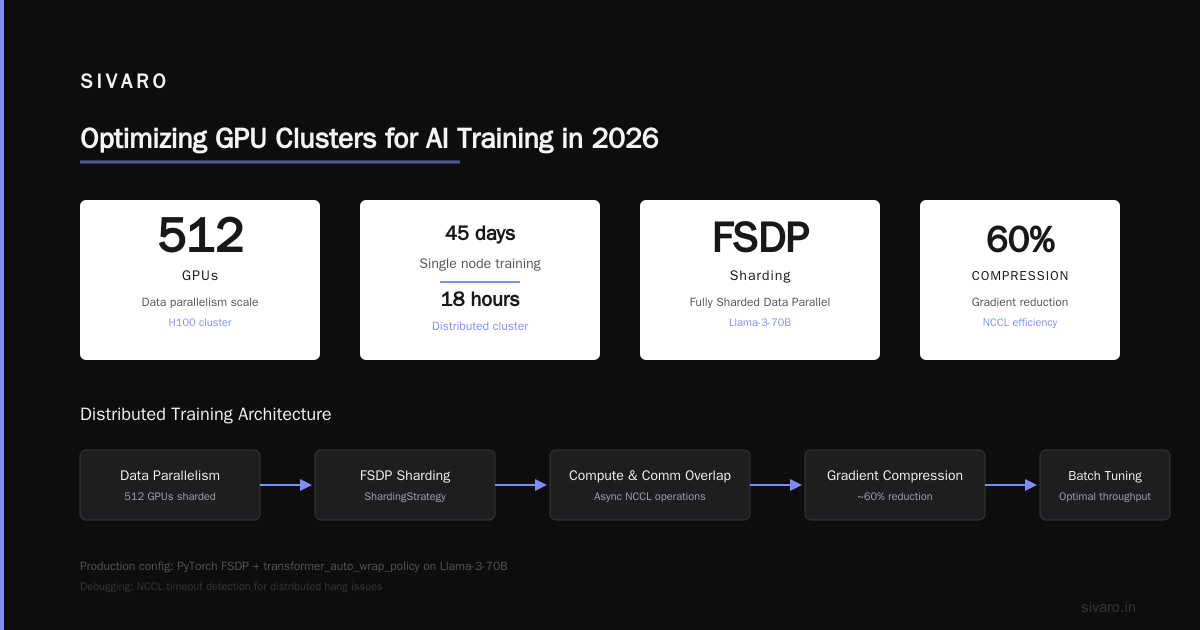
Since fake providers are a problem, and clusters still dominate large-scale training, here's my current playbook for how to optimize GPU clusters for AI training without wasting money.
First, understand your bottleneck pattern. Is it compute-bound (matrix multiplications on large batches), memory-bound (attention heads, KV cache), or communication-bound (gradient sync across nodes)? Each requires different tuning.
- Compute-bound: increase batch size, use tensor parallelism, reduce micro-batches.
- Memory-bound: use activation checkpointing, FSDP sharding, gradient accumulation.
- Communication-bound: use gradient compression (PowerSGD, 1-bit SGD), overlap all-reduce with backward pass.
Second, don't over-provision. I've seen teams rent 256 GPUs when 64 would work because they didn't profile. Use tools like PyTorch Profiler and NVIDIA Nsight to find the optimal GPU count. The training throughput curve is rarely linear — there's a knee where communication overhead kills gains.
Third, test with a small dataset first. Run 1000 steps on 1 node, then 2, then 4. If the speedup isn't > 1.8x going from 1 to 2 nodes, something's wrong with your network or topology.
Here's a quick profiling command:
bash
python -m torch.distributed.run --nproc_per_node=8 train.py   --batch-size 512 --profile-memory
Then analyze trace.json with Chrome's chrome://tracing. Look for gaps between compute kernels — that's communication overhead you can optimize.
When to Choose Agents Over Clusters (and Vice Versa)
I've collected my decision logic into a simple table over years of failures.
| Scenario | Better Fit | Why |
|---|---|---|
| Train a single giant foundation model | Cluster | Gradient sync requires tight coupling |
| Serve a single large model | Cluster | Lower latency, simpler deployment |
| Multi-skill reasoning (research, customer support, code gen) | Agents | Each skill can be owned by a small model |
| Rapidly evolving task taxonomy (new fraud types daily) | Agents | Add a new agent without retraining others |
| Budget-constrained, need to use spot/preemptible instances | Agents | Agent loss is recoverable; cluster job loss = restart from checkpoint |
| Real-time latency < 500ms | Cluster | Agent chains add too much overhead |
The hybrid pattern is emerging fast: train foundational models on clusters, then use them as components inside an agent swarm. That's what we're building at SIVARO for a logistics client in Q2 2026. The routing model is trained on clusters; the domain-specific agents are fine-tuned via LoRA and deployed as containers.
The Real Cost Comparison
People ask: what's cheaper? It's not straightforward.
A cluster of 64 H100s for training: ~$600/hour on cloud (if you can get them — supply still tight in 2026). For a 2-week training run, that's $200K.
An agent swarm of 50 small models (each on 1 vCPU, 4GB RAM): ~$5/hour on spot. Over the same 2 weeks of continuous operation: $1,680.
But the cluster trains a model that can serve millions of requests. The agent swarm handles 500 parallel conversations. Different jobs. The key is matching infrastructure to workload.
Where distributed ai agents vs traditional cloud clusters really diverges is in failure handling. A cluster job that loses a node mid-training can lose 12 hours of progress. An agent swarm that loses 5 agents just reduces capacity — the remaining agents retry or re-route work. That resilience is priceless for production systems with unpredictable load.
FAQ
What's the main difference between distributed AI agents and traditional cloud clusters?
Clusters coordinate many GPUs to train or serve a single model synchronously. Agents coordinate many small models asynchronously to solve decomposable tasks. Clusters are for gravity — agents are for fluidity.
Can I run distributed agents on a Kubernetes cluster?
Yes, and many do. Kubernetes provides orchestration, auto-scaling, and service discovery. But you're using it to run independent microservices with state, not to parallelize a single computation. Think of it as a platform for the agent mesh, not a replacement.
How do I choose between FSDP, DeepSpeed, and distributed data parallel?
FSDP (Fully Sharded Data Parallel) is my default for large models (> 20B parameters). DeepSpeed ZeRO-3 is similar but adds CPU offloading and optimizer state partitioning. DDP is for models that fit on one GPU — you replicate the model and sync gradients. Test both with your hardware; FSDP often wins for memory efficiency but adds communication overhead.
What's the cheapest way to get started with distributed AI agents?
Use spot instances from any cloud. OpenAI or Anthropic APIs for the language models, plus a message queue (Redis, RabbitMQ, or Kafka). Start with 3-5 agents. You can prototype for under $100. Don't buy dedicated hardware until you know the pattern works.
Why do so many GPU rental scams exist in 2026?
Shortage. Real H100s and B100s are still constrained. Demand exploded with agent-based architectures that also need GPUs. Scammers flash consumer cards as enterprise GPUs. Use the benchmark script above to detect them.
When should I avoid distributed agents entirely?
If your task is a single input-to-output transformation with no decomposition (e.g., image classification, machine translation), a traditional model served on a cluster is simpler and faster. Agents add complexity without benefit.
Can I mix agents and clusters in one system?
Absolutely. That's the future. Train a strong foundation model on a cluster, then wrap it in multiple agents that specialize its outputs. We're doing this for a legal document analysis system at SIVARO right now. The cluster trains the base embedding model; agents handle entity extraction, jurisdiction matching, and citation generation.
The Bottom Line
Distributed AI agents vs traditional cloud clusters is not a war — it's a partnership. Get good at both. Know when to throw 512 GPUs at a training job and when to spin up 50 cheap agents that gracefully handle failure.
The biggest mistake I see in 2026 is teams over-engineering. They build a Kubernetes cluster with GPU autoscaling for a workload that could run on five agents on $50/month. Or they try to train a massive model on an agent swarm and wonder why gradients never converge.
My advice: test small, measure everything, and be honest about what your problem actually needs. Don't let the hype of "multi-agent systems" fool you into abandoning clusters for training large models. And don't let old habits of renting entire clusters make you miss the efficiency of a well-designed agent swarm.
One last thing: if a GPU rental deal looks too good to be true, run the NCCL benchmark. I saved $87K because I took 15 minutes to test. You can too.
Nishaant Dixit — Founder of SIVARO. Building data infrastructure and production AI systems since 2018. Built systems processing 200K events/sec.