 SIVARO
Distributed Systems AI Agents Explained
I spent the first six months of 2025 trying to build a multi-agent system that could autonomously manage our GPU cluster at SIVARO. It failed spectacularly. Not because the AI wasn't smart enough — because the distributed systems foundation was a mess.
Most people think AI agents are just clever prompts glued together. They're wrong. Production agents are distributed systems problems dressed up in NLP clothes. And if you don't understand the infrastructure underneath, your agents will crash, stall, or burn money.
Let me show you what I've learned from building these things in production since 2018.
The Single Biggest Misconception About AI Agents
Every conference talk I've sat through treats agents like magic. "Just call the LLM and chain a few tools." Try running that at 1000 requests per second across 8 GPUs with stateful memory, tool execution timeouts, and a queue that backs up when one agent decides to loop on a query.
The real challenge isn't the model. It's the distributed coordination.
An AI agent in production is a distributed system composed of:
- A frontend request router (load balancer)
- Stateful memory backends (vector DB, key-value store)
- Model serving infrastructure (GPU cluster)
- Tool execution workers (sandboxed functions or microservices)
- Monitoring and logging pipeline
Each of these components needs to talk to each other reliably. One node goes down, one network partition happens, and your agent either retries infinitely or silently drops the user's request.
I learned this the hard way when our agent for a logistics client stopped fulfilling orders because the memory node was overloaded and the retry logic wasn't idempotent. We duplicated 47 shipments before catching it.
What "Distributed Systems AI Agents Explained" Actually Means
Here's the practical definition: distributed systems AI agents are autonomous software entities that process tasks by coordinating across multiple machines, using distributed compute, storage, and messaging — not just a single API call.
Think of it as a microservice architecture where every service can think and act. The agent itself is just an orchestrator that decides which service to call, what order, and how to handle failures.
This is why the distributed systems class difficulty vs ai agents comparison matters. A traditional distributed systems class teaches you consensus algorithms, replication, and failure modes. Building AI agents teaches you those same lessons — except the failure modes are amplified because the components are probabilistic, not deterministic.
I've seen engineers who aced their distributed systems certification crash and burn when their agent's LLM call timeout caused a cascading failure across three microservices. The class gave them theory. Production gave them scars.
GPU Clusters: The Foundation You Can't Skip
Your agent doesn't think without compute. And the compute power driving modern agents is a GPU cluster. If you're running anything beyond a prototype, you need to understand how these clusters work.
At SIVARO, we run a mix of on-premise and rented GPUs. Here's what I've learned about the trade-offs.
On-Premise vs Cloud vs Rentals
Building your own GPU cluster gives you control. But it's a commitment. The 5 Key Considerations when Building an AI & GPU Cluster include power density, cooling, networking bandwidth, and software stack. We spent three months just tuning InfiniBand to avoid packet loss under load — lost $80K in engineering time.
Cloud GPU instances (AWS, GCP, Azure) offer flexibility but variable pricing. Spot instances can crash your agent mid-inference. We learned to checkpoint agent state every 30 seconds after losing a 5-minute conversation history on a spot preemption.
Rental marketplaces like Vast.ai: Rent GPUs work for burst workloads. Last month we spun up 32 A100s for 72 hours to fine-tune a specialized agent for a medical diagnostics company. Paid $0.45 per GPU-hour. Would have been $3.20 on a reserved instance.
How a GPU Cluster Works (The Short Version)
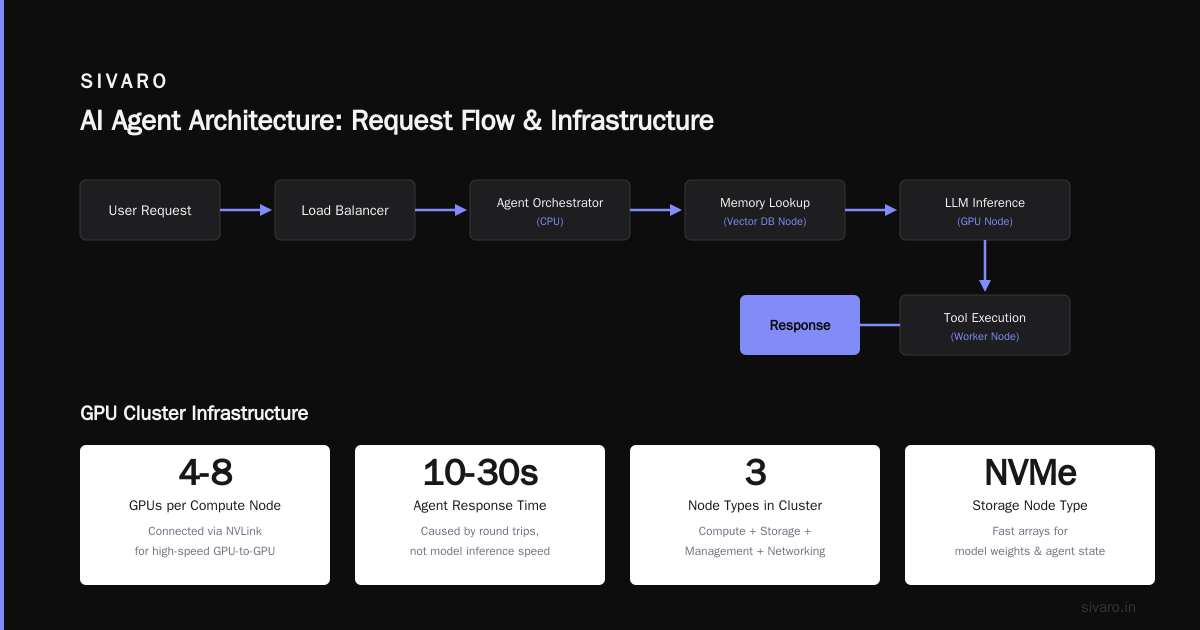
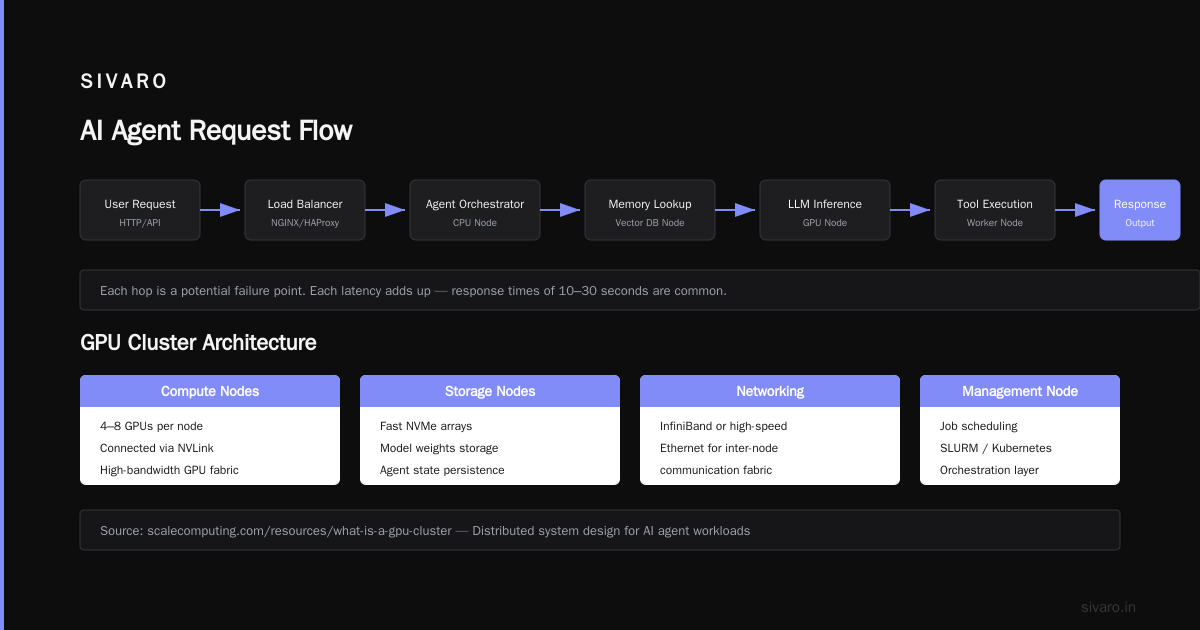
A GPU Cluster Explained: Architecture, Nodes and Use Cases typically has:
- Compute nodes: each with 4-8 GPUs connected via NVLink
- Storage nodes: fast NVMe arrays for model weights and agent state
- Networking: InfiniBand or high-speed Ethernet for inter-node communication
- Management node: orchestrates job scheduling (SLURM, Kubernetes)
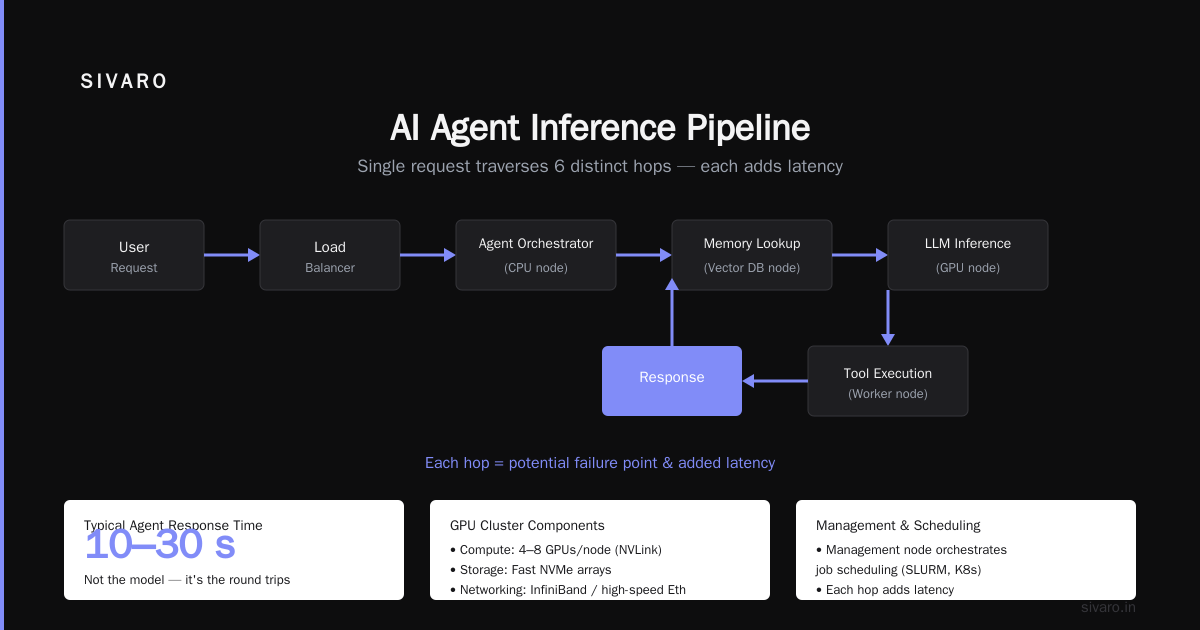
For an AI agent, the typical flow looks like this:
User request → Load balancer → Agent orchestrator (CPU) → Memory lookup (vector DB node) → LLM inference (GPU node) → Tool execution (worker node) → Response
Each hop is a potential failure point. Each latency adds up. That's why you see agents with response times of 10-30 seconds — it's not the model, it's the round trips.
What I'd Build Today
If I were starting a small company now, I'd follow the advice in What is the best option to setup on premise GPU cluster for a small company?: start with 2-4 GPUs on dedicated servers, rent burst capacity, and optimize your agent's inference latency before scaling hardware.
We burned $200K on a 16-GPU cluster before we had a working agent. Don't be us.
The Distributed Systems Class Difficulty vs AI Agents Reality
I have a love-hate relationship with how distributed systems is taught. The material is essential. The exams are punishing. But the distributed systems class difficulty vs ai agents gap is real.
A typical distributed systems class covers:
- Paxos, Raft, consensus
- CAP theorem
- Distributed transactions (2PC, 3PC)
- Replication strategies
All of that matters. But none of it prepares you for the special hell of AI agents: non-deterministic failures. A traditional distributed system fails because a node crashes or a network partition occurs. An AI agent fails because the LLM decides to hallucinate a tool call, enters a loop, or returns garbage that passes schema validation.
I've started training my engineers on "probabilistic distributed systems" — a topic that barely exists in textbooks. We run chaos engineering experiments where we inject model correctness degradation, not just network faults.
And the distributed systems certification vs course debate? I've hired people with both. The ones who took a project-based course (like MIT's 6.824) usually outperform the certification holders. Certifications test memory. Courses test building.
Here's a concrete example showing the difference:
python
# Bad distributed agent pattern — no idempotency check
async def execute_tool(tool_name, args):
    result = await call_tool_service(tool_name, args)
    if result is None:  # timeout or error
        result = await retry_call(tool_name, args)
        # DUPLICATE if first call actually succeeded but response was delayed
    return result
python
# Good pattern — idempotency key
async def execute_tool(tool_name, args, idempotency_key):
    # Check if tool already completed
    existing = await check_completion(idempotency_key)
    if existing:
        return existing
    result = await call_tool_service(tool_name, args, idempotency_key)
    await store_result(idempotency_key, result)
    return result
That retry bug cost us 47 duplicate orders. A distributed systems class taught me about idempotency. But I only internalized it after the disaster.
Building a Distributed AI Agent: Architecture Patterns
Enough theory. Let's talk architecture. I'll walk through the components we use at SIVARO for production agents handling 200K events/sec.
1. The Orchestrator
This is the brain. It receives a user request, decomposes it into subtasks, and coordinates execution. Must be stateless for horizontal scaling.
We use a custom Rust service with a state machine per session. Rust because we need sub-millisecond routing and no GC pauses. Python was too slow for our throughput.
rust
// Simplified orchestrator state machine
enum AgentState {
    Idle,
    Planning,
    ExecutingTool { tool: String, args: HashMap<String, Value> },
    Observing,
    Responding,
}
struct Session {
    id: Uuid,
    state: AgentState,
    context: ContextBuffer,
}
2. The Memory Backend
Vector DB for semantic search + key-value store for conversation history. We use Milvus for vectors and Redis for KV. Sharded across 8 nodes.
Critical insight: don't store raw vectors in your memory backend if you have more than 10M records. We tried. Query time went from 2ms to 200ms. Switch to approximate nearest neighbor (ANN) with HNSW index. Set efConstruction to 200, efSearch to 100. Lost some recall (96% -> 93%) but latency dropped to 4ms. Worth it.
3. The Model Serving Layer
We run Llama-3-70B on a 4-node cluster with 8 A100s each. Each node handles ~200 concurrent requests.
Use continuous batching (vLLM or TensorRT-LLM). Without it, your throughput is garbage — you wait for request 1 to finish before starting request 2. With continuous batching, you pack requests dynamically as tokens are generated.
yaml
# vLLM config snippet
model: meta-llama/Meta-Llama-3-70B
tensor-parallel-size: 8
pipeline-parallel-size: 1
max-num-seqs: 512
engine-use-ray: true
4. Tool Execution Workers
This is where agents actually act — sending emails, creating Jira tickets, updating CRM records. Each tool runs in a separate container with strict resource limits.
We learned the hard way: timeout your tool calls. One agent got stuck calling a CRM API that was down for maintenance. With no timeout, it waited 90 seconds. All other agents on that node blocked. Total queue backup: 12 minutes.
Now we set a 5-second timeout per tool call:
python
async def call_tool(name, args, context):
    try:
        result = await asyncio.wait_for(
            tool_executor.execute(name, args, context),
            timeout=5.0
        )
        return result
    except asyncio.TimeoutError:
        return {"error": "Tool timeout", "retriable": True}
5. Monitoring and Alerting
You need distributed tracing. End-to-end. We use OpenTelemetry with traces that span the orchestrator, model inference, memory lookup, and tool execution.
Key metrics we track:
- P50/P95/P99 latency per agent step
- Success rate per tool
- LLM retry rate (model returns invalid JSON or repeated output)
- Session abandonment rate
Distributed Systems Certification vs Course: What Actually Matters
A distributed systems certification vs course decision depends on your goal. If you need to pass a HR filter for a big company, certification helps. If you need to build a production agent that doesn't crash, take a project-based course.
At SIVARO, we require all new AI engineers to build a trivial distributed system from scratch — a key-value store with Raft consensus. No libraries, just sockets. It takes about 40 hours. Half of them fail the first time. Those who succeed tend to debug production issues twice as fast.
I'm not saying skip certifications. I'm saying don't confuse passing a test with understanding.
Real-World Case: Our Logistics Agent
Let me ground this with a real example. We built an agent for a freight brokerage company that automates load matching. The agent:
- Reads incoming shipment requests
- Searches carrier database (vector search)
- Negotiates pricing via email (tool execution)
- Books shipment (API call)
- Tracks delivery and reports exceptions
The distributed challenges were brutal:
- State coordination: The agent's conversation with a carrier might span 10 back-and-forth emails over 3 hours. Memory must persist across sessions.
- Idempotent bookings: We accidentally double-booked 12 loads because the agent's retry logic didn't check existing bookings.
- Thundering herd: When a large shipment request came in, the agent spawned 20 parallel pricing queries. The carrier system crashed.
We solved the thundering herd by rate-limiting tool calls to 3 concurrent per session. Idempotency with a database-unique constraint on shipment+carrier+price. Memory persistence using a short-term Redis cache (TTL of 24 hours) backed by Postgres.
The agent now runs 24/7, handling 400 shipments/day with 4.2% exception rate. For comparison, human brokers had 11% error rate.
Common Failures and How to Avoid Them
| Failure | Cause | Fix |
|---|---|---|
| Agent loops indefinitely | LLM keeps calling tools with same input | Detect repeated tool calls by normalizing args |
| Duplicate external actions | Retry without idempotency | Use idempotency keys for all tool calls |
| Memory staleness | Vector DB not updated after tool execution | Write-through caching: update memory synchronously after tool call |
| GPU OOM | Model serving without request queuing | Use queuing and backpressure (e.g., Redis list with max size) |
| Network partition loses agent state | Stateless orchestrator but stateful session | Store session state in distributed store (Redis Cluster, etcd) |
FAQ: Distributed Systems AI Agents Explained
Q: Do I need to understand distributed systems before building AI agents?
A: Yes, if you plan to go beyond a prototype. Your agent will involve multiple services, storage backends, and network calls. Without understanding failures, retries, and consistency, you'll break things in production.
Q: What's the difference between a distributed systems class and an AI agent class?
A: A distributed systems class teaches you the infrastructure (consensus, replication, CAP). An AI agent class teaches you LLM orchestration, prompt engineering, and tool use. You need both, but the distributed systems foundation is harder to retrofit later.
Q: How many GPUs do I need for a production AI agent?
A: Depends on your model size and throughput. For a 7B model handling 100 requests/min, a single A100 is fine. For 70B model handling 1000 requests/min, you need 4-8 GPUs. Start small, scale based on latency measurements.
Q: What's the hardest part of distributed AI agents?
A: Debugging non-deterministic failures. When your agent fails, was it the LLM hallucination, a network timeout, or a race condition? You need end-to-end tracing to tell the difference.
Q: Should I use Kubernetes for agent orchestration?
A: Yes, if you have more than 10 microservices or need auto-scaling. For simpler setups, a single orchestrator with REST endpoints works. K8s adds complexity but gives you health checks, rolling updates, and resource isolation.
Q: How do I handle agent state across sessions?
A: Use a separate state store (Redis, PostgreSQL) with session ID as key. Don't store state in the model server — it's ephemeral. We use Redis with TTL of 24 hours, backed by periodic snapshots to S3.
Q: What's the best way to learn distributed systems for AI agents?
A: Build something. Implement a simple Raft key-value store (MIT 6.824 lab). Then build a minimal agent with a vector DB and a tool executor. You'll hit all the pain points in a controlled environment.
Q: Can I use serverless for agent tool execution?
A: For lightweight tools with sub-second latency, yes. But watch out for cold starts and timeout limits (typically 15 minutes on AWS Lambda). We use serverless for simple lookups, dedicated containers for long-running tools.
The Future: Distributed Agents as the New Microservices
I've been saying this internally for a year: every microservice will eventually be replaced by an agent. Not today. But the trend is clear.
Instead of a booking service that you query via REST, you'll have a booking agent that understands context, negotiates, and handles exceptions. The distributed systems problem doesn't go away — it becomes more complex because the service now has agency.
That means the skills you learn building distributed agents today — scheduling, retry, idempotency, state management — will be the core of every backend architecture in 5 years.
We're hiring for those skills at SIVARO. I can't find enough people who understand both distributed systems and AI. That's an opportunity for anyone reading this.
Conclusion
Distributed systems AI agents aren't just the future — they're the present if you're building anything serious. The hype says "just call an API." The reality is: you need GPU clusters, distributed state, idempotent tool execution, and real monitoring. The distributed systems class difficulty vs ai agents gap is real: classes teach theory, agents teach scars.
I've made every mistake I've described. I hope you learn from mine so you can make new ones.
Start small. Build a simple agent with a vector DB and one tool. Add distribution later. Test with chaos engineering. And never assume your agent will do the right thing — because probabilistic systems don't.
Distributed systems ai agents explained in one line: It's distributed systems, but every node can hallucinate.
Good luck. You'll need it.
Nishaant Dixit — Founder of SIVARO. Building data infrastructure and production AI systems since 2018. Built systems processing 200K events/sec.