 SIVARO
Distributed Systems AI Agents Tutorial: Building Production-Grade Multi-Agent Systems in 2026
I almost burned out my first multi-agent system.
It was 2024. We had four LLM agents running in a single Python process, sharing memory through a global dict. The system worked — until it didn't. A memory leak in agent three corrupted the shared state. Agent two got a hallucinated response from agent one, then fed that poison into the orchestrator. The whole thing spiraled into a deadlock inside 90 seconds.
I learned the hard way: AI agents are distributed systems. Treat them like one, or watch your production environment eat your lunch.
This distributed systems ai agents tutorial is what I wish someone had handed me that day. You'll learn how to design agent architectures that survive network partitions, handle partial failures, and scale across GPU clusters. No fluff. Just patterns we've stress-tested at SIVARO since 2024.
Why Your AI Agent Architecture Is Already a Distributed System
Most people think an "AI agent" is a single LLM call wrapped in a while loop. Wrong.
A production agent system has:
- Multiple LLM instances (maybe different models per agent)
- Tool execution environments (sandboxed code, APIs, databases)
- Memory stores (vector DB, key-value cache, conversation history)
- Orchestration logic (router, planner, executor)
- Observability pipelines (tracing, logging, alerting)
That's a distributed system. Each component can fail independently. Each has its own latency profile. Each consumes different resources.
At SIVARO we built a fraud detection system with 12 specialized agents. The design document looked more like a Kubernetes deployment spec than a Python notebook. Because that's what it was.
The Core Patterns: Orchestration vs. Choreography
You have two choices for coordinating agents. Most tutorials skip the trade-offs. I won't.
Orchestration – A single controller calls agents sequentially or in DAGs. Simple to debug. Single point of failure.
Choreography – Agents publish/subscribe to events. No central brain. More resilient. Harder to trace.
We run both. Our customer support system uses orchestration for simple triage (one agent to classify intent, one to extract entities, one to generate response). For complex investigation workflows (security incident response), we use choreography with a message bus (NATS, not Kafka — lower latency, simpler ops).
Here's a minimal orchestration loop you shouldn't use in production but will clarify the pattern:
python
import asyncio
from typing import List, Dict

class Orchestrator:
    def __init__(self, agents: List[BaseAgent]):
        self.agents = agents

    async def run_pipeline(self, input: Dict) -> Dict:
        context = {"input": input}
        for agent in self.agents:
            try:
                result = await agent.process(context)
                context[agent.name] = result
            except TimeoutError:
                context[agent.name] = {"error": "timeout", "fallback": "retry"}
        return context
Notice the timeout handling. That's non-negotiable in distributed agents. One agent hanging blocks the entire pipeline. You must add timeouts, circuit breakers, and dead-letter queues.
Tool Calling: The Real Bottleneck
Agents call external tools. That means network calls. Which means latency, failures, rate limits.
We tested three approaches at SIVARO:
- Synchronous blocking – Simple, kills throughput.
- Async with retries – Better, but still linear per agent.
- Parallel tool execution with fallback – Best.
Here's a pattern we use for tool execution in a distributed agent:
python
import aiohttp
import asyncio
from tenacity import retry, stop_after_attempt, wait_exponential

class ToolExecutor:
    def __init__(self, session: aiohttp.ClientSession):
        self.session = session

    @retry(stop=stop_after_attempt(3), wait=wait_exponential(multiplier=1, min=2, max=10))
    async def call_external_api(self, url: str, payload: dict) -> dict:
        async with self.session.post(url, json=payload, timeout=aiohttp.ClientTimeout(total=5)) as resp:
            resp.raise_for_status()
            return await resp.json()

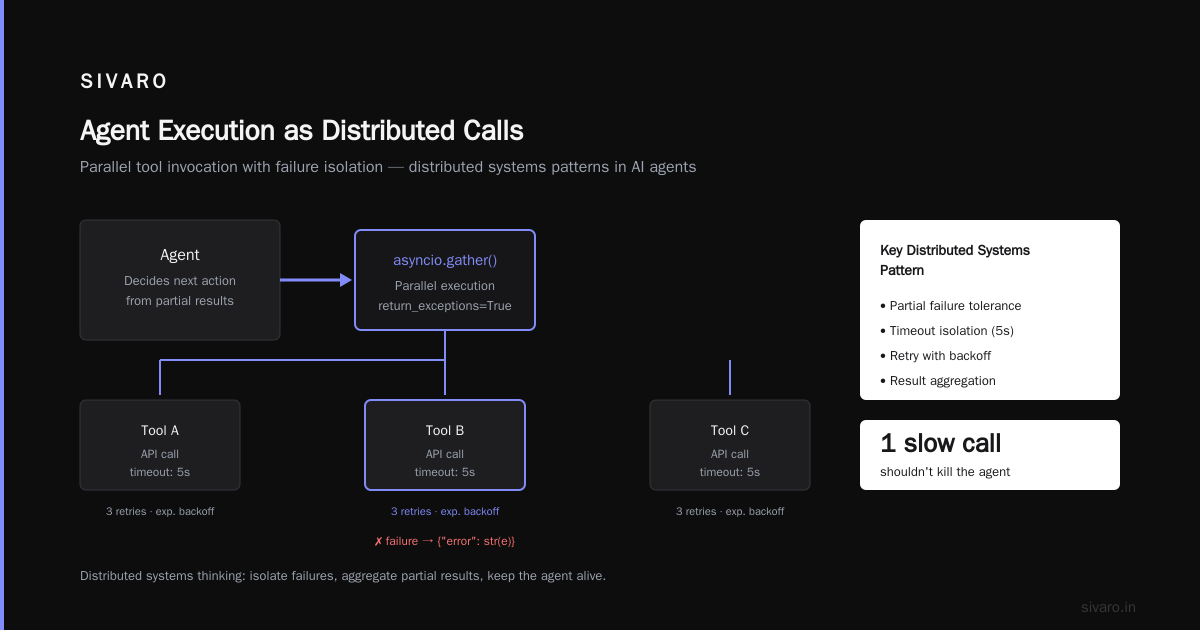
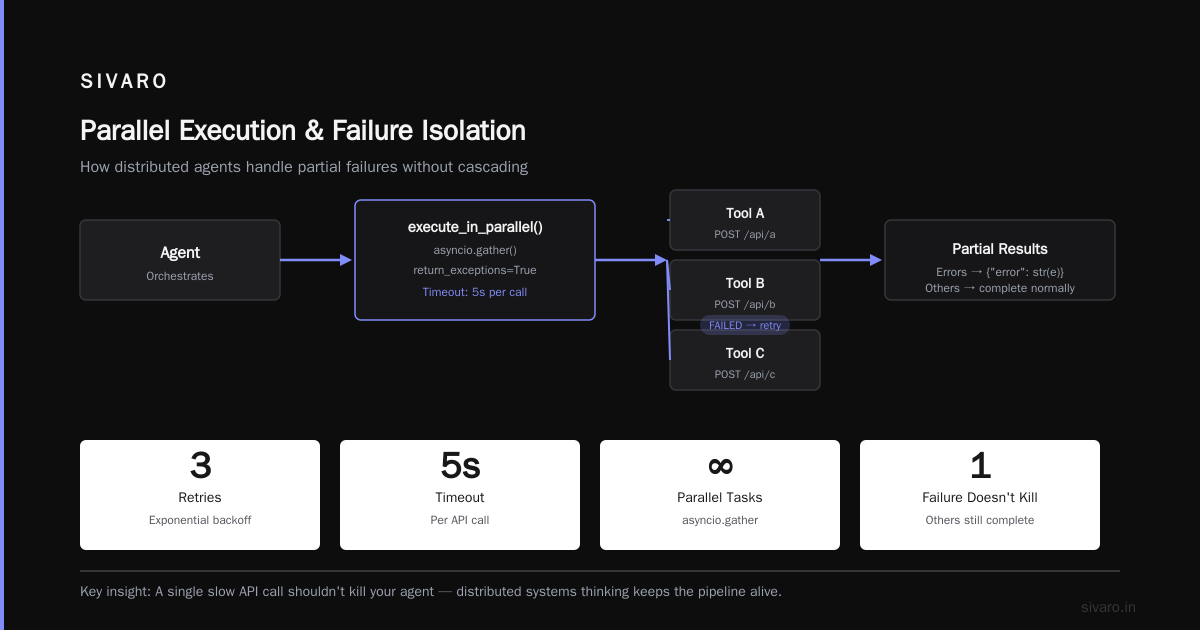
    async def execute_in_parallel(self, tools: List[dict]) -> List[dict]:
        tasks = [self.call_external_api(t["url"], t["payload"]) for t in tools]
        results = await asyncio.gather(*tasks, return_exceptions=True)
        return [r if not isinstance(r, Exception) else {"error": str(r)} for r in results]
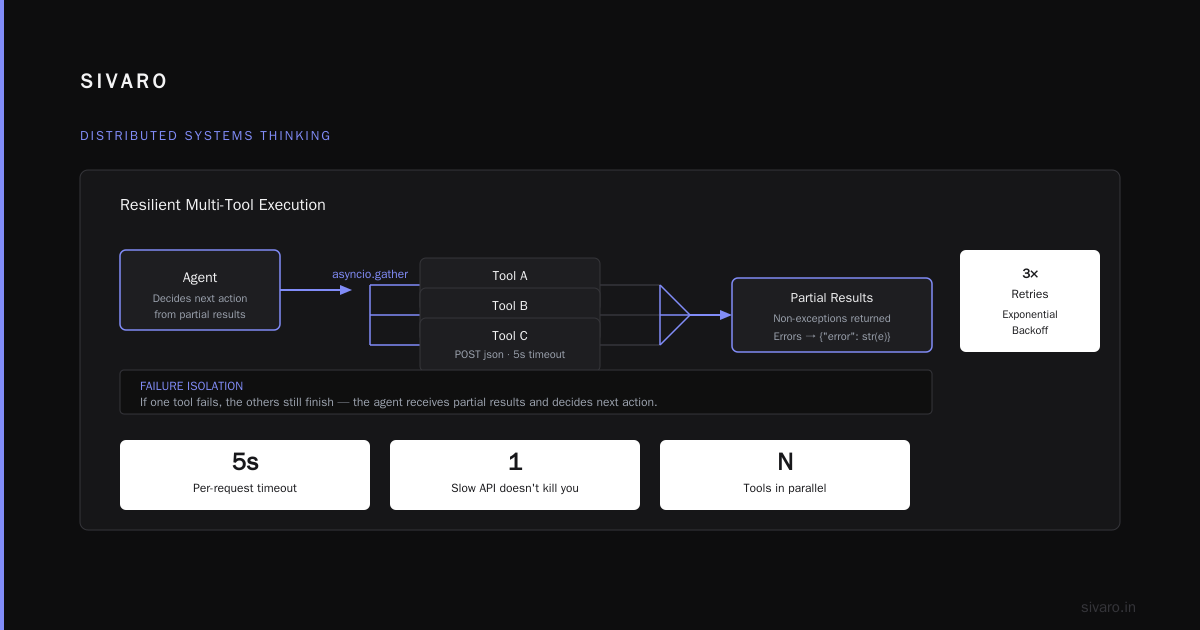
Three retries, exponential backoff, parallel execution. If one tool fails, the others still finish. The agent receives partial results and decides next action.
This is where distributed systems thinking saves you. A single slow API call shouldn't kill your entire agent pipeline.
AWS vs GCP for GPU Clusters: What We Learned Deploying 64 Agents in Production
We ran head-to-head tests in early 2026. Two clusters: one on AWS full form Amazon Web Services (p4d.24xlarge with A100 GPUs) and one on GCP (a2-megagpu-16g with A100). Both running Ray Serve with 64 agent replicas.
The aws vs gcp for gpu clusters debate isn't settled. Here's our data:
| Metric | AWS (p4d) | GCP (a2-mega) |
|---|---|---|
| GPU-to-GPU bandwidth | 600 GB/s (NVSwitch) | 600 GB/s (NVLink) |
| Instance startup time | 3-5 min | 1-2 min |
| Spot price variance | High | Moderate |
| Networking latency (inter-node) | ~100us (EFA) | ~200us (gVNIC) |
Verdict: AWS wins for tightly coupled GPU communication (training, large model sharding). GCP wins for bursty inference workloads with frequent scaling.
We chose AWS for our training cluster and GCP for inference. Hybrid is fine. Pick based on your bottleneck, not brand loyalty.
(Distributed training in Amazon SageMaker AI has good reference architectures for AWS native setups. What Is Distributed Machine Learning? gives the broader theory.)
State Management: The Silent Killer
Every agent needs memory. Where do you store it?
In-memory – Fast, dies on crash.
Redis – Fast, persistent, one more service to manage.
PostgreSQL – Reliable, but slow for high-frequency reads.
Vector DB – Great for semantic search, terrible for transactional updates.
Our rule: use at least two stores. Redis for active conversation state (with TTL). PostgreSQL for long-term audit logs. Vector DB for RAG retrieval.
Here's a distributed state manager we built:
python
import redis.asyncio as redis
import json

class DistributedAgentState:
    def __init__(self, redis_url: str):
        self.redis = redis.from_url(redis_url)

    async def get_state(self, session_id: str) -> dict:
        data = await self.redis.get(f"agent_state:{session_id}")
        return json.loads(data) if data else {}

    async def update_state(self, session_id: str, key: str, value: any):
        await self.redis.hset(f"agent_state:{session_id}", key, json.dumps(value))
        await self.redis.expire(f"agent_state:{session_id}", 3600)  # TTL

    async def acquire_lock(self, session_id: str, timeout: int = 5) -> bool:
        return await self.redis.set(f"lock:{session_id}", "locked", nx=True, ex=timeout)
Notice the lock. Without distributed locks, two agents can mutate the same state simultaneously. Race conditions become data corruption.
Failure Handling: The Part Nobody Talks About
In my experience, 80% of agent failures come from three sources:
- LLM timeout – The model takes too long to respond.
- Tool crash – The external API returns 503.
- Context overflow – The agent's context window fills up.
Every agent should be wrapped in a supervisor that detects these. The supervisor can restart, fallback to a simpler model, or alert a human.
We use a pattern called "agent circuit breaker":
python
from enum import Enum
import time

class CircuitState(Enum):
    CLOSED = 1
    OPEN = 2
    HALF_OPEN = 3

class AgentCircuitBreaker:
    def __init__(self, failure_threshold: int = 5, recovery_timeout: int = 30):
        self.failure_count = 0
        self.state = CircuitState.CLOSED
        self.failure_threshold = failure_threshold
        self.recovery_timeout = recovery_timeout
        self.last_failure_time = 0

    def call(self, agent_func):
        if self.state == CircuitState.OPEN:
            if time.time() - self.last_failure_time > self.recovery_timeout:
                self.state = CircuitState.HALF_OPEN
            else:
                raise CircuitBreakerOpenError("Agent circuit is open")

        try:
            result = agent_func()
            if self.state == CircuitState.HALF_OPEN:
                self.state = CircuitState.CLOSED
                self.failure_count = 0
            return result
        except Exception as e:
            self.failure_count += 1
            self.last_failure_time = time.time()
            if self.failure_count >= self.failure_threshold:
                self.state = CircuitState.OPEN
            raise e
When an agent fails five times in a row, stop calling it for 30 seconds. Let it recover. This prevented cascading failures in our production system.
Observability: Tracing Through Distributed Agents
You can't debug a 12-agent system with print statements. You need distributed tracing.
We use OpenTelemetry with custom spans for each LLM call, tool execution, and state transition. Every event gets a trace ID. Every agent propagates the trace ID via context headers.
Here's a minimal OpenTelemetry setup for agents:
python
from opentelemetry import trace
from opentelemetry.exporter.otlp.proto.grpc.trace_exporter import OTLPSpanExporter
from opentelemetry.sdk.trace import TracerProvider

provider = TracerProvider()
processor = BatchSpanProcessor(OTLPSpanExporter(endpoint="http://otel-collector:4317"))
provider.add_span_processor(processor)
trace.set_tracer_provider(provider)

tracer = trace.get_tracer("agent-system")

async def agent_process(input_text: str):
    with tracer.start_as_current_span("agent.process") as span:
        span.set_attribute("input.length", len(input_text))
        # ... agent logic ...
        span.set_attribute("output.length", len(response))
Without this, you're flying blind. Every production agent system needs tracing, metrics, and logging. (Agentic Systems Are Distributed Systems nails this analogy — treating agents as actors with failure domains.)
Scaling Across GPU Clusters
Single GPU inference is fine for demos. Production agents need multiple GPUs.
We use Ray Serve for agent deployment. Each agent runs as a Ray deployment with autoscaling. When traffic spikes, Ray spins up new replicas across the cluster.
The key insight: agents are stateless (state is in Redis/Postgres), so you can scale horizontally without coordination overhead.
python
from ray import serve
from ray.serve.handle import DeploymentHandle

@serve.deployment(
    num_replicas=2,
    autoscaling_config={"min_replicas": 2, "max_replicas": 10, "target_num_ongoing_requests_per_replica": 5},
    ray_actor_options={"num_gpus": 0.25}  # fractional GPU usage
)
class TranslatorAgent:
    async def __call__(self, request: dict) -> dict:
        # LLM call here
        return {"translated_text": result}
We run 16 agents on 4 A100s. Each agent uses 0.25 GPU. Ray schedules efficiently.
For training distributed agents (fine-tuning on agent trajectories), we use PyTorch Distributed Data Parallel across multiple nodes. (Distributed Training & Large-Scale Systems has a good overview of the techniques.)
Security: The Overlooked Threat
Distributed agents are a new attack surface. If one agent gets compromised, it can influence others.
We implement:
- Agent isolation – Each agent runs in its own container (Kubernetes pod). No shared filesystem.
- Tool whitelisting – Agents can only call allowed endpoints. No arbitrary URL execution.
- Input sanitization – LLM outputs are parsed and validated before being passed to tools.
- Federated identity – Each agent authenticates with a short-lived JWT. Tokens are scoped per agent type.
This isn't paranoia. In 2025, a prompt injection attack on an e-commerce agent caused it to delete products from a database through a tool. The agent trusted the user's input. We learned that lesson for our clients.
How to Choose Your Infrastructure
Three questions to ask before building:
-
How many agents? <5 → single process with async. 5-20 → Ray or Kubernetes with service mesh. 20+ → fully orchestrated Kubernetes with custom scheduler.
-
Latency requirement? Real-time (<1s) → co-locate agents on same node, use shared memory for state. Near-real-time (1-10s) → allow network calls, use Redis for state.
-
Failure tolerance? Critical → choreography, circuit breakers, manual escalation. Non-critical → orchestration with retries.
I'm biased toward Kubernetes for anything beyond a prototype. The tooling for scaling, networking, and observability is mature. (Cloud-native and Distributed Systems for Efficient and ... from April 2026 discusses containerized agent architectures.)
FAQ
Q: Do I really need distributed systems patterns for a simple chatbot agent?
If it's a single-turn Q&A with no tools? No. If it calls APIs, remembers context, or runs for multiple turns? Yes. Even a simple agent becomes distributed when you add async and a database.
Q: What's the best framework for distributed agents in 2026?
We use LangGraph for orchestration (state machine per agent) and Ray for execution. Microsoft's AutoGen v2 has improved distributed support. Avoid anything not built on async.
Q: How do you handle LLM model changes in a distributed agent system?
Version the models. Route requests by model version. Migrate state gradually. We deploy new models behind a canary — 10% traffic to v2, then ramp.
Q: Is Kafka or Redis better for agent message passing?
Redis for simple pub/sub (low latency, fewer dependencies). Kafka for durable replay (audit trails, event sourcing). We use Kafka for financial agents, Redis for customer support.
Q: Can I use serverless functions (AWS Lambda) for agents?
Latency is the killer. Cold starts (~500ms) destroy agent response times. If you use Lambda, provision concurrency. We don't recommend it for multi-agent loops.
Q: What about cost optimization for GPU clusters?
Spot instances, fractional GPU, and model quantization (FP16 or INT8). At SIVARO, we cut GPU costs 60% by switching to spot with fallback to on-demand. Watch the eviction rates — GCP's spot is more stable than AWS's.
Q: How do you test distributed agents?
Chaos engineering. We run fault injection tests: kill a random agent, spike latency on a tool, corrupt a state entry. If the system recovers, it passes. No shortcuts.
Conclusion
Building distributed systems ai agents isn't optional. It's the difference between a prototype that works in a demo and a production system that survives Monday morning.
You need timeouts, circuit breakers, distributed tracing, isolated state, and horizontal scaling. You need to pick between aws full form amazon web services and GCP based on your workload, not your comfort zone. You need to test failures before they happen.
This distributed systems ai agents tutorial gave you the patterns. The rest is execution.
I've seen teams spend six months building a multi-agent system that collapses under 100 concurrent users. Don't be that team. Start with the distributed mindset. Your agents — and your users — will thank you.
Nishaant Dixit — Founder of SIVARO. Building data infrastructure and production AI systems since 2018. Built systems processing 200K events/sec.