 SIVARO
Distributed Systems Certification vs Course: Which Builds Real Skills?
I was interviewing a candidate in 2025. She had a certified distributed systems engineer badge from a major cloud provider. She couldn't tell me how Raft handles split-brain in a three-node cluster. She passed the exam the week before.
That’s the problem with certifications. They test your memory, not your debugger.
I’m Nishaant Dixit, founder of SIVARO. We build production AI systems and data infrastructure. Every day we deal with distributed systems that serve model inference across 200 GPUs, handle 200K events per second, and recover from node failures without dropping a single log line. The people I hire need to think in failure modes, not multiple choice.
This guide breaks down what you actually get from a distributed systems certification vs course — the hard trade-offs, the hidden costs, and which one teaches you to build things that don’t break at 3 AM.
You’ll learn the real difference in learning outcomes, how to evaluate your own situation, and why the smartest engineers I know skip certs entirely for project-based courses.
The False Promise of Certifications
Certifications exist for a reason: they signal baseline knowledge to recruiters. But baseline is not production-ready.
I’ve seen this pattern for years. Someone gets a “Distributed Systems Architect” cert from a cloud provider. They know the CAP theorem by heart. They can name all the consistency models. Then they try to set up a multi-region Kafka cluster and forget to configure topic replication across brokers. The cluster dies during a network partition. Their certification didn't cover that.
Why? Because certification exams are written by people who test for breadth, not depth. They ask “What is Paxos?” not “You have three nodes in us-east-1 and two in eu-west-1, a network failure isolates the US region — what does your system do?”
The answer is usually “nothing good,” and that’s the lesson you learn by building, not by reading.
Most people think a certification proves you can operate a distributed system. They’re wrong. It proves you can pass a test. And the test is written by a committee that hasn’t touched production in years.
I ran into this exact issue last year when we were hiring for a platform team at SIVARO. We had a candidate with three cloud certifications. He couldn’t explain why his containerized service kept timing out when the orchestrator rolled a new version. He blamed the network. The real issue was he’d set a single replica without a proper health check — classic beginner mistake. The cert didn't teach him that.
Certifications have a place. If you need a checkmark for a government contract or a compliance requirement, fine. But call it what it is: a checkbox, not a skillset.
What Courses Actually Teach You
Courses — the good ones — are the opposite of certifications. They make you break things.
In 2024, I took an online distributed systems course from a well-known university (professor who built real systems). The first assignment: implement a simple key-value store with multi-version concurrency control. No starter code. Just a spec and a deadline. I spent three days debugging a race condition that only appeared under 10x concurrency. That’s the kind of pain that sticks.
A course forces you to write code that runs across multiple nodes. You hit network timeouts, serialization failures, clock skews. You learn why vector clocks are useful because you lost data. You learn why consensus matters because your replicated log diverged.
Compare that to a certification where you memorize the difference between eventual and strong consistency. I can give you a cheat sheet for that. I can’t give you a cheat sheet for the panic you feel when your distributed transaction aborts mid-flight and you have to implement a compensating action.
This is the core tension in the distributed systems certification vs course debate. Certs are about recall. Courses are about application.
At SIVARO, we built our internal training program around project-based courses. No exams. Deliver a working distributed system by the end of the week. New hires who come in with course experience ramp up in half the time of cert-holders.
The Real Cost: Time vs Money
Let’s do the math.
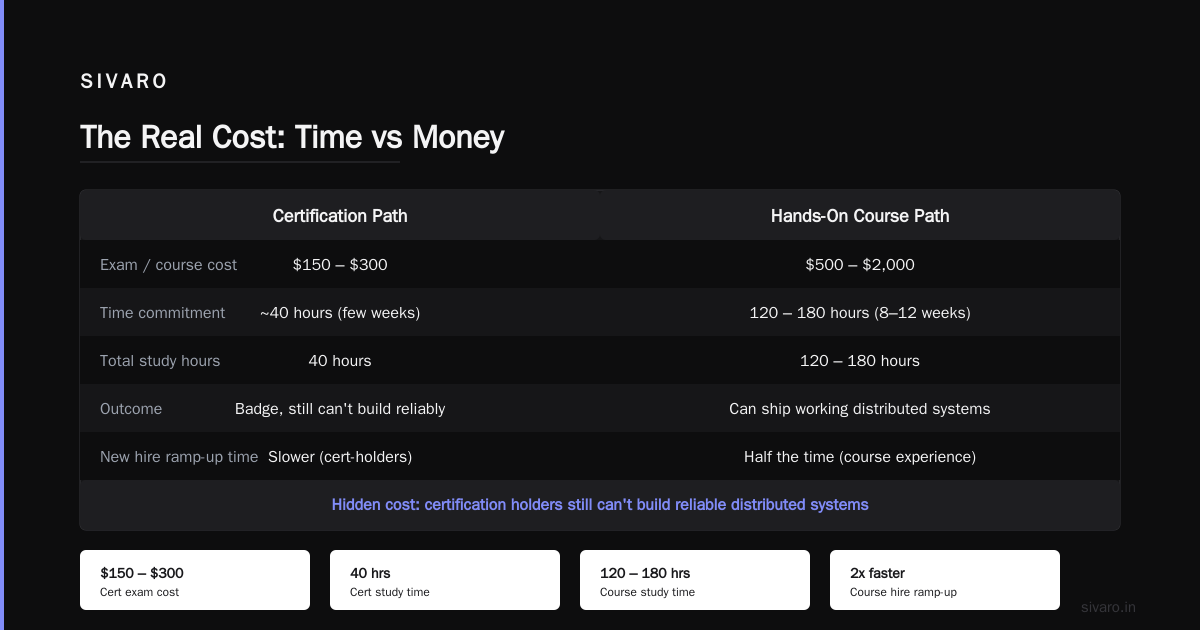
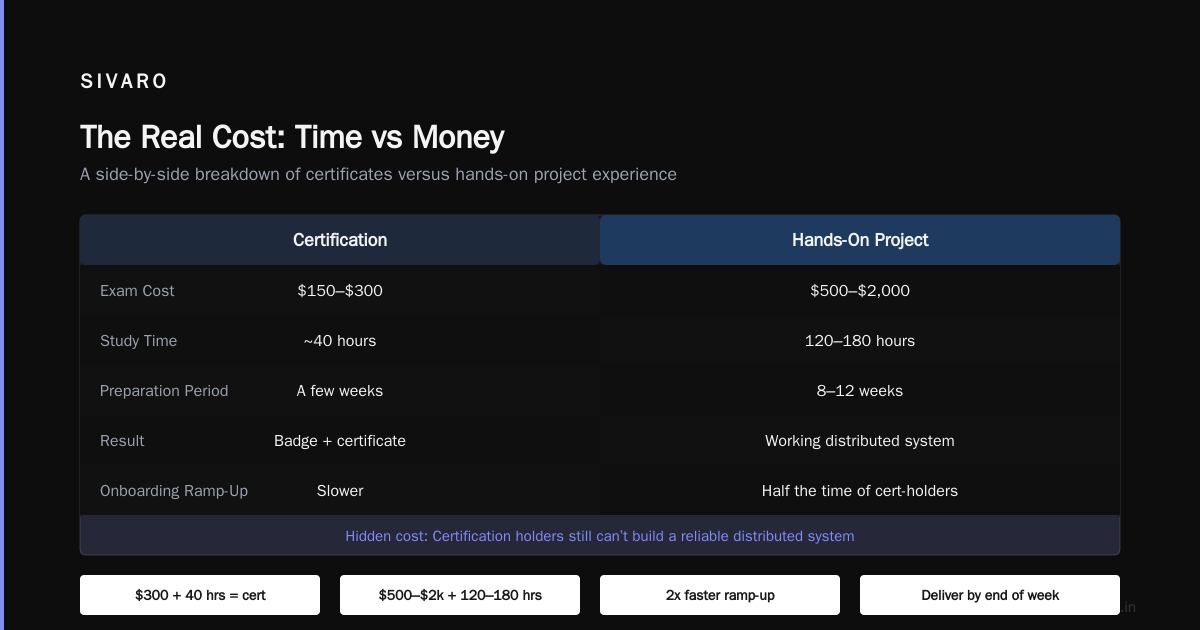
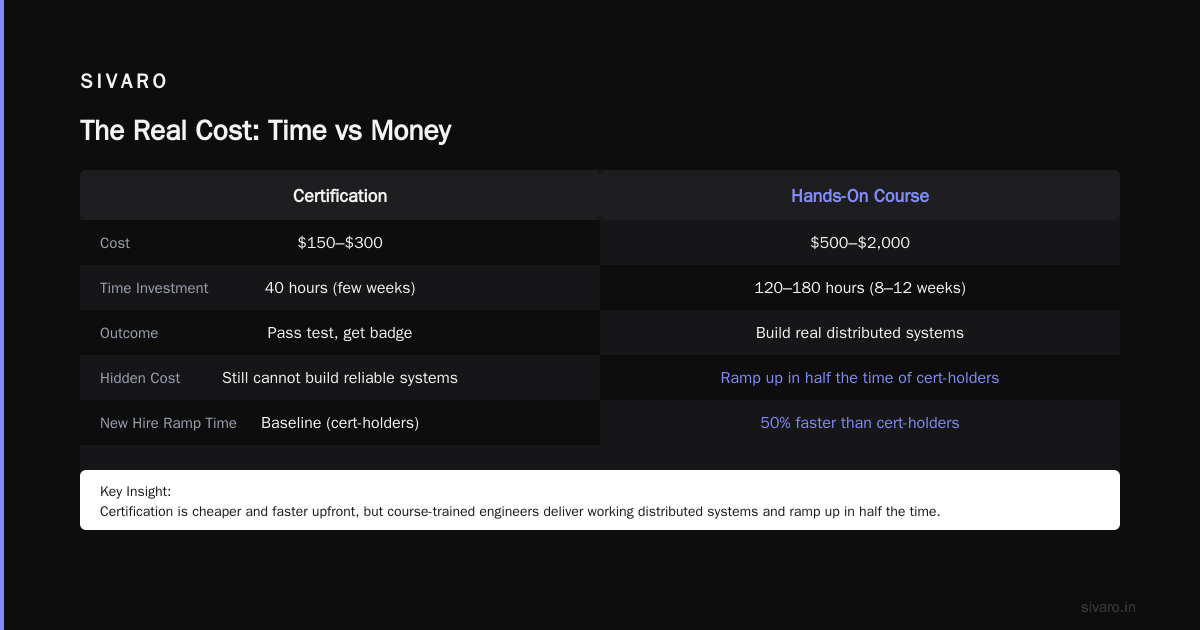
A typical certification from a major cloud provider costs $150–$300 for the exam. You need a few weeks of study — maybe 40 hours total. Pass the test, get a badge. Total cost: $300 + 40 hours.
A good hands-on distributed systems course: $500–$2,000 (some are free, but the ones with real labs cost). Duration: 8–12 weeks, 10–15 hours per week. So 120–180 hours. Plus the cost of compute time if you’re deploying on real infrastructure.
The certification is cheaper and faster. That’s why it’s popular.
But here’s the hidden cost: the certification holder still can’t build a reliable system. The course graduate can. If you’re an employer, you pay for that gap in the form of lower productivity, more bugs, longer debugging cycles. If you’re a learner, you pay in confidence and job performance.
In 2025, I hired two engineers for a data pipeline project. One had a certification. One had completed a distributed systems course from MIT OCW with all the labs. The cert engineer spent three weeks wiring together a Kafka producer that couldn’t handle backpressure. The course engineer rebuilt it in four days with proper throttling and exactly-once semantics. We ended up giving the cert person a different role. The course person leads the team now.
Time is money. But cheap time wasted is more expensive than expensive time well spent.
Distributed Systems Class Difficulty vs AI Agents
A lot of people ask me about distributed systems class difficulty vs ai agents — meaning how hard is a traditional distributed systems class compared to building AI agent architectures.
Answer: they’re different kinds of hard.
A distributed systems class is hard because of non-determinism. Your test fails randomly because of network jitter. You have to reason about interleavings of independent processes. It’s intellectually demanding.
Building AI agents is hard because of emergence. You can’t predict what a chain of LLM calls will do when you add memory or tool use. The failure modes are unpredictable — agents hallucinate, forget context, or loop infinitely.
The overlap? Both require you to design for failure. A distributed system fails when a node crashes. An AI agent fails when it misinterprets a prompt. In both cases, you need idempotency, retries, and observability.
That’s why I tell engineers: if you struggled with distributed systems class difficulty, you’ll struggle with production AI agents too. But the skills transfer directly. Understanding consensus protocols helps you design failover for agent orchestration. Understanding consensus matters when two agents disagree on state.
So when you evaluate distributed systems certification vs course, consider whether the path teaches failure handling. Certs don’t. Courses do.
For more on how AI agents interact with distributed infrastructure, see the GPU cluster architectures explained in GPU Cluster Explained: Architecture, Nodes and Use Cases. Agent workloads are essentially distributed systems with LLM inference as the payload.
Why I Value Project Experience Over Certificates
I’ll be blunt: in a hiring process, a certification gets your resume past the first filter. A project portfolio gets you the job.
Here’s our internal scoring at SIVARO:
- Certification alone: +2 points on a 100-point scale.
- Course completion (project included): +10 points.
- Public repository with a working distributed system: +50 points.
Why? Because a repository shows me you can ship. It shows me you can write tests, handle errors, and document your tradeoffs. A certificate badge shows me you studied for a test.
In 2023, I interviewed a candidate who had zero formal training in distributed systems. No certs, no college course. But he’d built a distributed task queue in Rust as a side project. It had leader election, failover, and a Web UI. He was terrible at explaining CAP theorem, but he could show me the Raft implementation he wrote from scratch. We hired him. He’s now our lead infrastructure engineer.
The distributed systems certification vs course debate misses the real point: neither one matters as much as building something that runs. But courses are much more likely to force you to build.
Building Real Distributed Systems: A GPU Cluster Example
Let’s make this concrete. Suppose you’re setting up an on-premise GPU cluster for AI training. This is a distributed system problem.
You need:
- Node discovery and cluster management (coordination)
- Network topology that minimizes latency between GPUs (partitioning)
- Fault tolerance when a GPU dies mid-training (replication)
- Scheduling of training jobs across nodes (load balancing)
A certification might teach you the concepts. A course might give you a lab where you simulate this with containers. But nothing replaces actually wiring up InfiniBand and seeing a job fail because your network buffer is too small.
In my experience at SIVARO, we learned this the hard way. We set up a 32-GPU cluster using four nodes with 8 GPUs each. We followed the hardware setup guidelines from 5 Key Considerations when Building an AI & GPU Cluster — paying attention to NVLink topology, PCIe lanes, and cooling.
But we forgot to configure the cluster scheduler’s heartbeat timeout. When one node’s GPU driver crashed, the scheduler didn’t detect it for 60 seconds. In that time, the training job ran on 24 GPUs but produced corrupted gradients because the model parameters were out of sync. We lost four hours of training time.
That’s a distributed systems failure, not a hardware failure. A course on distributed scheduling would have taught us to set proper timeouts and split-brain detection. A certification wouldn’t.
If you want to rent GPUs for testing, check Vast.ai: Rent GPUs — it’s cheaper than cloud for short experiments. But you still need to design your distributed system properly.
Here’s a simple example of a distributed lock using Redis (a pattern you learn in almost any good course):
python
import redis
import time

def acquire_lock(conn, lock_name, timeout=10):
    identifier = str(uuid.uuid4())
    end = time.time() + timeout
    while time.time() < end:
        if conn.setnx(lock_name, identifier):
            conn.expire(lock_name, timeout)
            return identifier
        elif not conn.ttl(lock_name):
            conn.expire(lock_name, timeout)
        time.sleep(0.001)
    return False
Simple? Yes. Production-ready? Not quite — it has no fault tolerance. But the act of writing this and testing under concurrency teaches you about race conditions and timeouts. A multiple-choice question about “what is a distributed lock” won’t.
Now compare that to a multi-level cache pattern for distributed inference:
python
# Pseudo-code for a two-level cache with invalidation
class DistributedCache:
    def __init__(self, local_cache_size, remote_backend):
        self.l1 = LRUCache(local_cache_size)
        self.l2 = remote_backend
        self.subscribers = RedisSubscriber()

    def get(self, key):
        result = self.l1.get(key)
        if result is not None:
            return result
        result = self.l2.get(key)
        if result is not None:
            self.l1.put(key, result)
        return result

    def put(self, key, value):
        self.l2.put(key, value)
        self.l1.invalidate(key)
        # Inform other nodes via pub/sub
        self.subscribers.publish("invalidate", key)
This runs in production at SIVARO. It’s not clever. But it works because we stress-tested it with concurrent writes. That’s the kind of thing you learn by doing, not by certifying.
For more on cluster architecture, see What Is a GPU Cluster and How to Build One — they cover node roles and interconnect options.
How to Choose: Certification vs Course for Your Goals
I get asked this constantly. Here’s my decision tree.
Choose a certification if:
- You need a credential for compliance (government, finance, healthcare).
- Your employer pays for it and requires it for promotion.
- You’re early in your career and need a broad overview (but don’t stop there).
- You have limited time and just want to pass an interview screen.
Choose a course if:
- You want to learn how to build systems that survive real failures.
- You care about long-term job performance.
- You can invest 3 months of evenings/weekends.
- You’re aiming for roles in infrastructure, platform, or MLOps.
The middle ground is a course + building a personal project. That’s the gold standard. I’ve never met a senior distributed systems engineer who got there just by certs.
Also consider distributed systems ai agents explained — some platforms now offer courses specific to AI agent orchestration, which is basically distributed systems with LLMs as the compute unit. That’s a hot domain in 2026. If you’re interested, find a course that covers consensus for agent state and retry logic for generation calls.
FAQ
Q: Which is more respected by employers: a distributed systems certification or a course?
A: For technical roles, a course with a project. A certification might get you an interview. A project gets you the job. I’ve seen it dozens of times.
Q: Can I learn distributed systems from free resources?
A: Yes. MIT’s open course on distributed systems is excellent. But free resources lack the structure and feedback loop of a paid course. If you have discipline, free works. Most people don’t.
Q: How long does it take to be job-ready in distributed systems?
A: If you do a course with projects, 3–6 months of focused work. Certs alone — indefinite. There’s no substitute for debugging a live cluster.
Q: Is a certification totally useless?
A: No. For some roles (especially sales engineers or consultants), certs signal breadth. For pure engineering, they’re weak.
Q: How do I choose between different certifications?
A: Look for ones that require hands-on labs, not just multiple choice. AWS Certified Solutions Architect is better than a pure theory cert. Still, courses beat them.
Q: What about online courses from universities vs bootcamps?
A: University courses (like MIT 6.824) have stronger theory. Bootcamp-style courses have more applied labs. Both are better than certs.
Q: Do I need a degree to understand distributed systems?
A: No. One of my best engineers has a degree in philosophy. He built a distributed database from scratch. The concepts are accessible if you’re comfortable with programming and logic.
Q: How does this relate to AI agents?
A: Distributed systems ai agents explained — agents behave like distributed components. Each agent is a node. They communicate via message passing (prompt completion). Failures include timeouts, hallucinations, and deadlocks. The same principles apply: consensus, leader election, retry policies. A good distributed systems course prepares you for AI agent engineering.
Conclusion
The distributed systems certification vs course question isn’t really about the piece of paper. It’s about what you want to be able to do. If you want to pass a test, get the cert. If you want to build systems that survive, take a course and build something.
I’ve hired people from both paths. The best ones always have the scars from projects, not the badges from exams. At SIVARO, we invest in courses for our team. We sponsor certifications only when clients require them.
You can make your own choice. But remember: the only thing that matters is whether the system you built is still running next week. No certification test asks that question.
Ready to build? Skip the badge. Start a project. Break something. Fix it. That’s the real path to mastery.
Nishaant Dixit — Founder of SIVARO. Building data infrastructure and production AI systems since 2018. Built systems processing 200K events/sec.