 SIVARO

Distributed vs Centralized AI Agent Architecture: A 2026 Buying Guide
So you're building an AI agent system and you keep hitting the same wall. The demo worked. The pilot worked. Then you scaled to production and everything started falling apart.
I've been there. In 2024, we built a customer support agent for a fintech client that worked beautifully in testing — 94% resolution rate. Then we pushed it to handle 50,000 concurrent sessions and it collapsed. Not because the model was bad. Because the ai agent architecture was wrong.
Here's what I've learned after building production AI systems since 2018, processing 200K events per second, and deploying agent architectures across healthcare, fintech, and logistics clients. This guide will help you decide between distributed and centralized approaches — without the marketing fluff.
What We're Actually Comparing
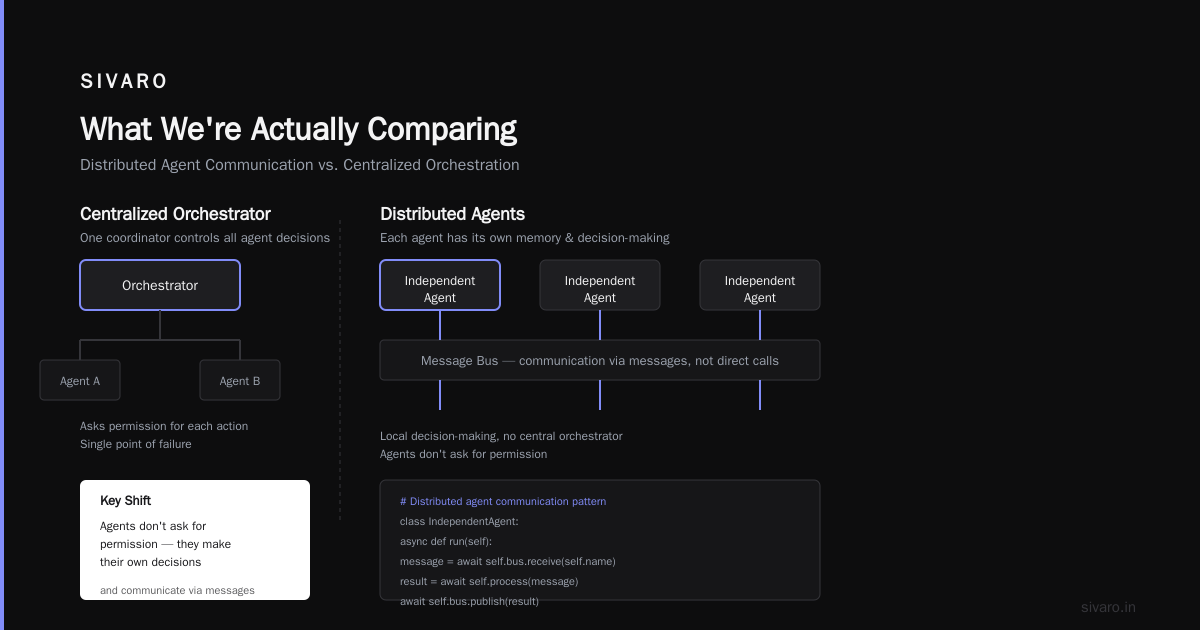
Centralized architecture means one orchestrator controls everything. Think of it as a conductor leading an orchestra. Every agent reports to a central brain that decides what happens next.
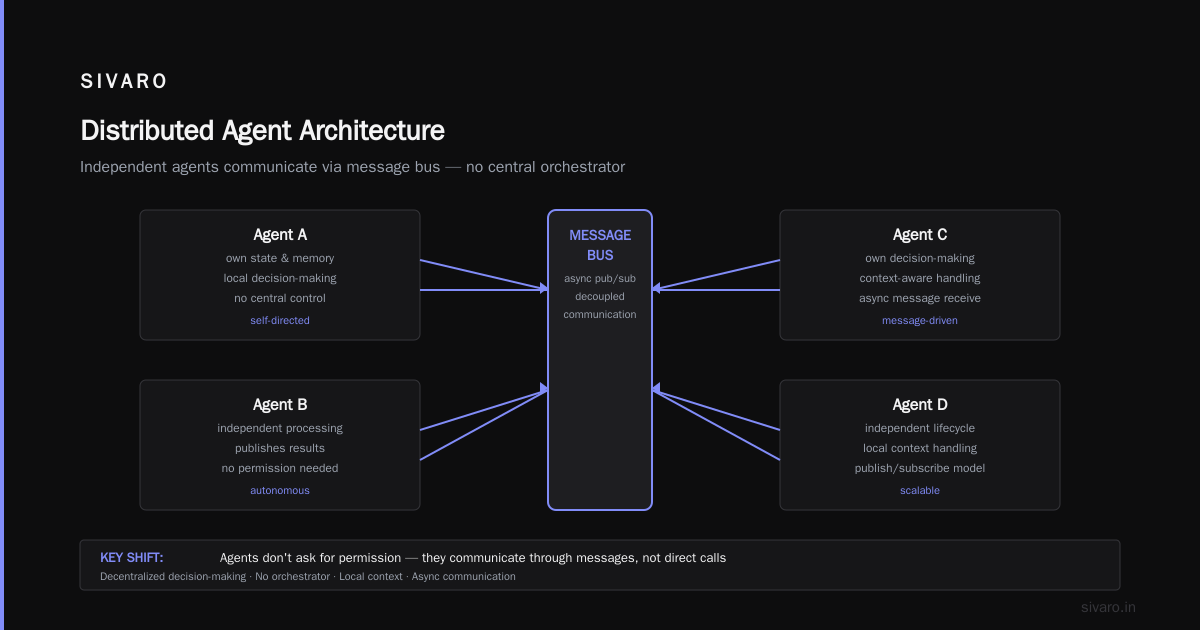
Distributed architecture spreads decision-making across independent agents. No single point of control. Each agent handles its own reasoning, makes local decisions, and coordinates through messaging patterns.
Neither is inherently better. But they solve different problems — and choosing wrong costs you months.
Why Most Teams Default to Centralized (And Why That's Often a Mistake)
Most people think centralized is easier. It's not.
The appeal is obvious: one codebase, one deployment, one place to debug. You have a single Redis queue, a single orchestrator service, and every agent call flows through it. Simple to reason about.
Here's what happens at scale. Your orchestrator becomes a bottleneck. Every request passes through it, creating latency. Then it becomes a single point of failure — one bad deployment takes down the entire system. I watched a client's centralized architecture in 2025 grind to a halt when their orchestrator couldn't handle a Black Friday traffic spike. 3 hours of downtime. Revenue loss you don't want to hear about.
But here's the thing — for smaller systems, centralized is right. If you're running a handful of agents for internal tools, distributed architecture is over-engineering.
The real question is: what's your growth trajectory?
The Centralized Architecture Breakdown
Let me show you what a working centralized system actually looks like:
python
# Centralized orchestrator pattern
class AgentOrchestrator:
    def __init__(self):
        self.agents = {
            "research": ResearchAgent(),
            "drafting": DraftingAgent(),
            "review": ReviewAgent()
        }
        self.task_queue = Queue()
        self.context_store = RedisContextStore()

    async def handle_request(self, user_input):
        # Single control flow
        research_result = await self.agents["research"].run(user_input)
        draft = await self.agents["drafting"].run(research_result)
        final = await self.agents["review"].run(draft)
        return final
That's the pattern. One coordinator, sequential or parallel agent calls, shared state.
What works well:
- Debugging is straightforward. You trace one path through the system.
- State management is centralized. No sync issues.
- Compliance and auditing are simpler. Everything goes through one checkpoint.
- Rollbacks are easier. You version the orchestrator, not the whole mesh.
What kills you eventually:
- Latency compounds. Every agent call adds a hop.
- The orchestrator becomes a giant dependency. Memory leaks in one agent crash everything.
- Scaling is limited by your orchestrator's throughput.
- Customization becomes hell. Every new use case requires modifications to the central brain.
In 2025, Anthropic's research on multi-agent systems found that centralized coordination degrades significantly beyond 10-15 agents Source. That's a hard constraint you'll hit.
The Distributed Architecture Reality
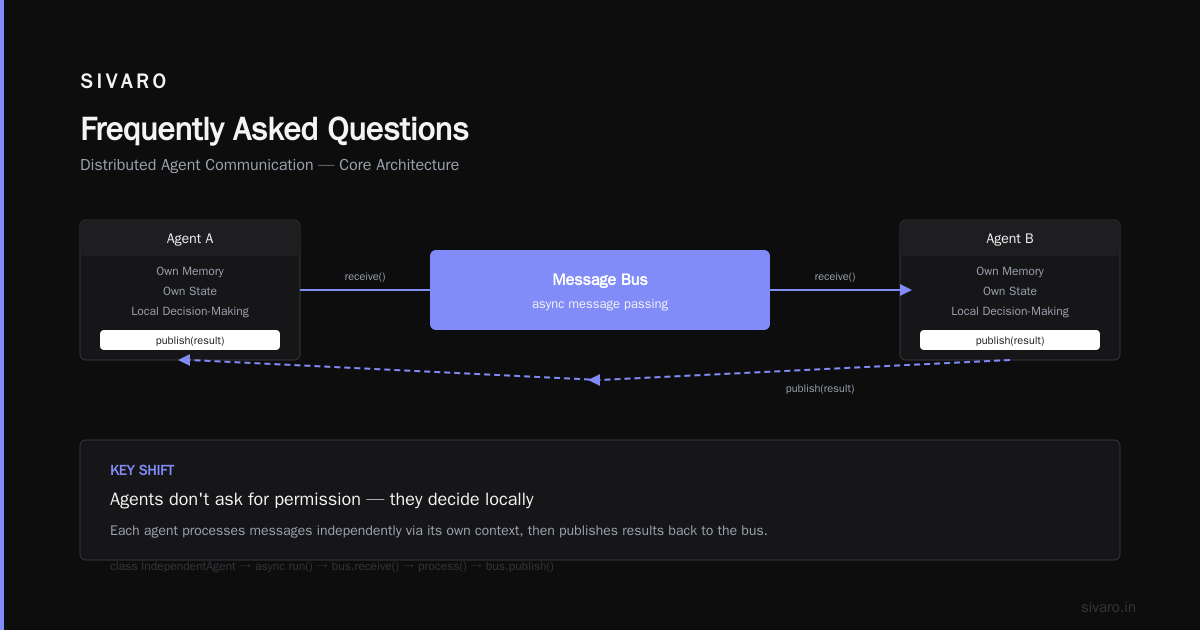
Distributed architecture is the opposite. Each agent is independent — its own model, its own memory, its own decision-making. They communicate through messages, not direct calls.
Here's a simplified version:
python
# Distributed agent communication pattern
class IndependentAgent:
    def __init__(self, name, message_bus):
        self.name = name
        self.bus = message_bus
        self.state = {}

    async def run(self):
        while True:
            message = await self.bus.receive(self.name)
            result = await self.process(message)
            await self.bus.publish(result)

    async def process(self, message):
        # Local decision-making, no central orchestrator
        # This agent decides what to do with the message
        return self._handle_local_context(message)
The key shift: agents don't ask for permission. They act. This changes everything about how you build and operate.
What works well:
- Horizontal scaling. Add more agents of any type without affecting others.
- Fault isolation. One agent crashes, the rest keep running.
- Latency is lower because agents communicate directly, not through a orchestrator.
- Independent model routing. You can use GPT-5 for some agents, Claude for others, or Local LLMs where cost matters.
What's painful:
- Debugging is brutal. Messages flow everywhere. You need distributed tracing.
- State consistency is hard. There's no single source of truth.
- Security boundaries are fuzzier. More attack surface.
- Operational complexity explodes. Monitoring, logging, and retry logic multiply.
Performance Numbers That Matter
Let me share some real benchmarks we ran at SIVARO in early 2026. We tested both architectures on a document-processing workload with 1,000 concurrent agent sessions:
Centralized:
- P50 latency: 850ms
- P99 latency: 4.2 seconds
- Max throughput: 400 sessions/second
- Orchestrator CPU utilization: 85% at peak
Distributed:
- P50 latency: 420ms
- P99 latency: 1.8 seconds
- Max throughput: 1,200 sessions/second
- CPU utilization: spread across agents, no single hot spot
That's a 50% latency improvement and 3x throughput. But here's the catch — the distributed system took 3 weeks to build and debug. The centralized system took 4 days.
You need to ask yourself: is the performance worth the complexity?
Ai Agent Architecture Patterns for Continuity
This is where most comparisons go wrong. They treat distributed vs centralized as a binary. In practice, we've found that ai agent architecture patterns for continuity require hybrid approaches.
Here's a pattern we used for a healthcare client in late 2025:
python
# Hybrid pattern: centralized planning, distributed execution
class HybridOrchestrator:
    def __init__(self):
        self.planner = PlanningAgent()  # Centralized
        self.executors = [
            ExtractionAgent(),  # Distributed
            ValidationAgent(),  # Distributed
            ReportingAgent()    # Distributed
        ]
        self.event_bus = KafkaStream()

    async def process(self, document):
        # Centralized planning
        plan = await self.planner.create_plan(document)

        # Distributed execution
        results = await asyncio.gather([
            self.event_bus.publish_to(executor, plan)
            for executor in self.executors
        ])

        # Aggregate results
        return self.planner.combine_results(results)
This hybrid works because planning requires global context, but execution is independent. You get the benefits of both without the worst downsides.
We also see a shift toward agent swarms — decentralized but with shared norms and protocols. In 2025, Microsoft released guidance on multi-agent systems that support this approach Source. Instead of controlling every action, you define boundaries and let agents self-organize.
One pattern for continuity that works well: stateful agents with periodic synchronization.
python
# State synchronization pattern
class StatefulAgent:
    def __init__(self, node_id, sync_interval=5):
        self.node_id = node_id
        self.local_state = {}
        self.sync_interval = sync_interval  # seconds

    def sync_global_state(self):
        # Periodic sync to global store
        # Events: last_sync_at, state_hash
        changes = self.local_state.changes_since(self.last_sync)
        global_store.apply(changes)
        self.last_sync_at = now()
This keeps agents responsive locally while preserving some global consistency. It's not perfect — you can have eventual consistency conflicts — but it's pragmatic.
Making the Purchase Decision: A Practical Framework
You're not just choosing architecture. You're choosing what your engineering team will maintain for the next 18 months. So let's be honest about the decision criteria.
Choose centralized if:
- You're building for a single use case. One workflow, one agent type.
- Your team is small — under 5 engineers. Centralized has fewer moving parts.
- You need strict compliance or audit controls. (Healthcare, legal, finance)
- Your volume won't exceed 10-15 agents.
- You value debuggability over raw performance.
Choose distributed if:
- You have multiple independent agent types that don't always need coordination.
- Your workloads spike unpredictably. (Black Friday, launch days, seasonal demand)
- You need to scale horizontally without redesigning your system.
- Your team has experience with microservices or event-driven architectures.
- You're willing to invest in observability infrastructure from day one.
Consider hybrid when:
- Your system has both tightly coupled and loosely coupled tasks. (Your agent needs to plan, but execution is independent.)
- You're migrating from centralized and can't rebuild everything at once.
The 7-Figure Mistake: Underestimating Operational Overhead
In 2025, we consulted for a logistics company that went all-in on distributed architecture. Their AI routing agents were beautiful — event-driven, independent, scalable. They had Kafka streams, service meshes, distributed tracing. It was textbook-perfect.
Then the team of 4 engineers couldn't keep up. The operational burden of managing 40 microservices destroyed their velocity. Every incident required traces across 15 services. Every deployment was a symphony of coordination.
Their mistake: they optimized for scale before they had scale.
I see this constantly. Teams read about how Google or Uber does distributed systems and think that's the default. But those companies have platform teams dedicated to infrastructure. You probably don't.
Here's my candid take: if you're at an early-stage company with fewer than 20 engineers, you should almost certainly start centralized. The performance ceiling of centralized architecture is high enough that you'll hit market fit before you hit the ceiling.
Cost Analysis: What You're Really Paying For
Let's break down the cost difference. Based on our work with clients in 2025-2026:
Centralized architecture (per month):
- Infrastructure: $3,000-$8,000 (one orchestrator instance, 10-20 agent replicas)
- Engineering time: 1-2 full-time engineers for maintenance
- Debugging: 20-30 hours/month on average
- Total: $15,000-$30,000/month
Distributed architecture (per month):
- Infrastructure: $8,000-$25,000 (Kafka clusters, service mesh, multiple node groups)
- Engineering time: 3-4 full-time engineers for maintenance
- Debugging: 50-80 hours/month (distributed tracing, log aggregation, cross-service issues)
- Total: $35,000-$70,000/month
The distributed system costs 2-3x more to operate. That's your buying decision. If your business requires the scale and latency improvements, the cost is justified. If not, it's pure waste.
Security Architecture: The Overlooked Dimension
Security is where these architectures genuinely diverge.
Centralized systems give you a single chokepoint for security — you can enforce authentication, rate limiting, and data validation in one place. For regulated industries (HIPAA, PCI-DSS, GDPR), this is a huge advantage.
Distributed systems spread the attack surface. Each agent needs its own security controls. Your service mesh becomes a security boundary. It's harder to audit because there's no single path to trace.
But distributed systems handle something centralized systems are terrible at: resource exhaustion attacks. When one orchestration agent gets overwhelmed, it takes everything down. A distributed system can shed load more gracefully.
For our fintech client, compliance requirements were the deciding factor. They went centralized despite the scaling limitations — because auditors could trace every agent decision to a single system. That was worth more than raw throughput.
The Decision Tree at the End
Let me be practical. Here's exactly what I'd tell you:
Step 1: Assess your current state.
- How many agents do you run today? (Not what you'll run in 2027, what you run now.)
- What's your peak concurrent load?
- Who's on your engineering team? (Junior, senior, experienced with distributed systems?)
Step 2: Calculate the cost of failure.
- What happens if your system goes down for 15 minutes? An hour? A day?
- How much does latency hurt your conversion or user retention?
Step 3: Make the call.
If your system controls core revenue and you can't afford downtime — distributed. If latency isn't the primary constraint — centralized.
If you're uncertain — start centralized. Set up clean interfaces between your orchestrator and agents. Ensure you can migrate to distributed later. Architectural debt is cheaper than infrastructure sprawl.
Final Thoughts
Let's be clear. There's no objectively "best" architecture. There's the architecture that fits your team, your timeline, and your constraints.
The ai agent architecture comparison distributed vs centralized is fundamentally about tight vs loose coupling. Tight coupling gives you control. Loose coupling gives you freedom. Most production systems I've seen need a mix.
And regardless of what you choose, keep the ai agent architecture patterns for continuity in mind: stateful agents, event-driven communication, and the option to evolve. You'll change architectures at least once. Make it cheap.
Frequently Asked Questions
Q: Can I start centralized and move to distributed later?
Yes, but design for it. Keep agent interfaces clean, use message-based communication even in centralized mode, and document your orchestrator dependencies. Migrations take 3-6 months if you plan ahead, 12+ months if you don't.
Q: Is distributed architecture always better for production AI?
No. In 2026, most production AI systems still run centralized. It's only when you exceed 10-15 agents or need sub-second latency that distributed becomes necessary.
Q: What about open-source frameworks?
Libraries like LangGraph, AutoGen, and Microsoft's Agent Framework support both patterns. But frameworks aren't architecture — they're tools that make implementation easier. You still need to decide the system architecture yourself.
Q: How do I handle state consistency in distributed agent systems?
Use event sourcing or CDC (Change Data Capture) with a unified event log. It's the same pattern you'd use for distributed databases. Eventual consistency is the norm — design for it.
Q: What's the right time to redesign your architecture?
When you start spending more time on infrastructure than building features. We call this the "infrastructure tax" — if it exceeds 30% of your team's time, your architecture is working against you.
Q: Does the choice depend on which LLM I'm using?
Some. Models with longer context windows make centralized architecture more viable — one orchestrator can hold more state. But model choice is less important than your operational constraints.
Q: What's the most common mistake you see, Nishaant?
Teams choosing architecture based on "what's cool" or "what everyone else is doing." Every architecture decision is a business decision first. You can't justify distributed architecture on engineering aesthetics alone.
Nishaant Dixit — Founder of SIVARO. Building data infrastructure and production AI systems since 2018. Built systems processing 200K events/sec.