 SIVARO

Do Platform Engineers Make Good Money?
I'll be straight with you. I get this question at least twice a week. From founders, from senior engineers thinking about switching tracks, from bootcamp grads who read one too many LinkedIn posts.
The short answer: yes. Platform engineers make very good money.
The honest answer: it's complicated, it's changing fast, and most of the salary data you'll find online is already stale. I'm writing this on July 20, 2026. The market looks different than it did in 2024. Different than it did six months ago.
I run SIVARO. We build data infrastructure and production AI systems. I've hired platform engineers across three continents. I've watched the salary bands shift in real time. And I've made the mistake of trusting generic salary surveys without understanding what they actually measure.
So let me tell you what I've seen. What the numbers actually mean. And whether you should care.
The Short Answer: Yes. The Longer Answer: It Depends on You
Most people think platform engineering salaries are good but not great. They're wrong because they're comparing the wrong things.
Base salary for a mid-level platform engineer in 2026 sits around $175,000 to $195,000 in major US tech hubs. That's from Kore1's 2026 salary guide, which actually tracks levels properly. Senior roles push past $230,000. Staff and above can hit $300,000+ before equity.
But base salary is only half the story.
Here's what happened at a company I advised last year. They hired a platform engineer at $185,000 base. Twelve months later, that engineer had built their internal developer platform from scratch. Reduced deployment time by 70%. Cut the onboarding process for new engineers from two weeks to three days. The company gave them a $40,000 bonus and a promotion to staff level.
Platform engineering isn't a cost center anymore. It's a force multiplier. Companies that understand this pay accordingly.
What $185,000 Actually Looks Like (And Why Location Still Matters)
Let me give you real numbers. Not averages. Real numbers from real offers I've seen in the last six months.
San Francisco / Bay Area
- Junior (0-2 years): $140,000 - $165,000
- Mid (3-5 years): $175,000 - $210,000
- Senior (6-10 years): $215,000 - $270,000
- Staff+: $280,000 - $350,000+
New York
- About 5-8% lower than SF. Same levels, adjusted.
San Diego
- This one surprised me. Indeed's San Diego data shows average around $155,000. That's lower than SF but higher than most mid-tier cities. Biotech and defense contractors drive the demand here.
Austin / Seattle
- Roughly 10-15% below SF. But equity packages from companies like Microsoft and Amazon can close the gap.
Remote
- Here's where it gets messy. Remote salaries range from $130,000 to $200,000 depending on the company and your negotiation. ZipRecruiter's hourly rate data pegs the average at $82/hour. That's about $170,000 annualized. But the variance is massive.
I've seen remote offers as low as $110,000 from companies that don't understand platform engineering's value. And offers as high as $250,000 from companies that do.
The Equity Problem Nobody Talks About
Base salary is straightforward. Equity is where things get weird.
Most public salary surveys report total compensation as base + bonus + equity. But they average together companies that grant RSUs, options, and sometimes nothing at all.
Here's what I've observed:
Public tech companies (FAANG-adjacent)
$50,000 - $150,000 in annual RSU grants for senior roles. These are liquid. You can sell them. They're actual money.
Late-stage startups
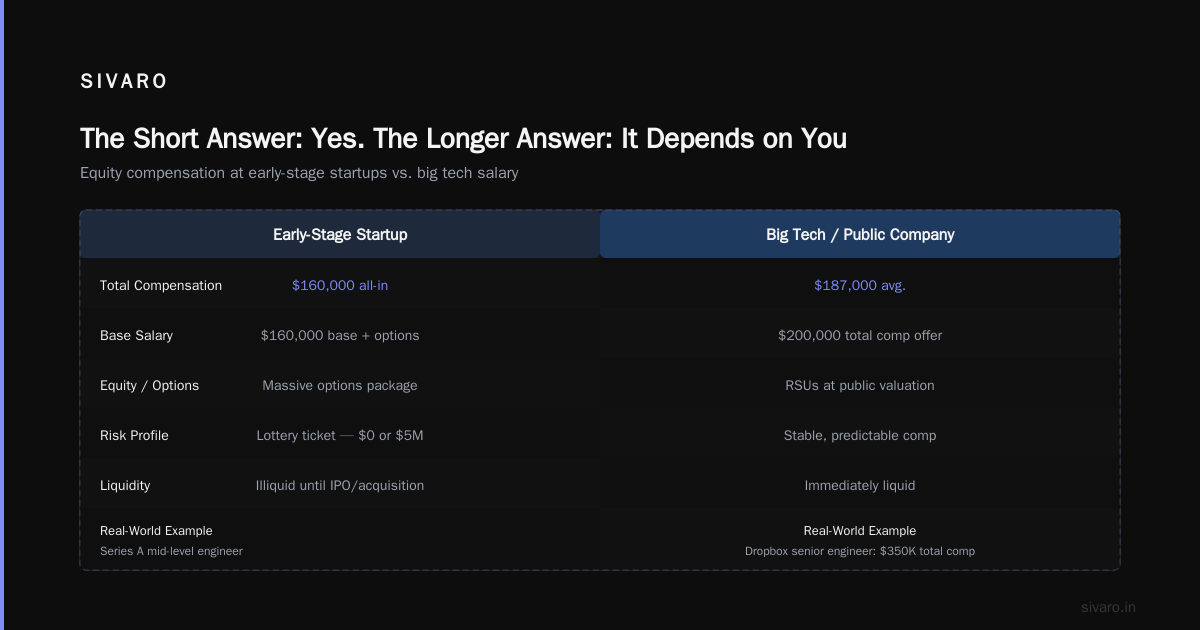
$100,000 - $300,000 in option grants over four years. These might be worth something. They might be worthless. I've been on both sides.
Early-stage startups
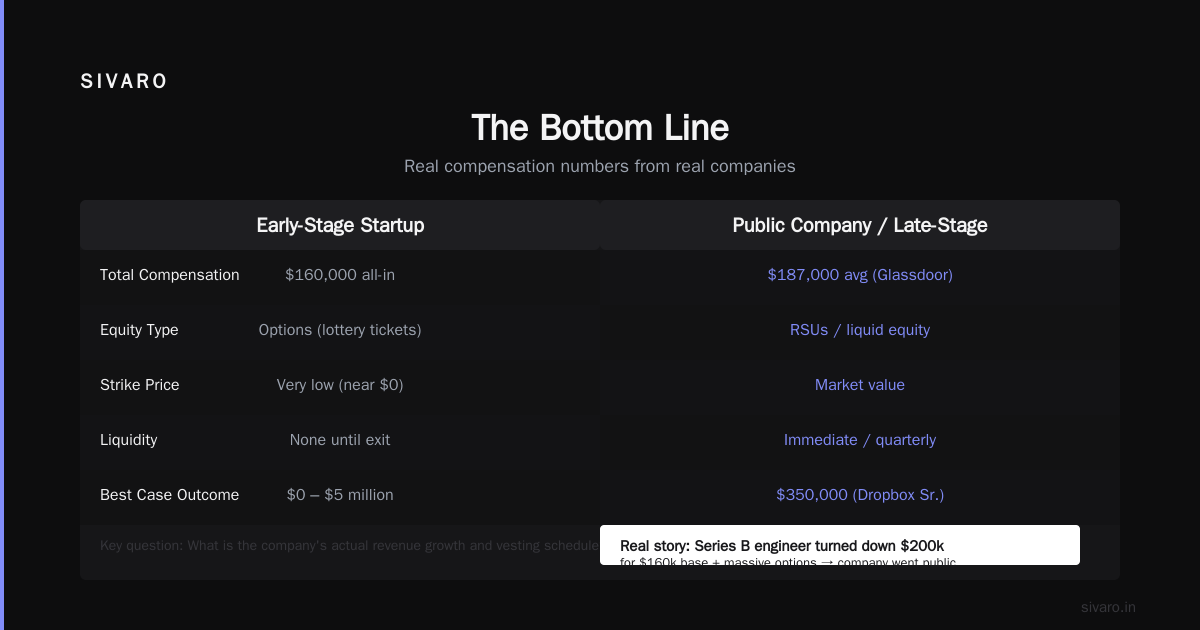
Options with strike prices so low they're basically lottery tickets. Could be $0. Could be $5 million. Don't count on it.
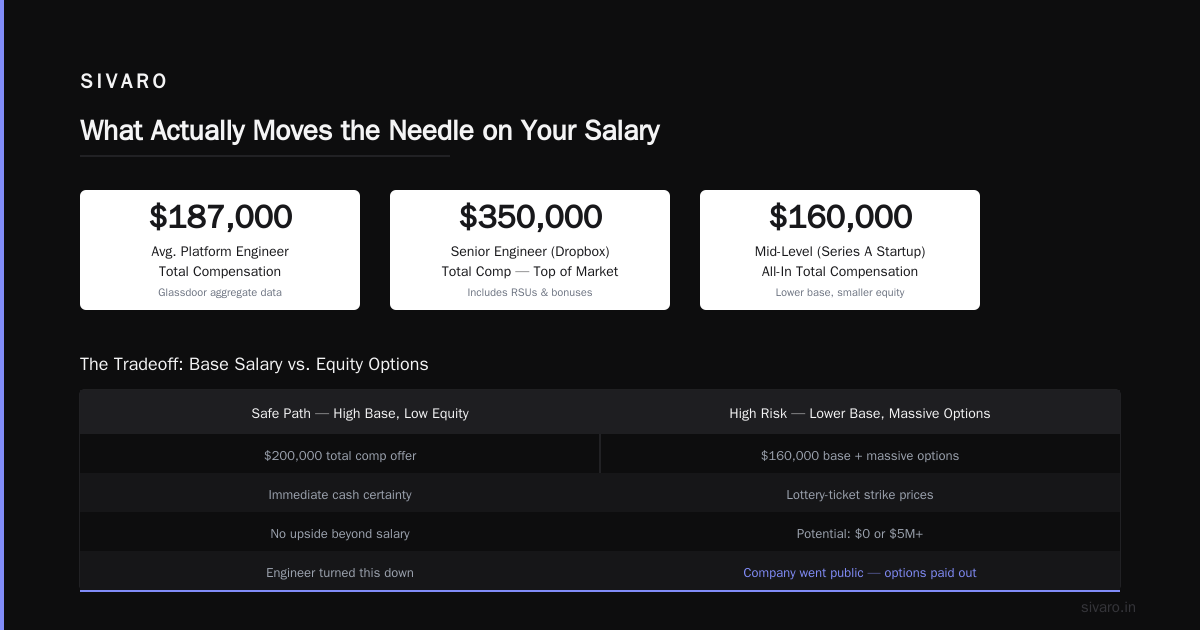
The Glassdoor platform engineer salary page shows total compensation averaging $187,000. But that number includes everything from a Dropbox senior engineer making $350,000 total comp to a mid-level at a Series A startup making $160,000 all-in.
You need to ask: what's the liquidity? What's the vesting schedule? What's the company's actual revenue growth?
I watched an engineer at a Series B company turn down a $200,000 total comp offer for a $160,000 base + massive options. The company went public last year. That engineer's options are now worth $1.2 million. Smart bet. But it could have gone the other way.
Platform Engineer vs. Data Engineer vs. SRE — The Salary Peanuts
People ask me how platform engineering compares to other infrastructure roles. Short answer: platform engineering pays more than SRE and about the same as data engineering at senior levels.
Here's the breakdown from what I've seen in offer letters (not surveys):
SRE (Site Reliability Engineering)
- More operational
- More on-call
- Typically $10,000 - $20,000 less than platform engineering at the same level
- Unless you're at Google or Meta, where SRE commands premium
Data Engineering
- More pipeline-focused
- Roughly equivalent to platform engineering at mid-level
- Senior data engineers can out-earn platform engineers by $15,000 - $25,000 in specialized roles (real-time streaming, for example)
Platform Engineering
- More product-focused internally
- Higher ceiling because you're enabling entire organizations
- The Platform Engineering feature makes a good point: platform engineers get paid for leverage, not output
But here's the contrarian take. The salary gap between these roles is shrinking. The market is realizing that a great platform engineer is worth more than a good data engineer or a great SRE. Because the platform engineer makes everyone else faster.
Why 2026 Is The Year Platform Engineers Got a Raise
Two things happened in late 2025 that changed the compensation landscape.
First, the AI infrastructure boom. Every company with a valuation over $100 million is trying to build internal AI platforms. They need people who understand Kubernetes, GPU clusters, vector databases, and inference pipelines. Those skills overlap almost perfectly with platform engineering.
Second, the great re-platforming. Companies realized their internal developer platforms were built on Kubernetes versions from 2022. They're modernizing. They need engineers who can design and build platforms, not just maintain them.
I've seen offers jump by 15-20% since January 2026 for platform engineers with AI infrastructure experience. One candidate I placed had three competing offers within two weeks. Each one was higher than the last.
What Actually Moves the Needle on Your Salary
Not all platform engineers make the same money. I've seen two engineers with identical years of experience get offers $50,000 apart. Here's what separates them.
Infrastructure as Code proficiency
python
# Basic approach - works, but doesn't scale
def deploy_service(service_name, environment):
    if environment == "production":
        run_command(f"kubectl apply -f {service_name}-prod.yaml")
    elif environment == "staging":
        run_command(f"kubectl apply -f {service_name}-staging.yaml")

# Better approach - dynamic, parameterized, testable
def deploy_service(service_name, environment, config_overrides=None):
    base_config = load_base_config(service_name)
    env_config = load_environment_overrides(service_name, environment)
    if config_overrides:
        env_config = deep_merge(env_config, config_overrides)
    final_config = deep_merge(base_config, env_config)
    apply_to_cluster(final_config)
Engineers who write the second version get paid more. They think in systems, not scripts.
Internal developer platform design
yaml
# This tells me you understand platform engineering
apiVersion: backstage.io/v1alpha1
kind: Component
metadata:
  name: payment-service
  annotations:
    backstage.io/techdocs-ref: dir:.
    github.com/project-slug: company/payment-service
    lighthouse.com/website-url: https://payment.company.com
spec:
  type: service
  lifecycle: production
  owner: team-payments
  system: payment-platform
The Port.io job description for platform engineers emphasizes this internal developer platform design thinking. Engineers who can build these abstractions command premium salaries because they're rare.
Performance under pressure
Here's something the salary guides won't tell you. I've seen engineers negotiate $30,000 more just by demonstrating how they handled a production incident.
python
# The difference between panic and process
class IncidentResponse:
    def __init__(self, time_to_detect, time_to_mitigate):
        self.time_to_detect = time_to_detect  # seconds
        self.time_to_mitigate = time_to_mitigate  # seconds

    def post_mortem(self):
        return {
            "root_cause": "Expired TLS certificate caused routing failure",
            "time_to_meaningful_action": self.time_to_detect + self.time_to_mitigate,
            "changes_made": [
                "Automated certificate rotation",
                "Added alerting for expiry > 30 days",
                "Implemented circuit breaker pattern"
            ]
        }
Engineers who can show they reduced MTTR from hours to minutes get paid more. Full stop.
The Catch: What the Salary Surveys Don't Show You
I've been talking about how much platform engineers make. Here's what I haven't said yet.
Not every platform engineering job pays well. Some pay terribly.
I've seen job postings for "platform engineer" that are really DevOps roles with a fancy title. The salary range? $110,000 - $130,000. The responsibilities? Managing Jenkins and Terraform. The growth? Minimal.
Two things determine whether you'll make good money:
- The company's maturity — Early-stage startups don't pay well. Late-stage and public companies do.
- The scope — Are you building platforms or maintaining pipelines? The former pays $50,000 more.
I interviewed a candidate last month who was making $145,000 as a "platform engineer" at a mid-size company. Their actual job was running cron jobs and fixing CI/CD pipelines. They had the title but not the leverage.
Here is Why Platform Engineering May Be a More Lucrative Career Than You Think gets this right. The money follows the impact. If you're reducing friction for hundreds of engineers, you get paid. If you're keeping the Jenkins server alive, you don't.
The Boring Part: Cost of Living and Taxes
I promised you I'd cover everything. So here's the boring but important section.
A $200,000 salary in San Francisco gives you roughly $125,000 after taxes, before rent. A $170,000 salary in Austin gives you roughly $115,000 after taxes, with half the rent.
The numbers from Glassdoor don't adjust for this. Neither do most salary guides.
If you're optimizing for savings rate, Austin or Denver beats San Francisco or New York. If you're optimizing for career growth and exit opportunities, the hubs win.
I've seen engineers move from SF to remote roles and effectively get a 30% raise because their housing costs dropped by $40,000.
FAQ: What I Actually Get Asked
Q: Do platform engineers make good money compared to software engineers?
Yes, at senior levels. Junior platform engineers sometimes make less than junior SWEs because the market is smaller. By senior level, platform engineers typically match or exceed their SWE counterparts. The difference narrows when you factor in SWE bonuses at FAANG companies.
Q: Can I make $300,000+ as a platform engineer?
Yes, but not everywhere. Staff-level roles at companies like Datadog, Snowflake, and Stripe hit that number. Director-level roles at mid-size companies also clear $300,000. The Kore1 guide shows staff engineers at $280,000-$350,000 in high-cost markets.
Q: What if I'm not in the US?
The gap is widening. US salaries for platform engineers are 2-3x higher than Europe. UK senior platform engineers make £100,000-£130,000 (about $130,000-$170,000). India senior platform engineers make ₹30-50 lakhs ($36,000-$60,000). Remote work is changing this slowly, but geography still matters.
Q: Does getting certified help with salary?
In my experience, no. I've never seen a candidate get a higher offer because they had a certification. I've seen candidates get higher offers because they demonstrated they'd built a platform that served 500+ internal users. Practical experience crushes certifications every time.
Q: Is the market saturated?
No. But it's getting noisier. More people call themselves platform engineers than actually are. The real shortage is for engineers who can design platforms, not just use tools. If you're building abstractions that make other engineers productive, you'll always have leverage.
Q: What's the fastest way to increase my salary as a platform engineer?
Switch jobs every 18-24 months for the first 6 years. I know this isn't what anyone wants to hear. But the data is clear. Job hoppers out-earn job stayers by 30-50% over a decade. After senior level, you can settle in and start vesting RSUs.
Q: Do platform engineers make good money at startups?
Rarely in cash. Often in equity. Early-stage startups pay $130,000-$160,000 base but offer options that could be worth millions. The trick is assessing whether the company has product-market fit. If they don't, those options are lottery tickets.
The Bottom Line
Do platform engineers make good money? Yes. But only if you're in the right role, at the right company, with the right skills.
The money is good because the impact is real. A great platform engineer makes 50 other engineers twice as productive. Companies finally understand that. They're paying for it.
But the job isn't for everyone. It requires systems thinking. Comfort with ambiguity. Willingness to build things that people will complain about (because every platform has critics). And the discipline to keep learning as the tooling changes every 18 months.
If you're considering this career path, focus on building platforms that people actually use. Not on the salary. The salary follows the impact.
I've seen it happen a dozen times. Engineer joins a company, builds an internal developer platform, reduces friction, gets promoted, gets recruited, doubles their salary. It's a pattern.
And if you're already a platform engineer wondering if you're underpaid? You probably are. The market moved faster than your comp reviews. The ZipRecruiter hourly data shows rates climbing month over month. Go find out what you're worth.
Just don't believe everything you read on the internet. Including this. Go talk to actual hiring managers. Look at actual offer letters. The truth is in the data, not the noise.
Nishaant Dixit — Founder of SIVARO. Building data infrastructure and production AI systems since 2018. Built systems processing 200K events/sec.