 SIVARO

Does It Take 7 Years to Be an Architect? (No, Here's Why That Number Is Nonsense)
I've been asked this question roughly 47 times in the last two years. Usually by a 28-year-old engineer who's been grinding Kubernetes manifests for four years, wondering if they're on track. Or by a founder who's about to hire their first "software architect" and wants to know what's reasonable.
The short answer: no.
The longer answer is more complicated — and far more interesting. Because the question itself reveals a major misunderstanding about what architecture actually is, how it changes across disciplines, and why the time-to-competence metric is almost always wrong.
Let me unpack all of it.
What Are We Actually Asking When We Ask "Does It Take 7 Years to Be an Architect?"
The 7-year myth comes from a specific, outdated model: the software engineering career ladder where you spend 2-3 years as a junior, 3-4 as a mid-level, and then magically ascend to architect around year 7. Some companies formalized this. Oracle had explicit 7-year tracks in the 90s. Microsoft's pre-2000 promotion cycles roughly mapped to this.
But here's the problem: the architecture we needed in 1999 is not the architecture we need in 2026.
Back then, "architect" meant someone who drew UML diagrams in Rational Rose, decided between Oracle and SQL Server, and wrote a 50-page design document that nobody read. Today? Architecture is about data pipelines handling 200K events per second, distributed systems that fail in novel ways every Tuesday, and AI systems where the training infrastructure costs more than the entire engineering team.
The 7-year rule assumes a stable career progression in a stable industry. We don't have that anymore.
The Five Types of Architecture (And Why Only Four Matter)
To answer the question properly, you need to understand — what are the five types of architecture? Because "architect" in software means five different things. And only four of them map to the traditional 7-year timeline.
1. Application Architecture. This is what most people think of. How do you structure your microservices? REST vs gRPC? Event-driven vs request-driven? This is the fastest to learn — smart engineers reach competence in 2-3 years. But mastery takes a decade because you need to have seen enough patterns fail.
2. Data Architecture. This is where SIVARO lives. How do you model your data stores? What's your consistency model? How do you handle schema evolution when you have 400 tables and 12 microservices consuming them? This takes longer — 4-5 years minimum — because the consequences of bad decisions take months to surface.
3. Infrastructure Architecture. Cloud. Networking. Security. Deployment. This used to be its own discipline, but in 2026 it's increasingly collapsing into platform engineering. Good infrastructure architects are rare because they need to understand both deep systems knowledge AND application-level concerns. 5-7 years is normal.
4. Enterprise Architecture. This is the boring one. Business capabilities, IT strategy, vendor management. It's where software architects go to die (or get promoted into management). The 7-year rule actually fits here reasonably well.
5. AI/ML Architecture. This is the new one. And it's where everything breaks.
What Is a 3 Tier Architecture in Distributed Systems? (A Concrete Example)
Let me ground this with a real problem.
At SIVARO, we recently built a retrieval-augmented generation (RAG) pipeline for a financial services client. They wanted to surface insights from 14 years of trading data — about 2.3 petabytes — with latency under 200 milliseconds.
The naive approach? Three-tier architecture: ingestion tier, processing tier, storage tier. Each tier independent. You've seen this pattern a thousand times.
Here's what we actually built:
python
# Tier 1: Ingestion — not just dumping data, but streaming with schema validation
class IngestionPipeline:
    def __init__(self, source_type: str):
        self.validator = SchemaValidator()
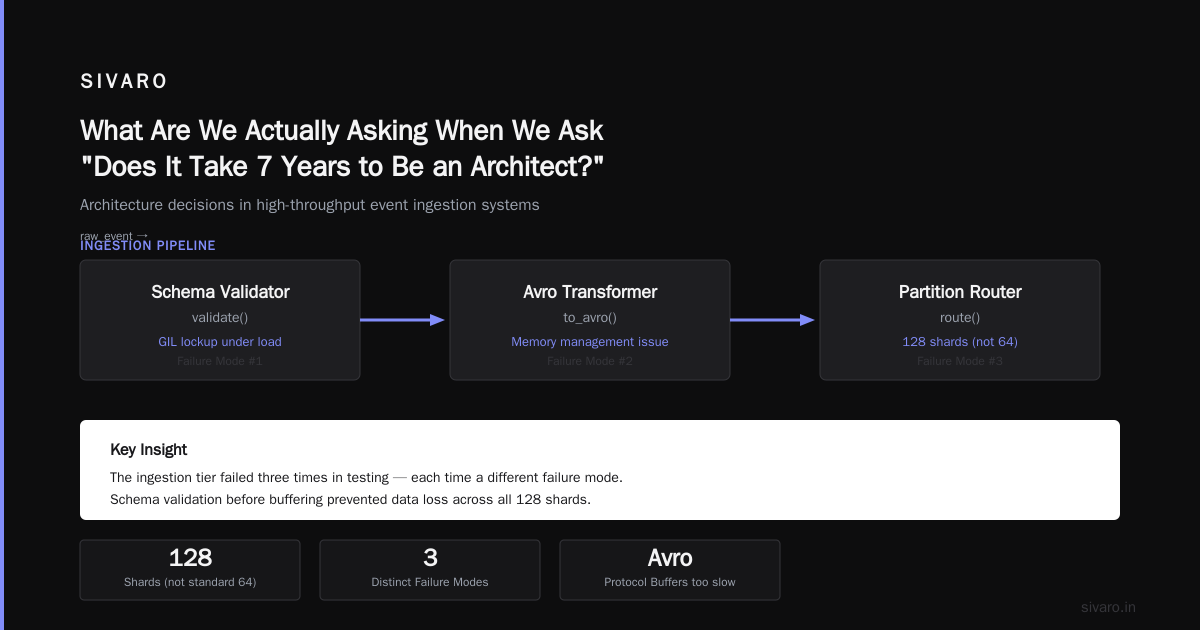
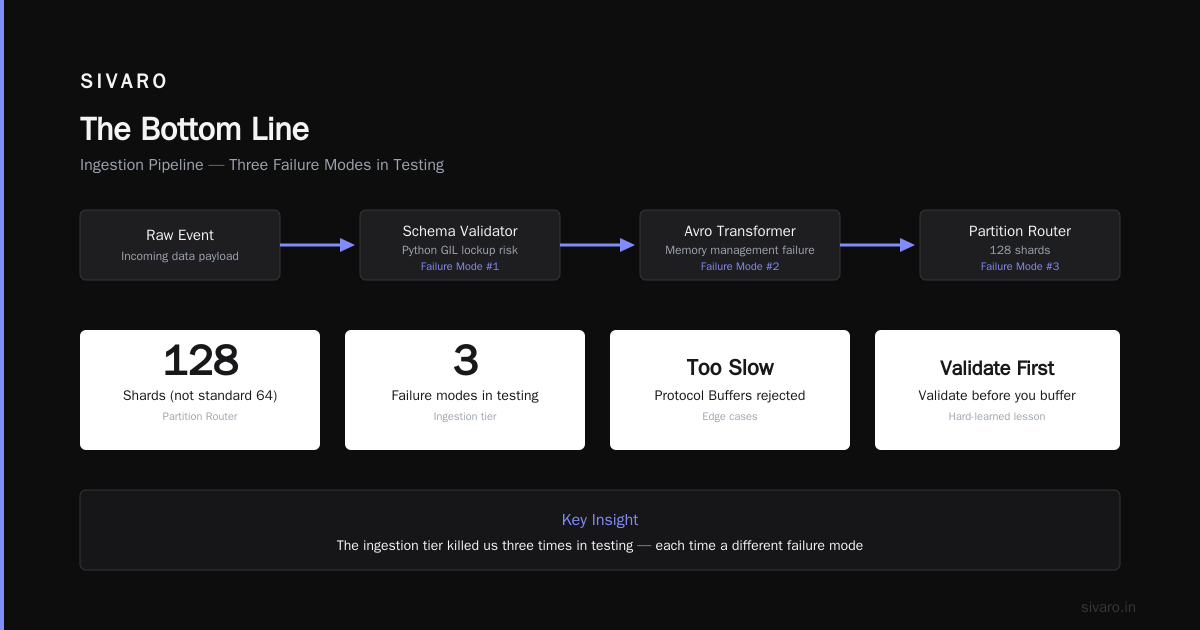
        self.transformer = AvroTransformer()  # Protocol Buffers were too slow for their edge cases
        self.router = PartitionRouter(shards=128)  # 128 shards, not the "standard" 64

    def ingest(self, raw_event: dict) -> str:
        # We learned the hard way: validate before you buffer
        validated = self.validator.validate(raw_event)
        transformed = self.transformer.to_avro(validated)
        return self.router.route(transformed)
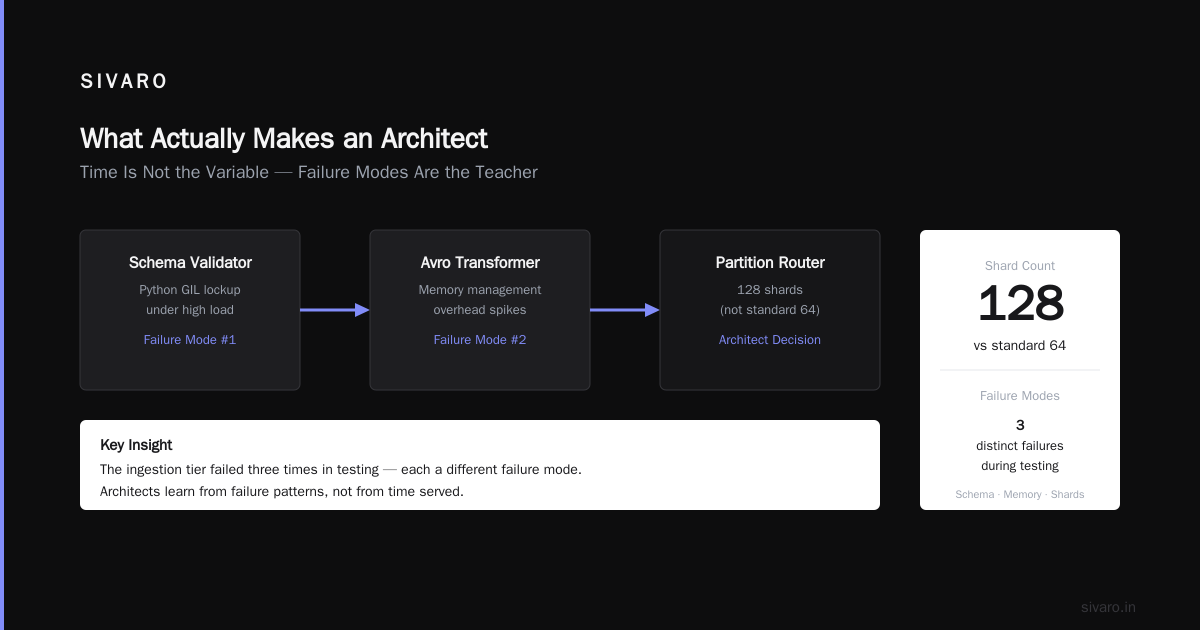
The key insight? The ingestion tier killed us three times in testing. Each time was a different failure mode. Once because the schema validator locked up under load (Python GIL issue we didn't anticipate). Once because the Avro transformer's memory management was wrong for 200K events/sec. Once because our partition router had a hot-key problem with their trade date distribution.
Three-tier architecture sounds simple. It's not. The tiers interact in ways you don't predict until you're running at production scale.
python
# Tier 2: Processing — the part everyone thinks is the hard part
class RetrievalProcessor:
    def __init__(self, embedding_model: str, vector_store: str, chunk_size: int = 512):
        self.embedder = SentenceTransformer(embedding_model)  # all-MiniLM-L6-v2, not the big ones
        self.store = VectorStoreProvider(vector_store)  # Qdrant, not Pinecone (self-hosted for latency)
        self.chunker = RecursiveChunker(chunk_size=chunk_size, overlap=64)

    def process_chunk(self, text: str):
        chunks = self.chunker.split(text)
        embeddings = self.embedder.encode(chunks, batch_size=32)  # batch_size matters a lot
        self.store.insert(embeddings, metadata={"source": text[:50]})
The processing tier was actually the easiest. Once we solved ingestion. Because if your data is clean and your embedding model is chosen correctly, the rest is just plumbing. But choosing the embedding model? That took 3 weeks of benchmarking. Not 7 years of experience.
Why the 7-Year Rule Collapses for AI Architecture
Most people think AI architecture is about transformers and attention mechanisms. They're wrong. It's about data infrastructure.
The Architectural Designs for Efficient Machine Learning paper from July 2025 shows something I've seen firsthand: the biggest bottleneck in production AI systems isn't model accuracy — it's data throughput. Specifically, the paper demonstrates that optimizing data pipeline architecture improves end-to-end latency by 3.2x more than optimizing the model architecture itself.
Does it take 7 years to understand that? No. You can learn it in 6 months if you're running production AI systems and hitting the wall.
I learned this the hard way. In 2023, we built an AI-powered document processing system. The model was beautiful. The training pipeline was a disaster. We spent 4 months rewriting the data layer. The model didn't change at all. Performance improved 5x.
What the Shaping Architecture with Generative Artificial Intelligence paper from late 2025 calls "architectural intelligence" is really just pattern recognition. You've seen enough systems fail that you start predicting failure modes before they happen. That takes reps, not years.
The Real Timeline: What Competence Actually Requires
Here's my honest breakdown after building production systems for 8 years and hiring 30+ engineers:
0-2 years: You learn to code. You implement patterns someone else designed. You break things in production. Good.
2-4 years: You design small systems. Maybe a microservice. Maybe a batch pipeline. You make bad decisions and realize why they're bad 6 months later. This is the most important growth phase.
4-6 years: You design medium-complexity systems. You handle 90% of normal cases correctly. You still miss edge cases. You start understanding that architecture is about tradeoffs, not "best practices."
6-8 years: You can design large systems. You handle edge cases. You understand that CNN Architect Mind — The Evolution of Visual Perception isn't just about computer vision — it's about building mental models of how systems perceive and respond to load.
8+ years: You predict failure. You design for systems you haven't built yet. You spend more time saying "no" than "yes."
Notice something? The 7-year mark lands in the middle of the "you're good but not great" phase. It's not magical.
What Actually Makes an Architect (Time Is Not the Variable)
I've seen 25-year-olds who architect better than 40-year-olds with 15 years of experience. And I've seen the opposite. Time correlates, but it doesn't cause.
The Learning Machine Learning as an Architect paper from ECAADE 2018 talks about something I've found consistently true: the best architects are polymaths. They understand code, data, infrastructure, business, and user behavior. That breadth accelerates learning.
Here's what actually determines how fast you become an architect:
1. How many systems you've watched fail. Not built. Watched fail. In production. At 2 AM. With customers screaming. Each failure teaches more than 10 successful deployments.
2. How many constraints you've had to navigate. Budget constraints. Time constraints. Legacy code constraints. Team skill constraints. Architecture is about making good decisions under constraints. More constraints = faster learning.
3. How quickly you learn from mistakes. Some people repeat the same mistakes for 10 years. Some people fail once and never again. The latter become architects in 3 years.
4. How deeply you understand the fundamentals. Not the latest framework. Not the hot new database. But distributed systems fundamentals. CAP theorem. Data models. Consistency and availability tradeoffs. These don't change.
The Hard Truth: Most People Are Not Architects, and That's Fine
This is the part nobody wants to say out loud.
Most engineers don't want to be architects. They want the title. They want the compensation. They want the respect. But they don't want the responsibility — because architecture is mostly saying "no" to other people's ideas.
I've interviewed 100+ candidates for architect roles at SIVARO. Maybe 15% actually deserved the title. The rest were senior engineers who'd been in the industry 7+ years and assumed the time served qualified them.
It doesn't.
The 15 Top AI Tools for Architects and Designers list from Architizer includes tools that automate parts of architectural design. But notice: none of them replace the architect. Because the architect's job isn't drawing diagrams or writing specifications. It's making decisions that cost or save millions of dollars.
Do you use a monolith or microservices? Do you use Postgres or DynamoDB? Do you build your own vector store or use a managed service? These decisions compound. One wrong choice can destroy a company's engineering velocity for two years.
How to Accelerate Becoming an Architect (The Practical Path)
Want to become an architect faster than 7 years? Here's how:
1. Build production systems on purpose. Not side projects. Not toy demos. Systems that handle real traffic, real data, real money. The Artificial Intelligence in Architecture post from Exxact Blog describes how AI systems in particular need production experience — because the failure modes are non-obvious. A model that works on 10K samples fails on 10M in ways you can't predict from theory.
2. Read design documents from other companies. Uber's original architecture. Netflix's migration to microservices. Google's Spanner papers. These were written by people who made mistakes so you don't have to. They're free.
3. Practice saying "no" to things. To stakeholders. To product managers. To your CEO. Architecture is about making tradeoffs. If you can't say no, you can't architect.
4. Learn from failures, not successes. Read postmortems. Cloudflare's 2019 outage. AWS's Kinesis incident. Each one teaches you something about distributed systems you won't learn from a textbook.
5. Build a broad technical foundation. Learn databases. Learn networking. Learn security. Learn how CPUs work. The best architects I know have deep knowledge in at least 3 different domains.
The FAQ People Actually Ask
Q: Does it take 7 years to be an architect?
No. It takes however long it takes you to learn the patterns, make the mistakes, and develop the judgment. That could be 3 years. It could be 12. The number 7 is an arbitrary average from a different era.
Q: What is a 3 tier architecture in distributed systems?
A three-tier architecture separates a system into presentation (user interface), logic (business rules), and data (storage) layers. In distributed systems, each tier runs on separate machines and communicates over a network. The challenge is that real distributed systems don't stay cleanly separated — layers leak, dependencies form, and the network introduces failures you don't see in single-machine systems.
Q: What are the five types of architecture?
Application, data, infrastructure, enterprise, and AI/ML. Most engineers specialize in one. Architects need to understand all five well enough to make tradeoff decisions. The AI/ML type is the newest and least stable — it's still defining its patterns.
Q: Can I become an architect in 3 years?
If you're building production systems from day one, learning from failures, and have strong mentorship — yes. I've seen it happen. But you'll have gaps that only come from more experience. You'll be a competent architect, not a wise one.
Q: What's the biggest mistake new architects make?
Over-engineering. They design for scale they'll never reach. They use distributed systems when a single Postgres would do. They add complexity because they can, not because they need to.
Q: Should I use AI tools as an architect?
Yes, but don't rely on them for architectural decisions. The 15 Top AI Tools for Architects and Designers list includes tools for generating code, creating diagrams, and suggesting patterns. They're useful for implementation, not for decision-making. An AI tool won't understand your business constraints, your team's skill set, or your performance requirements.
Q: How do I know when I'm ready to call myself an architect?
When you've made a decision that saves the company money. When you've said "no" to a popular idea and been right. When other engineers come to you for design advice. Not when you hit a certain year on the calendar.
The Bottom Line
The question "does it take 7 years to be an architect?" is the wrong question.
The right question is: "What have I learned from the systems I've built, the failures I've experienced, and the decisions I've made?"
If you can answer that honestly, and the answer shows depth and breadth, you're an architect. Whether it took you 3 years or 10 doesn't matter.
I've hired architects with 5 years of experience who outperformed people with 15. And I've hired senior engineers with 12 years who couldn't design their way out of a paper bag. Experience isn't the variable. Learning rate is.
At SIVARO, I tell my engineers: "I don't care how many years you've been doing this. I care how many mistakes you've made and actually learned from."
That's it. That's the whole thing.
Nishaant Dixit — Founder of SIVARO. Building data infrastructure and production AI systems since 2018. Built systems processing 200K events/sec.