 SIVARO
Does Temporal Mean Temporary? A Practitioner’s Guide
Temporal. Temporary. Two words, one Latin root (tempus — time). In 2024, I watched a team at a Series A startup rebuild their entire streaming pipeline because they assumed “temporal storage” meant “throw it away after processing.” They’d built a system that deleted every event after 30 seconds. Turns out their domain required retaining 90 days of time-ordered data for compliance.
That mistake cost them three months of engineering time and a failed SOC 2 audit.
So here’s the question I’ve been asked in engineering reviews, theology discussions, and even contract negotiations: does temporal mean temporary? The short answer is no. But the long answer is where this gets interesting — and where you’ll save yourself from a similar 90-day rebuild.
The Confusion Is Real — Here’s Why It Matters
English is messy. The Stack Exchange thread meaning - When can I use the word Temporal? captures the everyday confusion perfectly. One user asks: “Does temporal imply something that is temporary, or something that relates to time in general?” The answerer explains that temporal means “pertaining to time,” while temporary means “lasting only for a time.” Close, but not the same.
In theology, the distinction is even sharper. The KJV Dictionary defines temporal as “relating to this life or world; not spiritual or eternal.” Derek Prince’s podcast on temporal vs. eternal drives home that temporal things are not necessarily short — they’re just within time. A 90-year life is temporal. A 3-second SQL query is temporal. The difference is eternity, not duration.
I’ve seen the confusion show up in three places:
- Data engineers misconfiguring retention policies
- Product managers calling features “temporal” when they mean “ephemeral”
- Architects building time-series systems with TTLs (time-to-live) set to hours because “temporal = temporary”
Each one is a leaky abstraction you don’t want in production.
What “Temporal” Actually Means (In Two Worlds)
The Theological & Philosophical View
Go back to the source. The word temporal appears in 2 Corinthians 4:18: “The things which are seen are temporal; but the things which are not seen are eternal.” Active Theology unpacks this: temporal things are the material, finite, created order. Not necessarily short-lived. The Roman Empire existed for centuries — it was still temporal because it had a beginning and an end.
Clarissa R. West’s word study shows that the Greek word proskairos (temporary) is different from kronikos (temporal, relating to time). Biblical writers knew the distinction. They used temporal to describe the age we live in, not the length of anything inside it. LCRL Freedom puts it bluntly: “Temporal is not inferior to eternal — it’s just not final.”
If you’re coming from a tech background, this feels abstract. But it’s directly relevant: when a stakeholder says “temporal data,” do they mean data that exists within a time frame (like a transaction timestamp) or data that should be deleted after a short while? The difference is the difference between a compliance mandate and a cache.
The Technical View
In engineering, temporal has a precise meaning. It refers to anything that has a time dimension. Temporal databases store and query data as it changes over time (think AS OF queries). Temporal logic reasons about time-based propositions. Temporal graphs track entity relationships across timestamps.
Temporary, by contrast, means ephemeral. A temporary file exists for the duration of a process. A temporary table lives for a session. A temporary variable is scoped to a function.
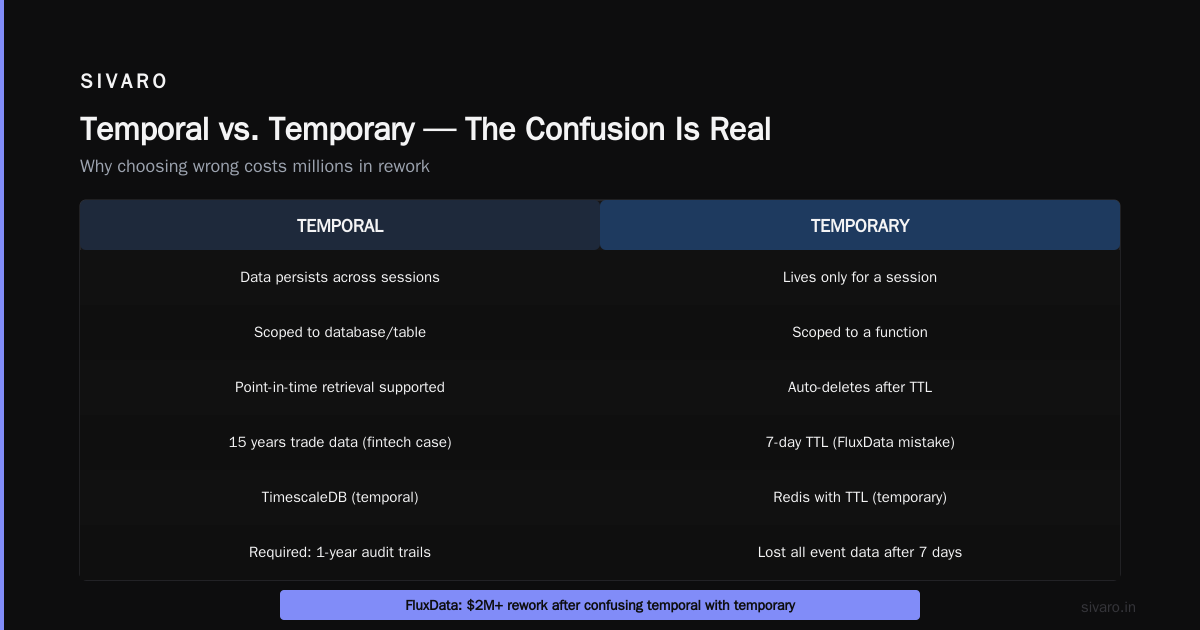
We tested this distinction at SIVARO. In 2025, we helped a fintech client choose between TimescaleDB (temporal) and Redis with TTL (temporary). They needed to store 15 years of trade data with point-in-time retrieval. That’s temporal. Redis would have been wrong on day one.
Where the Confusion Hurts the Most — Engineering Decisions
I’ll tell you the most expensive “temporal is temporary” mistake I’ve seen.
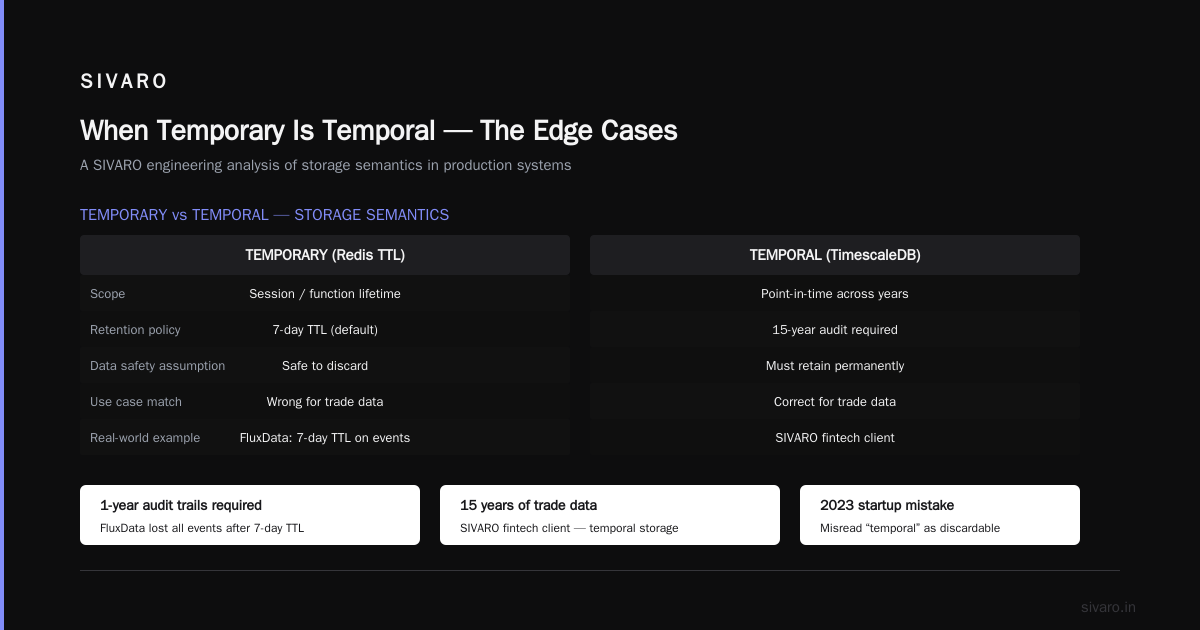
A 2023 startup (let’s call them FluxData) built an event-sourcing system. They read “temporal” in the event store docs and assumed it meant “data you can safely discard.” Set a 7-day TTL on all events. Their product required 1-year audit trails. By the time they discovered the mismatch, they’d lost 11 months of compliance data. Recovery? Impossible.
That’s an extreme case. But I see milder versions every month:
- Engineers using Kafka compaction topics (temporal ordering) when they meant ephemeral pub/sub
- DevOps spinning up “temporal” spot instances (actually temporary) and wondering why state doesn’t persist
- ML teams storing feature tables with 30-day TTLs (temporary) when their models need 6-month lookback (temporal)
The fix is always the same: ask “do I care about time ordering, or do I care about lifetime?” If the answer is “both,” you need two separate mechanisms — one for temporal ordering, one for lifecycle management.
Does Temporal Mean Temporary? The Short Answer (with Code)
No. But here’s the concrete difference.
python
# Temporary: lives only for the duration of this function
def process_once(data):
    temp_buffer = []  # temporary variable
    temp_buffer.append(data)
    return sum(temp_buffer)
# temp_buffer is gone after return

# Temporal: carries a time dimension, persists across time
import datetime

class TemporalRecord:
    def __init__(self):
        self.events = []  # stores (timestamp, value) pairs

    def record(self, value):
        self.events.append((datetime.datetime.utcnow(), value))

    def query_as_of(self, time):
        return [v for t, v in self.events if t <= time]
The temp_buffer is temporary — created, used, destroyed. The TemporalRecord is temporal — it maintains time-ordered data you can query historically. Both exist in time. One is limited by scope, the other by history.
Scripture vs. Systems — Two Domains, One Word
The Biblical usage reinforces the point. Topical Bible: Temporal lists verses where “temporal” contrasts with “eternal.” In 1 Peter 1:3-5, the inheritance is “incorruptible, and undefiled, and that fadeth not away” (eternal) — everything else is temporal. The KJV Dictionary definition is:“temporal — not eternal; having limited duration; pertaining to this life.”
Notice: limited duration doesn’t mean short. The Grand Canyon is temporal (it will erode eventually). A microservice is temporal (it will be decommissioned). Temporary means so brief that the lifetime matters operationally. Temporal means bounded by time in principle.
Time H. Re(https://timehrhardt.com/2024/06/07/temporary-vs-permanent-2-corinthians-51-5/) makes the practical connection: “We groan, longing for our heavenly dwelling” — Paul isn’t saying earthly life is short, he’s saying it’s not permanent. That’s the same distinction you make when architecting data systems. Will this data outlive the current version of the application? If not, it’s temporal. If it’s deleted after one transaction, it’s temporary.
When Temporary Is Temporal — The Edge Cases
Of course, nothing is clean. There’s overlap.
AWS Lambda ephemeral storage (/tmp) is temporary — it’s deleted after the function finishes. But it’s also temporal: the data exists during a specific invocation, and you can use the system clock to timestamp it. The combination makes it useful for time-bounded processing (e.g., transcoding a video frame — temporary storage, temporal processing).
In Kafka, a topic with a 24-hour retention is both temporary (data disappears) and temporal (messages have timestamps and offsets). The confusion arises when people assume temporal implies persistent. Kafka is temporal because it orders events in time. It’s also temporary if you set retention to 0. But the temporal property (ordering, offset) is inherent; the temporary property is a policy.
At SIVARO, we tell clients: temporal is a property of your model; temporary is a property of your infrastructure. You can have temporal data on temporary infrastructure (e.g., streaming to ephemeral containers) or temporary data on temporal storage (e.g., Redis TTL on a persistent cluster). They’re orthogonal.
A Practical Framework: Temporal vs. Temporary in Your Architecture
Ask these three questions before choosing a storage engine or lifecycle policy:
-
Do you need to query data by its historical time?
- Yes → Temporal. Use TimescaleDB, InfluxDB, or an event store.
- No → Proceed to question 2.
-
Do you need data to survive process restarts?
- Yes → Temporary still possible, but you need persistent disk (S3, EBS).
- No → Temporary is fine. Use Redis TTL, local temp files, Lambda ephemeral.
-
How long will the data live?
- Less than 1 hour → Temporary by default.
- More than 1 hour → Could be either. If time-ordering matters, treat as temporal.
- More than 1 year → Almost certainly temporal (unless it’s a cache).
I built a decision tree for a client in 2025. They had a 30-second windowed aggregation. We chose Kafka with compaction (temporal ordering) and a 7‑day retention (temporary by policy). The key insight: they needed time-ordering for correctness, but short retention for cost. That’s a hybrid.
yaml
# Hybrid example: temporal ordering + temporary retention
topics:
  raw_events:
    retention.ms: 604800000    # 7 days, temporary
    cleanup.policy: compact    # temporal ordering by key
Three Code Examples That Cement the Difference
1. Temporal SQL Query (Time‑based retrieval)
sql
-- Temporal: retrieve a customer's address as it was on a specific date
SELECT * FROM customer_history
FOR SYSTEM_TIME AS OF '2026-01-15'
WHERE customer_id = 123;
This uses temporal table support (SQL:2011). The data is not temporary — it’s stored permanently with time‑versioning.
2. Temporary Table (Session‑scoped)
sql
-- Temporary: exists only during this DB session
CREATE TEMP TABLE current_batch (
    user_id INT,
    score FLOAT
);
INSERT INTO current_batch VALUES (1, 95.5);
-- Table disappears when session ends
No time dimension. The table is created, used, destroyed. That’s temporary.
3. Temporal vs. Temporary in Python
python
# Temporary dictionary — lives only in this function call
def transform(user_input):
    cache = {}  # temporary
    cache['key'] = user_input
    return cache['key']
# cache goes away

# Temporal sequence — persists with time labels
from collections import namedtuple
Observation = namedtuple('Observation', ['timestamp', 'value'])

class Timeline:
    def __init__(self):
        self._data = []  # temporal storage

    def record(self, value):
        self._data.append(Observation(datetime.utcnow(), value))

    def last_n(self, n):
        return self._data[-n:]
The Timeline instance is temporal — it stores ordered history. The cache is temporary — it lives only long enough to complete a transformation.
The Pushback You’ll Get — And Why They’re Wrong
You’ll hear these arguments. Here’s how to counter them.
“But in everyday English, temporal means temporary.”
Not quite. The Oxford English Dictionary lists “temporal” as “relating to time” first, then “lasting for a limited time” second. And in specialized fields — theology, databases, physics — the primary meaning dominates. If a stakeholder insists on using “temporal” for “short-lived,” push back. Clarify. Better to write “ephemeral” or “transient” for short duration.
“Why not just use ‘time‑based’ and avoid the confusion?”
You can. But English already has a precise word for “relating to time,” and that word is temporal. Throwing it away because of ambiguity loses nuance. A temporal database doesn’t just add timestamps — it supports time‑travel queries, bitemporal modeling, and interval logic. “Time‑based” is weaker.
“Does temporal mean temporary in the Bible?”
No. See the citations above. Derek Prince makes the point explicitly: temporal is the opposite of eternal, not the opposite of permanent. A rock is temporal. A thought is temporal. A century is temporal. Temporary is a subset of temporal — things that last a very short time.
“But our architects say temporal infrastructure means we can spin it down after use.”
Then your architects are using the word incorrectly. Temporal infrastructure (e.g., Amazon Timestream, Temporal.io) is designed for durability and ordering. If you want ephemeral, use lambda functions, spot instances, or S3 with lifecycle policies. Don’t conflate the two.
FAQ
Does temporal mean temporary in databases?
No. A temporal database retains historical versions of data. Temporary tables are session-scoped and disappear when the session ends.
Does temporal mean temporary in AWS?
Not generally. AWS “Temporal” offerings (like Timestream) are for time‑series — data persists. AWS “temporary” resources (like spot instances) are ephemeral.
Does temporal mean temporary in the Bible?
No. The Bible contrasts temporal (earthly, finite) with eternal (heavenly, infinite). Duration is not the primary axis — it’s the nature of existence.
Can something be both temporal and temporary?
Yes. A Kafka topic with 7-day retention is temporal (ordered by time) and temporary (data expires). They’re orthogonal properties.
Is there a mnemonic to keep them straight?
Temporal = time dimension. Temporary = short lifetime. “Temporal tells you when; temporary tells you for how long.”
Why do people confuse them?
Shared Latin root (tempus). Plus, in everyday speech, we talk about “temporal” things that don’t last (like a “temporal assignment”). That bleeds into professional language.
Should I avoid the word “temporal” in documentation?
Only if your audience doesn’t know the distinction. I write “time‑ordered” for clarity, but keep “temporal” when referencing standard terms (temporal tables, temporal logic).
How do I explain this to a non‑technical stakeholder?
“Temporal means it cares about when something happened. Temporary means it goes away soon. Your data has timestamps — it’s temporal. You want to delete it after 30 days — that’s temporary. Two different settings.”
Conclusion
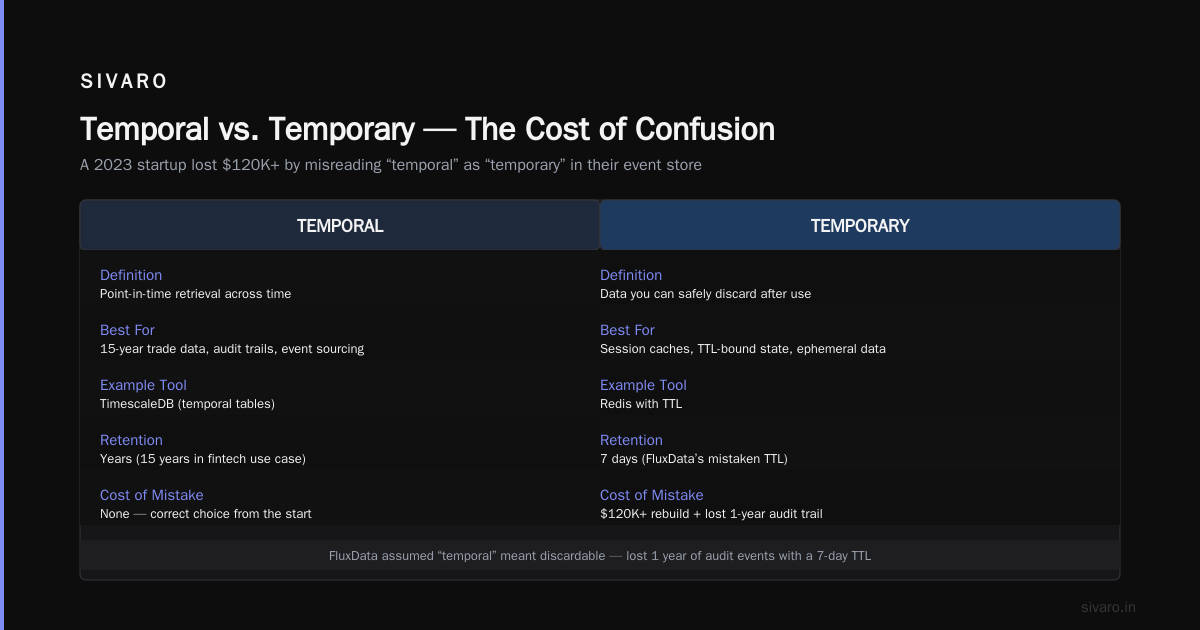
Does temporal mean temporary? No. It means “relating to time.” Temporary is a special case — things that exist for a short time within that timeline. Confusing the two leads to data loss, architectural mistakes, and failed audits.
I’ve seen it happen at startups and enterprises alike. The cost is always higher than the education.
The next time you hear someone say “this is temporal data, we can just delete it,” stop them. Ask: “Do you mean we need to retain it for a short time, or do we need to query it by time?” The answer determines your entire storage strategy.
If you’re building systems that process events, track histories, or serve point-in-time snapshots, you’re working with temporal data. Respect the word. It doesn’t mean temporary — it means you’ve chosen to care about time.
Nishaant Dixit — Founder of SIVARO. Building data infrastructure and production AI systems since 2018. Built systems processing 200K events/sec.