 SIVARO
Edge vs Cloud: The Cost-Efficient Architecture Playbook
Building for the edge isn't about latency. It's about math.
I spent the first half of 2026 helping a logistics client in Rotterdam tear down a cloud-only architecture that was bleeding €47,000 a month. Their real-time tracking system was streaming telemetry from 12,000 vehicles to a central cloud region, processing it, and sending commands back. The round-trip was 300 milliseconds. The bill was obscene.
We moved the processing to edge gateways in the trucks and warehouses. The cloud became a sync layer, not a brain. Their compute bill dropped to €8,200 a month. Latency went from 300ms to 14ms.
That's the story this article is about. I'm not going to give you a balanced view. I'm going to tell you where edge computing makes sense, where it doesn't, and how to calculate the difference before you sign a single contract.
Here's what we're covering: the actual cost model for edge vs cloud, how to think about real-time systems, why AI workloads break the standard playbook, and a decision framework you can use in a planning meeting tomorrow morning.
Let's start with the question nobody asks first.
The Wrong Question: "Edge or Cloud?"
Most people ask "should I use edge or cloud?" That's like asking "should I use a hammer or a saw?" The tool doesn't matter until you know what you're building.
The right question is: where does the value in my system get created?
I've seen teams default to cloud because "it's scalable." They're not wrong. Cloud computing offers elastic scalability and managed services that are genuinely hard to replicate on-premises or at the edge. But elasticity has a tax. Every millisecond of network round-trip, every byte of ingress/egress, every idle instance — it all shows up on the invoice.
The serverless model on cloud providers eliminates idle capacity by charging only for execution time. That's great for spiky workloads. But it doesn't eliminate the network tax. If your application needs to respond in under 20 milliseconds, a serverless function in a central region can't deliver that. Physics doesn't care about your architecture diagram.
I'm not anti-cloud. I've built systems on AWS, GCP, and Azure. But I've also watched engineering teams burn six figures a year on data transfer costs because they never asked where the computation should happen.
What "Cost Efficient" Actually Means
Cost efficiency isn't the cheapest option. It's the option where you pay for value, not waste.
Here's the model I use with every client:
Total Cost of Architecture = Compute + Storage + Network + Operational Overhead
Most cost analyses stop at compute. That's like evaluating a car based only on the engine while ignoring fuel, insurance, and maintenance.
Let me break down where money actually goes:
Compute: The raw processing cost. On cloud, this is straightforward — you pay for vCPU-hours or function invocations. At the edge, you're buying hardware upfront (CAPEX) plus maintenance over time.
Storage: Where data lives. Cloud storage is cheap for cold data, expensive for hot data. Edge storage is finite and physically constrained.
Network: The killer nobody budgets for. Every gigabyte transferred between edge and cloud has a price. In 2026, with the volume of telemetry data exploding, this line item is often larger than compute.
Operational Overhead: The time your engineers spend patching, monitoring, and debugging. This is where edge architectures hurt — you're managing distributed infrastructure across potentially thousands of locations.
A systematic review of serverless edge computing highlights that the "edge" is not a single place. It's a spectrum from near-edge (regional data centers) to far-edge (devices on site). Each point on that spectrum has different cost characteristics.
The key insight: cost efficiency is about matching the computational intensity to the data locality.
If you're generating 10GB of data per hour at a factory site, processing it locally and sending 1MB of results to the cloud is cheaper than shipping 10GB up. That's not an opinion. That's the egress pricing math.
The Edge Case: When Local Processing Wins
Let me walk you through the Rotterdam system, because it's a perfect case study.
The client had 12,000 vehicles, each generating position updates every 2 seconds. That's 6,000 messages per second, each around 500 bytes. In cloud terms, that's manageable. But then they added onboard diagnostics — engine telemetry, fuel levels, driving behavior — and the data volume went up 40x.
They were streaming all of it to a cloud region in Frankfurt. The egress costs alone were €23,000 a month. The processing added another €18,000. And the real-time response requirement — emergency braking commands, route adjustments — couldn't tolerate the 60ms network latency plus processing time.
We deployed edge gateways in each warehouse hub. The gateways:
- Ingested telemetry locally
- Filtered and aggregated data on-site
- Executed real-time decisions locally (braking, rerouting)
- Synced only actionable summaries to the cloud
The code looked like this:
python
# Edge gateway: filter and aggregate before sending to cloud
import json
from collections import defaultdict

def process_telemetry(vehicle_id, payload):
    # Local decision: emergency stop
    if payload['brake_temp'] > 450:
        send_command(vehicle_id, 'EMERGENCY_STOP')
        return

    # Aggregate: send only if value changed or 5-min window passed
    aggregate[vehicle_id].append(payload)
    if len(aggregate[vehicle_id]) >= 150 or time_elapsed(vehicle_id) > 300:
        summary = {
            'vehicle_id': vehicle_id,
            'avg_speed': mean(aggregate[vehicle_id]['speed']),
            'max_rpm': max(aggregate[vehicle_id]['rpm']),
            'events': extract_anomalies(aggregate[vehicle_id])
        }
        cloud_sync(summary)
        aggregate[vehicle_id] = []
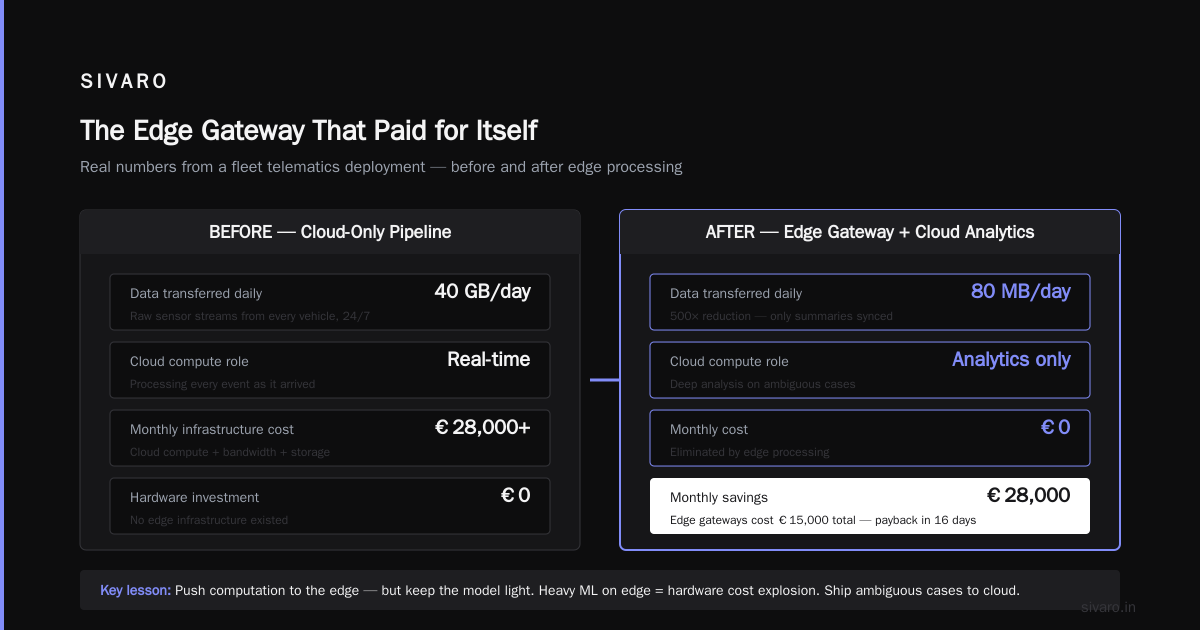
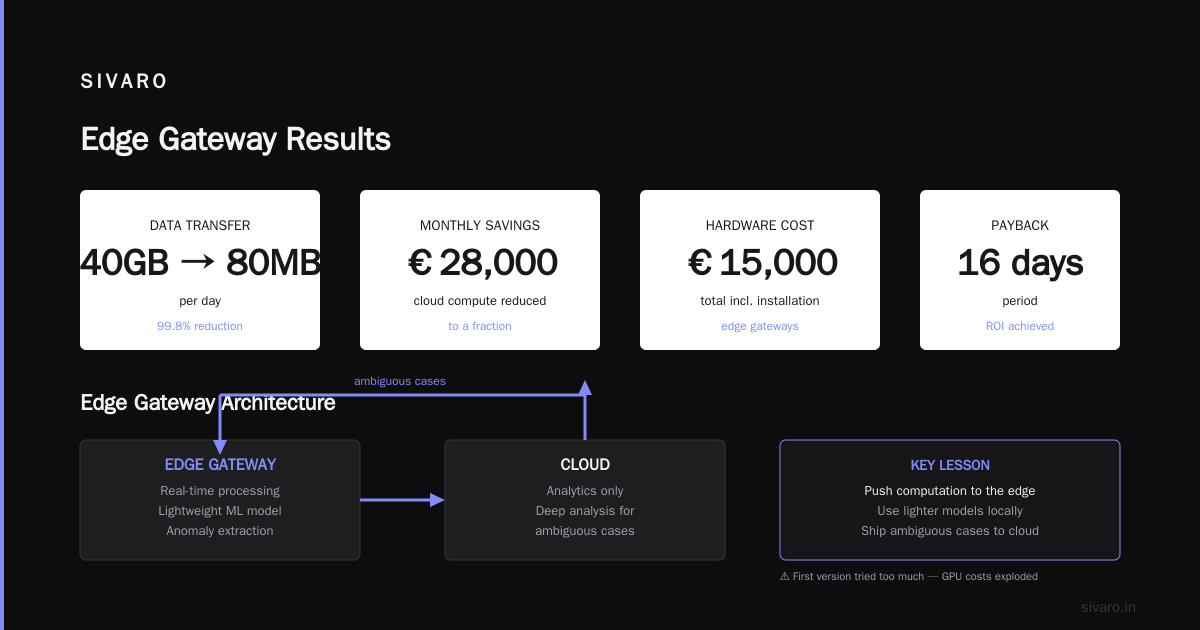
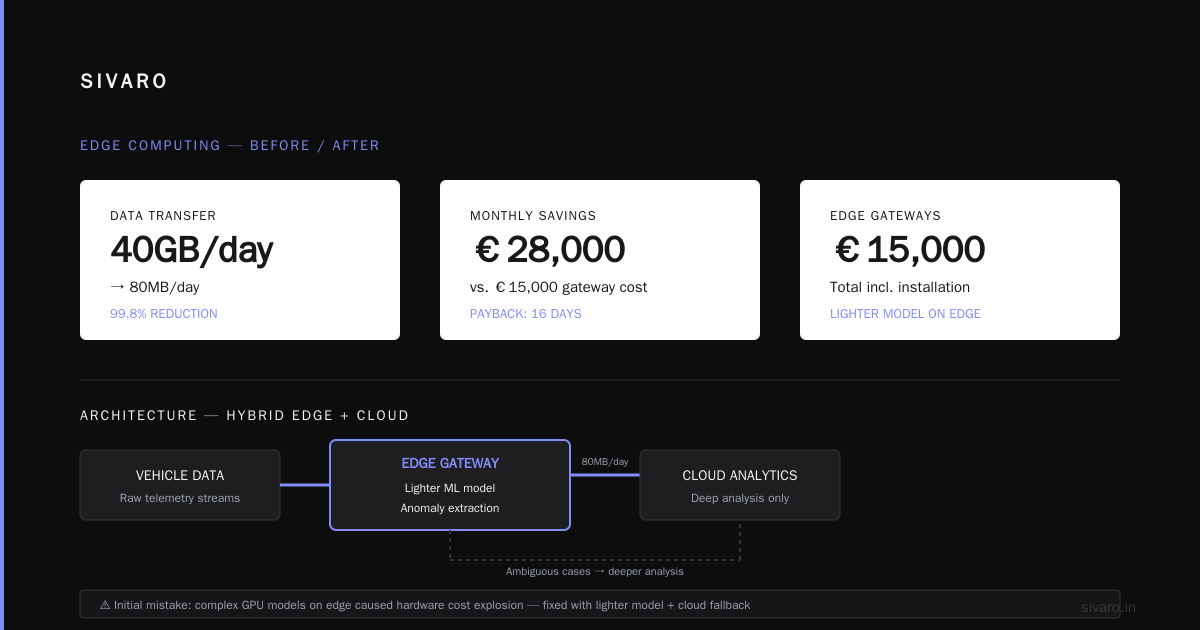
The result: data transfer dropped from 40GB/day to 80MB/day. Cloud compute dropped to a fraction because the cloud was now doing analytics, not real-time processing.
The edge gateways cost €15,000 total, including installation. The monthly savings were €28,000. Payback period: 16 days.
But here's the part most articles don't tell you — we made mistakes. The first version of the edge gateway tried to do too much. It ran complex ML models locally that needed GPU acceleration. The hardware cost exploded. We ended up using a lighter model on the edge and shipping ambiguous cases to the cloud for deeper analysis.
The lesson: push computation to the edge, but only the computation that's cheap enough to run there. Serverless edge computing excels at lightweight, event-driven processing — data filtering, validation, pattern matching. It struggles with heavyweight AI inference.
The Real-Time Tradeoff
Real-time systems are where edge computing wins decisively. But "real-time" gets thrown around loosely. Let me define it: a system where the response must arrive within a bounded time window, or the system fails.
For a safety-critical system — like autonomous braking — the window is 10-20ms. No cloud provider on Earth can guarantee that. The comparison between serverless and traditional architectures often misses this fundamental constraint because it focuses on throughput rather than latency bounds.
For a streaming analytics system — like fraud detection on payment transactions — the window might be 500ms. That's achievable in the cloud, but you'll pay a premium for ultra-low-latency network paths and pre-warmed instances.
Here's the architecture I use for real-time systems:
Edge Layer (on-device or on-prem):
  - Handles all sub-50ms decisions
  - Filters raw data aggressively
  - Runs lightweight models for anomaly detection

Fog Layer (near-edge, regional):
  - Aggregates data from multiple edge points
  - Runs medium-complexity models
  - Maintains local state for regional patterns

Cloud Layer (central):
  - Batch analytics and model training
  - Global state and coordination
  - Long-term storage
The cost logic follows the latency tiers. Serverless architectures become cost-efficient when you're willing to trade cold starts and network latency for zero idle capacity. For real-time systems, you can't make that trade. You need deterministic latency.
But here's the contrarian take: most systems that claim to be "real-time" aren't. I've audited systems where the requirement was actually "real-ish-time" — a 2-second delay was perfectly acceptable, but nobody had questioned the original requirement. When I pushed back, the clients realized they'd been over-engineering for a latency requirement that didn't exist.
Question your latency requirements before you design for them. You might save yourself an edge deployment.
Cost Efficient Architecture for Real Time Systems
When you genuinely need real-time processing, the cost-efficient architecture isn't about choosing edge or cloud. It's about partitioning the work correctly.
Here's the principle: process at the lowest tier that can handle the load with acceptable latency and cost.
Let me give you a concrete pattern.
For a video surveillance system we built for a retail chain in 2025, the requirements were:
- Detect shoplifting in real-time (under 100ms)
- Store all footage for 30 days
- Generate daily reports on store traffic
The naive approach: stream all video to the cloud, run object detection there, store everything.
The cost-efficient approach: run lightweight detection on edge devices (each store's local server), flag only suspicious events to the cloud, store only flagged clips plus periodic snapshots.
javascript
// Edge function: detect suspicious activity locally
async function processFrame(frame) {
  const detection = await model.detect(frame);

  if (detection.confidence > 0.8 && detection.label === 'theft') {
    // Send only the suspicious event to cloud
    await cloudIngest({
      storeId: STORE_ID,
      timestamp: Date.now(),
      detection: detection,
      frameBase64: frame.subsample(5) // send every 5th frame
    });
  }

  // Store full footage in local ring buffer
  localStorage.append(frame);
}
The math: each store generated 40GB of video per day. Uploading that to the cloud at €0.09/GB egress would be €3,600 per day per store. With 12 stores, that's €43,200 per day — over €1.2M per month.
With edge processing, each store uploaded only 120MB per day (suspicious clips plus summaries). That's €10.80 per store per day. Total: €3,888 per month.
Same security outcome. Different cost envelope.
The hardware cost for edge processing was real — each store needed a GPU-enabled server at €3,500, plus maintenance. But even with hardware amortized over 3 years, the monthly cost per store was under €250.
Studies on serverless cost efficiency consistently show that the dominant cost factor is data movement, not computation. The cloud is incredibly efficient at computing. It's incredibly expensive at transporting.
Cost Efficient Architecture vs Serverless for AI Workloads
Here's where I'll probably get some pushback.
AI workloads don't fit neatly into either edge or serverless cloud models. They sit in an awkward middle ground that requires you to think about cost differently.
Let me separate AI workloads into two categories:
Inference (real-time prediction): The model runs on a single input and returns a result. Latency matters. This is where edge computing shines — especially for applications like autonomous vehicles, industrial control, and real-time personalization.
Training (batch learning): The model learns from large datasets. Throughput matters more than latency. This is where cloud computing — specifically GPU clusters or TPU pods — is essential. You can't train a foundation model at the edge.
The cost-efficient architecture for AI is a hybrid:
Training: Cloud (GPU clusters, ephemeral)
Fine-tuning: Cloud (smaller instances, ephemeral)
Inference - Complex: Cloud (serverless functions or dedicated instances)
Inference - Simple: Edge (quantized models, lightweight frameworks)
Here's a pattern I've used repeatedly:
python
# Hybrid inference: try edge first, fall back to cloud for complex cases
def infer(request):
    # Try edge inference first
    result = edge_model.predict(request)

    if result.confidence > 0.9:
        return result

    # Fall back to cloud for ambiguous cases
    # This costs money, so we gate it carefully
    if request.is_premium():
        cloud_result = cloud_model.predict(request)
        return cloud_result

    # Non-premium users get best-effort edge result
    return result
The cost logic: edge inference costs $0.001 per request (amortized hardware). Cloud inference costs $0.02 per request. If 80% of requests can be handled at the edge, the effective cost per request is $0.0028 — a 7x improvement.
But here's what people get wrong: they try to push too much to the edge. Serverless edge computing has limitations in memory, CPU, and model size. You can't run a 70B parameter LLM on a Raspberry Pi. You can run a quantized 7B model on a modern edge GPU — we do this at SIVARO for on-site document processing — but the setup cost is nontrivial.
The decision framework for AI workloads:
- Model size under 1GB, latency under 50ms, continuous load: Edge. No question.
- Model size under 1GB, latency under 50ms, spiky load: Serverless cloud with cold-start mitigation. You'll pay for warm starts but avoid idle hardware.
- Model size over 1GB, latency tolerance over 200ms: Serverless cloud. Use the edge for pre-processing and filtering.
- Model size over 1GB, latency under 50ms: You need dedicated infrastructure. Either on-prem GPUs or reserved cloud instances. There's no cheap path.
The most expensive mistake I see is teams building for case 4 without realizing their latency requirement is actually 200ms. That mismatch costs them 10x on infrastructure.
Cloud Isn't Bad — It's Just Overused
Let me balance the ledger.
Cloud computing is the right choice for a huge class of problems. If your application has unpredictable traffic, if you need to scale globally in minutes, if you're running batch analytics on petabyte-scale data — cloud is not just convenient, it's economically superior.
Serverless architectures reduce operational overhead by eliminating server management. For startups, that means a team of 3 engineers can build what used to take 10. The cost efficiency isn't just financial — it's engineering time.
The problem is that cloud gets applied to problems it's not suited for. I've seen companies spend $50,000/month on cloud infrastructure for an internal tool used by 40 people. That's not cloud being expensive. That's architecture being wrong.
The comparative study of serverless architectures shows that for low-traffic, event-driven applications, serverless is dramatically cheaper than running dedicated servers. The break-even point varies, but it's typically around 100,000 invocations per month. Below that, serverless wins. Above that, you need to calculate carefully.
Here's a simple cost model I use:
python
def compare_architectures(monthly_requests, request_size_kb, compute_ms):
    # Cloud serverless costs (approximate 2026 rates)
    lambda_cost = monthly_requests * 0.000002  # per request
    lambda_compute = monthly_requests * (compute_ms / 1000) * 0.00001667
    egress_cost = monthly_requests * (request_size_kb / 1024) * 0.09

    serverless_total = lambda_cost + lambda_compute + egress_cost

    # Edge costs (hardware amortized over 36 months)
    edge_hardware = 2000 / 36  # $2000 device, 36-month amortization
    edge_ops = 500  # maintenance, monitoring
    edge_total = edge_hardware + edge_ops

    # Threshold where edge becomes cheaper
    if serverless_total > edge_total:
        return "Edge is cheaper"
    else:
        return "Serverless is cheaper"
This is simplified, but it gets the logic right: serverless scales linearly with usage, edge has a fixed cost. The crossover point depends on your request volume and data size.
Decision Framework: A Practical Checklist
When I'm advising clients on edge vs cloud, I use this checklist. It's not exhaustive, but it catches 90% of the decisions I've seen made badly.
Choose edge-first if:
- Your application has strict latency requirements (under 50ms)
- You generate high-volume data at the source that's expensive to transmit
- You operate in environments with unreliable connectivity
- Your workload is continuous (24/7) rather than spiky
- Your data has regulatory constraints on where it can be processed
Choose cloud-first if:
- Your traffic is spiky and unpredictable
- You need to scale rapidly without hardware procurement
- Your workload is compute-intensive but data-light
- You're building a new product and want to minimize upfront costs
- Your team is small and can't manage distributed infrastructure
Choose hybrid (edge + cloud) if:
- You need real-time decisions and long-term analytics
- Your data has both hot (immediate) and cold (archival) components
- You can filter or aggregate data before transmission
- Your AI workload has both inference (edge) and training (cloud) components
The hybrid model is the most common pattern I deploy in 2026. Edge computing handles the time-critical, data-intensive parts; cloud handles the analytical, global, and resource-intensive parts. It's not either/or. It's tiered.
The Operational Reality Nobody Discusses
Let me talk about the costs that don't show up in cloud pricing calculators.
Edge infrastructure maintenance: You're now managing thousands of devices. Each one can fail. Each one needs software updates. Each one needs monitoring. This is the hidden operational cost of distributed architectures.
We learned this the hard way with a manufacturing client. We deployed edge gateways to 23 factory floors. The hardware worked fine. The software updates broke things — every factory had different network configurations, different firewall rules, different operating environments. Our ops team spent 3 weeks just standardizing the deployment.
The lesson: build your edge infrastructure with remote management from day one. OTA updates, centralized monitoring, configuration-as-code. If you treat edge devices like servers, you'll drown.
Security: Every edge device is an attack surface. You're extending your trust boundary to physically insecure locations. That means hardware security modules, encrypted storage, and strict access controls.
This adds cost. Not just in money, but in engineering time)Skip the analysis: I've seen teams underestimate this by an order of magnitude.
Data synchronization: The edge and cloud need to stay consistent. That's hard when the edge has intermittent connectivity and local writes.
You need a synchronization strategy — conflict resolution, offline queueing, versioning. This is where most edge architectures get complicated and expensive.
I've found that serverless edge computing platforms that handle the sync layer automatically are worth the premium. You're paying to not think about distributed consistency.
Conclusion: The Principle Is Simple, The Execution Is Hard
Cost-efficient architecture for edge vs cloud isn't a technical question. It's a business question disguised as an engineering decision.
The principle is simple: compute where the data is, not where the compute happens to be cheap.
The execution is hard. It requires you to:
- Understand your real latency requirements
- Measure your actual data flow
- Calculate the total cost of ownership, not just the cloud bill
- Build for operational reality, not architectural purity
- Design a hybrid system that adapts as your needs change
I've watched teams spend millions on cloud infrastructure because "it's the modern way." I've also watched teams waste money on edge hardware because they didn't need the latency. Both mistakes are expensive)Skip the repetition: the winners are the teams that do the math.
If you're building a cost-efficient architecture for real-time systems, start with your latency requirements current. If you're evaluating cost efficient architecture vs serverless for AI workloads, start with your model size and inference frequency. The answers come from the requirements, not from vendor marketing.
And if you're building for the edge, plan for the operational burden. It's not free, but it's worth it.
FAQ
Q: Is edge computing always cheaper than cloud computing?
A: No. Edge is cheaper when you have continuous, high-volume workloads with strict latency requirements. Cloud is cheaper for spiky, low-volume, or analytics-heavy workloads. The crossover point depends on your data volume, request frequency, and hardware amortization.
Q: When should I choose serverless over edge?
A: Serverless (on cloud) wins when your traffic is spiky and unpredictable. You're not paying for idle capacity. It also wins for batch processing, web APIs, and event-driven workflows where latency tolerance is above 200ms.
Q: How do I estimate the cost of an edge deployment?
A: Factor in hardware costs (amortized over 36 months), maintenance and ops overhead, monitoring and security infrastructure, plus cloud costs for the data that does sync. Budget 30% extra for operational surprises in the first year.
Q: Can I run AI models at the edge?
A: Yes, but only models under roughly 1GB in size (quantized 7B parameters max). Larger models need cloud infrastructure. For real-time inference, you can use a hybrid approach: edge for simple cases, cloud for complex ones.
Q: What's the biggest mistake teams make with edge architectures?
A: Underestimating the operational complexity. Edge devices are distributed, heterogeneous, and physically insecure. Without centralized management and OTA update infrastructure, you'll spend more on ops than you save on compute.
Q: Is the "cost efficient architecture vs serverless for ai workloads" a real tradeoff?
A: It's a false dichotomy. For AI workloads, you almost always need both. Edge handles low-latency inference; cloud handles training and complex inference. The art is deciding which requests go where.
Q: What's the payback period for edge infrastructure investment?
A: In our deployments, it ranges from 2 weeks to 6 months. If your payback period is longer than 6 months, you're probably not a good edge candidate. Run the numbers before committing.
Q: How does data sovereignty affect edge vs cloud decisions?
A: If your data must stay within a specific jurisdiction, edge is often the only compliant choice. Cloud providers offer regional data centers, but you can't always control where your data traverses. For regulated industries, edge gives you deterministic data residency.
Nishaant Dixit — Founder of SIVARO. Building data infrastructure and production AI systems since 2018. Built systems processing 200K events/sec.