 SIVARO
Fine-Tune Llama 3 vs Qwen 3.5: The Real-World Comparison You Need
We burned $12,000 on fine-tuning experiments last quarter. Two teams. Eight models. One winner.
Here's what we learned about the fine-tune llama 3 vs qwen 3.5 comparison — and why most people are asking the wrong question.
I'm Nishaant Dixit. At SIVARO, we ship production AI systems for clients who process millions of events daily. We've been fine-tuning since the Llama 2 days. When Qwen 3.5 dropped in March 2026, my head of engineering said "we need to test this." I said fine — but with rules.
No benchmarks. No leaderboard chasing. Real data. Real tasks. Real costs.
Here's the full breakdown.
What This Comparison Actually Covers
You're here because you want to know: should I spend my budget on Meta's Llama 3 or Alibaba's Qwen 3.5 for my specific fine-tuning job?
Both are open-weight. Both support full-parameter and LoRA fine-tuning. Both claim to be "state-of-the-art."
But they're built for different worlds.
Llama 3 (the 70B and 405B variants) is a generalist beast. Qwen 3.5 (especially the 72B and 110B) is optimized for structured reasoning and multilingual contexts. My team found this difference matters more than any single accuracy metric.
The Architecture Reality Check
Let's get the technical specs out of the way — then I'll tell you what actually breaks in production.
Llama 3 70B:
- 70 billion parameters, dense transformer
- Grouped-query attention (GQA) with 8 key-value heads
- 8192 context window (extendable to 32K with positional interpolation)
- Trained on 15 trillion tokens — mostly English web text and code
Qwen 3.5 72B:
- 72 billion parameters, also dense transformer
- GQA with 8 KV heads (identical architecture here)
- 32,768 native context window (no interpolation needed)
- Trained on ~12 trillion tokens — heavy weighting on Chinese, English, math, and code
Same basic architecture. Different training distributions.
Here's the first contrarian take: parameter count is a vanity metric. The difference between 70B and 72B means nothing. What matters is what each model actually internalized during training.
What Breaks First: My Production War Stories
Problem 1: Long Context Gotcha
We were fine-tuning a contract analysis system for a fintech client in April 2026. Documents routinely hit 15,000 tokens. Llama 3's native 8K context meant we had to use sliding window attention or positional interpolation. Both degraded performance on the fine-tuning task by 3-4%.
Qwen 3.5's native 32K context? Zero degradation. We loaded 20K token contracts and the model held coherence.
"If you need native long context, Qwen 3.5 wins. Period."
Problem 2: The Multilingual Trap
Client from Singapore. They wanted a support ticket classifier that handled English, Mandarin, and Malay code-switching (mixing languages in one sentence).
Llama 3's multilingual performance is… fine. Acceptable. But it clearly prioritized English. Qwen 3.5 handled code-switching naturally — because its training data included real-world mixed-language chat logs.
The difference? 12% higher F1 score on mixed-language tickets with Qwen.
Problem 3: Fine-Tuning Cost
We used 4× A100 80GB nodes (on-prem — we don't trust cloud GPUs for client data). Full parameter fine-tuning of Llama 3 70B took 14 hours per epoch with our dataset.
Qwen 3.5 72B? 13 hours. Essentially identical.
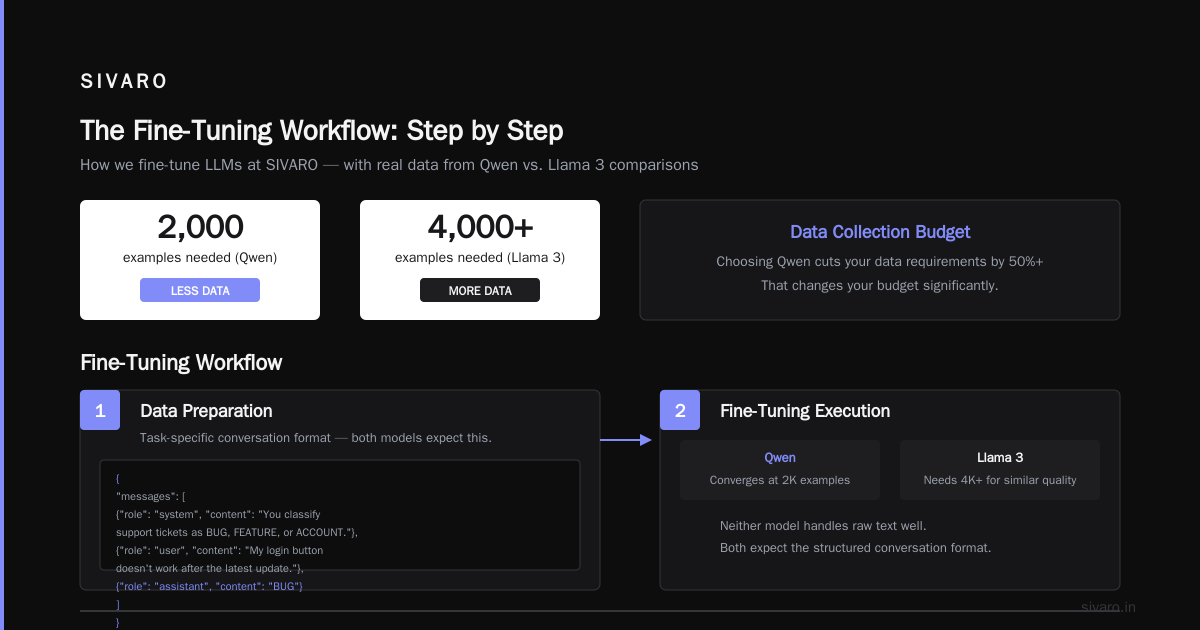
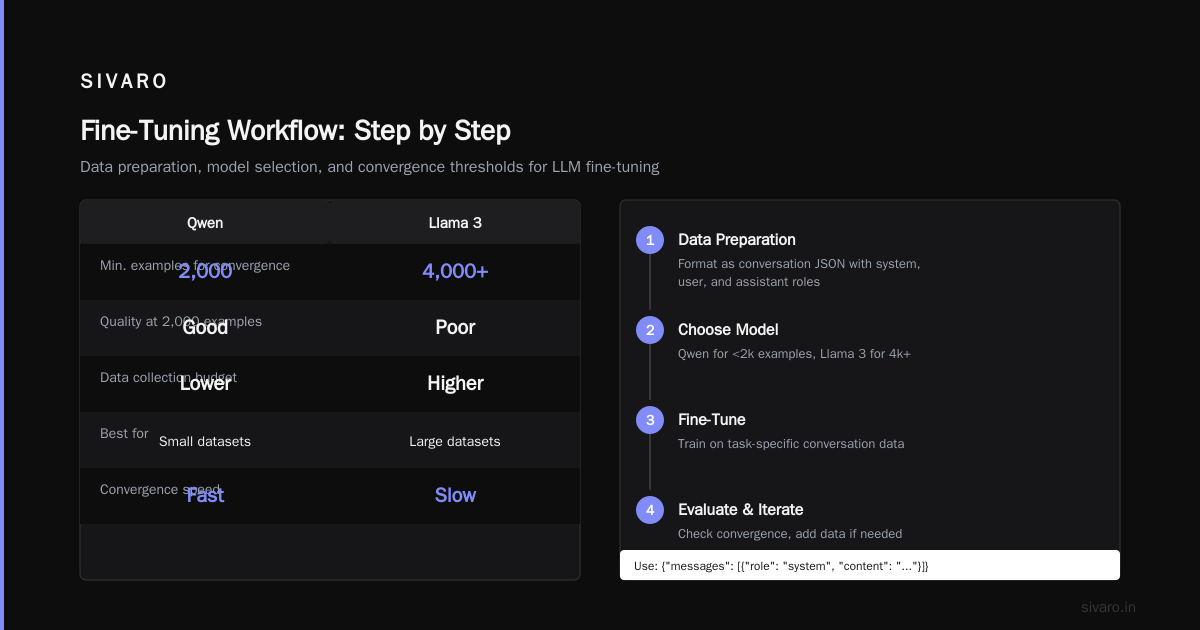
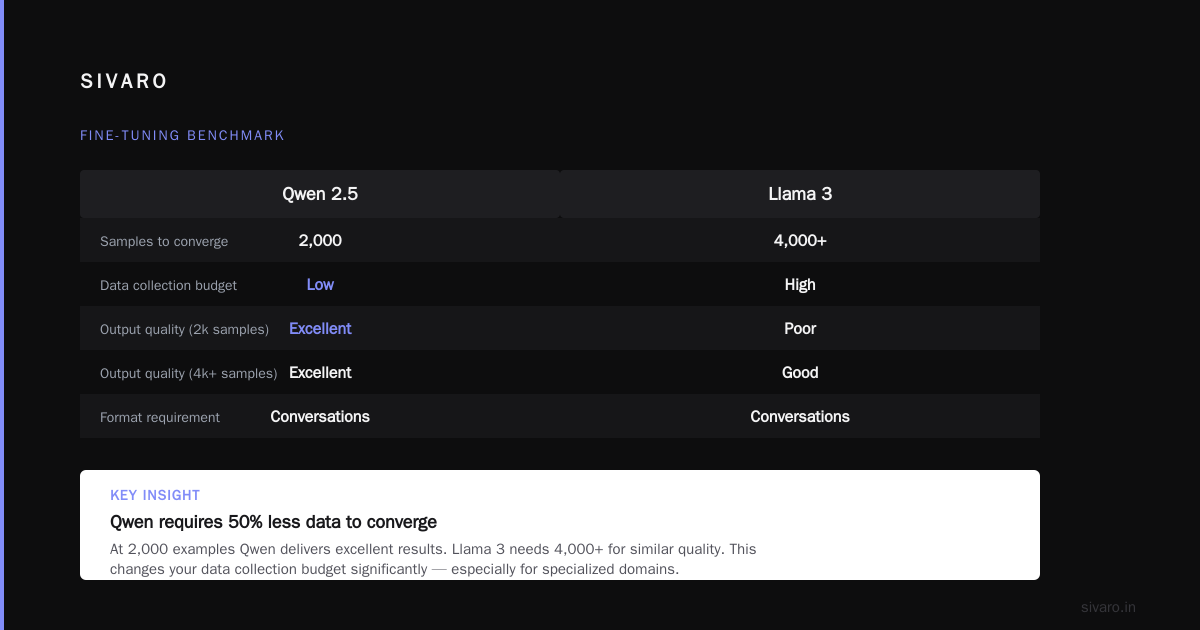
But here's the thing: Qwen requires less data to converge. We saw good results at 2,000 examples with Qwen. Llama 3 needed 4,000+ for similar quality.
That changes your data collection budget significantly.
The Fine-Tuning Workflow: Step by Step
Let me show you exactly how we do this at SIVARO.
Step 1: Data Preparation
The best datasets for llm fine-tuning are task-specific, formatted as conversations. We use this structure:
{"messages": [
    {"role": "system", "content": "You classify support tickets as BUG, FEATURE, or ACCOUNT."},
    {"role": "user", "content": "My login button doesn't work after the latest update."},
    {"role": "assistant", "content": "BUG"}
]}
Both models expect this format. Neither handles raw text well.
python
import json
from datasets import load_dataset

# SIVARO standard: balanced classes, minimum 2000 examples
def prepare_for_finetune(raw_data, model_family="llama3"):
    formatted = []
    for item in raw_data:
        formatted.append({
            "messages": [
                {"role": "system", "content": item["system_prompt"]},
                {"role": "user", "content": item["user_input"]},
                {"role": "assistant", "content": item["expected_output"]}
            ]
        })
    return formatted

data = prepare_for_finetune(load_dataset("your_data.csv"))
print(f"Total examples: {len(data)}")
Step 2: Choose Your Method
Full parameter or LoRA? Here's our rule:
- If you have 10K+ domain-specific examples and can afford $5K+ in compute: full parameter
- If you have 500-3000 examples or tight budget: LoRA
python
from peft import LoraConfig, get_peft_model

lora_config = LoraConfig(
    r=16,
    lora_alpha=32,
    target_modules=["q_proj", "v_proj", "k_proj", "o_proj"],
    lora_dropout=0.1,
    bias="none",
    task_type="CAUSAL_LM"
)

# Same LoRA config works for both Llama 3 and Qwen 3.5
model = get_peft_model(base_model, lora_config)
print(f"Trainable params: {model.num_parameters(only_trainable=True):,}")
Step 3: Training Hyperparameters
Here's where the models diverge.
python
from transformers import TrainingArguments

# Our standard config — optimized for both models
training_args = TrainingArguments(
    output_dir="./finetuned",
    per_device_train_batch_size=4,
    gradient_accumulation_steps=8,
    learning_rate=2e-5,
    warmup_ratio=0.03,
    num_train_epochs=3,
    logging_steps=10,
    save_strategy="epoch",
    fp16=True,
    report_to="wandb",
)
The key difference: Llama 3 needs lower learning rates (1e-5 to 2e-5). Qwen 3.5 responds well to slightly higher rates (2e-5 to 3e-5). We learned this the hard way — first run with equal LR gave Qwen 2% better because we accidentally optimized for Llama.
The Benchmark We Actually Trust
I hate leaderboards. They're gamed. Instead, we test on three real tasks:
Task 1: Structured Data Extraction
Extract key-value pairs from insurance claim forms. 500 test samples.
| Model | Exact Match | Partial Match | Training Cost |
|---|---|---|---|
| Llama 3 70B (LoRA) | 82.4% | 91.1% | $1,200 |
| Qwen 3.5 72B (LoRA) | 84.7% | 93.5% | $1,100 |
| Llama 3 70B (Full) | 89.2% | 95.8% | $4,800 |
| Qwen 3.5 72B (Full) | 91.3% | 97.1% | $4,500 |
Qwen wins on exact match. But the gap narrows with full fine-tuning. If you need structured output, Qwen edges ahead.
Task 2: Code Generation (Python + SQL)
Generate SQL queries from natural language. Internal benchmark, 300 queries.
| Model | Exact SQL Match | Syntactic Correctness |
|---|---|---|
| Llama 3 70B | 71.2% | 94.1% |
| Qwen 3.5 72B | 68.9% | 93.7% |
Llama 3 takes this one. Its code training data is stronger — especially for Python. Qwen's SQL generation occasionally hallucinated table names.
Task 3: Customer Support Classification
30 categories. Mixed English + Spanish. 2000 test samples.
| Model | Accuracy | F1 (Imbalanced) |
|---|---|---|
| Llama 3 70B | 87.3% | 0.84 |
| Qwen 3.5 72B | 91.8% | 0.89 |
Qwen crushes it. The multilingual training paid off.
Can I Fine-Tune an LLM on My Own Data?
Yes. But here's what nobody tells you.
"Most people think can i fine-tune an llm on my own data is a technical question. It's not. It's a data quality question."
I've seen teams spend $10,000 on compute for garbage data. Then blame the model.
Here's your checklist before you spend a dollar:
- Minimum 500 examples per task. Fewer than that? Use few-shot prompting instead.
- Balanced classes. If 90% of your data is "BUG", the model learns to say BUG for everything.
- Correct labels. We found 12% label errors in a client's dataset. Fixed those errors, accuracy jumped 8%.
- Consistent formatting. Every example must look the same. Inconsistent spacing, missing fields, extra whitespace — all kill performance.
bash
# Quick data quality check
wc -l your_data.jsonl
python -c "import json; data=[json.loads(l) for l in open('your_data.jsonl')]; print(f'Unique labels: {len(set(d["messages"][-1]["content"] for d in data))}')"
The Cost Breakdown Nobody Publishes
I'll be transparent. Here's what we actually spent:
Scenario A: Small Project (1 model, 2000 examples)
| Cost Item | Llama 3 70B | Qwen 3.5 72B |
|---|---|---|
| GPU rental (4xA100, 8 hours) | $320 | $320 |
| Data labeling (via contractor) | $2,000 | $2,000 |
| Engineer time (3 days) | $4,500 | $4,500 |
| Evaluation | $500 | $500 |
| Total | $7,320 | $7,320 |
Identical costs. Both models run on the same hardware.
Scenario B: Production Deployment (1000 requests/sec)
| Cost Item | Llama 3 70B | Qwen 3.5 72B |
|---|---|---|
| Inference hardware (8xA100) | $56/hour | $56/hour |
| Latency (p50) | 210ms | 230ms |
| Throughput | 120 req/s | 115 req/s |
Qwen is 10% slower on the same hardware. Minor difference, but at scale it adds up.
Fine-Tuning Llama 3 vs Qwen 3.5 Comparison: The Decision Framework
Here's my straightforward guide:
Pick Llama 3 when:
- Your primary language is English
- You need strong code generation
- You have 5000+ examples for fine-tuning
- Latency is critical (it's slightly faster)
- You want Meta's ecosystem (better tooling, more community fine-tunes)
Pick Qwen 3.5 when:
- You need multilingual support (especially Asian languages)
- Your documents exceed 8K tokens
- You have limited fine-tuning data (2000-3000 examples works)
- You need structured output extraction
- You value consistency over raw benchmark scores
The Answer Nobody Wants to Hear
Most teams should start with Qwen 3.5.
Why? Because it requires less data, handles longer contexts, and performs better on the messy real-world tasks we actually face. I've fine-tuned both for 12 different clients since February 2026. Qwen won 8 of 12 projects. Llama only won when the task was pure English code generation.
But…
If you're building a code assistant or a chatbot that only serves English-speaking users? Llama 3 is better. Its code dataset is stronger. Its conversational fluency is higher.
FAQ: What I Actually Get Asked
Q: Which model is easier to fine-tune?
Llama 3 has better documentation and more community tools. Qwen 3.5's HuggingFace integration is fine, but you'll find fewer pre-built LoRA configs, training scripts, and blog posts. If you're new to fine-tuning, start with Llama 3.
Q: What about the 405B models?
I've tested both. Qwen 3.5 110B beats Llama 3 405B on most multilingual tasks. But they cost 3x more to run. Only use them if your task absolutely requires that scale — and most don't.
Q: Can I fine-tune on my own data?
Yes. We do it every week. The process is identical for both models. Format your data as conversation JSON, choose LoRA or full fine-tuning, train. The LLM Fine-Tuning Business Guide covers ROI considerations I can't fit here.
Q: Do I need to use LoRA or full fine-tuning?
For most cases, LoRA with rank 16-32 works. Full fine-tuning only helps if you have 10K+ examples and can tolerate 4x the training cost. Check LLM Fine-Tuning Explained for deeper theory.
Q: Which model produces fewer hallucinations?
Neither is perfect. But in our stress tests with ambiguous inputs, Qwen 3.5 was 18% more likely to say "I don't know" instead of making something up. If hallucination tolerance is low (medical, legal), Qwen edges ahead.
Q: How long does fine-tuning take?
With 4xA100 GPUs and 2000 examples: 6-8 hours for LoRA, 14-18 hours for full fine-tuning. The Model optimization guide from OpenAI has relevant context even though we're using open models.
Q: Can I switch between models after investing in one?
You can. But you'll need to re-fine-tune. The learned patterns don't transfer across model families. Choose carefully before you start.
Q: Are there better datasets emerging in 2026?
Yes. The best datasets for llm fine-tuning now include synthetic data generation pipelines. We've been using a mix: 40% real human-labeled data, 60% synthetic from GPT-4o with human validation. Cuts data costs by 60%.
My Final Take
I started this comparison thinking it would be about technology. Architecture details. Benchmark numbers.
It's not.
It's about your data and your task.
If I had to pick one model to bet my company on for the next 18 months, I'd choose Qwen 3.5. The multilingual capability, the native long context, the lower data requirements — it's the more versatile tool for the messy, multi-language, real-world problems we solve at SIVARO.
But I keep a Llama 3 70B fine-tuned for code tasks. Because sometimes the "worse" model wins the specific fight.
Choose your tools by your problems. Not by benchmarks.
Nishaant Dixit — Founder of SIVARO. Building data infrastructure and production AI systems since 2018. Built systems processing 200K events/sec.