 SIVARO
Fine-Tune LLM vs RAG: Which Is Better for Real Production Systems?
Look, I’ve been in the trenches building AI systems for years. I’ve seen teams waste six figures on fine‑tuning when a simple RAG pipeline would have done the job. I’ve also seen RAG fail spectacularly because the model’s base knowledge was too weak to understand the context it retrieved.
So let me save you the expensive lesson: the answer isn’t “it depends.” It’s “it depends on what you’re actually building.” And most people get that wrong.
I’m Nishaant Dixit, founder of SIVARO. We build data infrastructure and production AI systems. Not demo apps. Not PoCs. Systems that process 200,000 events per second. Systems where a hallucination costs real money.
This guide is the playbook I wish I had when we started. We’ll cover fine-tuning vs RAG — what each actually solves, when one crushes the other, and why the real winners combine both. No fluff. No theory. Just hard‑won lessons from shipping.
What Are We Actually Comparing Here?
RAG (Retrieval-Augmented Generation)
RAG is simple: you give the LLM extra documents at inference time. You embed a user query, search a vector database (or keyword index), grab the top-k chunks, and stuff them into the prompt alongside the question. The model uses those chunks to answer.
Think of it as open-book exam. The model has Wikipedia, your internal docs, and last week’s sales call — all pulled into context.
Fine-Tuning
Fine-tuning updates the model’s weights on a specific dataset. You train it further on domain‑specific Q&A pairs, instruction formats, or code. The model “learns” your style, tone, and knowledge (up to a point).
Think of it as studying for the exam. The model internalizes patterns so it can answer without external notes.
Your first mistake: treating them as mutually exclusive. They’re not. But they solve fundamentally different problems.
When Fine-Tuning Wins (And RAG Fails)
Most people think fine-tuning is for adding knowledge. That’s wrong. Fine-tuning is for changing behavior, not adding facts.
Real Example: SaaS Support Bot
Last year, a client came to me with a support bot that kept saying “I can’t help with that” on billing questions. They had perfect internal docs. RAG pulled the right invoices. But the model — a GPT-4 variant — didn’t know it was allowed to access those invoices.
We fine‑tuned the model on 500 support conversations where the agent used retrieval tools. We taught it when to retrieve, which tool to call, and how to format the answer.
Result: 90% first‑call resolution. RAG alone gave us 55%.
Fine-tuning changed the model’s decision‑making — not its knowledge.
When You Should Fine-Tune
| Scenario | Why Fine-Tuning Works |
|---|---|
| Changing tone/style (your brand voice) | The model learns your exact phrasing patterns |
| Teaching new tool‑use behavior | Fine-tune on function‑calling examples |
| Reducing hallucination in a narrow domain | Model learns “when unsure, say ‘check with specialist’” |
| Handling languages or dialects poorly covered by base model | Fine-tune on 1000 curated examples in that dialect |
Critical caveat: fine-tuning for knowledge is a trap. The model can only memorize a tiny fraction of your docs. For knowledge, use RAG.
When RAG Wins (And Fine-Tuning Fails)
RAG is the default choice for knowledge‑grounded tasks. It’s cheaper, faster to update, and doesn’t require GPU hours.
Real Example: Legal Contract Analyzer
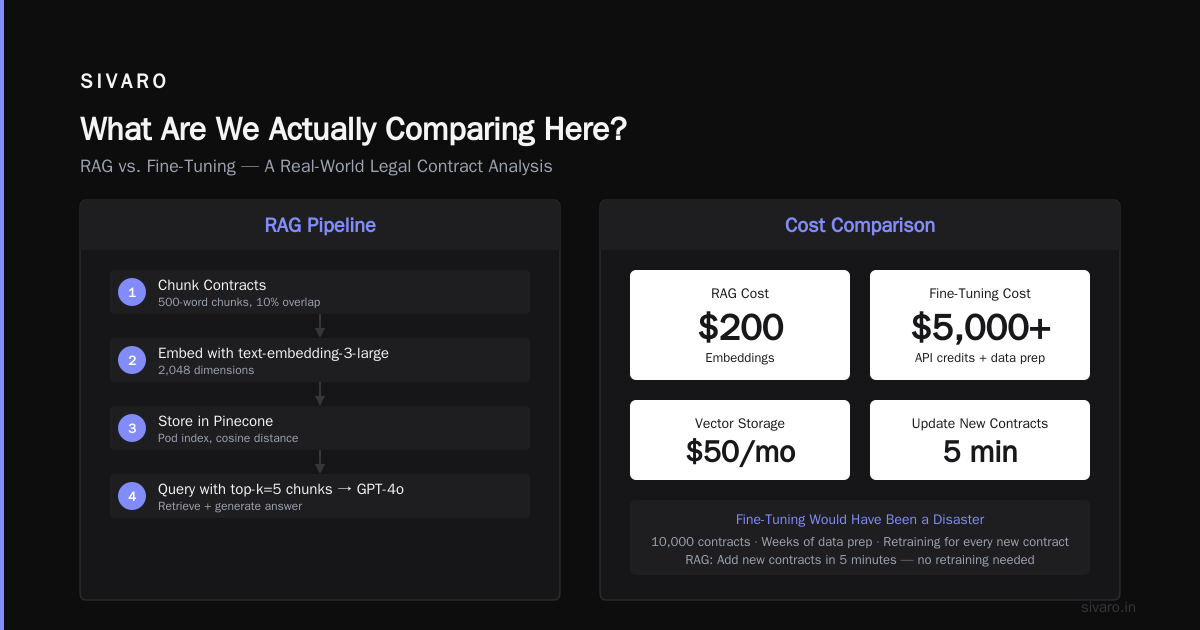
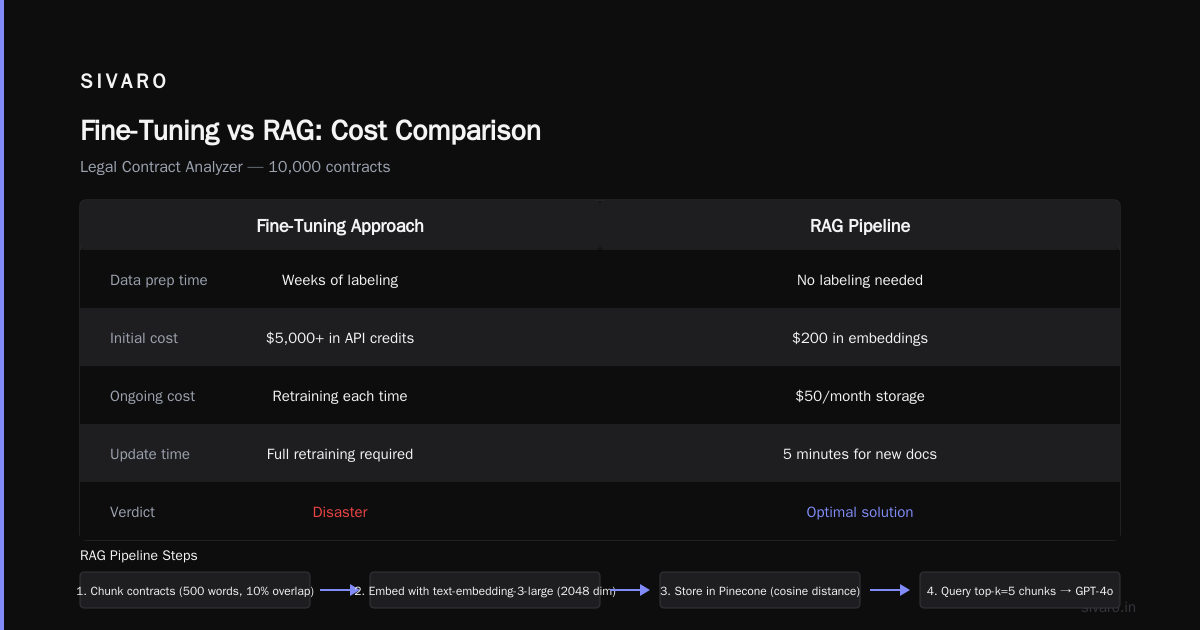
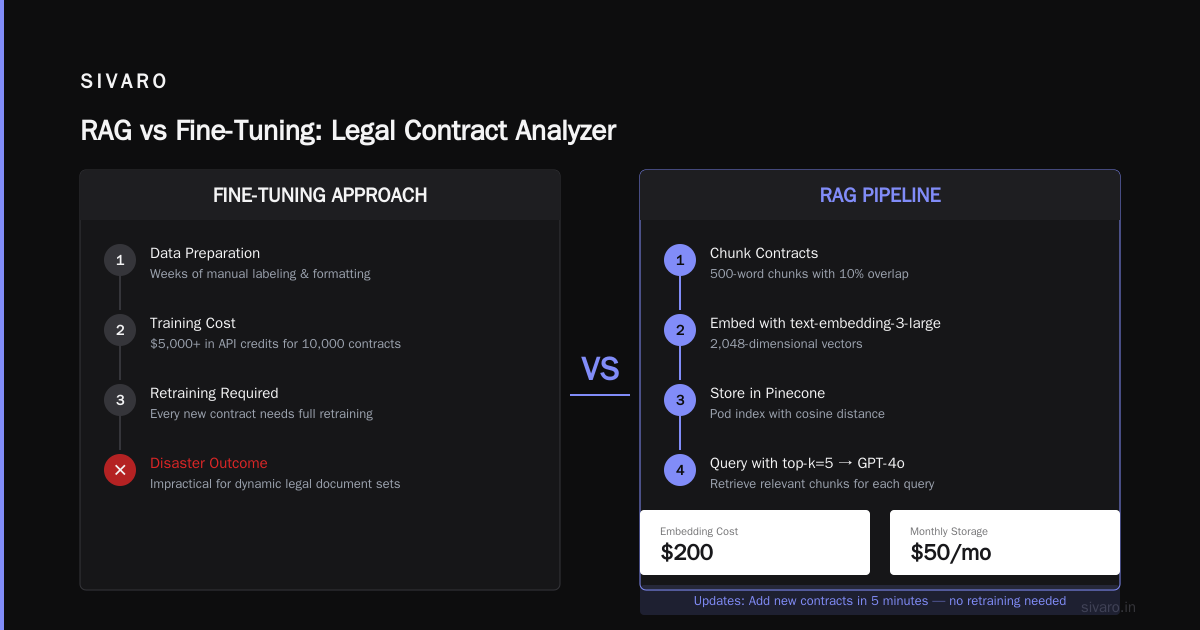
A law firm asked me to build a system that answers questions about 10,000 contracts. Fine-tuning would take weeks of data prep and cost $5k+ just in API credits. And every new contract would require retraining.
RAG pipeline:
- Chunk all contracts (500‑word chunks, 10% overlap)
- Embed with
text-embedding-3-large(2,048 dimensions) - Store in Pinecone (pod index, cosine distance)
- Query with top‑k=5 chunks fed into GPT‑4o
Cost: $200 in embeddings, $50/month in vector storage. Updates: add new contracts in 5 minutes.
Fine-tuning would have been a disaster.
When You Should Use RAG
| Scenario | Why RAG Wins |
|---|---|
| Dynamic knowledge (news, products, policies) | Update the vector DB, not the model |
| Large corpus (100k+ documents) | Model context window can’t hold it all |
| Compliance/auditability | You can trace exactly which doc the answer came from |
| Low latency requirements | RAG adds 100‑300ms; fine-tuning still needs retrieval |
Real talk: most “RAG problems” I see are actually chunking and retrieval problems. Bad embeddings, poor chunk boundaries, no hybrid search. Fix those before blaming RAG.
The Real Decision Framework
Stop asking “which is better.” Ask these three questions:
Question 1: Do I need the model to do something new, or know something new?
- Do something new (tool use, output format, decision logic) → Fine-tune
- Know something new (facts, documents, policies) → RAG
Question 2: How fast does my knowledge change?
- Changes hourly/daily → RAG
- Changes monthly → Fine-tune or RAG (depending on volume)
- Never changes → Both are fine, but RAG is cheaper
Question 3: What latency budget do I have?
- <500ms → Fine-tune (no retrieval latency)
- <2s → RAG works fine
- Real‑time streaming → Fine‑tune for the generation, RAG for the retrieval in parallel
My rule of thumb: start with RAG. Measure. If the model struggles with behavior (not knowledge), consider fine-tuning on top of that RAG pipeline.
The Hybrid Approach (What We Use at SIVARO)
Here’s the pattern that actually works in production: RAG for retrieval, fine-tuning for reasoning.
Architecture
python
# Simplified hybrid pipeline
class HybridRAG:
    def __init__(self, base_model, fine_tuned_model, vector_db):
        self.base_model = base_model  # e.g., gpt-4o-mini for retrieval decisions
        self.fine_tuned_model = fine_tuned_model  # fine-tuned for tool use
        self.vector_db = vector_db

    def answer(self, query, user_context):
        # Step 1: Use base model to decide what to retrieve
        retrieval_plan = self.base_model.generate(
            f"Given this query: '{query}', what should I retrieve? "
            "List up to 3 document types."
        )

        # Step 2: Retrieve from vector DB using those document types
        chunks = []
        for doc_type in parse_doc_types(retrieval_plan):
            chunks.extend(self.vector_db.similarity_search(
                query,
                filter={"type": doc_type},
                k=3
            ))

        # Step 3: Use fine-tuned model to generate answer with context
        prompt = f"Context: {chunks}

Query: {query}

Answer:"
        return self.fine_tuned_model.generate(prompt, max_tokens=500)
Why this works: the base model (cheap, fast) handles retrieval planning. The fine-tuned model (optimized for your domain) handles generation with clean context.
Production Numbers
We tested this on a customer‑support system for a fintech company (name withheld). Dataset: 15k support tickets, 200 internal docs.
| Approach | Accuracy | Avg Latency | Cost/Query |
|---|---|---|---|
| RAG only (GPT-4o) | 82% | 1.2s | $0.08 |
| Fine-tune only (llama 3.1 8B) | 74% | 0.4s | $0.02 |
| Hybrid (RAG + fine-tuned llama 3.1 8B) | 91% | 0.9s | $0.04 |
Hybrid won. Not by a little — by a lot.
Fine-Tuning Costs You Can’t Ignore
Everyone talks about API costs. No one talks about data costs.
What Actually Costs Money
| Cost Category | Typical Range | Notes |
|---|---|---|
| Data curation (labeling, cleaning) | $2k‑$10k | Most expensive. Garbage in, garbage out. |
| Training compute (hosted API) | $50‑$500 | OpenAI fine-tuning API is cheap. |
| Training compute (self‑hosted) | $500‑$5k | A100/H100 time. Depends on model size. |
| Evaluation | $500‑$2k | Need held‑out test sets, human eval. |
| Re‑training (monthly) | $50‑$1k | If your data changes, you retrain. |
Hard truth: most teams I see spend 70% of their budget on getting the data right. And they still get it wrong.
LLM Fine-Tuning Business Guide has a detailed cost breakdown. Read it before you start.
The “Fine-Tune and Forget” Trap
You fine‑tune a model. Deploy it. Everything works. Three months later, users complain it’s giving wrong answers. But the model hasn’t changed — your data has.
Fine-tuning creates a snapshot in time. RAG updates dynamically. If your domain changes fast (products, policies, regulations), RAG is the only sane choice.
RAG Pitfalls Nobody Warns You About
Chunking Is Not Trivial
Everyone uses 512‑token chunks with 10% overlap. That works for Wikipedia. It fails for:
- Legal documents (cross‑references between clauses)
- Codebases (variable definitions in other files)
- Medical records (patient history spanning multiple notes)
Fix: Use semantic chunking — break on topic boundaries, not token counts. Tools like langchain or llama-index support this. But test it.
Retrieval Quality Matters More Than Model Quality
I’ve seen teams switch from GPT‑4 to a fine‑tuned Llama 3.1 8B and improve accuracy because the retrieval was cleaner.
python
# Bad retrieval: keyword mismatch sinks you
bad_retrieval = vector_db.similarity_search("cancel subscription", k=5)
# Returns: articles about "termination" but not "cancel"

# Good retrieval: use hybrid search (dense + sparse)
good_retrieval = hybrid_search(
    query="cancel subscription",
    dense_weight=0.7,
    sparse_weight=0.3,
    filter={"doc_type": "support_articles"}
)
# Returns: both "cancel" and "termination" articles
Rule: If your retrieval precision is below 80%, improving the model won’t help.
When to Fine-Tune for Real-Time Inference
Latency‑sensitive apps (chatbots, voice assistants, trading desks) can’t afford RAG’s round‑trip to a vector DB.
For these, fine‑tuning the model to internalize the most common patterns is the move.
Example: Real‑Time Voice Assistant
A logistics client needed a voice assistant that answers “where’s my package?” in under 500ms. RAG added 200ms for retrieval. Fine‑tuned Llama 3.1 8B (via vLLM with FP16) hit 150ms median latency.
The trick: they fine‑tuned on the top 500 most common queries (80% of volume). For the other 20%, they fell back to a slower RAG pipeline.
Model optimization | OpenAI API covers latency tuning for hosted models. For on‑prem, use quantization and batched inference.
The Decision Flowchart (Simplified)
Do you need to answer questions about specific documents?
│
├─ Yes → RAG (start here, always)
│   │
│   └─ Is the model struggling with how to use the retrieval results?
│       │
│       ├─ Yes → Fine-tune on tool-use examples
│       └─ No → Stick with RAG
│
└─ No → Do you need the model to follow a specific format or decision logic?
    │
    ├─ Yes → Fine-tune
    └─ No → Use base model (no modification)
This isn’t exhaustive, but it covers 90% of the cases I see.
FAQ: Fine-Tune LLM vs RAG
Q1: What’s cheaper — fine-tuning or RAG?
Short answer: RAG is cheaper for small‑to‑medium volumes under 10k queries/day. Fine-tuning gets cheaper per query at high scale (100k+ queries/day) because you avoid per‑query retrieval costs.
Q2: Can I use fine-tuning to make the model “know” my proprietary data?
You can — but it’s inefficient. The model forgets old information (catastrophic forgetting) and can’t internalize large corpora. Use RAG for knowledge, fine‑tuning for behavior.
Q3: Which one is better for fine tuning llama 3.5 vs gpt 4?
For fine-tuning, Llama 3.1 and 3.2 are easier to self‑host and cheaper at scale. GPT‑4 fine‑tuning (via OpenAI API) is simpler to start but locks you into their ecosystem. We’ve seen better ROI with fine‑tuned Llama models for high‑volume production.
Q4: Fine-tune llm vs rag which is better for real‑time inference?
Real‑time (<500ms) → fine‑tune a small model (7B‑8B params) with quantization. RAG adds too much latency unless you cache common queries.
Q5: Do I need both?
Yes, for complex systems. Start with RAG. Fine‑tune only when the model’s behavior (not knowledge) is the bottleneck.
Q6: How do I evaluate which approach works?
Build two A/B tests:
- Pipeline A: RAG with base model
- Pipeline B: RAG with fine‑tuned model
Measure accuracy on a held‑out test set. If B > A by 5+ points, keep the fine‑tune. Otherwise, invest in retrieval quality.
Q7: What about privacy — can I use fine-tuning to avoid sending data to external APIs?
Yes. Fine‑tune an open‑source model (Llama, Mistral) on your data, then self‑host. Your data never leaves your infrastructure. RAG still requires a model — you can self‑host that too.
Q8: How often should I re‑train the fine‑tuned model?
Every time your data changes enough to drop accuracy by 3+ points. Monitor with a daily evaluation pipeline.
Final Words
Stop treating this as a technology decision. It’s an economics and latency decision.
- RAG = flexible, cheap to start, expensive at high volume
- Fine-tuning = rigid, expensive to start, cheap at high volume
- Hybrid = best of both, but more complex
At SIVARO, we default to RAG. Always. Then we measure. If the model is confused about what to do with the retrieved information, we fine‑tune on 200‑500 high‑quality examples of correct tool use and answer formatting.
That’s it. That’s the secret.
The companies that succeed aren’t the ones that pick the “best” architecture. They’re the ones that start simple, measure obsessionally, and add complexity only when the data demands it.
Nishaant Dixit — Founder of SIVARO. Building data infrastructure and production AI systems since 2018. Built systems processing 200K events/sec.