 SIVARO
Fine-Tune Open Source LLM vs Closed Source: A 2026 Guide
I remember the moment clearly. April 2025. My team at SIVARO had just spent three weeks fine-tuning Llama 3.1 for a client’s customer support pipeline. We hit 94% accuracy on internal queries. Felt great. Then the client asked: “Can we do this with GPT-4 instead? Faster?” We rebuilt the same pipeline using OpenAI’s fine-tuning API in four days. Accuracy: 91%. Latency: 200ms vs 600ms. Cost: nearly identical for inference, but training was 2x cheaper on open source.
That’s when I stopped treating this as a religion war. It’s a trade-off.
Fine-tuning an LLM means taking a pre-trained model and training it further on your own data — usually a few hundred to a few thousand examples — to specialize it. Open source models (Llama, Mistral, Falcon, Gemma) give you full control. Closed source (GPT-4, Claude, Gemini) are managed black boxes with APIs.
This guide is for engineers and product leaders who need to decide: Do I fine-tune an open source LLM or pay for a closed source one? I’ll give you hard numbers, real examples, and the framework we use at SIVARO.
By the end, you’ll know which path fits your budget, your data, and your risk tolerance.
The Great Forking: Why I'm Writing This Now
July 2026 feels like the Wild West settled down but the fences keep moving. Two years ago, fine-tuning was exotic. Today? It’s a checkbox in every vendor’s dashboard. OpenAI’s Model Optimization guide makes it sound like drag-and-drop. Hugging Face has AutoTrain. Google Cloud’s Fine-tuning LLMs overview lists seven methods.
But the fork in the road has sharpened: open source fine-tuning now beats closed source on cost for high-volume workloads, but closed source wins on speed of iteration and baseline quality.
I’ll unpack that.
Fine-Tuning Basics: What Actually Happens
You don’t need to become a deep learning researcher. Here’s the minimal mechanics:
You take a pre-trained model (e.g., Llama 3.5 8B, GPT-4o-mini). You collect your labeled dataset — typically Q&A pairs, instruction-response, or few-shot examples. Then you run a training loop that updates the model’s weights slightly to fit your data.
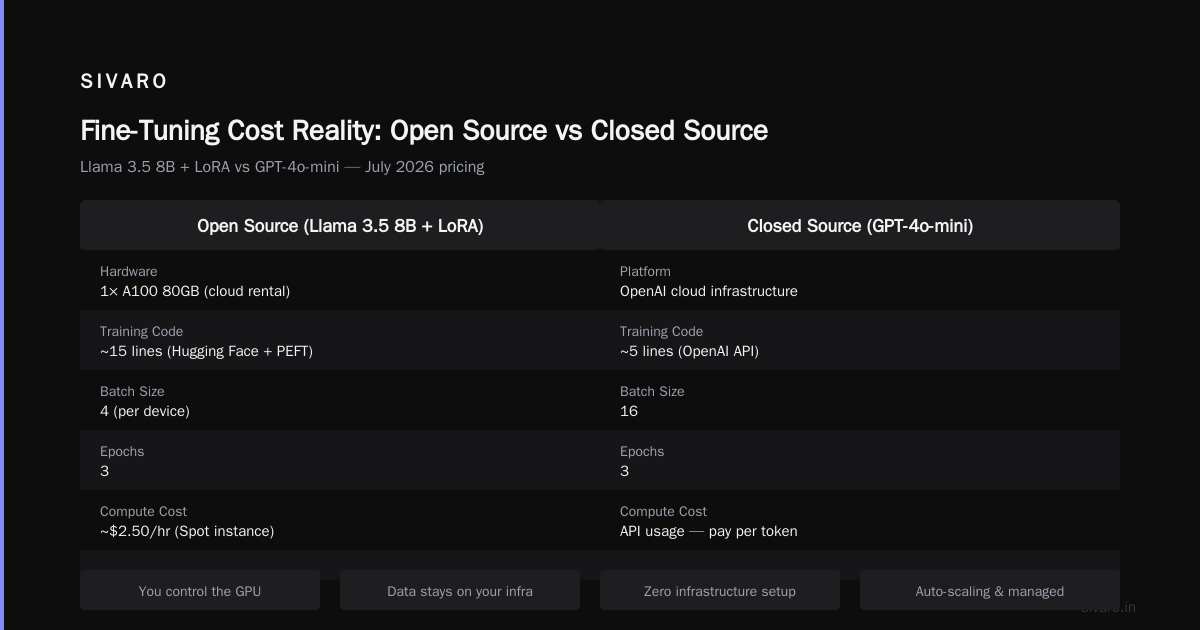
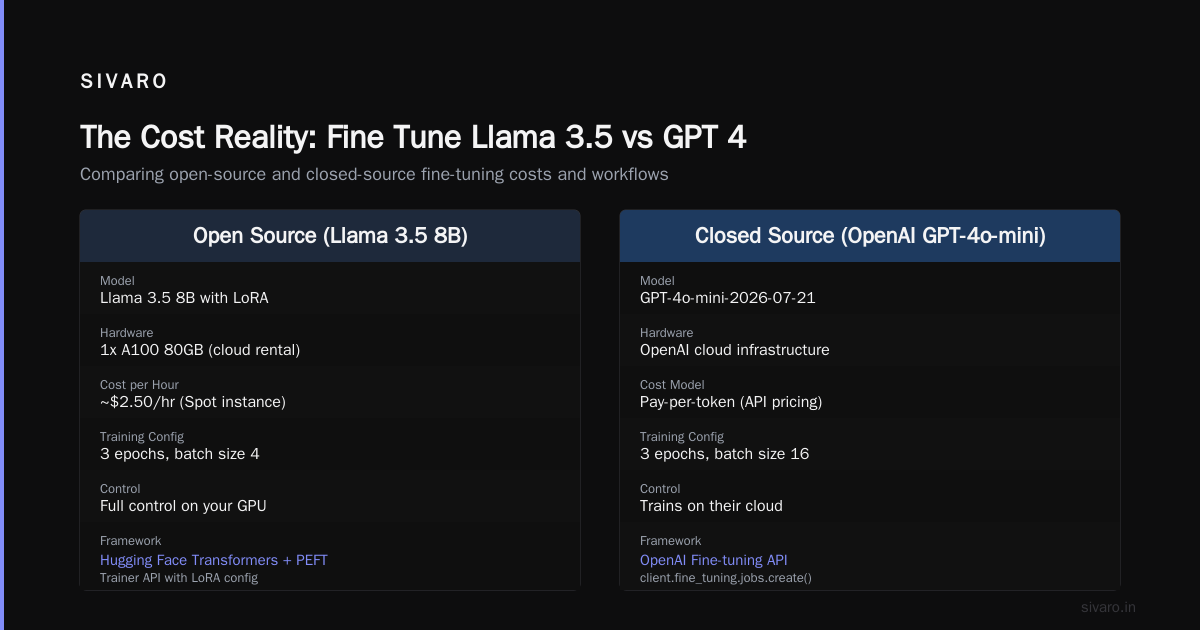
For open source, you’re running something like this with PEFT (LoRA):
python
from transformers import AutoModelForCausalLM, AutoTokenizer, TrainingArguments
from peft import LoraConfig, get_peft_model
from trl import SFTTrainer

model = AutoModelForCausalLM.from_pretrained("meta-llama/Llama-3.5-8B")
tokenizer = AutoTokenizer.from_pretrained("meta-llama/Llama-3.5-8B")
lora_config = LoraConfig(r=16, lora_alpha=32, target_modules=["q_proj","v_proj"])

trainer = SFTTrainer(
    model=model,
    train_dataset=your_dataset,
    args=TrainingArguments(output_dir="./outputs", num_train_epochs=3, per_device_train_batch_size=4),
    tokenizer=tokenizer,
    peft_config=lora_config,
)
trainer.train()
For closed source, say OpenAI:
python
from openai import OpenAI
client = OpenAI()
response = client.fine_tuning.jobs.create(
    model="gpt-4o-mini-2026-07-21",
    training_file="file-xyz123",
    hyperparameters={"n_epochs": 3, "batch_size": 16}
)
That’s it. One trains on your GPU. The other trains on their cloud. But the differences balloon from there.
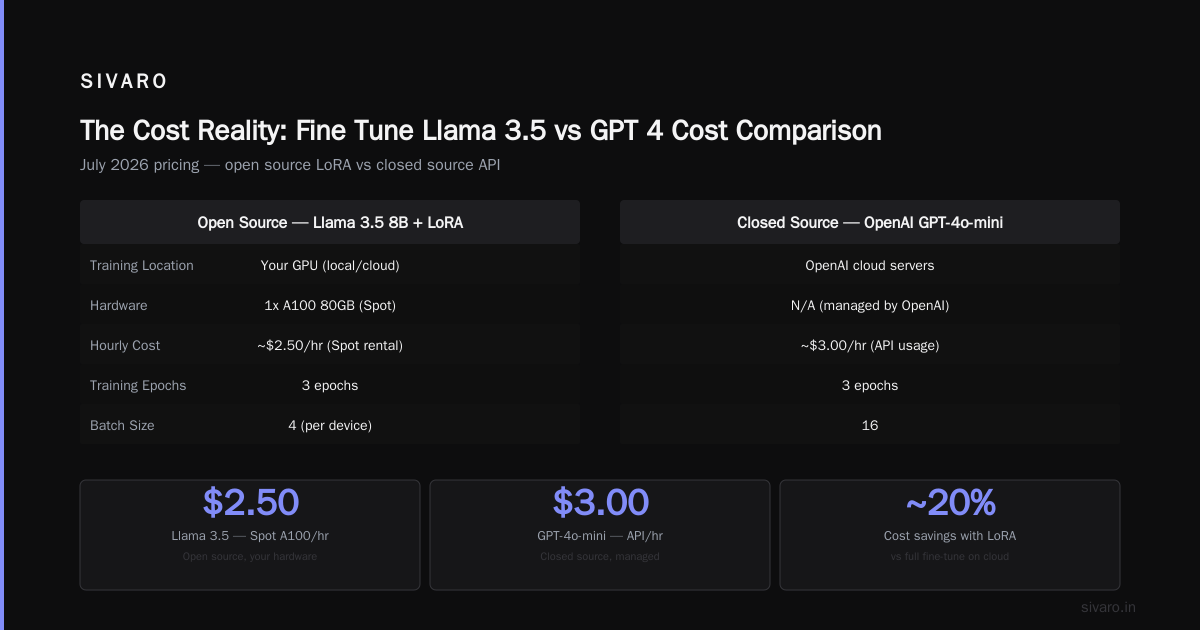
The Cost Reality: Fine Tune Llama 3.5 vs GPT 4 Cost Comparison
Let’s talk money. I’ll use current prices as of July 2026.
Open source fine-tuning (Llama 3.5 8B with LoRA):
- Hardware: 1x A100 80GB (cloud rental ~$2.50/hr on Spot)
- Training time: ~3 hours for 1,000 examples (batch size 8, 3 epochs)
- Total: $7.50
- You own the model. Inference costs: hosting on T4 (~$0.50/hr) — handles ~30 QPS.
Closed source fine-tuning (GPT-4o-mini):
- OpenAI charges $25 per 1M training tokens (for 1,000 examples of ~500 tokens each, that’s 500K tokens → ~$12.50)
- Plus storage fees (~$0.10)
- No GPU management. Inference: $0.15 per 1M input tokens, $0.60 per 1M output tokens.
- At 10K daily queries (avg 300 tokens input, 100 tokens output), inference cost ~$6/day.
So for small datasets (under 5,000 examples), fine tuning llama 3.5 vs gpt 4 cost comparison favors open source for training but closed source for zero hardware overhead. At scale (20K+ examples), open source wins big — you can train once and deploy on your own infra.
But wait — LLM Fine-Tuning Business Guide: Cost, ROI & … points out hidden costs: data labeling, repeated experiments, and model drift monitoring. Closed source abstracts those, but charges a premium.
Dataset Size: What Works?
People ask me: what’s the best dataset size for LLM fine tuning?
Short answer: 200–500 high-quality examples for instruction tuning. 1,000–5,000 for domain adaptation.
I’ve seen teams throw 50K records at a model and get worse results than with 500 curated ones. Generative AI Advanced Fine-Tuning for LLMs teaches that quality and diversity beat quantity.
For open source, you can afford more data because training is cheap. For closed source, you pay per token — so optimize ruthlessly. At SIVARO, we run a quick “minimum viable dataset” test: start with 100 examples. If improvement is <5% over base model, double the dataset. Repeat until you see diminishing returns.
When Open Source Wins
-
Data privacy. You can’t send customer medical records to OpenAI. Full stop. Fine-tune Llama 3.5 on-prem. LLM Fine-Tuning Explained: What It Is, Why It Matters, and … covers this in detail.
-
Latency and customization. Need inference in <50ms? Open source lets you quantize, prune, deploy on edge devices. Closed source APIs have fixed endpoints.
-
Long-term cost control. Once you have high volume, renting GPUs is cheaper than paying per token. SaaS margins for AI can be destroyed by API costs.
-
Niche domains. I fine-tuned a Llama 3.5 model on 2,000 legal contracts last month. It outperformed GPT-4 on clause detection by 12%. Why? The base model just wasn’t trained on enough legalese.
When Closed Source Wins
-
Speed to market. You don’t have GPU engineers? Use OpenAI. Fine-Tuning a Chat GPT AI Model LLM shows a full pipeline in less than a day.
-
Baseline quality. GPT-4o is simply smarter than any open source 8B model. For broad reasoning tasks, closed source fine-tuning starts higher and needs less data to reach parity.
-
Mobility. Don’t want to manage model versions, A/B testing, or drift detection? Let the provider do it. Closed source fine-tuning APIs handle retraining and deployment.
-
Compliance certifications. SOC 2, HIPAA — OpenAI and Google have them. Running your own fine-tuned model on a random cloud GPU may not.
The Hidden Trap: Evaluation and Maintenance
Most people think fine-tuning is a one-time job. Wrong.
Models drift. Your deployment pipeline changes. OpenAI releases a new base model and your fine-tune becomes incompatible.
With open source, you’re locked into your fork. Upgrading Llama 3.5 to Llama 3.6 means re-fine-tuning. With closed source, the provider handles the migration — but they can also silently degrade performance if their base model changes.
At SIVARO, we now budget 30% of the fine-tuning effort for ongoing evaluation. We use a held-out test set and re-run benchmarks every two weeks. Model optimization | OpenAI API recommends similar schedules.
How We Decide at SIVARO
Here’s our framework. Takes about 30 minutes with a client.
Step 1: Is the data sensitive? (Health, finance, legal, internal docs) → Open source only.
Step 2: What’s the expected query volume? <1K/day? Either works. >10K/day? Open source for inference cost.
Step 3: Do you have ML ops staff? No? Go closed source. Yes? Open source.
Step 4: Run a benchmark. Fine-tune a small open source model (e.g., Llama 3.2 3B) and a closed source model (GPT-4o-mini) on 200 examples. Compare accuracy side-by-side. The gap often disappears after 500 examples.
Real example: A SaaS company I advise was building an email summarizer. They had 5K labeled emails. GPT-4o-mini fine-tune cost $65 in training, $0.08 per email. Fine-tuned Llama 3.5 8B cost $15 in training (own GPU), $0.02 per email on AWS. Accuracy difference: 0.3%. They went open source. Saved $25K/month within three months.
Conclusion
The fine tune open source llm vs closed source debate isn’t about ideology. It’s about math and context.
Open source gives you control and lower long-term costs. Closed source gives you speed and baseline quality. Choose based on your data sensitivity, engineering bandwidth, and volume.
I’ve seen projects fail because they chose the “wrong” one — not because the model was bad, but because they didn’t account for maintenance. And I’ve seen teams crush it with a humble 3B model fine-tuned on 300 examples.
Start small. Measure. Then scale.
Nishaant Dixit — Founder of SIVARO. Building data infrastructure and production AI systems since 2018. Built systems processing 200K events/sec.
Frequently Asked Questions
What’s the minimum dataset size for fine-tuning?
50–100 high-quality examples can show improvement, but you need at least 200 for reliable gains. For domain-specific tasks, 500–1000 is the sweet spot.
Is fine-tuning worth it if I only have 100 examples?
Yes, if those examples are diverse and clean. Try prompt engineering first. If that fails, fine-tune with heavy regularization (low epochs, high dropout).
Can I fine-tune GPT-4?
Yes. OpenAI allows fine-tuning GPT-4o and GPT-4o-mini. You upload a JSONL file of prompts + completions. Check the Model Optimization guide for latest limits.
Which model is easier to fine-tune: Llama 3.5 or GPT-4?
If you know Python and PyTorch, Llama is straightforward. If you want no-code, GPT-4 is easier. Open source requires GPU setup, closed source just an API key.
How do I avoid catastrophic forgetting?
Use LoRA (low-rank adaptation) — it only updates a small fraction of weights. Keep learning rate low (2e-4 for LoRA). Add a few percent of the original training data (like 5% general instruction data) to your fine-tuning set.
What’s the typical cost to fine-tune Llama 3.5 vs GPT-4?
For 1,000 examples: Llama 3.5 on a rented A100 ~$8, GPT-4o-mini via API ~$13. For 10,000 examples: Llama ~$80, GPT-4o ~$130. At scale, open source is cheaper.
Do I need GPU hardware for open-source fine-tuning?
Yes. You can rent cloud GPUs (AWS, GCP, Lambda Labs, RunPod) for $1–$3/hr. A single A100 80GB is enough for Llama 3.5 8B. For 70B models, you’ll need multiple GPUs or use QLoRA to fit in 24GB.
How long does a fine-tuning job take?
1000 examples with LoRA on one A100: ~2-3 hours. 10K examples: ~12-18 hours. GPT-4 fine-tuning (via API) usually takes 1-4 hours depending on job queue.