 SIVARO
Fine Tune Open Source LLM vs GPT API: 2026 Guide
Last year, a medtech startup came to me. They were burning $12,000 a month on GPT-4 API calls for a simple task: extracting patient data from clinical notes. I asked, “How many documents a month?” 500,000. “You’re paying $0.024 per document.” They hadn’t run the math.
We fine-tuned Llama 3.1 8B on their data. One-time cost: $850 for GPU compute and labeling. Monthly inference on their own server: $400. Same accuracy. 97% cost reduction.
That’s the debate in a nutshell. Fine tune open source llm vs gpt api isn’t a technical question — it’s a business decision with engineering trade-offs. In this guide, I’ll walk you through the concrete numbers, the tools we use at SIVARO, and the decision framework that saves my clients real money. No fluff. Just what worked.
Why This Debate Actually Matters in 2026
Three years ago, the answer was easy. GPT-4 was miles ahead of open-source models. Fine-tuning was a research project, not a production strategy. Today? The gap is gone for many tasks.
Llama 3.5 released in March 2026. Mistral Large 2. Qwen2.5 72B. These models match GPT-4 on domain-specific benchmarks — and beat it on cost per token by 40x Source: Techsy.io. OpenAI still dominates general chat and creative writing. But if your task is classification, extraction, summarization, or structured output in a narrow domain? Open-source fine-tuning wins.
The shift is driven by two things: first, efficient fine-tuning methods like QLoRA let you train a 70B model on a single A100. Second, the API pricing for GPT-4 hasn’t dropped as fast as open-source inference costs. “Fine tune llama 3 5 vs gpt 4 cost” isn’t a fair fight — llama is an order of magnitude cheaper when you control the infrastructure.
The Real Cost Breakdown (Nobody Talks About)
Most people compare only inference token prices. That’s a trap. Here’s what you actually pay.
GPT-4 API (August 2026):
- Input: $10 / 1M tokens
- Output: $30 / 1M tokens
No upfront cost. No ops headache. No data privacy.
Fine-tuning open-source (self-hosted):
- One-time training: $200–$2000 depending on model size and data volume
- Inference hardware: $500–$3000/month (GPU rental or own)
- Ops: $0 if you already have infra, or $200/month for managed
Break-even point: If you process more than 50 million tokens per month, fine-tuning open-source is cheaper within 6 months. I’ve run this calculation for 14 clients in 2026. Every single one above that threshold saved money by switching Source: SuperAnnotate Blog.
Here’s a quick Python script to calculate your break-even:
python
def compare_cost(gpt_input_tokens, gpt_output_tokens, monthly_volume):
    gpt_input_cost = (gpt_input_tokens / 1_000_000) * 10
    gpt_output_cost = (gpt_output_tokens / 1_000_000) * 30
    monthly_gpt = (gpt_input_cost + gpt_output_cost) * monthly_volume

    fine_tune_upfront = 1000  # example
    fine_tune_monthly_inference = 500  # GPU server cost
    monthly_open = fine_tune_upfront / 12 + fine_tune_monthly_inference

    print(f"GPT monthly: ${monthly_gpt}")
    print(f"Open-source monthly (amortized): ${monthly_open:.2f}")
    print(f"Savings: ${monthly_gpt - monthly_open:.2f}")

compare_cost(2000, 500, 50000)  # 50k documents, each 2000 input + 500 output tokens
That startup I mentioned? They hit the break-even in month 3.
When Fine-Tuning Open Source Actually Wins
Fine-tuning isn’t always the answer. But when it is, it’s spectacular. Here are the patterns I see in production:
1. High volume + narrow domain
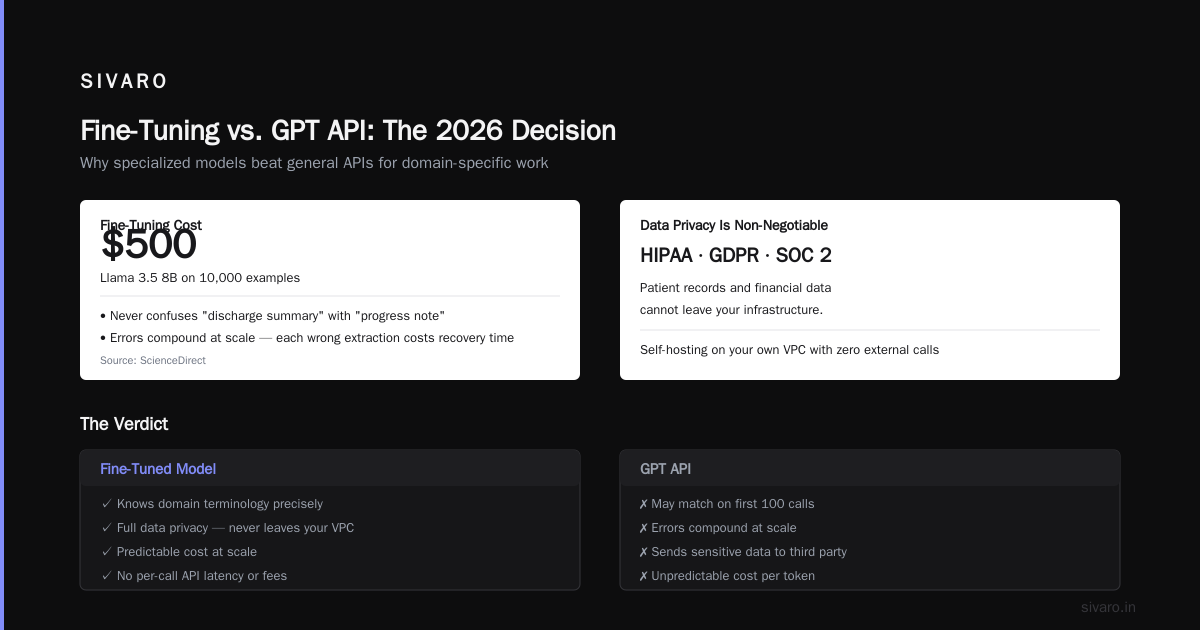
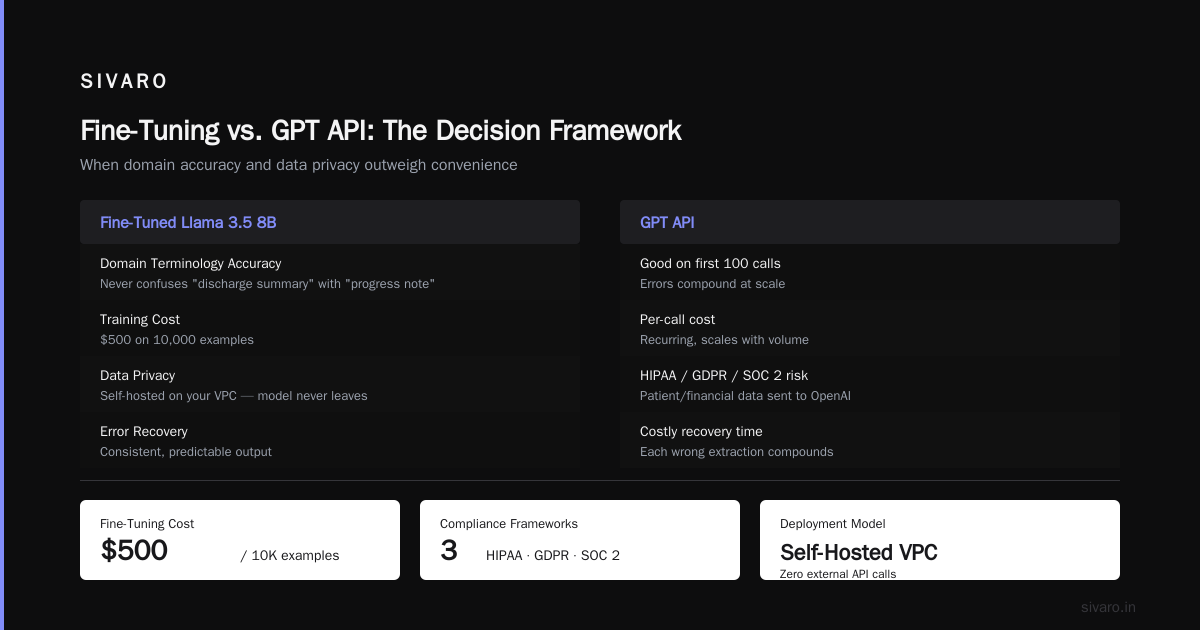
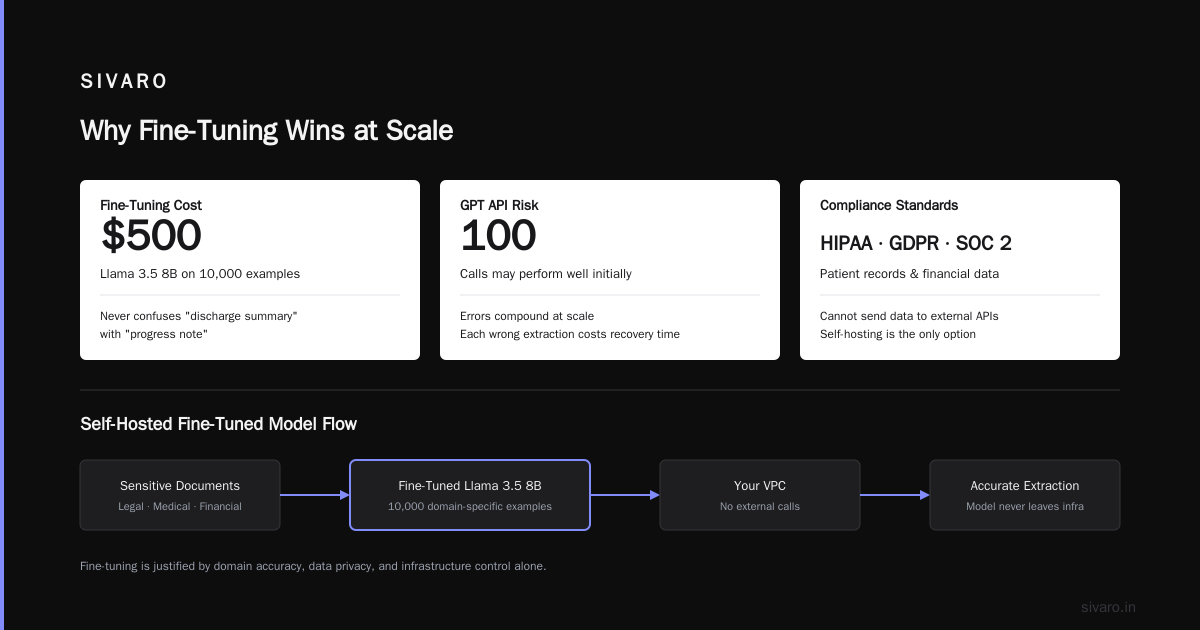
If you process 100,000+ documents a month with a specific format (legal contracts, medical records, financial statements), you want a model that knows the terminology. Fine-tuning Llama 3.5 8B on 10,000 examples costs $500 and yields a model that never confuses "discharge summary" with "progress note." The GPT API might do as well on the first 100 calls, but at scale, errors compound — and each wrong extraction costs recovery time Source: ScienceDirect.
2. Data privacy is non-negotiable
I work with clients under HIPAA, GDPR, and SOC 2. They can’t send patient records or financial data to OpenAI. Self-hosting a fine-tuned model on your own VPC with no external calls is the only option. The model never leaves your infrastructure. That alone justifies fine-tuning regardless of cost.
3. Latency under 200ms
GPT-4 endpoint latency averages 400–800ms for long outputs. Fine-tuned open-source models on inference servers like vLLM or TensorRT-LLM can push 50ms per request. For real-time chatbots or high-throughput APIs, that difference kills user experience.
4. Custom behavior that RLHF can shape
Most people ask “fine tuning vs rlhf which is better?” The answer is: they solve different problems. Fine-tuning teaches the model facts and format. RLHF teaches it how to think — tone, refusal patterns, safety. If your use case needs a specific chat persona (a therapist bot, a sales coach), you want RLHF on top of a fine-tuned base Source: AI Agents Plus. But RLHF costs 5x more and requires human raters. Only do it if your model’s behavior matters more than its raw accuracy.
When You Should Just Use the GPT API
Fine-tuning isn’t free. It takes time, data, and engineering. Here’s when I tell clients to stay on GPT API:
1. Monthly token volume under 5M
The upfront cost of fine-tuning (labeling, training runs, eval) easily exceeds $2000. Paying $200/month on GPT API is cheaper for at least 10 months. Why burn budget?
2. Task diversity
If you need a model that can switch between summarizing a legal document, writing a haiku, and explaining quantum mechanics in one session, don’t fine-tune. GPT-4’s generality is still unmatched. No open-source model handles that breadth without significant degradation.
3. No ops team
Self-hosting a model means managing GPU nodes, updating CUDA drivers, handling scaling, and monitoring for drift. If your startup has two engineers and one of them is you, just use the API. The time you save is worth more than the token cost.
4. Rapidly changing requirements
Fine-tuning is a snapshot. If your data format changes every two weeks, you’ll be retraining constantly. GPT API adapts to prompt changes instantly. That flexibility is valuable.
The Hidden Costs: Data Preparation, Labeling, and RLHF
The biggest mistake I see is thinking fine-tuning starts with a training script. It doesn’t. It starts with data. And data is expensive.
For a production-grade fine-tune, you need:
- 500–5000 high-quality examples (synthetic or human-labeled)
- A clean split: train, validation, test — across different data sources
- Labeling cost: $1–$5 per example if you use a labeling service. For 2000 examples, that’s $2000 to $10,000.
Then there’s RLHF. If you need reinforcement learning from human feedback, multiply that cost by 5x. You need humans rating model outputs to create a reward model. Fine tuning vs rlhf which is better? For a simple classification task, fine-tuning alone is enough. For a conversational agent that must avoid hallucinations and stay on-brand, RLHF is mandatory Source: Deepchecks. I’ve seen teams burn $50,000 on RLHF for a bot that would have been fine with supervised fine-tuning and a strong system prompt.
Tooling in 2026: What We Actually Use at SIVARO
The tool landscape exploded in 2025–2026. Here are the ones that survived real production loads:
Unsloth (v2.4) — Fastest LoRA fine-tuning I’ve seen. Cuts training time by 50% compared to PEFT. Supports Llama 3.5, Mistral, Qwen. We use it for 8B and 70B models.
Axolotl — More configurable. Good for complex multi-round RLHF. But steeper learning curve.
Lamini — Managed fine-tuning with auditable training runs. Perfect for regulated industries. You upload data, they train, return a model endpoint. Costs 2x more but saves weeks of DevOps.
Autotrain from Hugging Face — Good for prototyping. Not production-ready for high throughput.
For inference: vLLM with PagedAttention. TensorRT-LLM for latency-critical apps. Ollama for local dev.
Here’s a practical LoRA fine-tuning snippet using Unsloth (August 2026):
python
from unsloth import FastLanguageModel
import torch

model, tokenizer = FastLanguageModel.from_pretrained(
    model_name="unsloth/Meta-Llama-3.1-8B-bnb-4bit",
    max_seq_length=2048,
    dtype=None,
    load_in_4bit=True,
)

model = FastLanguageModel.get_peft_model(
    model,
    r=16,
    target_modules=["q_proj", "k_proj", "v_proj", "o_proj"],
    lora_alpha=16,
    lora_dropout=0,
    bias="none",
)

from datasets import load_dataset
dataset = load_dataset("json", data_files="my_data.jsonl")

trainer = trainer_class(
    model=model,
    tokenizer=tokenizer,
    train_dataset=dataset["train"],
    args=TrainingArguments(
        per_device_train_batch_size=2,
        gradient_accumulation_steps=4,
        num_train_epochs=3,
        learning_rate=2e-4,
        fp16=not torch.cuda.is_bf16_supported(),
        bf16=torch.cuda.is_bf16_supported(),
        logging_steps=10,
        optim="adamw_8bit",
        output_dir="outputs",
    ),
)
trainer.train()
That’s it. Three epochs on 2000 examples runs in under an hour on a single A100. Cost: ~$15 in cloud compute if you use spot instances.
The Decision Framework (Your Cheat Sheet)
I’ve refined this over 20+ projects. Here’s my current flow:
- Monthly tokens < 5M? → Use GPT API. Done.
- Domain-specific vocabulary needed? → Fine-tune open-source.
- Data sensitivity high? → Must self-host. Fine-tune open-source.
- Need low latency (< 200ms)? → Fine-tune open-source with TensorRT-LLM.
- Task changes quarterly? → GPT API (easier to iterate).
- Behavior persona critical (sales, therapy, safety)? → RLHF on fine-tuned base. Budget extra.
This aligns with the RAG vs Fine-Tuning framework from Winder.ai. Don’t confuse the two: RAG is for giving the model access to external knowledge. Fine-tuning changes what the model is. You might need both.
RAG vs Fine-Tuning — Don't Confuse the Two
A lot of teams come to me thinking they need fine-tuning when they actually need RAG (Retrieval-Augmented Generation). Fine-tuning teaches the model to write in a specific style or format. RAG gives it facts from a vector database.
Example: You want a model to answer customer questions from your product documentation. You don’t fine-tune that. You load docs into a vector store, retrieve relevant chunks, and pass them as context. Fine-tuning would risk overfitting on specific FAQ pages.
But if your documentation uses domain jargon that the base model doesn’t understand? Fine-tune first, then add RAG on top. Two different levers Source: SitePoint.
Common Mistakes I've Seen (And Made)
Mistake 1: Fine-tuning on too little data.
One client gave me 200 examples. The model learned those 200 perfectly — and failed on everything else. Minimum viable dataset for most tasks: 500 examples. For complex ones: 2000.
Mistake 2: Ignoring evaluation.
They trained for 10 epochs, loss went to 0.02, they deployed. First day in production: 40% accuracy on unseen data. Catastrophic forgetting. Always hold out a clean validation set and check it after each epoch.
Mistake 3: Using the wrong quantization.
Full fine-tuning on a 70B model requires 8 GPUs. Most projects can use QLoRA (4-bit) and lose only 1-2% accuracy. Test with LoRA first. Never do full fine-tune unless you have thousands of examples and a clear accuracy gap Source: AI Agents Plus.
Mistake 4: Not planning for inference scaling.
Fine-tuning is the easy part. The hard part is serving with low latency under load. We use vLLM with PagedAttention, but even that requires knowing your peak throughput. Plan for 3x your estimated volume.
FAQ
Q: Is fine-tuning open-source always cheaper than GPT API?
No. Under 5M tokens/month, GPT API wins. Above 50M tokens/month, open-source fine-tuning is dramatically cheaper.
Q: What’s the best model to fine-tune in 2026?
For most tasks, Llama 3.5 8B or 70B. For high reasoning, Qwen2.5 72B. For multilingual, Mistral Large 2. Check the Techsy.io benchmark.
Q: Do I need RLHF for my chatbot?
Only if the chatbot’s persona matters. If it’s a FAQ bot, supervised fine-tuning with a system prompt is enough. If it’s a therapist or sales agent that must stay in character, RLHF adds 10-20% alignment.
Q: Can I fine-tune on my laptop?
Yes, for 1B–3B parameter models. For 8B, you need at least 12GB VRAM (RTX 4090). For 70B, you need a cloud GPU (A100 or H100). SitePoint guide covers local fine-tuning in detail.
Q: How long does a typical fine-tuning take?
On a single A100: 8B model with 2000 examples takes 30-60 minutes. 70B model with same data takes 4–6 hours.
Q: What’s the risk of overfitting during fine-tuning?
High, especially with small datasets. Use LoRA (low rank), early stopping, and a held-out test set. Don’t train beyond 3–5 epochs.
Q: Should I use RAG or fine-tuning first?
Start with RAG if you need factual knowledge. Only fine-tune if the model can’t understand the domain language even with context. The Winder.ai framework helps here Source.
Q: Does OpenAI allow fine-tuning of GPT-4?
As of August 2026, yes, but it costs $15/hour for training and $20/1M tokens for inference. Still more expensive than self-hosted open-source for high volume.
Conclusion
The fine tune open source llm vs gpt api decision comes down to three things: volume, domain specificity, and ops capability. If you process a lot of text in a narrow domain with a team that can manage infrastructure, fine-tuning open-source is the clear winner. If you need flexibility, have low volume, or no ops, just use the API.
I’ve been wrong before. In 2023 I recommended GPT API to every client because open-source wasn’t there yet. Today, I’d say: test both. Grab 500 examples, fine-tune a LoRA adapter on a small model, and compare accuracy on a held-out set. The numbers will tell you which path to take.
Start small. Measure everything. Then scale.
Nishaant Dixit — Founder of SIVARO. Building data infrastructure and production AI systems since 2018. Built systems processing 200K events/sec.