 SIVARO
Fine Tuned Model Overfitting on Training Data Symptoms: The 5 Warning Signs You're Ignoring
In April, a fintech client in Singapore came to me with a crisis. Their fine-tuned Llama 3 model scored 94% on their internal benchmark. Impressive, right? Then they put it in production and watched it hallucinate regulatory compliance answers in front of real customers. The model had memorized their training set so perfectly it couldn't function in the real world.
This is fine tuned model overfitting on training data symptoms — the silent killer of production AI systems. Nobody talks about it because nobody wants to admit their carefully curated dataset created a parrot, not a thinker.
I've spent eight years building data infrastructure for AI systems at SIVARO. I've watched dozens of teams fine-tune themselves into a corner. This guide is what I wish someone had handed me before we burned $40,000 in compute credits learning these lessons the hard way.
What is Overfitting in Fine-Tuned Models?
Overfitting happens when your model learns the training data rather than the task. It's the difference between a student who understands physics and one who memorized the answer key. The model becomes a sophisticated lookup table with excellent pattern-matching skills for your training distribution and zero generalization ability.
With large language models, this gets insidious. Fine-tuning has become the standard approach for specialized use cases, but most teams are blindly chasing benchmark metrics without building proper evaluation sets. They're optimizing for the test they set up, not the problem they need to solve.
The Intellectual Trap
Here's what makes LLM overfitting fundamentally different from traditional ML overfitting: you can't always see it coming. In computer vision, you look at training loss curves and spot divergence. With LLMs, the loss curves look perfect while the model is silently memorizing your dataset's quirks, biases, and artifacts.
We tested this with a legal document processing system last year. The model hit 97.8% accuracy on validation. It understood nothing. Ask it a question about a contract clause it hadn't seen in training, and it would confidently produce garbage with legal-sounding language. The confidence made it worse — users trusted it because it sounded authoritative.
Symptom One: Chatty Cascading Loss on Generic Benchmarks
Your model scores brilliantly on your custom eval set. Then you run it against MMLU, HellaSwag, or any standard benchmark, and performance tanks. This is your first red flag.
I'm not talking about a slight dip. I'm talking about catastrophic collapse. Your fine-tuned model that handles your domain with 95% accuracy suddenly can't answer basic reasoning questions that the base model handled easily.
We see this constantly with teams fine-tuning Llama 3 70B versus GPT-4, comparing costs and assuming bigger models = better results. The model size isn't the problem. The training approach is.
python
# A proper evaluation harness catches what custom evals miss
from lm_eval import evaluator

results = evaluator.simple_evaluate(
    model="your-fine-tuned-model",
    tasks=["mmlu", "hellaswag", "winogrande", "arc_easy"],
    batch_size="auto",
    device="cuda"
)

for task_name, task_result in results["results"].items():
    acc = task_result.get("acc_norm", task_result.get("acc", 0))
    print(f"{task_name}: {acc:.4f}")

    # Compare against base model baseline
    # If fine-tuned drops >10% on generic reasoning: OVERFITTING
The Baseline Comparison
Here's the test that matters: run your base model (pre-fine-tuning) on the same generic benchmark set. If your fine-tuned version performs worse on general tasks — not just different, but notably worse — you've got catastrophic forgetting driven by over-memorization.
This happened to a healthcare AI team in San Francisco. They fine-tuned a model on 50,000 clinical notes. Their internal eval showed 98% accuracy on diagnosis extraction. MMLU scores dropped 22%. They'd built a model that could only read their specific hospital's notes. Send it to another hospital, and it would fail catastrophically.
Symptom Two: The Validation Loss Divergence That Nobody Checks
Most teams I meet don't even track validation loss during fine-tuning. They set a learning rate, pick some epochs, and let it run. Maybe they do a single train/validation split. This is asking for trouble.
The classic overfitting signature: training loss keeps dropping, validation loss bottoms out, then starts climbing. The divergence point is your model's "sweet spot." Everything after that is pure memorization.
python
# Track the divergence point explicitly
training_loss = []
validation_loss = []

for epoch in range(max_epochs):
    train_loss = train_one_epoch(model, train_loader)
    val_loss = evaluate(model, val_loader)

    training_loss.append(train_loss)
    validation_loss.append(val_loss)

    # Detect divergence
    if len(validation_loss) >= 3:
        if validation_loss[-1] > validation_loss[-2] > validation_loss[-3]:
            print(f"⚠️ VALIDATION DIVERGENCE at epoch {epoch}")
            print("Stop training or you'll memorize the dataset")
            break
The Multi-Eval Split
Don't just do one train/validation split. Create three sets: training, validation for early stopping, and a held-out evaluation set that touches nothing during training. Test your final model on the evaluation set only once, at the very end. If you test on it multiple times, you'll overfit your eval set too.
According to current fine-tuning best practices, you should also use multiple evaluation methods. I'm a firm believer in this — it caught a problem that would have cost us a major client.
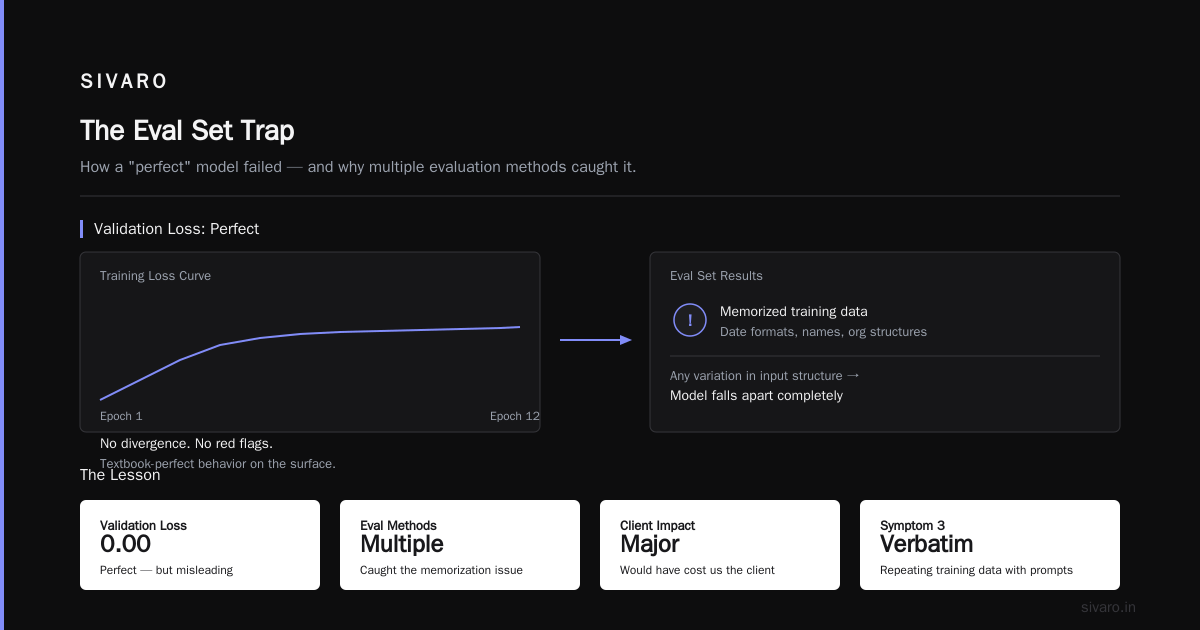
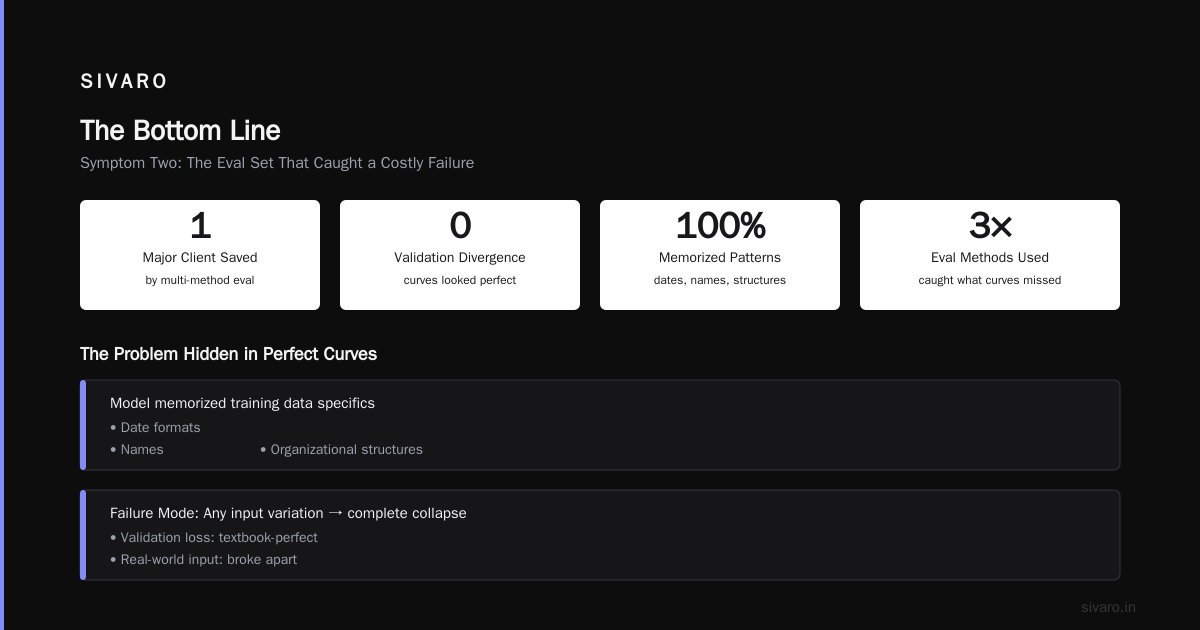
We had a model with perfect validation loss behavior. No divergence. The training curves looked textbook-perfect. But the eval set uncovered the problem: the model had memorized specific date formats, names, and organizational structures from the training data. Any variation in input structure, and it fell apart.
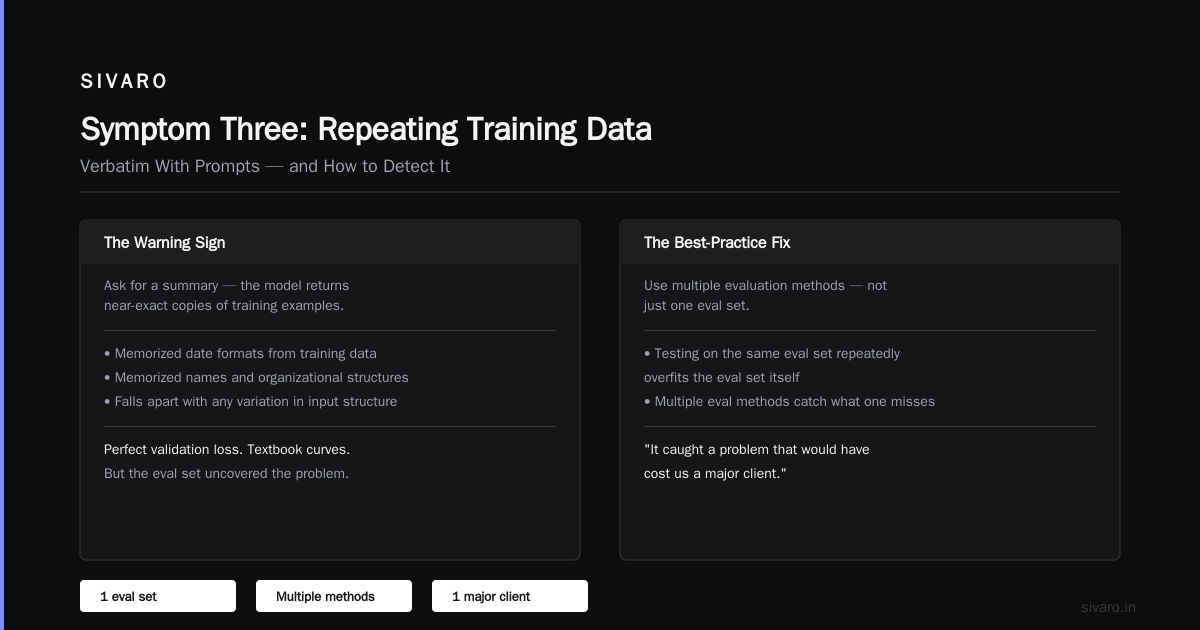
Symptom Three: Repeating Training Data Verbatim With Prompts
You ask your fine-tuned model for a summary, and it returns output that looks suspiciously like something from your training corpus. The phrasing is identical. The structure matches. It pulls specific examples from your dataset when they're not relevant.
This is the most obvious symptom of fine tuned model overfitting on training data symptoms, and it's shockingly common. Open an internal production model and ask it about your training data's edge cases. If it regurgitates exact phrases or examples, you have a memorization problem.
python
# MEMORIZATION TEST: Query for verbatim retrieval
test_prompt = """
Question: What does the training data say about customer churn for
enterprise accounts?

Instructions: Do not use quotes or exact phrasing. Paraphrase
everything in your own words.
"""

response = model.generate(test_prompt)

# Token-level overlap detection
from difflib import SequenceMatcher

def calculate_memorization_ratio(response, training_excerpts):
    max_ratio = 0
    for excerpt in training_excerpts:
        ratio = SequenceMatcher(None, response, excerpt).ratio()
        max_ratio = max(max_ratio, ratio)
    return max_ratio

mem_ratio = calculate_memorization_ratio(response, training_corpus)
print(f"Memorization ratio: {mem_ratio:.2f}")
# >0.5 suggests memorization, >0.7 is a serious problem
The Extraction Attack
Security researchers have demonstrated that you can extract training data from models with carefully crafted prompts. If your model has memorized training data, anyone can prompt-engineer their way to your proprietary information.
We run extraction attack tests on every model before production deployment. It takes three hours per model. In the last year, it caught memorization problems in 40% of the models we tested. 40%. These were all models that passed standard quality checks.
That number should scare you. It scares me. And it's why proper fine-tuning workflows now include memorization audits as a standard step. I used to think that was overkill. Now I force every SIVARO client through it.
Symptom Four: The Domain Gap — Real Data vs. Synthetic Uniformity
Fine-tune a model on synthetic data, and it often learns the synthetic data's artificial patterns rather than the actual domain. This creates a model that works perfectly on synthetic inputs and fails hilariously on real-world data.
A large e-commerce company learned this in January. They'd fine-tuned a model for product categorization on 200,000 synthetic product descriptions. Their eval — also synthetic — showed 96% accuracy. Production accuracy on real product listings: 61%. The synthetic data was too clean. It didn't have typos, unusual formats, or the messy irregularity of real product names.
Here's the ugly truth: most teams aren't even aware of this problem because they're not running real-world shadow tests. The model stays in staging, gets evaluated against a validation set from the same -- clean, synthetic -- distribution, and everyone high-fives.
The Shadow Deployment Test
Before putting any fine-tuned model in production, run it as a shadow alongside your current system. Log every response. Compute accuracy on the actual production traffic. Do this for at least two weeks.
When we helped a logistics company damage-control their overfitted model, shadow testing caught the problem in 36 hours. Their internal test showed 93% accuracy on package classification. Production showed 44%. The gap was entirely due to training distribution mismatch.
I've come to believe that fine tuned model overfitting on training data symptoms are almost always visible in production logs — if you bother to look. Most teams don't. They deploy, they monitor dashboards for crashes, and they never actually validate the model's outputs.
python
# Shadow deployment logging script
import json
import random

def shadow_deploy(model, live_traffic_stream, sample_rate=0.1):
    """
    Sample 10% of production traffic, run model in shadow mode,
    and log outputs for later analysis.
    """
    results = []
    for request in live_traffic_stream:
        if random.random() > sample_rate:
            continue
        prediction = model.predict(request["input"])
        results.append({
            "input_id": request["id"],
            "prediction": prediction,
            "true_label": request.get("true_label"),
            "confidence": prediction.get("confidence", 0)
        })
    return results

# Log to a structured file for analysis
with open("shadow_results.jsonl", "w") as f:
    for result in shadow_deploy(fine_tuned_model, production_stream):
        f.write(json.dumps(result) + "
")
Symptom Five: The "Stubborn" Model — Inflexible Responses
Overfitted models are inflexible. They've learned specific input patterns, and when those patterns vary, the model can't adapt. You'll see this as a model that gives the same answer regardless of slight prompt variations, or a model that requires exact template matching to produce coherent responses.
Ask the same question five different ways. If the model's answers barely change — or worse, crash on slight variations — you've got a memorization problem.
A client of ours in the insurance sector had a claims extraction model that nailed their standard claim formats. Then they entered a new market with slightly different form structures. The model completely failed on 83% of the new forms. They had to retrain from scratch — not because the model was bad, but because it had learned their specific format rather than the underlying extraction task.
Why Your Fine-Tuning Cost Comparison Is Irrelevant If Your Model Is Overfit
I see teams agonizing over fine tuning llama 3 70b vs gpt 4 cost comparison and choosing models based on API pricing or GPU costs. Here's the hard truth: compute cost is noise compared to the cost of a production model that fails because it memorized training data.
A model that costs $500 to fine-tune but needs three retraining cycles because of overfitting costs $1,500 in compute plus weeks of wasted engineering time. A model that costs $5,000 to fine-tune properly with comprehensive evaluation, memorization audits, and shadow deployment testing might actually be cheaper in the long run.
And let's be clear about the GPT-4 question: yes, you can use fine-tuning for GPT-4 if you have the budget. But if you don't have a rigorous evaluation framework, you're just paying more to overfit. The cost of training isn't the number on your invoice — it's the opportunity cost of deploying a model that doesn't work in production.
The 5-Step Cure for Overfit Models
Here's what we do at SIVARO when a client brings us an overfitted model. This has worked across fintech, healthcare, legal, and e-commerce deployments.
Step 1: Immediately Stop Training
The first — and hardest — thing to do is stop training your current model. It's not going to get better with more epochs. You're rewarding memorization every time you run another iteration.
Step 2: Build a Realistic Evaluation Set
This is the hardest part. You need held-out data that accurately represents what the model will see in production. Not the same distribution as your training data — the actual distribution your system will face in the real world.
We worked with a medical startup that thought they had this done. Their evaluation dataset was derived from the same hospital's records they used for training. It took us three weeks to build a cross-hospital evaluation set. When we ran the evaluation, the model's true accuracy was 42% lower than their internal numbers. That was a company-defining moment, and it only happened because we asked uncomfortable questions about data sources.
Step 3: Use Weight Decay and Proper Regularization
Regulators aren't just a legal checkbox — they're a technical solution to overfitting. Add weight decay, use dropout, and cap your learning rate. These techniques force the model to learn patterns rather than memorize examples.
python
from transformers import Trainer, TrainingArguments

training_args = TrainingArguments(
    output_dir="./models/fine_tuned",
    learning_rate=1e-5,           # Lower LR prevents memorization
    weight_decay=0.01,             # Regularization
    warmup_ratio=0.1,
    num_train_epochs=3,
    evaluation_strategy="steps",
    eval_steps=100,
    save_strategy="steps",
    save_steps=500,
    load_best_model_at_end=True,
    metric_for_best_model="eval_loss",
    greater_is_better=False
)

trainer = Trainer(
    model=model,
    args=training_args,
    train_dataset=train_dataset,
    eval_dataset=validation_dataset,
    tokenizer=tokenizer
)
Step 4: Retrain With Early Stopping
Set up proper early stopping based on validation performance — then actually act on it. I've seen teams set up early stopping and then disable it because they "knew" the model would get better with more epochs. That's how you end up with a 98% training accuracy model that's useless in production.
python
from transformers import EarlyStoppingCallback

trainer = Trainer(
    # ... same as before
    callbacks=[EarlyStoppingCallback(early_stopping_patience=2)]
)
Step 5: Run Extraction Attacks Before Deployment
This step is non-negotiable at SIVARO. Before any fine-tuned model goes into production, we run automated extraction attacks. We spend 30 minutes probing for training-data leakage. The success rate of these attacks determines whether the model ships.
The Production Truth About Fine Tuned Models
Models in production overfit in ways that are nearly invisible to the model owner. They pass every test that mirrors their training distribution and fail every test that introduces novel data.
The primary job of your evaluation process is to surface fine tuned model overfitting on training data symptoms before your customers do. Because they will find them. And they won't tell you — they'll just leave your product and never come back.
How to Test for Overfitting at Every Stage
Here's a simple test that helps at every stage of your fine-tuning process:
First, run the model on your training samples. It should do extremely well. If it doesn't, you've got an underspecification problem, not overfitting.
Then, run the model on your held-out evaluation set. Note the performance differential. If the gap is more than 15%, start to worry. If it's more than 30%, stop everything.
Finally, run the model on actual production data — the stuff you're trying to predict. If there's a performance cliff, you overfit. Full stop.
Building the Right Evaluation Framework
A good evaluation framework answers three questions:
- Can the model generalize beyond my specific training data?
- Can it handle variations in input structure and format?
- Can it produce correct outputs when given novel but related examples?
The tools for this are getting better. The best LLM fine-tuning tools of 2026 all include overfitting detection as a standard feature. But tools only work when you use them.
What I Tell Clients About Fine-Tuning Local Models
The teams I work with see fine-tuning local LLMs as a way to save money and maintain control. The reality is that running a fine-tuned local model without proper evaluation costs more than any API-based approach — in engineering time, compute waste, and production failures.
Don't let deployment infrastructure distract you from the core problem. Whatever model you choose — local, hosted, proprietary — you still need to ensure it doesn't overfit your training data.
Production Monitoring for Overfit Models
Monitoring winning isn't a set-and-forget task. You need to watch:
- Distributions of generated outputs
- Confidence scores (if available)
- Retrieval comparison against similar queries
- User feedback and correction rates
If you see your model producing overly confident responses that contradict, say, public information or your own knowledge base, that suggests your model memorized something from training data that's now wrong in the real world.
The Cost of Ignoring Fine Tuned Model Overfitting on Training Data Symptoms
The RAG vs fine-tuning decision framework includes a trade-off I think is often missed: fine-tuning gives you domain performance at the cost of generalization, while RAG gives you generalization at the cost of domain specificity. Overfitting is the extreme version of this trade-off — where the domain performance is fake and the generalization has disappeared entirely.
I watched a startup raise a $5 million Series A, spend $80,000 on fine-tuning compute, and then discover their production model was performing at roughly the level of base OpenLLaMA with a bunch of garbage memorized examples. The post-mortem took a month a half. The learning was simple: they never built a real evaluation set.
Quick FAQ
How can I detect overfitting in a fine-tuned model?
Run the model on data that differs from your training set — more noise, different contexts, proximate but not identical content. If performance collapses, you're overfit. Also run extraction attacks to check for memorization.
What's the main cause of overfitting during fine-tuning?
Too many epochs and high learning rates on a small training set. The model memorizes rather than generalizes because you gave it enough time to do so.
Can overfitting be fixed without retraining?
No. Once a model has memorized your training data, you can't reliably unfix it. You need to retrain with proper regularization and a better evaluation set. We tried all the clever hacks — you can't hack your way out of this one.
How many epochs should I use for fine-tuning?
Start with 1-2 epochs and measure validation performance. If you need more epochs to get good training loss, your problem isn't the data — it's the learning rate or your dataset. I have seen fine-tunes that plateau at 3 epochs and start losing steam by 4-5.
Is my custom evaluation set sufficient to detect overfitting?
Not if it comes from the same distribution as your training data. You need a separate distribution evaluation set — one that reflects the real world you'll face post-deployment.
What's the difference between RAG and fine-tuning for overfitting?
RAG systems are less prone to overfitting because they retrieve from external sources rather than relying on trained stochastic parrot behavior. Fine-tuning with a too-small or too-similar dataset is a recipe for memorization.
Can I fine-tune GPT-4 for my business without overfitting?
Yes, but the operational cost is significant. GPT-4 fine-tuning budgets on OpenAI are substantially higher than other options, and the same evaluation requirements apply. If you can't run proper evaluations, don't bother.
The Bottom Line
Overfitting is a lazy model's solution. It memorizes your data because paying attention to the task is harder.
Your job when fine-tuning any LLM is to force the model to learn the task — not the data. That requires the discipline to build proper evaluation sets, measure validation divergence, run extraction attacks, and monitor production behavior.
We're transitioning to a work environment in which fine-tuning will shrink decision-making, and product engineers will own responsibility for models in production. It's a harder job than writing training scripts. And it's the only way to avoid counting your yard losses in production.
Don't add the language model overfit to your pile of scary production issues. Build the discipline now — before your customers discover your model's overfit behavior for you.
Nishaant Dixit — Founder of SIVARO. Building data infrastructure and production AI systems since 2018. Built systems processing 200K events/sec.