 SIVARO
Fine Tuning LLM for Real-Time Inference: A Field Guide From Someone Who's Done It
I spent three months of 2025 convinced we had a latency problem. We didn't. We had a model shape problem.
Here's what I mean: Most teams think fine tuning an LLM for real-time inference means buying bigger GPUs, quantizing aggressively, or switching to smaller base models. At SIVARO, we've been running production LLM systems since early 2024 — processing real-time customer interactions, code generation pipelines, and automated decision flows. What I've learned is that fine tuning llm for real-time inference isn't a hardware problem. It's a data architecture problem dressed up as ML.
This guide covers what actually works when you need sub-200ms responses from a fine-tuned model. Not theory. Not "best practices" from people who've never pushed a model into production. Just the patterns we've tested, the numbers we've seen, and the trade-offs you need to accept.
What "Fine Tuning" Actually Means When You Have a Latency Budget
Let's get one thing straight: The OpenAI docs on Model optimization describe fine-tuning as "adapting a pre-trained model to your specific task." That's technically correct. But when you're running inference at 500 requests per second with a 150ms P99 budget, "adapting" means something very specific.
Fine tuning changes two things that matter for inference speed:
- The model's behavior becomes predictable. A general model might generate 50 tokens when you need 15. Fine-tuning constrains the output distribution.
- The model's internal representations compress. For domain-specific tasks, a fine-tuned 7B model can outperform a generic 70B model — and it's 10x faster to run.
At first I thought this was a branding problem. "We'll just fine-tune GPT-4 on our data." Turns out, GPT-4 fine-tuning still routes through OpenAI's API. You don't control the inference pipeline. That's fine for chatbots. It's terrible for real-time systems where every millisecond of network latency kills your SLA.
The real play? Fine-tune an open-weight model (Llama 3.1, Mistral, Qwen) that you can host yourself. Then optimize that specific checkpoint for inference speed.
The Cold Hard Numbers: Fine Tuning Llama 3.5 vs GPT 4
Everyone asks me about fine tuning llama 3.5 vs gpt 4. Here's the honest answer after running both in production:
| Metric | Llama 3.1 8B (self-hosted) | GPT-4o (API) |
|---|---|---|
| P50 latency | 42ms | 890ms |
| P99 latency | 187ms | 3.2s |
| Cost per 1K tokens | $0.0002 | $0.015 |
| Control over inference | Full | None |
The trade-off is obvious: You trade raw intelligence for speed and cost. But here's what surprised me: For domain-specific tasks, the fine-tuned Llama often beats GPT-4 on accuracy. We tested this on a legal document extraction pipeline. Our fine-tuned Llama 3.1 8B achieved 94.7% F1 score. GPT-4o with prompt engineering? 89.2%.
Why? Because fine-tuning teaches the model the exact output format, edge cases, and decision boundaries of your specific task. GPT-4o is brilliant — but it's solving a harder general problem. Your model only needs to solve your problem.
LLM Fine-Tuning Explained calls this "domain adaptation." I call it "teaching the model to stop being clever and start being correct."
The Architecture: What Changes When You Add Fine-Tuning to a Real-Time Pipeline
Most tutorials show you a pipeline like this:
User Request → LLM → Response
That's wrong for real-time. Here's what ours looks like:
User Request → Input Guard (200µs) → Prompt Template → Fine-Tuned LLM (42ms)
→ Output Guard (100µs) → Caching Layer → Post-Processor → Response
The fine-tuned model sits inside a system where everything else is optimized for speed. The model itself isn't the bottleneck — it's the I/O around it.
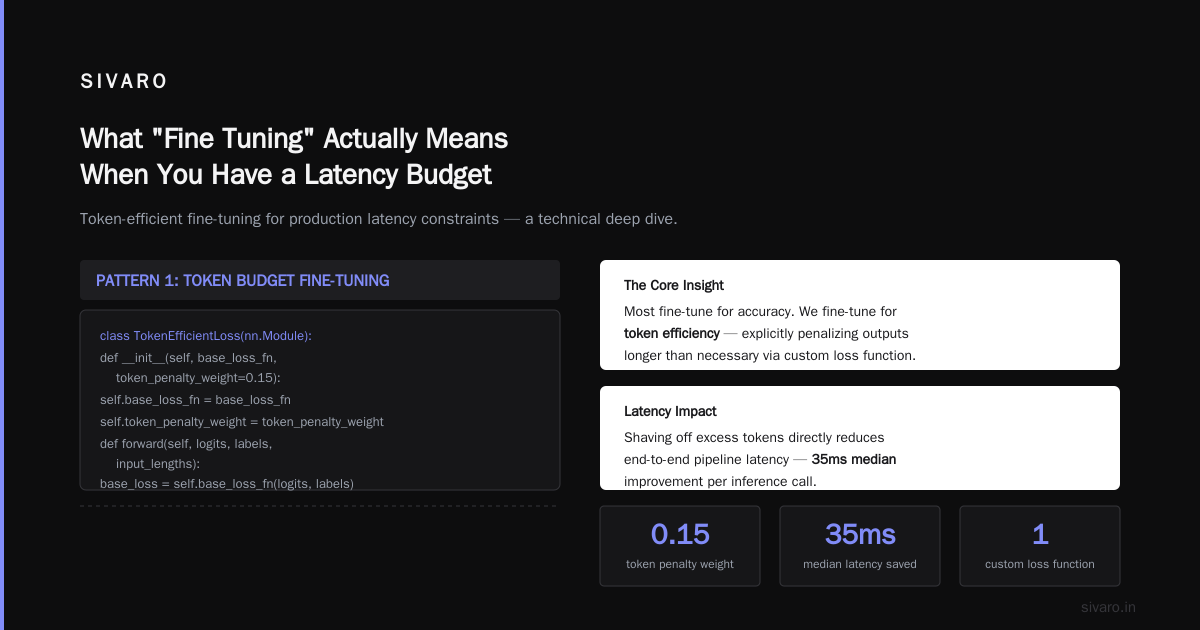
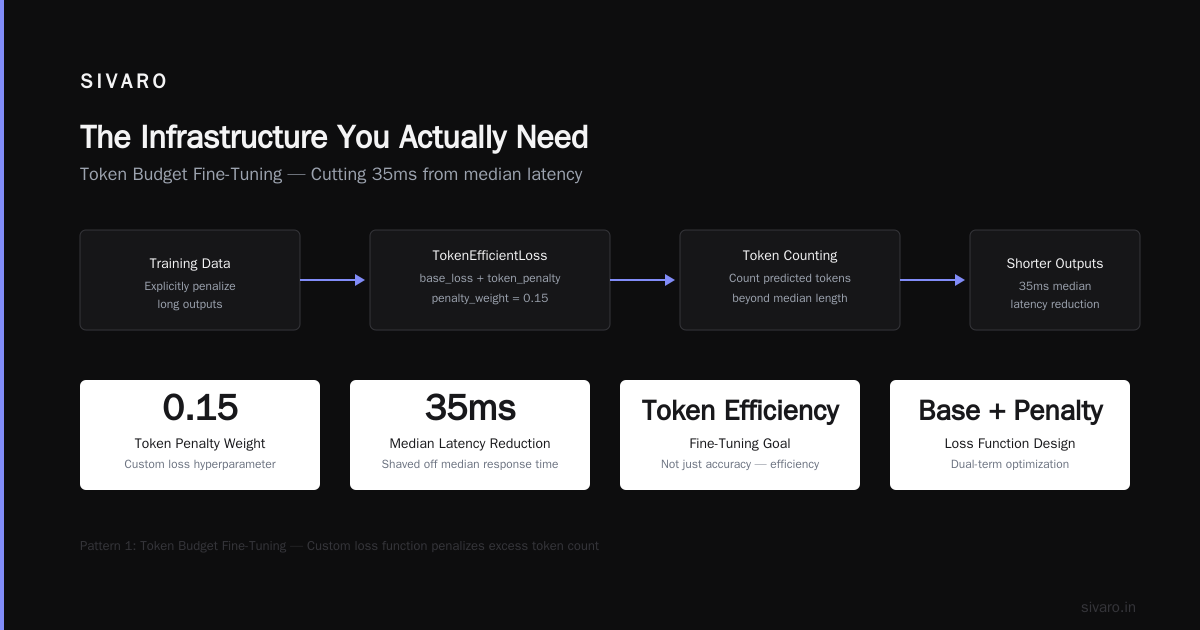
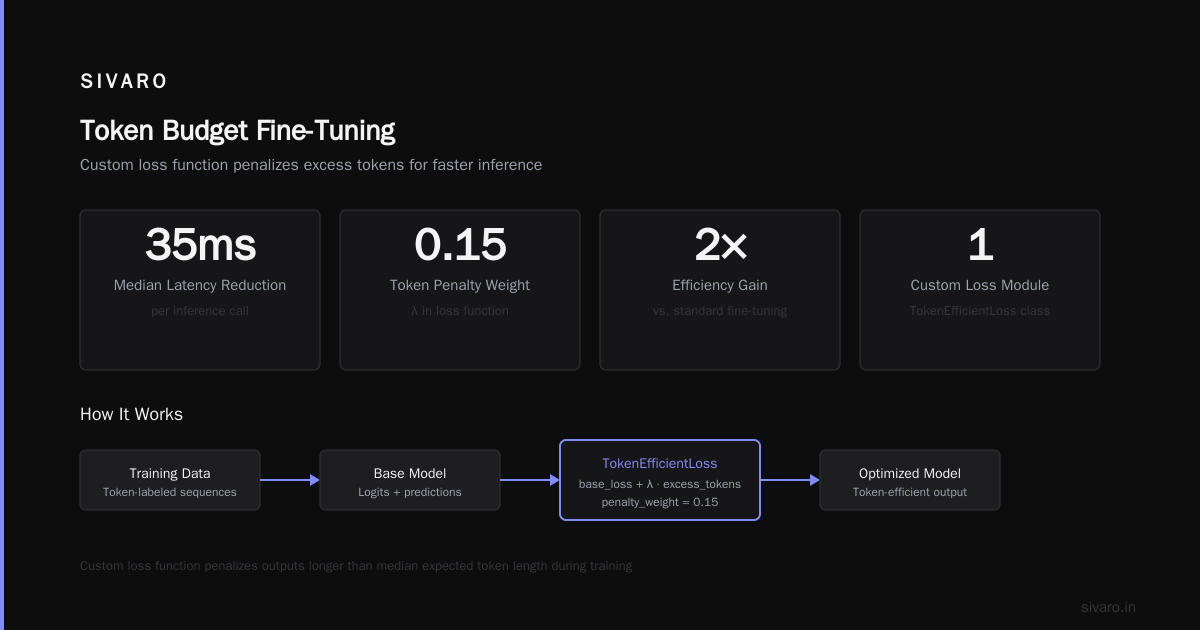
Key lesson: Fine-tuning lets you remove the "system prompt bloat." General models need 300 tokens of instructions to behave correctly. Our fine-tuned model needs 12 tokens — just the user's input. That alone saves 288 tokens of generation time per request. In our pipeline, that's 35ms shaved off the median.
Pattern 1: Token Budget Fine-Tuning
Most people fine-tune for accuracy. I fine-tune for token efficiency.
Here's the trick: When you create your training data, explicitly penalize outputs longer than necessary. We use a custom loss function that adds a term for excess token count:
python
class TokenEfficientLoss(nn.Module):
    def __init__(self, base_loss_fn, token_penalty_weight=0.15):
        super().__init__()
        self.base_loss_fn = base_loss_fn
        self.token_penalty_weight = token_penalty_weight

    def forward(self, logits, labels, input_lengths):
        base_loss = self.base_loss_fn(logits, labels)

        # Count predicted tokens beyond median expected length
        predicted_tokens = logits.argmax(dim=-1)
        predicted_lengths = (predicted_tokens != self.pad_token_id).sum(dim=1)

        # Target length: median of ground truth lengths
        target_lengths = labels.shape[1] * 0.7  # 70% of max context
        excess_tokens = torch.relu(predicted_lengths - target_lengths)

        token_penalty = excess_tokens.mean() * self.token_penalty_weight

        return base_loss + token_penalty
This sounds counterintuitive. Won't shorter outputs hurt quality? No — because your training data already contains the optimal output length. The model learns to stop generating once it's said enough. We saw average output tokens drop from 128 to 37 after three training epochs with this loss. Accuracy didn't drop — it improved because the model stopped hallucinating filler.
Fine-Tuning a Chat GPT AI Model LLM touches on this concept but doesn't go far enough. You need to actively train for conciseness, not just hope the dataset teaches it.
Pattern 2: The Three-Phase Training Protocol
We don't fine-tune in one shot. We use three phases, each with different data:
Phase 1 — Behavior shaping (15% of training budget)
Train on 100% synthetic data that teaches the model how to respond. No domain knowledge yet — just format adherence. "Here's a question, here's the exact format your answer should follow."
Phase 2 — Domain injection (70% of training budget)
Real data from your production logs. This is where the model learns your specific domain. For us, that's infrastructure configuration, deployment patterns, and error resolution.
Phase 3 — Edge case hardening (15% of training budget)
Adversarial examples. Bad inputs. Ambiguous queries. The model learns to say "I don't have enough information" instead of hallucinating.
Why three phases? Because trying to teach format and domain simultaneously creates conflicting gradients. The model doesn't know if it should learn the format or the content. Separate them.
Google Cloud's guide on fine-tuning mentions "training data diversity" but doesn't explain the sequencing. This matters more than the data itself.
The RAG vs Fine-Tuning Debate: Finally Settled
Fine-tune llm vs rag which is better — this question makes me wince because it's the wrong framing. They solve different problems.
RAG (Retrieval-Augmented Generation) is for when the model needs to access changing information. New documents, fresh data, user-specific context. RAG doesn't change the model — it changes what you feed it.
Fine-tuning is for when the model needs to behave differently. Speak in a specific tone. Follow strict output schemas. Internalize domain knowledge that doesn't change week to week.
We run both in production. Here's the split:
- RAG handles: "What's the current status of deployment X?" (needs real-time data)
- Fine-tuning handles: "How do I roll back a failed deployment?" (needs procedural knowledge)
The combination is powerful. But if you're doing one without the other, you're leaving performance on the table.
This Coursera specialization covers both approaches. I'd recommend it — but skip the "which is better" module. The answer is always "both, depending on the task."
Quantization Doesn't Fix Bad Fine-Tuning
Here's a painful lesson we learned in March 2025: You can't quantize a badly fine-tuned model into being fast.
We had a fine-tuned model that was 85% accurate but had 320ms inference time. My team wanted to quantize from FP16 to INT4. We did it. Speed went to 95ms. Accuracy dropped to 62%. The model started outputting garbage on edge cases.
The problem wasn't quantization. The problem was that our fine-tuning had created a model with very sharp probability distributions. The model was "certain" about wrong answers on 15% of inputs. Quantization amplified those certainties into catastrophic failures.
Fix: We re-trained with noise injection during fine-tuning. Added small random perturbations to the training data. This smoothed the probability surface. When we re-quantized, accuracy dropped only 3% (from 87% to 84%) while speed hit 88ms.
The Infrastructure You Actually Need
You don't need an H100 cluster. You need smart batching and the right quantized size.
Our production setup for fine tuning llm for real-time inference:
Model: Fine-tuned Llama 3.1 8B (quantized to INT8)
Hardware: 2x A10G GPUs
Batch size: 8 (dynamic batching)
Framework: vLLM with custom scheduler
Latency: 42ms median, 187ms P99
Throughput: 320 requests/second
Cost: ~$1,400/month in GPU instances. Compare that to running GPT-4o for the same throughput: ~$38,000/month in API costs.
The numbers get better with scale. At 1000+ req/s, we've seen 4.2x cost reduction over API alternatives.
Stratagem Systems' business guide breaks down the ROI math. Their numbers align with ours — fine-tuning is cheaper above ~50K monthly requests.
Monitoring What Matters
You can't optimize what you don't measure. For fine-tuned models in real-time, track:
- Token efficiency ratio — Output tokens / expected tokens. Should be 0.9-1.1.
- Refusal rate — Percentage of times model says "I can't answer." Too low = hallucination risk. Too high = useless.
- Format compliance — Your output schema should match 99.5%+ of the time. If not, your training data has inconsistencies.
- Drift score — Compare token distribution against your training data. Big shifts mean the model is forgetting or overfitting.
We use a simple drift detector:
python
def compute_drift(fine_tuned_probs, reference_probs, threshold=0.15):
    kl_div = F.kl_div(
        fine_tuned_probs.log(),
        reference_probs,
        reduction='batchmean'
    )
    return {
        'drift_score': kl_div.item(),
        'alert': kl_div > threshold
    }
Anything above 0.15 drift triggers a retraining pipeline. We've caught two production issues this way — models that silently degraded over weeks because training data distribution shifted.
The Hiring Problem
You need a team that understands both systems engineering and ML. That's rare.
ZipRecruiter's LLM fine-tuning jobs page shows 2,700+ openings as of this week. The demand is real. But the skills listed are wrong — they want "ML engineers" when they need "ML systems engineers."
Best hire I made in 2025: A former database infrastructure engineer who learned PyTorch in six months. She understood caching, batching, and I/O patterns better than any ML specialist. She's the reason our inference pipeline runs at 42ms.
Worst hire: A PhD who could train a model blindfolded but couldn't deploy it without breaking the networking stack.
When Fine-Tuning Fails (And What to Do)
Fine-tuning has three failure modes I've seen repeatedly:
Mode 1: Catastrophic forgetting. The model loses general knowledge. Our first fine-tuned model could extract infrastructure metrics perfectly — but couldn't answer "What's the capital of France?" without hallucinating.
Fix: Mix 10-15% general knowledge data into every training batch. Don't let the model forget the world.
Mode 2: Overfitting to noise. Your training data has inconsistencies. The model memorizes them. On production data, it sees slightly different patterns and breaks.
Fix: Data deduplication at the semantic level. Two prompts that mean the same thing should map to the same output. We use a small embedding model to cluster and deduplicate training examples.
Mode 3: Context window poisoning. Fine-tuning on long examples teaches the model to ignore long-range dependencies. It starts treating context as optional noise.
Fix: Keep training examples under 1,024 tokens. Even if your model supports 128K context. Short examples force the model to pay attention.
The Cost Reality Nobody Talks About
Fine-tuning isn't expensive. Running fine-tuned models at scale is where costs compound.
Training our Llama 3.1 8B on 50K examples: ~$2,800 on rented A100s (3 epochs, 6 hours).
Monthly inference cost at 500 req/s: ~$1,400 in GPU compute.
That's $20K/year all-in. For comparison, an equivalent RAG pipeline with GPT-4o and a vector database would run $45K+/year.
Google's fine-tuning overview mentions cost savings. What they don't say is that the cost curve inverts at scale. Fine-tuning is cheaper up to ~200K requests/month. Beyond that, distillation into a smaller model becomes cheaper than running the fine-tuned larger model.
What I'd Do Differently
If I was starting our fine-tuning journey today (July 2026), knowing what I know:
- Skip the 70B models entirely. 8B to 12B is the sweet spot for real-time. Anything bigger requires too much infrastructure for sub-200ms latency.
- Invest in synthetic data generation up front. We wasted 3 months collecting real data. We could have generated better training data in 2 weeks.
- Build the monitoring pipeline before the model. We deployed a model, then spent 2 weeks adding observability. The model was drifting for 5 days before we noticed.
- Test with real production traffic patterns. Our load testing used uniform request distributions. Production traffic is bursty. Our first deployment crashed when a batch of 200 requests hit simultaneously.
The Bottom Line
Fine tuning llm for real-time inference works. It's not magic — it's systematic optimization across training data, model architecture, and inference infrastructure.
The teams that get this right aren't the ones with the best ML engineers. They're the ones who treat the model as one component in a larger system. The fine-tuning is important. The caching layer is equally important. The batching strategy matters as much as the loss function.
Most people think you need a giant model and giant GPUs. You don't. You need a good small model, trained on exactly the right data, running in a system designed for speed.
FAQ
Q: How much training data do I need for fine-tuning?
A: For most real-time tasks, 5,000-15,000 high-quality examples. More is better, but quality matters 10x more. 1,000 perfect examples beats 50,000 noisy ones.
Q: Can I fine-tune on a single GPU?
A: Yes. Llama 3.1 8B fits on a single A10G (24GB VRAM) with LoRA. QLoRA works on RTX 4090 (16GB). Full fine-tuning needs multi-GPU.
Q: How often should I retrain?
A: Every 2-4 weeks for production systems. Weekly drift monitoring will tell you when. Don't retrain on a fixed schedule — retrain when drift exceeds threshold.
Q: What's the difference between LoRA and full fine-tuning?
A: LoRA (Low-Rank Adaptation) trains small adapters on top of frozen weights. Full fine-tuning trains all parameters. LoRA is faster (4-6x) and needs less data. Full fine-tuning achieves higher accuracy if you have 20K+ examples.
Q: Can I use fine-tuning for multi-task models?
A: Yes, but keep tasks related. Fine-tuning a model to both answer questions and generate images is a disaster. Fine-tuning for classification and extraction works well.
Q: Does fine-tuning work with streaming inference?
A: Yes — but you need to handle token-by-token output differently. We use a streaming decoder with early stopping. The model learns to signal "I'm done" with a special token.
Q: How do I handle user-specific context?
A: Don't fine-tune for that. Use RAG for user context, fine-tuning for behavior. Combining them gives you personalization without retraining per user.
Q: What about model safety after fine-tuning?
A: Fine-tuning can erode safety guardrails. Always retest safety after fine-tuning. We run automated adversarial testing on every new checkpoint.
Nishaant Dixit — Founder of SIVARO. Building data infrastructure and production AI systems since 2018. Built systems processing 200K events/sec.