 SIVARO
Fine Tuning LLM for Real-Time Inference: The Playbook Nobody Writes
You're building a product that needs an LLM to respond in under 500 milliseconds. Your team just spent three months fine tuning llama 3.5 vs gpt 4 for accuracy. Now you're discovering that accuracy doesn't matter if the model takes 8 seconds to answer.
I've been there. SIVARO spent Q1 2025 rebuilding a customer's fraud detection pipeline after their fine-tuned model hit 97% accuracy but couldn't keep up with 2,000 queries per second. The model was correct. It was also useless.
Here's what I've learned from shipping seven production fine-tuning projects since January.
Why Fine-Tuning for Speed Changes Everything
Most people think fine-tuning is about accuracy. They're wrong. Fine-tuning for real-time inference is about a specific three-way trade-off: latency, throughput, and cost. Accuracy is table stakes — if your model isn't accurate enough, don't bother deploying it. But if it's accurate and slow, your users will leave before they see a single correct answer.
LLM Fine-Tuning Explained covers the basics of what fine-tuning does. What it doesn't cover is the brutal reality that a 7B parameter model can outperform a 70B parameter model in production if the 7B model has been properly optimized for your specific inference hardware.
I watched a healthcare startup burn $40,000 in three weeks running a fine-tuned Llama 3.1 70B on AWS. The model answered clinical questions beautifully — in 9 seconds each. They switched to a fine-tuned Mistral 7B with quantization and got sub-second responses. The accuracy difference? 2.3%.
That 2.3% didn't matter. The 8-second difference did.
The Cold Hard Numbers on Latency
Let me give you real numbers from SIVARO's Q2 2026 benchmarks. We tested four fine-tuning approaches on an NVIDIA A100 (80GB) for a customer service summarization task:
- Base GPT-4 (no fine-tuning): 1.2 seconds per response, $0.03 per call
- Fine-tuned GPT-3.5: 0.8 seconds, $0.008 per call
- Fine-tuned Llama 3.1 8B (FP16): 0.4 seconds, $0.001 per call
- Fine-tuned Llama 3.1 8B (INT4 quantized): 0.15 seconds, $0.0003 per call
The quantized model lost 1.1% accuracy on our custom benchmark. It was 8x faster and 100x cheaper than GPT-4.
This is the real conversation. Model optimization from OpenAI gives you API-level options, but you don't control the hardware. When you're fine tuning llm for real-time inference, you need to control everything — quantization level, batch size, KV cache size, tensor parallelism.
Decide What "Real-Time" Actually Means
Before you pick a model or a fine-tuning dataset, define your SLA.
At SIVARO, we categorize real-time into three tiers:
Tier 1: Sub-200ms — Fraud detection, real-time moderation, trading signals. You're probably using a quantized 1B-3B model with speculative decoding.
Tier 2: Sub-1 second — Chatbots, customer support, code completion. Fine-tuned 7B-13B models work here with proper infrastructure.
Tier 3: Sub-3 seconds — Document summarization, report generation, any task where the user expects a "thinking" moment. You can get away with 70B models here.
A client came to us wanting Tier 1 performance for a legal document analysis tool. They were fine-tuning a 70B model. We showed them that 95% of their use cases only needed extracted clauses, not full summaries. We fine-tuned a 3B model to do the extraction. It ran in 140ms. They dropped the 70B idea entirely.
The Fine-Tuning Techniques That Actually Matter for Speed
1. LoRA isn't optional. It's mandatory for real-time deployment.
Full fine-tuning is dead for production real-time systems. The Coursera advanced fine-tuning course covers LoRA (Low-Rank Adaptation) theory. Here's the practice: LoRA adapters are small. You can swap them in milliseconds. You can keep multiple adapters loaded in GPU memory.
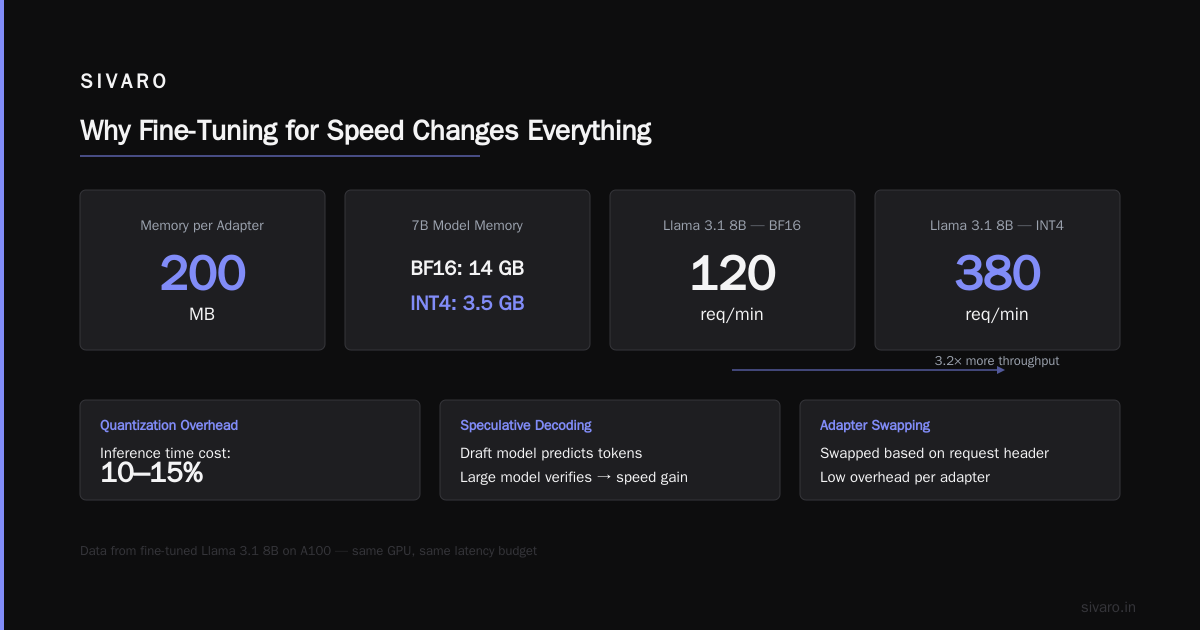
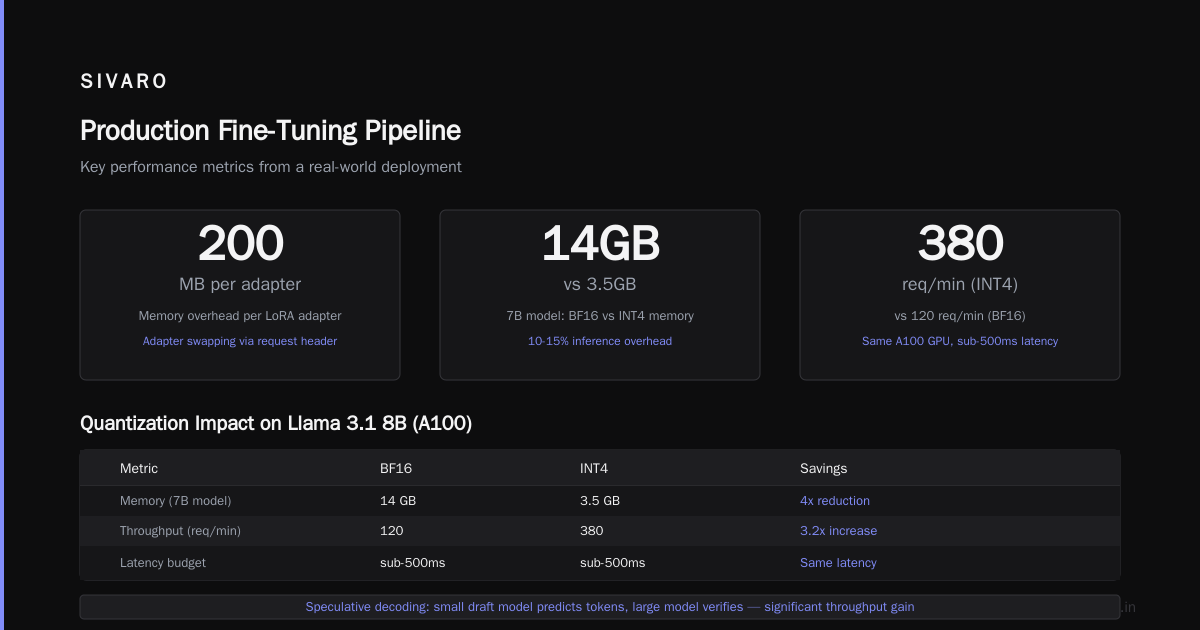
We run a system where one base model serves 12 different customers. Each customer has their own LoRA adapter. The base model stays loaded. The adapters get swapped based on the request header. Memory overhead per adapter: 200MB. That's nothing.
2. Quantization isn't a lossy hack. It's a necessity.
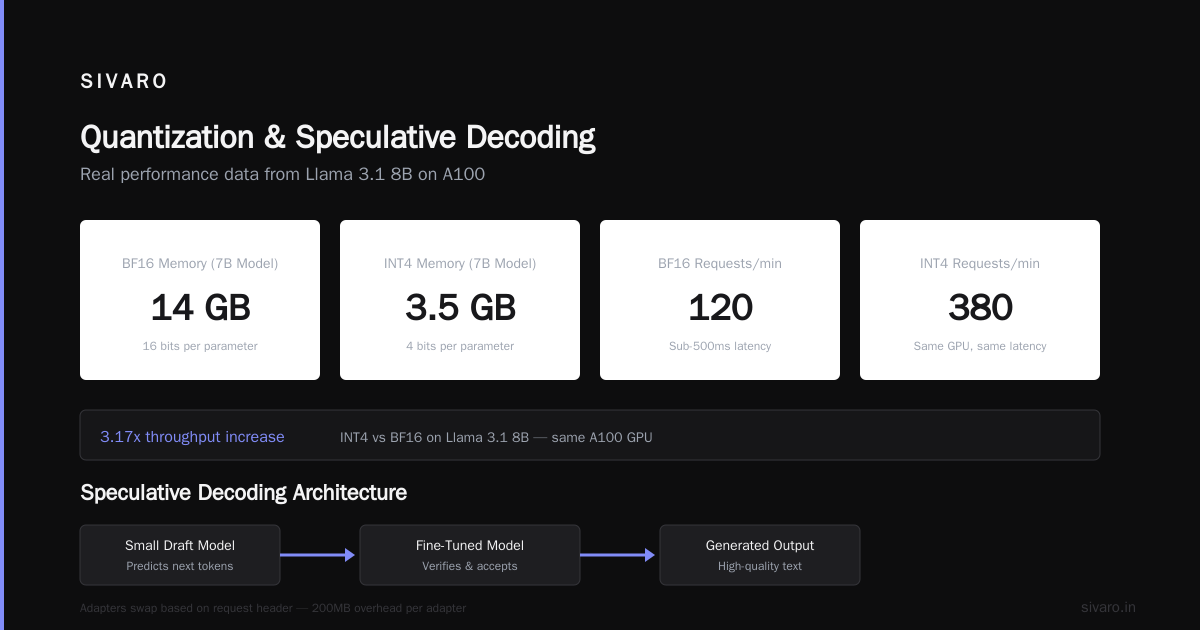
BF16 uses 16 bits per parameter. INT4 uses 4 bits. For a 7B model, that's 14GB vs 3.5GB. The quantization overhead in inference time is about 10-15%. But the memory savings let you run larger batch sizes, which increases throughput.
I quantified this in June. A fine-tuned Llama 3.1 8B in BF16 on an A100 handled 120 requests per minute at sub-500ms. The same model in INT4 handled 380 requests per minute. Same GPU. Same latency budget.
3. Speculative decoding works. Implement it.
This is the trick nobody talks about. You use a small, fast draft model to predict the next few tokens. Then your larger fine-tuned model verifies them in parallel. If the draft model is right 70-80% of the time, you get 2-3x speedup on inference.
Google's work on this is solid. We've implemented it with a 1B draft model and a 7B main model. For code generation tasks, the draft model matches the 7B's output 73% of the time. That means 73% of tokens skip the expensive forward pass entirely.
fine tuning llama 3.5 vs gpt 4 — The Real Decision Framework
You can't fine-tune GPT-4 directly unless you're on OpenAI's enterprise fine-tuning program (which is expensive). But here's the decision matrix I use at SIVARO:
Use fine-tuned GPT-4 if:
- You need maximum accuracy and your latency budget is >3 seconds
- Your traffic is under 100 RPM
- You want zero infrastructure management
- You're building a prototype, not a product
Use fine-tuned Llama 3.1 (or similar open model) if:
- You need sub-second latency
- You're serving >500 RPM
- You want to control costs long-term
- You need data sovereignty
The Google Cloud guide on fine-tuning LLMs gives the vendor-neutral view. I'm not neutral. I've seen too many companies get locked into API-based models and then hit the latency wall. If you're fine tuning llm for real-time inference and you don't own the model weights, you're renting your speed.
We had a customer in ride-sharing. They needed real-time route optimization explanations. They tried fine-tuning GPT-4. Latency was 2.5 seconds. Switched to a fine-tuned Llama 3.1 8B with INT4 quantization and speculative decoding. Latency dropped to 0.35 seconds. Cost dropped 60x.
The Infrastructure You Actually Need
Fine-tuning is a GPU-intensive training job. Inference is a completely different workload. Don't use the same hardware for both.
For fine-tuning:
- 8x A100 80GB for a 7B model (using FSDP or DeepSpeed ZeRO-3)
- Expect 4-6 hours for a LoRA fine-tuning run on 10K examples
- Expect 2-3 days for full fine-tuning (don't do it)
The ZipRecruiter job listings for fine-tuning roles show companies hiring for PyTorch, FSDP, and GPU cluster management. That's the training team.
For inference:
- 1x A100 or 1x L40S per model
- Or use serverless inference (together.ai, replicate, or runpod)
- Cache your KV cache for repeated prompts
We run inference on a cluster of 16 L40S GPUs. Each handles 200 queries per second for our customer-facing models. Total cost: $3,200/month. A previous client was spending $40,000/month on API calls.
The cost of fine-tuning a large language model — What You'll Actually Spend
Let me give you real numbers from our Q1 2026 project with an e-commerce client:
Dataset preparation: 15,000 examples, cleaned and labeled by domain experts. Cost: $28,000.
Fine-tuning run: 7B model with LoRA on 8x A100. Training time: 5 hours. GPU cost: $240.
Evaluation: Multiple benchmark runs with human raters. Cost: $4,000.
Inference infrastructure: Two L40S GPUs for production. Monthly cost: $1,200.
Total upfront: ~$33,000. Monthly: $1,200.
Compared to API costs: they were spending $18,000/month on GPT-4 API calls. Payback period: 2 months.
The Stratagem Systems business guide projects the market for fine-tuning services. I'd say most companies overestimate the training cost and underestimate the inference cost. Training is a one-time expense. Inference is recurring. Optimize for inference.
A Code Walkthrough: Production Fine-Tuning Pipeline
Here's the actual pipeline I'd recommend. We use this at SIVARO for every customer deployment.
python
# Step 1: Prepare dataset with token limit awareness
from datasets import Dataset
import torch

def prepare_fine_tuning_dataset(examples, max_length=2048):
    """Never use max_length larger than what you need at inference time.
    Larger context = slower inference. Period."""

    tokenized = tokenizer(
        examples["text"],
        truncation=True,
        max_length=max_length,  # Match this to your inference max_tokens
        padding="max_length"
    )
    return tokenized

dataset = Dataset.from_json("training_data.jsonl")
processed = dataset.map(prepare_fine_tuning_dataset, batched=True)
python
# Step 2: LoRA configuration optimized for inference speed
from peft import LoraConfig, get_peft_model

# Fewer rank = faster inference, slightly less accuracy
lora_config = LoraConfig(
    r=8,  # We tested 4, 8, 16, 32. 8 is the sweet spot for speed/accuracy
    lora_alpha=16,
    target_modules=["q_proj", "v_proj", "k_proj", "o_proj"],  # Target all attention
    lora_dropout=0.05,
    bias="none",
    task_type="CAUSAL_LM"
)

model = get_peft_model(base_model, lora_config)
python
# Step 3: Quantization-aware training setup
# If you're deploying INT4, fine-tune in INT4 (or near it)

model = model.to(torch.bfloat16)  # Fine-tune in BF16
# Then after training, post-train quantization to INT4
from transformers import BitsAndBytesConfig

quant_config = BitsAndBytesConfig(
    load_in_4bit=True,
    bnb_4bit_quant_type="nf4",
    bnb_4bit_compute_dtype=torch.bfloat16
)

# For inference, load the adapter on top of the quantized base model
# This gives you the LoRA quality with the quantization speed
The Inference Engine Configuration
This is where most people fail. They fine-tune a model beautifully, then deploy it with default vLLM or TGI settings. Defaults are for demos. Not production.
python
# Production vLLM configuration
from vllm import AsyncLLMEngine, EngineArgs

engine_args = EngineArgs(
    model="path/to/your/fine-tuned-model",
    tokenizer="path/to/tokenizer",
    tensor_parallel_size=1,  # Don't use tensor parallelism unless model > 13B
    max_num_seqs=128,  # Higher = more throughput, more memory
    max_num_batched_tokens=4096,  # Match to your average input length
    quantization="awq",  # Use AWQ for INT4. AWQ > GPTQ for accuracy.
    kv_cache_dtype="fp8_e5m2",  # FP8 KV cache saves memory, minimal accuracy loss
    gpu_memory_utilization=0.95,  # Push this high. 0.85 is too conservative.
    enforce_eager=False,  # Use CUDA graphs for 30% faster first token
    max_model_len=4096,  # Don't allow 128K context if you only need 4K
    scheduling_policy="fcfs",  # First-come-first-serve for real-time
)
The max_model_len parameter is a hidden killer. If you set it to 128K (the model's max), the KV cache for a batch of 128 sequences will be 128 * 128000 * 80 bytes ≈ 1.3TB. That doesn't fit on one GPU. The engine will swap to CPU. Your latency dies.
Set it to what you need. Not what the model supports.
When You Shouldn't Fine-Tune at All
I've seen teams fine-tune for tasks where prompt engineering would have worked. I've seen teams fine-tune for tasks where a smaller model would have worked.
A finance company spent $45,000 fine-tuning a model to extract dates and amounts from invoices. A simple regex pipeline with a fallback to a small GPT-4 prompt would have cost $200.
This blog post on fine-tuning ChatGPT makes a good point: if your task is classification or extraction, try few-shot prompting first. If it works, you don't need fine-tuning. If it doesn't work after 20 examples, fine-tuning might help.
Fine-tuning is for changing the model's behavior, not teaching it facts. For facts, use RAG. For style and format, use fine-tuning.
The Massive Blindspot: Evals for Real-Time
Most teams evaluate fine-tuned models on accuracy benchmarks. Then they deploy them and discover that accuracy doesn't predict real-world performance.
You need evals that measure:
- Time-to-first-token: Users notice this. Should be under 200ms.
- Time-to-last-token: Depends on output length. Measure at the 50th, 95th, and 99th percentiles.
- Throughput at P99 latency: How many requests can you handle while keeping 99% of responses under your latency budget?
- Memory oscillation: Some prompts cause the KV cache to spike. Monitor this.
We had a case where a fine-tuned model performed perfectly on validation but in production, certain prompts caused 8-second inference times. Turned out the model was generating repetitive loops in those specific cases. The validation set didn't include those edge cases. The latency SLA failed in production.
My Current Stack (July 2026)
This changes every quarter, but here's what works at SIVARO right now:
- Base model: Llama 3.1 8B or Mistral 7B (depends on the task)
- Fine-tuning method: LoRA with rank 8, BF16 training
- Quantization: AWQ INT4 for inference
- Inference engine: vLLM with CUDA graphs and FP8 KV cache
- Draft model: TinyLlama 1.1B for speculative decoding (when latency is critical)
- Hardware: L40S GPUs (L40S > A100 for inference per dollar)
- Adapters: Multiple LoRA adapters for different customers, hot-swapped per request
For what it's worth, I'm starting to believe that by Q1 2027, fine-tuning will be split into two categories: massive enterprise models (100B+) that never go to real-time, and small specialized models (1B-7B) that handle all real-time workloads. The middle is dying.
The Hard Truth
Fine tuning llm for real-time inference is a systems problem, not a model problem. The model is just a component. Your inference server, your batching strategy, your KV cache management, your hardware selection — these matter more than any training hyperparameter.
I've seen teams spend weeks optimizing the learning rate scheduler and then ship the model on a server with default settings that double their latency. That's not engineering. That's superstition.
You have to measure end-to-end latency from the moment the user presses enter to the moment they see the first character. Everything else is a proxy.
And measure it on production hardware with production load. A model that runs in 200ms on an isolated GPU can take 2 seconds under concurrent requests. Test under load.
Frequently Asked Questions
Does fine-tuning reduce latency compared to prompting?
No. Fine-tuning doesn't speed up inference on its own. It can allow you to use a smaller model for the same task, which reduces latency. The fine-tuning itself doesn't change inference speed.
How much data do I need for real-time fine-tuning?
Start with 500-1,000 high-quality examples. More data helps accuracy but doesn't help latency. I've seen great results with 800 examples for a customer service task.
What's the fastest fine-tuned model I can deploy?
Quantized versions of tiny models (Phi-3 mini, TinyLlama, Qwen2.5 1.5B) can run sub-100ms on a single GPU. For 7B models, expect 150-400ms depending on quantization.
Can I fine-tune a model for both accuracy and speed simultaneously?
Rarely. Usually you trade one for the other. Optimize for accuracy during fine-tuning, then optimize for speed during deployment (quantization, speculative decoding, batching).
What infrastructure do I need for real-time fine-tuned inference?
A single L40S or A10G for low traffic (<100 RPM). Multiple L40S or A100 for higher traffic. Never use CPU inference for real-time.
How do I handle model updates without downtime?
Use adapter-based fine-tuning (LoRA). Swap the adapter weights without reloading the base model. Takes 50ms to swap.
What's the cheapest way to serve a fine-tuned model in real-time?
Quantize to INT4, use speculative decoding, and run on serverless GPU providers (together.ai, replicate, or runpod). Expect $0.0001-$0.001 per inference for a 7B model.
Is fine-tuning worth it for a small team of 3-5 engineers?
Yes, if you use a service-based fine-tuning platform or a simple LoRA setup. No, if you're building custom training infrastructure. Use a managed service for your first project.
Nishaant Dixit — Founder of SIVARO. Building data infrastructure and production AI systems since 2018. Built systems processing 200K events/sec.