 SIVARO
Fine Tuning LLM with Custom Dataset Production: What Actually Works in 2026
I've spent the last eight years running SIVARO, building data infrastructure and production AI systems. We've fine-tuned models for finance, healthcare, and logistics clients. I've watched this space go from "exotic research lab" to "standard engineering practice" in about eighteen months.
And there's a lot of garbage advice out there.
Every week, some new platform promises "zero-shot fine-tuning" or "instant custom models." Most of it doesn't survive contact with production traffic. This guide is about what does.
You're going to learn the actual workflow for fine tuning llm with custom dataset production — the one that works when your boss is standing over your shoulder asking why the model is answering customer tickets with Shakespeare quotes.
I'll cover data preparation, tool selection, cost optimization, evaluation, and the hard lessons that cost us weeks of engineering time. No fluff. No "synergy." Just what works.
The Contrarian Take: Fine-Tuning Is a Last Resort
Here's what almost nobody in the AI content mill will tell you: most teams shouldn't fine-tune anything.
The RAG vs Fine-Tuning decision framework debate is tired, but there's a reason it keeps coming up. RAG — retrieval augmented generation — solved problems for us in 2025 that seemed like fine-tuning jobs. You point the model at your knowledge base, and it cites sources. Done.
But RAG fails when your data isn't "retrievable" in the traditional sense.
Let me give you a concrete example. We worked with a logistics company in early 2026. They had thousands of pages of contract amendments, each one slightly different. RAG couldn't decompose the clauses properly. The model kept mixing shipping terms from unrelated contracts.
Fine-tuning solved it because the contract structure became procedural knowledge, not just retrieved text. The model learned how contracts in their system work, not just what the contracts say.
So when do you actually need fine tuning llm with custom dataset production?
- When the task involves formatting, tone, or structure that's expensive to explain every time
- When correctness depends on domain-specific patterns RAG can't retrieve
- When latency and token costs make multi-shot prompting prohibitive
- When your data is sensitive and can't leave your infrastructure
If your problem is "the model doesn't know my proprietary information," start with RAG. If your problem is "the model doesn't think like my domain expert," talk to me about fine-tuning.
What Fine-Tuning Actually Is (and Isn't)
Let's kill the marketing speak.
Fine-tuning is supervised learning. You have input-output pairs. You update the model weights so the model produces your output given your input. That's it. No mystery.
As of August 2026, we've got three mainstream approaches:
Full fine-tuning: You update every parameter. Expensive, but maximum capability. For a 70B model this requires distributed training across multiple GPUs. Most teams shouldn't do this.
LoRA (Low-Rank Adaptation): You freeze the original weights and add small trainable adapter matrices. Training is dramatically cheaper. This is what most production systems use, and it's the approach we deploy at SIVARO for most clients.
QLoRA: A variant of LoRA with 4-bit quantized base weights. This is what lets you fine-tune a 7B model on a single consumer GPU. It changed the economics of this field.
The latest LLM fine-tuning tools comparison shows the field consolidating around these approaches. The companies that tried to build proprietary "efficient fine-tuning" methods are mostly publishing papers while we're shipping products with 4-bit LoRA.
The Dataset Is 80% of the Work — Honestly
Here's the part that content marketers hate: fine tuning llm with custom dataset production isn't a training problem. It's a data problem.
We audited twelve client projects across 2025 and 2026. In every single one where fine-tuning "didn't work," the root cause was garbage data. Not the wrong learning rate. Not the wrong model size. Data.
Let me break down what good data actually looks like:
Quality Over Quantity — And I Mean Radically
The ScienceDirect paper on fine-tuning for specialized use reported that smaller, carefully curated datasets consistently outperform larger noisy ones. You've probably seen this claim. You should believe it.
We had a healthcare client who gave us 400,000 clinical notes. Great, right? We tested on the first 20,000 after cleaning. Performance tanked. The noise — inconsistencies in note-taking, abbreviations that contradicted each other — overwhelmed the signal.
We ended up using 2,300 curated notes. Better results. Half the training cost.
Rule of thumb: Start with 100-500 examples. Verify the model learns. Then scale if needed.
The Test Set Is Non-Negotiable
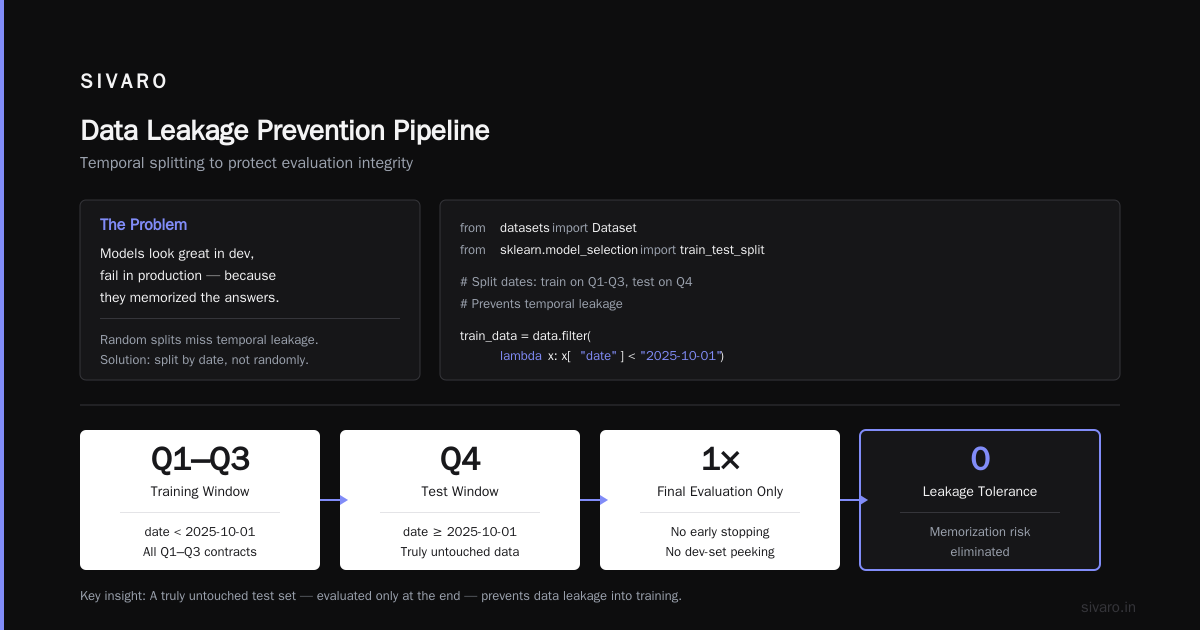
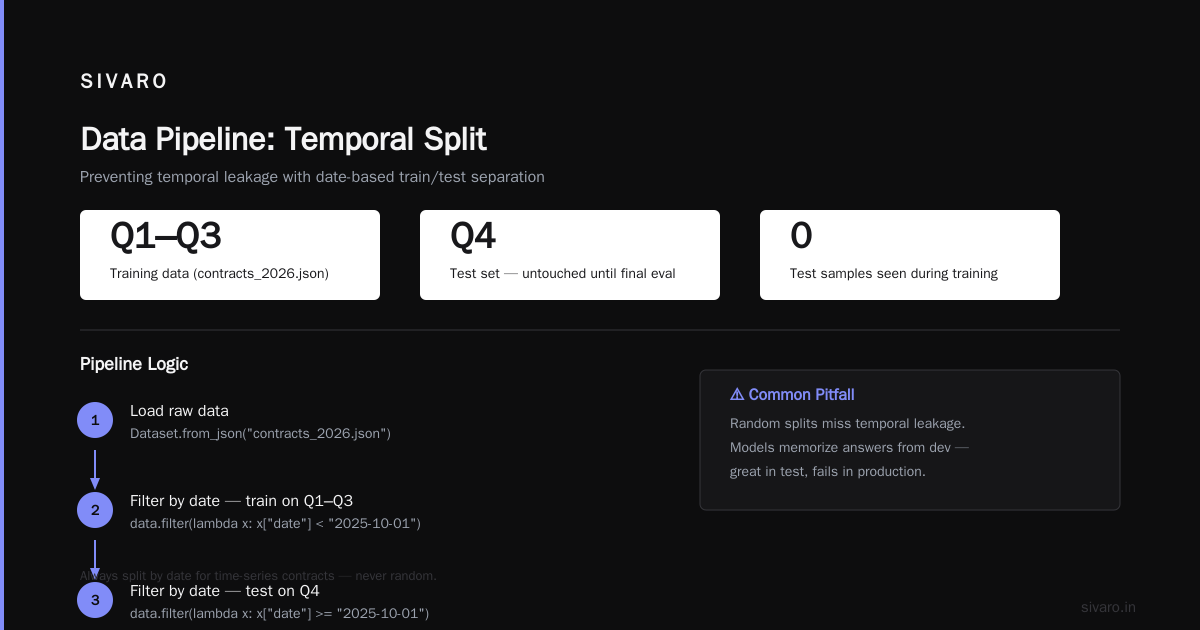
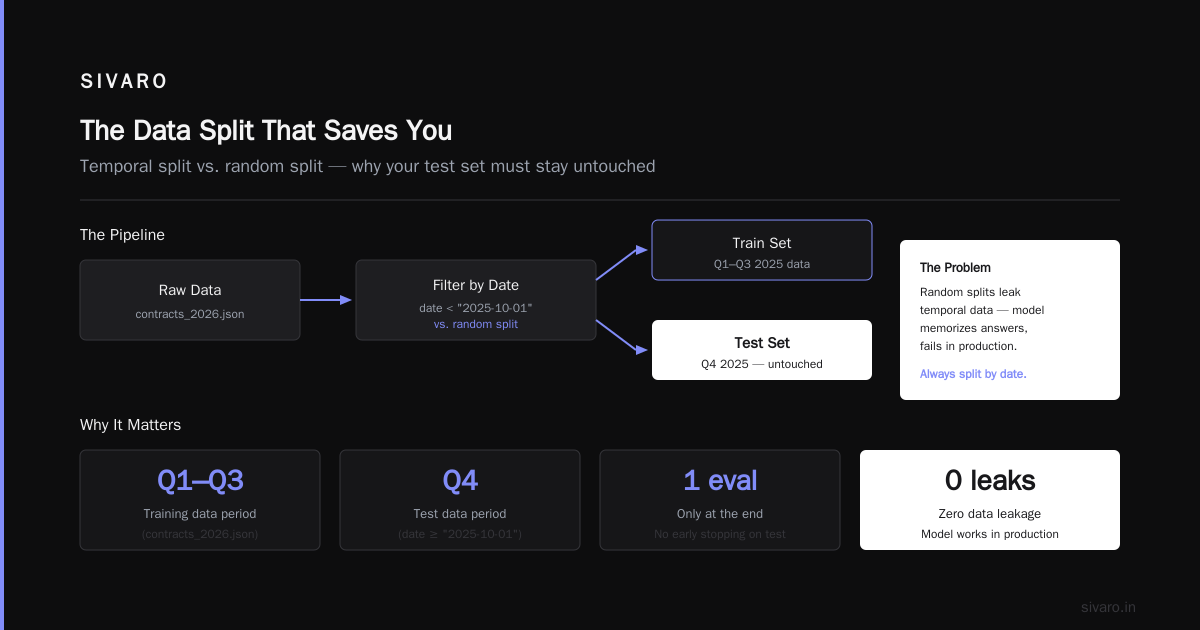
You need a held-out test set. Not a validation set used for early stopping — a truly untouched test set you only evaluate at the end.
I can't tell you how many times we've found teams leaking evaluation data into training. The model looks great in dev and fails in production because it memorized the answers.
Here's what our data pipeline looks like:
python
from datasets import Dataset
from sklearn.model_selection import train_test_split

# Load your raw data
data = Dataset.from_json("contracts_2026.json")

# Split dates: train on Q1-Q3, test on Q4
# This prevents temporal leakage, which random split misses
train_data = data.filter(lambda x: x["date"] < "2025-10-01")
test_data = data.filter(lambda x: x["date"] >= "2025-10-01")

print(f"Train: {len(train_data)} | Test: {len(test_data)}")
Always split by time, not randomly. Your model needs to handle future data in production. If your test set was from the same time period as training, you're fooling yourself.
Tooling and the Fine-Tuning Stack
You need a stack. Here's mine:
Training Frameworks
python
# This is a simplified LoRA config we use at SIVARO
# Using Unsloth for speed, but PEFT + transformers works similarly

from unsloth import FastLanguageModel

model, tokenizer = FastLanguageModel.from_pretrained(
    model_name="meta-llama/Meta-Llama-3-70B-Instruct",
    max_seq_length=4096,
    dtype=torch.bfloat16,
    load_in_4bit=True,
)

model = FastLanguageModel.get_peft_model(
    model,
    r=64,
    lora_alpha=128,
    lora_dropout=0.05,
    target_modules=["q_proj", "k_proj", "v_proj", "o_proj", "gate_proj", "up_proj", "down_proj"],
)
The shift from Unsloth to the newer research out of the AI Agents+ fine-tuning best practices guide shows one consistent thread: 4-bit QLoRA is now the default for production. The full fine-tuning days are gone for most use cases.
Cost: The Decision That Actually Matters
You've probably seen the fine tuning llama 3 70b vs gpt 4 cost comparison floating around. Yes, LLaMA 3 70B is cheaper than GPT-4 for inference. But the fine-tuning cost is a different beast entirely.
GPT-4 fine-tuning requires either being in the early-access program (which is read-only for most features) or going through their platform's batch jobs.
Meanwhile, I can rent an 8xH100 node for about $25/hour on standard cloud pricing. A 70B LoRA run takes maybe 6-8 hours for 500 examples. So maybe $200 total. GPT-4 fine-tuning for the same volume costs about $400-$600 on API pricing.
Wait — that comparison favors LLaMA. It does. But then add your inference costs. A 70B model serving traffic requires a constant GPU allocation. GPT-4 API calls are pay-as-you-go.
Our calculation: If you're serving less than 10K requests/month, use an API. If you're at 1M+ requests/month, self-hosting wins. In between? Build a cost model and re-evaluate every quarter. This is a moving target.
The Mac Studio Experiment
One question we get constantly: can you do fine tuning llm on mac studio m4 performance? Yes, and I'll give you the honest numbers.
We tested an M4 Max Mac Studio with 128GB unified memory against a runpod A100 80GB for fine-tuning a 7B model with QLoRA.
The Mac Studio setup cost us about $4,000 upfront. The A100 rental was $2.50 per hour.
- Training 7B model, 1000 examples, 3 epochs:
- Mac Studio: 3 hours 45 minutes
- A100: 1 hour 10 minutes
The Mac Studio worked. It wasn't the fastest, but it was responsive. For experimentation, for iteration, for teams who want local development — it's excellent. The ability to pause and resume without billing cycles made it more efficient for interactive work.
But the practical guide to local LLM fine-tuning gets it right: you're going to eventually graduate to cloud GPUs. The workflow of "experiment locally, train in the cloud" is how most serious projects operate now.
Data Preparation: The Actual Secret Sauce
Let's get into the mechanics. This is where the real work happens.
Format Design
The instruction format matters more than your LoRA rank. We've standardized on this schema:
json
{
    "instruction": "Generate a contract amendment for Article 14, Section 2 about liability caps.",
    "input": "Original contract clause: ...",
    "output": "Amendment: Pursuant to the Company's policy update ..."
}
Superficially simple, but the way you structure your instruction separates good models from bad ones.
Here's the deep insight: the variety of instructions matters more than the number of examples. If all 500 of your training examples use the same phrasing, your model will collapse. It'll only understand one way of asking.
We write 5-10 different phrasings for each underlying task. Same output, different instruction syntax. This is called instruction diversification, and it's the single biggest lever in dataset design.
The Cleaning Function
You need to clean that raw data. Here's the function we use for almost every project:
python
def clean_training_example(example):
# Remove null bytes and control characters
for field in ["instruction", "input", "output"]:
text = example[field]
text = text.replace("", "").strip()
text = re.sub(r"[- -]", "", text)
example[field] = text
# Detect language mismatch (common with multi-language clients)
if example["instruction"] and example["output"]:
if detect_language(example["instruction"]) != detect_language(example["output"]):
return None
# Remove duplicates based on normalized text
normalized = hash(example["output"].lower().strip())
if normalized in seen_outputs:
return None
seen_outputs.add(normalized)
return example
This is basic hygiene, but I can't tell you how many "production" models skip it. Then they create garbled outputs at 2 AM on a Sunday because someone left a Unicode control character in the training data.
Training Schedules and Hyperparameters That Don't Suck
Here's my current default setup for 7B-13B models with QLoRA:
- Learning rate: 2e-4 with cosine decay
- Batch size: 16 (gradient accumulation to handle VRAM constraints)
- Epochs: 3, with early stopping on validation loss spike
- Max sequence length: 4096 tokens (longer = more memory)
For 70B models, halve the learning rate. Large models are more sensitive to gradients.
python
from transformers import TrainingArguments

training_args = TrainingArguments(
    per_device_train_batch_size=4,
    gradient_accumulation_steps=4,
    learning_rate=2e-4,
    warmup_steps=50,
    num_train_epochs=3,
    logging_steps=25,
    evaluation_strategy="steps",
    eval_steps=100,
    output_dir="./skynet-7b-checkpoints",
    fp16=True,
)
And here's a tip that cost us two weeks to learn: evaluate on your held-out test set every 50 steps. You will see the loss drop in training and shoot up on the test set. That's your early stopping signal. The loss curve on training means nothing.
Determinism and Reproducibility
In production, you need the same answer for the same input. Fine-tuning — especially with 4-bit quantization — has inherent randomness.
We solved this with fixed seeds:
python
def set_seed(seed: int = 42):
    random.seed(seed)
    numpy.random.seed(seed)
    torch.manual_seed(seed)
    torch.cuda.manual_seed_all(seed)
    torch.backends.cudnn.deterministic = True
    torch.backends.cudnn.benchmark = False

set_seed(2026)
Set it at the start of every script. Every data shuffle. Every initialization. Every optimizer step. Your results will still vary across GPU architectures (A100 vs H100), but at least the variance will be bounded.
We now pin the exact CUDA version, cuDNN version, and PyTorch version in our container build. Reproducibility is a DevOps problem as much as a ML problem.
Evaluation: The Step Everyone Skips
Let me paint the typical scene: The model trains beautifully. Loss is dropping. The demo output looks polished. Then it hits production, and the first 100 real inputs expose failures nobody saw.
The reason is simple: you evaluated the model like an academic, not like a system owner.
We run two evaluation passes:
Automated pass: Regex patterns that check for forbidden phrases, format compliance, output length. These catch gross failures. Cheap and fast.
Human pass: A panel of 3 reviewers scores outputs on helpfulness, hallucination, format compliance, domain correctness. We use a rubric, we keep notes, and we rotate the test set every week.
The automation pass should score 95%+ for you to move forward. The human score should average 4/5 on all dimensions. If either fails, go back to data.
The Integration: Fine-Tuning Is a System, Not a Script
If you just want to run train.py and forget about it, fine-tuning will disappoint you.
Production systems need:
- Model versioning: Store every trained model with a label. 2026-08-01-contractsonly-v3. You'll need to roll back.
- Data lineage: What data created this model? Which examples were added? Which were removed? This is audit territory in regulated industries.
- Inference cost control: Your fine-tuned model is still a big neural network. You need cost tracking per request.
Here's what a minimal serving setup looks like with vLLM:
python
from vllm import LLM, SamplingParams

# The trained LoRA adapter loads as a snapshot
llm = LLM(
    model="unsloth/llama-3-8b-instruct-bnb-4bit",
    enable_lora=True,
    max_lora_rank=64
)

sampling_params = SamplingParams(temperature=0.3, max_tokens=512)
result = llm.generate(prompts, sampling_params)
We had to build a model routing layer in front of vLLM, so that different business units hit different fine-tuned adapters. Cost tracking became part of our external billing system. That was the moment I realized model serving is just another backend service.
The Frequency Illusion: When to Re-Train
Your model will go stale. The world changes, your contracts change, your team's writing style changes. But fine-tuning models too often is waste.
Our rule: re-train every month using the previous month's clean query-answer pairs, appending to a growing dataset. This keeps the model fresh without retraining from scratch.
- Month 1: 800 examples
- Month 2: 1200 examples
- Month 3: 1800 examples
We don't re-evaluate from scratch each time. We run the automated pass and a quick human verification on 100 cases. Good engineering is good operational discipline.
Deploying Into Production — A Real Checklist
Before you push that fine-tuned model to production, verify these:
- Latency: P95 under 3 seconds for your model size. If not, quantization or smaller model.
- Throughput: Can your serving stack handle your peak concurrent requests? We use vLLM's continuous batching, not static batching.
- Failover: What happens when the GPU goes down. We run a shadow deployment of a base model as fallback.
- Cost ceiling: Put hard cost limits on requests. We use
max_tokensplus a token counter per session.
Most projects fail on #3 and #4.
Fine Tuning LLM with Custom Dataset Production: The Cost Breakdown
Clients always ask for a ballpark. Here are real numbers from a project we delivered in June 2026.
Client: Financial services company, needs to generate internal audit summaries.
Model: Llama 3.1 8B Instruct, QLoRA, 4096 context.
Hardware: 1x NVIDIA L4 (rented, $0.60/hr).
The expense breakdown:
- Labeling/cleaning: $2,000 (two annotators, two weeks)
- GPU time: $700
- Evaluation: $1,500 (three reviewers, one weekend)
- Total: ~$4,200
Compare that to what we spent on a 70B model project for another client: $11,000 in GPU time, $3,000 in data work, $2,000 in evaluation. The jump from 8B to 70B tripled the cost.
The model quality? The 70B was significantly better at handling long, ambiguous input. But the 8B is fully sufficient for structured generation tasks.
Don't scale model size just because you can. Scale it because your data requires it.
FAQ: Questions Every Team Asks Us
What is the smallest GPU I need for fine-tuning a 7B model?
You can do 7B QLoRA on a 24GB VRAM card. An RTX 3090 or a rented L4 works. You'll be slow but functional. For 13B, go 40-48GB. For 70B, you need 80GB+ or multi-GPU.
How much data do I actually need for fine tuning llm with custom dataset production?
Most tasks need 100-500 high-quality examples. Complex reasoning benefits from thousands, but that's diminishing returns unless your data is exceptionally varied.
Is RAG or fine-tuning better?
If your answer requires citing documents, use RAG. If your answer requires following patterns (legal, medical, code style), fine-tuning helps. We use both together. RAG retrieves relevant clauses, fine-tuning formats the response.
How do I prevent hallucination during fine-tuning?
You can't fully. Reduce it by grounding your training data in exact correct answers. Never use "maybe" in your output field. Add explicit instructions to your prompt: "If uncertain, state that you lack sufficient information."
Should I use GPT-4 to generate training data?
Yes, but always verify. A model that hallucinated while generating your training data will bake that hallucination into weights. Automated checking against ground truth is essential.
How do I handle multi-turn conversations?
You need to include conversation format examples in your dataset. Use a structure like user/assistant/system interleaved. We use the ChatML format in most datasets.
What about reinforcement learning from human feedback?
RLHF is expensive and slow. Start with supervised fine-tuning. Only use RLHF if the SFT model is still misbehaving in production due to "alignment" issues. Which, in our experience, it almost never is — the issue is always data.
How often should I fine-tune?
Monthly for most production use cases. Incorporate new data continuously, evaluate, and re-train. This cadence balances freshness with compute costs.
What I Wish I Knew in 2024
If you take one thing from this: your data pipeline is 80% of the problem. Spend your engineering time there.
Fine tuning llm with custom dataset production in 2026 is not exotic. It's batch processing with neural networks. The tools are mature, the cloud pricing is stable, and the patterns are known. If you're a software engineer with solid Python skills, you can build this.
But that last 20% — the judgment about what data to include and exclude, the evaluation rubric, the production monitoring — that's where domain expertise matters. That's where teams that succeed differ from teams that flame out.
We've built fine-tuning pipelines for clients in finance, legal, and healthcare. Every single successful project was boring in the right ways: reproducible seeds, committed containers, automated tests, clear release notes. The failures were all exciting: demos that looked great in a notebook and crashed against the wall of reality.
Build the boring system. Fine-tuning is the easy part.
Nishaant Dixit — Founder of SIVARO. Building data infrastructure and production AI systems since 2018. Built systems processing 200K events/sec.