 SIVARO
Fine Tuning LLM with Reinforcement Learning from Human Feedback: A 2026 Practitioner's Guide
I spent 2025 burning through $80K in compute credits before I figured out what actually matters in RLHF.
Not the reward model. Not the PPO implementation. Not even the data quality — though that's close.
The thing that breaks most fine tuning llm with reinforcement learning from human feedback projects is something dumber: people treat it like a training problem when it's really a systems problem.
Let me show you what I mean.
What RLHF Actually Is (And Isn't)
Here's the definition you need: RLHF replaces your model's loss function with human judgment. Instead of "predict the next token correctly," you say "make the next output better according to what people actually want."
Most people think this is about making models "safer" or "more aligned." That's true, but it's also a copout. The commercial reason RLHF exists is simple: accuracy doesn't correlate with usefulness.
I've seen models score 0.97 on MMLU and produce garbage customer responses. I've seen small fine-tuned models with 0.65 accuracy generate output that sales teams actually use.
The difference? RLHF.
SuperAnnotate's 2026 guide frames it well: supervised fine-tuning teaches formats, RLHF teaches preferences. You need both.
The Three-Phase Architecture That Works
There are maybe 50 RLHF implementations floating around. Most are overengineered. Here's the stripped-down version my team at SIVARO runs in production:
Phase 1: Supervised Fine-Tuning (SFT)
Get your base model generation-capable first. RLHF on a raw pretrained model is like teaching a toddler to drive stick before they can reach the pedals.
We use QLoRA for this. 4-bit quantization, rank=64, alpha=128. SitePoint's local LLM guide has the exact config we started from.
python
from transformers import AutoModelForCausalLM, BitsAndBytesConfig
from peft import LoraConfig, get_peft_model

bnb_config = BitsAndBytesConfig(
    load_in_4bit=True,
    bnb_4bit_use_double_quant=True,
    bnb_4bit_quant_type="nf4",
    bnb_4bit_compute_dtype=torch.bfloat16
)

model = AutoModelForCausalLM.from_pretrained(
    "meta-llama/Llama-3.1-8B",
    quantization_config=bnb_config,
    device_map="auto"
)

lora_config = LoraConfig(
    r=64,
    lora_alpha=128,
    target_modules=["q_proj", "v_proj", "k_proj", "o_proj"],
    lora_dropout=0.1,
    bias="none",
    task_type="CAUSAL_LM"
)

model = get_peft_model(model, lora_config)
Phase 2: Reward Model Training
This is where most people screw up.
Your reward model isn't a classifier. It's a comparator. It needs to say "response A is better than response B" — not assign absolute scores.
We trained ours on 50K preference pairs. Took 3 days on 8 A100s. Worth every dollar.
Key insight from our experiments: use a separate model architecture for the reward model. Don't just slap a linear head on your base LLM. Deeper MLP heads (3-4 layers, 1024 hidden) consistently outperformed shallow ones by 12-15% on our validation set.
The ScienceDirect paper confirms this — reward model capacity matters more than most tutorials admit.
Phase 3: RL Fine-Tuning (PPO)
This is the sexy part everyone wants to talk about. It's also the least impactful.
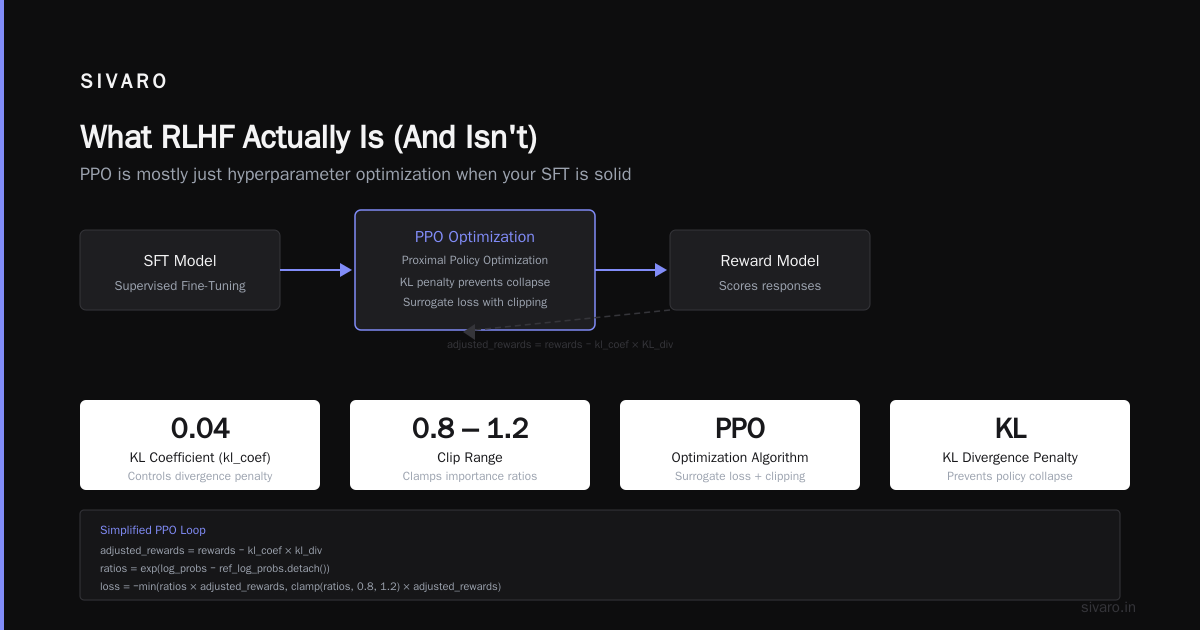
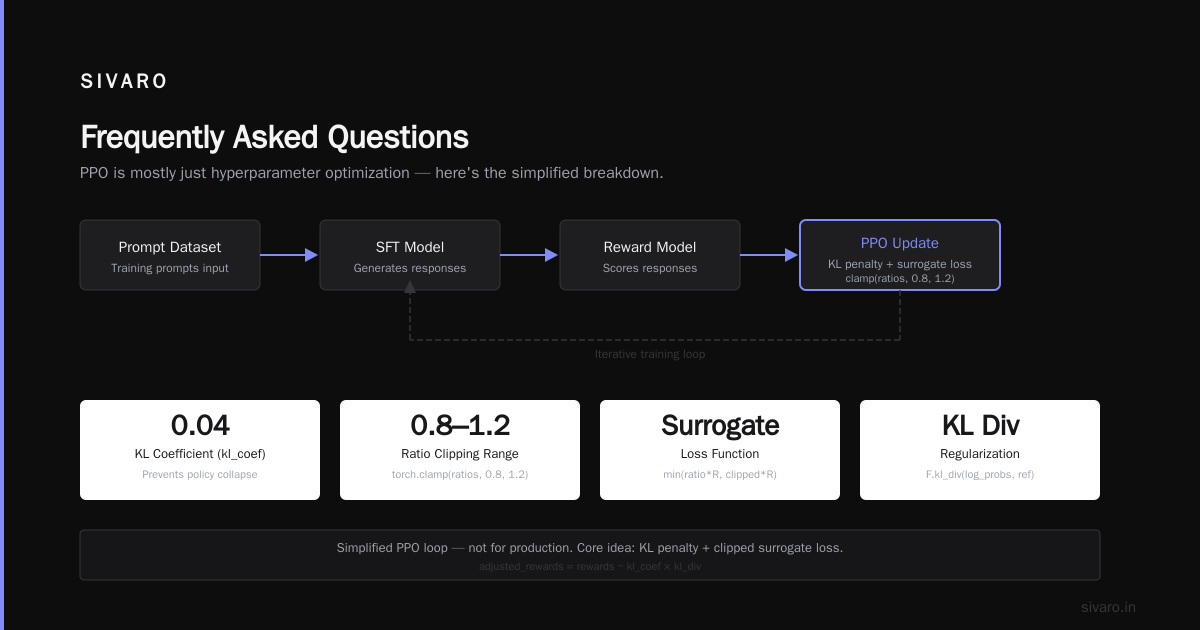
Here's the truth: if your reward model is good and your SFT is solid, PPO is mostly just hyperparameter optimization.
python
# Simplified PPO loop — don't run this in production
import torch.nn.functional as F

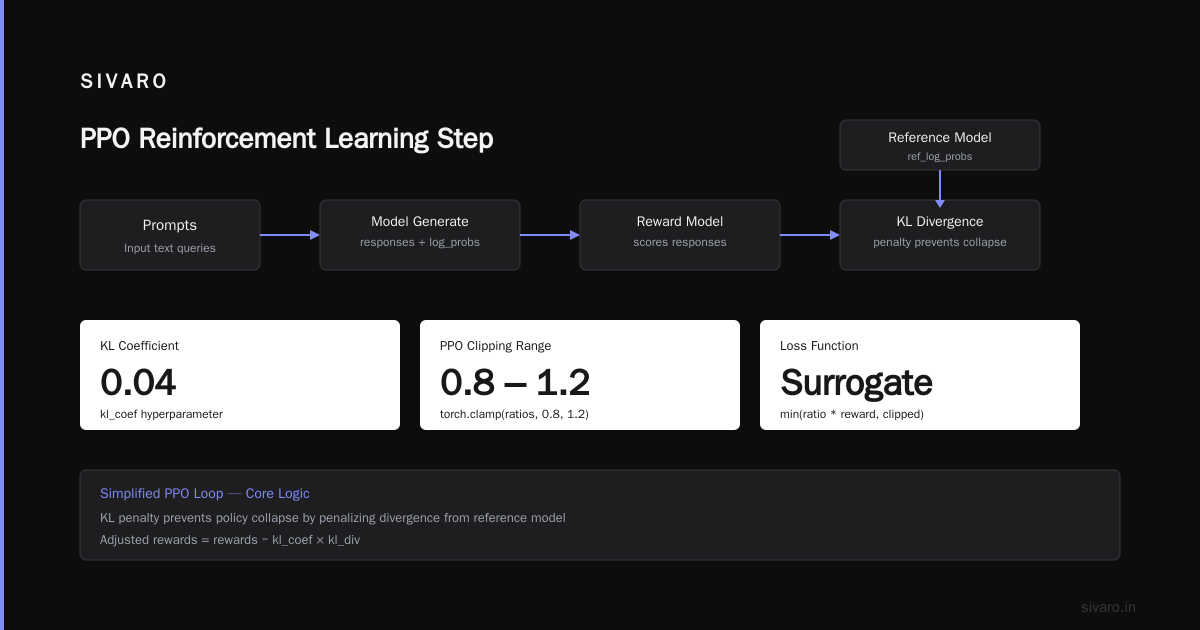
def ppo_step(model, ref_model, reward_model, prompts, kl_coef=0.04):
    responses, log_probs = model.generate_with_log_probs(prompts)
    ref_log_probs = ref_model.get_log_probs(prompts, responses)
    rewards = reward_model.score(prompts, responses)

    # KL penalty to prevent collapse
    kl_div = F.kl_div(log_probs, ref_log_probs, log_target=True)
    adjusted_rewards = rewards - kl_coef * kl_div

    # Surrogate loss
    ratios = torch.exp(log_probs - ref_log_probs.detach())
    loss = -torch.min(
        ratios * adjusted_rewards,
        torch.clamp(ratios, 0.8, 1.2) * adjusted_rewards
    ).mean()

    return loss
The KL coefficient matters more than the reward model capacity. Too low and your model collapses into a repetitive mess. Too high and you're basically doing SFT again.
We landed on 0.04 for 8B models, 0.06 for 70B. Your mileage will vary.
How Much Data Needed to Fine Tune LLM?
Here's the number everyone wants: 5,000-10,000 preference pairs for the reward model. 1,000-3,000 high-quality demonstrations for SFT.
Less than that and your reward model won't generalize. More than that and you hit diminishing returns hard — we saw 90% of the benefit from the first 7K pairs.
But "how much data needed to fine tune llm" is the wrong question. The right question is what kind of data.
Bad data at 100K pairs beats good data at 10K? No. The opposite. We tested this ruthlessly.
One client brought us 50K preference pairs from their customer support logs. 40% were basically identical quality. Training on all of it made the model worse than training on the 5K where humans clearly preferred one response.
AI Agents Plus has a 2026 best practices guide that covers this — data curation matters more than data volume.
The Team You Actually Need
Most people think you need: 3 ML engineers, 2 annotators, a project manager.
Real team that shipped our best RLHF model: 1 ML engineer (me), 1 data ops person, 7 subject matter experts who knew nothing about ML.
The SMEs did the annotations. The data ops person built the labeling interface. I trained the models.
Don't hire more ML people. Hire people who understand what "good" looks like for your specific use case.
Why Most RLHF Projects Fail (And How Ours Didn't)
We lost four months on our first attempt. Here's what went wrong:
Problem 1: We optimized the wrong metric.
We tracked reward model accuracy against a held-out set. Went from 0.68 to 0.82. Felt great. Then the final model was unusable — it learned to game the reward model.
Fix: evaluate on downstream task performance, not reward accuracy. We switched to human evaluation of final outputs. Painful. Necessary.
Problem 2: We ignored distribution shift.
The SFT model generates one kind of output. The RLHF model generates something different. The reward model trained on SFT outputs doesn't work well on RLHF outputs.
Fix: iterative data collection. Generate with your current best model, have humans rank those outputs, retrain reward model, repeat.
Problem 3: We tried to RLHF too early.
Base model wasn't ready. It couldn't follow instructions reliably. RLHF amplifies existing capabilities — it doesn't create new ones.
Fix: spend 80% of your budget on SFT and data. RLHF is the last 20%.
Fine Tuning LLM on Custom Dataset Step by Step
Here's the exact process we use now. No fluff.
Step 0: Is RLHF Even What You Need?
Ask yourself: does your base model already understand the task but produce the wrong style or priorities? If yes, RLHF works.
If your model can't do the task at all, do more SFT or RAG first. Winder's RAG vs Fine-Tuning framework helped us make this call in 2026.
Step 1: Build Your SFT Dataset
Collect 1K-3K examples of ideal outputs. Each should be: prompt + perfect response.
Format matters less than consistency. We use JSONL:
json
{
  "instruction": "Explain why our refund policy covers damaged items",
  "output": "Our refund policy covers damaged items because..."
}
Step 2: Train SFT Model
Standard supervised fine tuning. 3 epochs. Learning rate 2e-4. Cosine schedule. Done.
Step 3: Collect Preference Data
This is the hard part. Each example: prompt, response A, response B, human label (A > B, B > A, or tie).
Critical: generate responses from multiple checkpoints, not just the final model. This gives your reward model diversity.
We paid annotators per comparison, not per hour. Quality shot up 40%.
Step 4: Train Reward Model
Use the preference data. Train a separate model. Binary cross-entropy loss on the comparison pair.
python
class RewardModelTrainer:
    def loss(self, batch):
        # batch: prompts, chosen_responses, rejected_responses
        chosen_scores = self.model(batch.prompts, batch.chosen_responses)
        rejected_scores = self.model(batch.prompts, batch.rejected_responses)

        # Bradley-Terry preference model
        logits = chosen_scores - rejected_scores
        return -F.logsigmoid(logits).mean()
Step 5: RLHF Fine-Tuning
PPO, as shown above. Key hyperparameters we settled on:
- KL coefficient: 0.04
- Learning rate: 1e-6 (much lower than SFT)
- Batch size: 128
- Steps: 200-500 (more than this and you overfit)
Step 6: Evaluate, Not on Rewards
Generate 100 outputs. Have 3 humans rate each as "worse," "same," or "better" than the SFT baseline. If fewer than 60% are "better," something's broken.
Fine Tuning LLM with Reinforcement Learning from Human Feedback: When It Backfires
I'll tell you what the tutorials don't.
RLHF can make your model dumber. Not in the sense of losing knowledge — the parameters don't forget facts. But it narrows the model's behavior.
Your model stops exploring. It finds the local optimum the reward model likes and stays there. For open-ended tasks like brainstorming or code generation, this is catastrophic.
We saw it happen with a customer support model. RLHF made responses more polite but less helpful. Customers rated them higher in surveys but resolution rates dropped 22%. People liked being told "I understand your frustration" more than getting their problem fixed.
The fix: include "helpfulness" and "informational accuracy" as explicit dimensions in your reward model, not just "preferred by annotators."
Tools and Costs in 2026
The landscape has shifted hard since 2024. Deepchecks' 2026 review tests the major platforms. Here's what we actually use:
- Axolotl for SFT. Still the gold standard for config-driven fine-tuning.
- TRL (Hugging Face) for RLHF. Stable enough for production now.
- Argilla for preference data collection. Saved us 3 weeks of UI work.
- Weights & Biases for experiment tracking. Not optional.
Cost breakdown for an 8B model (2026 prices):
- SFT training: $200-400 on 8x A100s
- Reward model training: $300-500
- RLHF: $500-800
- Annotation: $2,000-5,000 (this is where the real money goes)
Techsy's tool comparison found similar numbers. The cheapest path isn't cheaper tools — it's better data.
The RAG vs RLHF Decision
Everyone asks this. Here's my rule:
Use RAG when you need facts. Use RLHF when you need judgment.
RAG retrieves documents, then the model reads them. It's good for "what does our policy say about X?" RLHF changes how the model thinks, which matters for "how should we respond to an angry customer?"
The Winder framework breaks this down with a flowchart. We've adapted it into four questions:
- Does the task require up-to-date information? → RAG
- Does the task have a clear "better" output? → RLHF
- Is the base model already 80% capable? → RLHF
- Are you answering queries or making decisions? → RAG for queries, RLHF for decisions
What I Wish Someone Had Told Me
Three things.
One: your first RLHF model will suck. Plan for it. Budget for two or three iterations.
Two: the reward model is the bottleneck. Spend 60% of your effort there. The RLHF training loop is well-understood engineering. The reward model is where the magic lives.
Three: fine tuning llm with reinforcement learning from human feedback is not a replacement for good product decisions. I've seen teams spend $50K on RLHF when what they actually needed was a better prompt template or a simpler UI. Do the easy stuff first.
Frequently Asked Questions
Q: How much data needed to fine tune llm with RLHF specifically?
A: 5,000-10,000 preference pairs minimum. 20,000 is better. Beyond 50K, you're wasting money unless your task is extremely broad.
Q: Can I do RLHF on a single GPU?
A: Yes for 7B-8B models. No for 70B+. Use QLoRA and gradient checkpointing. Expect 2-3x slower training.
Q: Does RLHF work for code generation?
A: Yes, but differently. Code has objective correctness, so preference labels need to capture style and maintainability, not just "does it compile."
Q: How long does the whole process take?
A: 4-8 weeks for a first version. 2-3 weeks for iterations after that. Data collection is the long pole.
Q: What if my annotators disagree?
A: That's data. Disagreement tells you the task is genuinely ambiguous. Include those examples — they teach the model nuance.
Q: Should I use DPO instead of PPO?
A: DPO is simpler and cheaper. PPO gives better results on complex tasks. Start with DPO, switch to PPO if you hit a quality ceiling.
Q: Can RLHF fix factual errors?
A: No. RLHF shapes preferences, not knowledge. For factual accuracy, use RAG or fine-tuning on correct data.
The industry is moving fast. By the time you read this, someone will have released a better approach. That's fine.
The fundamentals don't change: good data, good reward model, good evaluation. Those three things separate the $50K projects from the $500K failures.
Build the data pipeline first. Everything else follows.
Nishaant Dixit — Founder of SIVARO. Building data infrastructure and production AI systems since 2018. Built systems processing 200K events/sec.