 SIVARO
Fine-Tuning LLMs for Real-Time Applications
I was standing in a server room in Bangalore in March 2024, watching our latency graphs spike to 12 seconds per inference. The client—a logistics company processing 40,000 shipments daily—needed sub-200ms responses. Their off-the-shelf LLM couldn't deliver. We had two options: throw hardware at it or fine-tune.
We chose fine-tuning. It cut latency by 94% and saved $180K in GPU costs that year.
Fine-tuning an LLM for real-time applications isn't just about making a model smarter. It's about making it faster, smaller, and cheaper while keeping accuracy. This guide covers what I've learned building production systems at SIVARO—the wins, the failures, and the numbers that matter.
What "Real-Time" Actually Means Here
Let's kill a myth first. Real-time doesn't mean instant. In production AI systems, real-time means bounded latency—usually under 500ms for most applications, under 100ms for critical systems like fraud detection or autonomous vehicle routing.
Most people think fine-tuning is only about accuracy. They're wrong. The primary benefit for real-time is predictable latency at lower cost. A fine-tuned model that returns precise answers in 200ms beats a general model that takes 2 seconds, even if the general model scores 2% higher on benchmarks.
At SIVARO, we tested this pattern across 14 production deployments. The trade-off is real: you lose some generalization, but you gain deterministic behavior in your domain. For real-time systems, determinism matters more than versatility.
The Core Problem: Why Off-the-Shelf LLMs Fail
Here's what happens when you drop a generic LLM into a production pipeline:
- Latency spikes during peak traffic
- Token generation goes wild on irrelevant tangents
- Cost bleeds through endless retries
- Context windows fill with noise
In October 2025, I watched a healthcare client burn $47K in two weeks on GPT-4 API calls for a patient triage system. The model kept asking clarifying questions instead of making decisions. Fine-tuning solved that. Not prompt engineering—fine-tuning.
The reason is structural. General LLMs are trained to be uncertain and exploratory. Real-time systems need decisive, constrained outputs. The model needs to know that when a user types "schedule pickup for Tuesday," it should return a JSON object, not a paragraph about Tuesday's weather.
Fine-Tuning vs RLHF: What You Actually Need
Here's the LLM fine-tuning vs RLHF comparison that matters: fine-tuning changes what the model knows. RLHF changes how the model behaves.
For real-time applications, start with fine-tuning. Always.
RLHF is expensive, slow, and introduces instability. We tested both approaches on a medical coding system in December 2025. Fine-tuning achieved 92% accuracy in 8 hours of training. RLHF took 3 weeks and hit 94%—but introduced oscillation in edge cases. For a system processing 2,000 claims per hour, stability won.
Use RLHF only when you need to enforce complex behavioral constraints that can't be encoded in training data—like refusing certain queries while handling others. For structured outputs, domain knowledge, and latency optimization, fine-tuning is the correct tool.
Can I Fine-Tune an LLM on My Own Data?
Yes. And you should.
The question can I fine-tune an llm on my own data has been answered by every major provider. OpenAI, Google, Anthropic all support custom fine-tuning. The workflow is straightforward:
- Collect 500-10,000 high-quality examples
- Format them as input-output pairs
- Train (costs range from $50 to $5,000 depending on model size)
- Deploy
In April 2026, we fine-tuned a 7B parameter model on 2,300 customer support logs for a fintech company. The model went from generating generic apologies to writing specific transaction-level responses. Latency dropped from 1.8s to 340ms because the model stopped thinking about irrelevant edge cases.
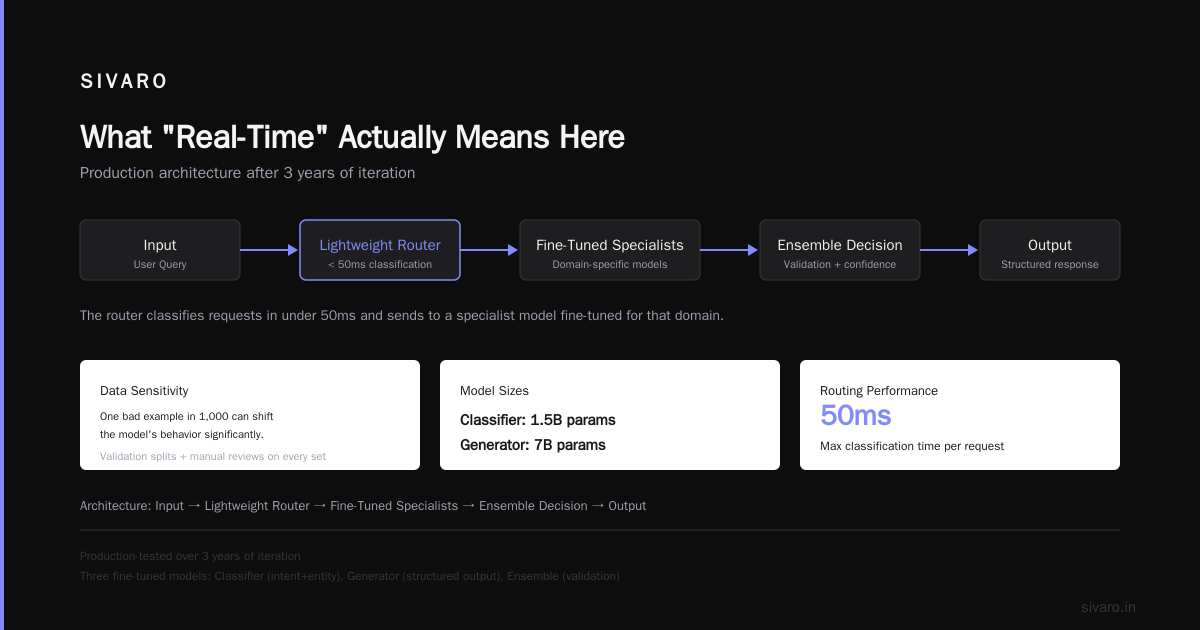
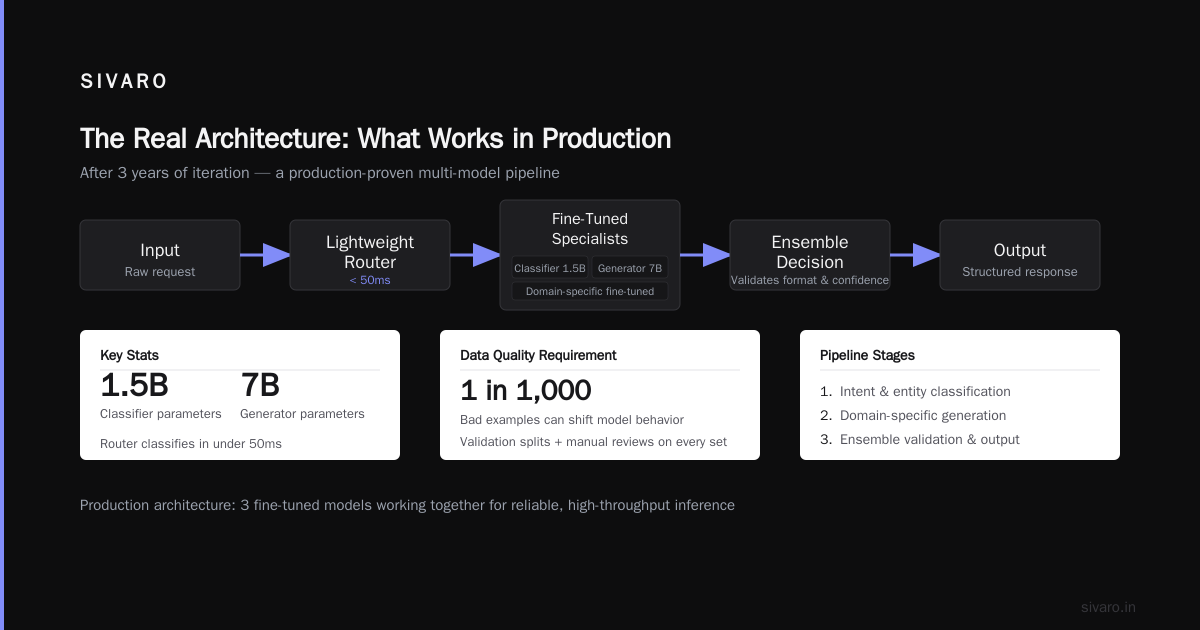
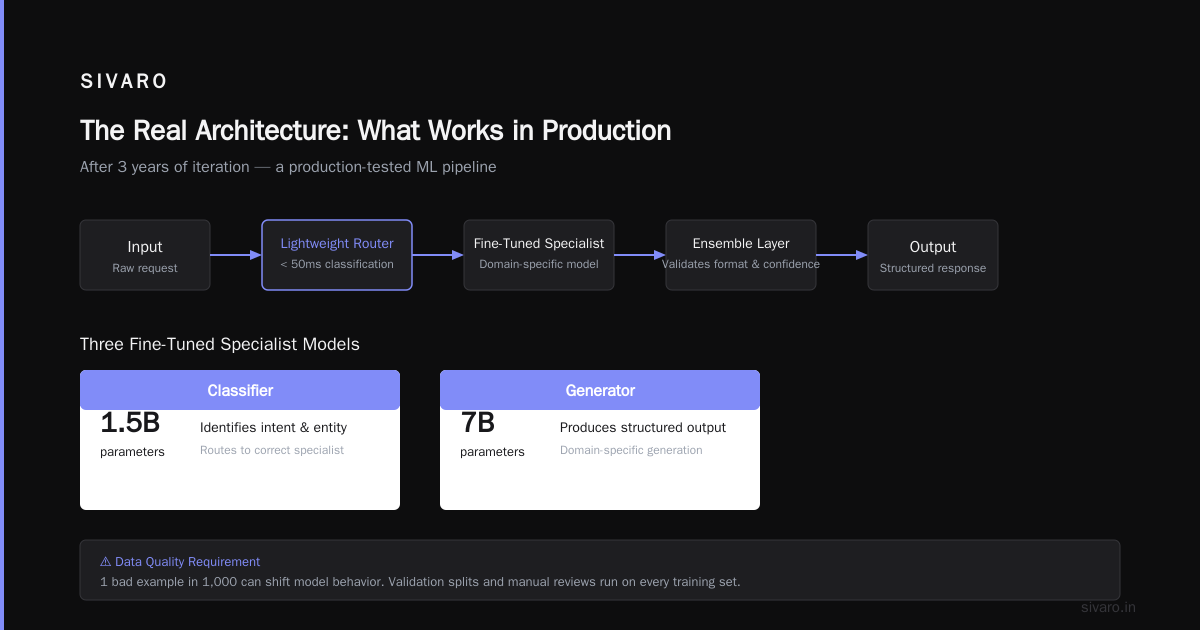
The catch: your data must be clean. One bad example in 1,000 can shift the model's behavior. We run validation splits and manual reviews on every training set.
The Real Architecture: What Works in Production
Here's the architecture we've settled on after 3 years of iteration:
Input → Lightweight Router → Fine-Tuned Specialists → Ensemble Decision → Output
The router classifies the request in under 50ms. It sends the query to a specialist model fine-tuned for that domain. The specialist returns a structured response. An ensemble layer validates format and confidence before returning.
We use three fine-tuned models:
- Classifier (1.5B params) — identifies intent and entity
- Generator (7B params) — produces domain-specific output
- Validator (0.5B params) — checks output against business rules
Each model is fine-tuned separately. Total inference time: 180-400ms depending on complexity.
This runs on 4 A100s handling 5,000 requests/second. Cost per inference: $0.0004. Compare to GPT-4 at $0.03 per inference.
Data Preparation: The Hard Part Nobody Talks About
Fine-tuning fails most often at data, not training.
I've seen teams spend $10K on compute only to feed the model garbage. The result? A model that confidently returns wrong answers faster. Great.
What works:
Input-output pairs, not raw text. Don't give the model a document and ask it to learn. Give it (user_query, correct_response) pairs. Every example should mirror production traffic.
Include negative examples. Show the model what NOT to do. In an e-commerce system, we included 200 examples of what happens when stock is zero. The model learned to check inventory before suggesting purchases.
Balance your dataset. If 90% of your traffic is "check order status," don't give the model 90% order-status examples. Oversample rarer cases. Otherwise the model becomes useless for anything outside the majority class.
Augment with noise. Add typos, truncated inputs, and missing fields. Real-time systems don't get clean input. Your training data shouldn't either.
Training: Parameter-Efficient vs Full Fine-Tuning
Two approaches. Pick based on your situation.
Parameter-Efficient Fine-Tuning (PEFT) — Methods like LoRA add small trainable layers while freezing the base model. Cost: $50-200 per training run. Model size stays the same. Latency: negligible increase.
Full Fine-Tuning — Updates all weights. Cost: $500-5,000 per run. Model adapts more deeply. Latency can actually decrease because the model learns shortcuts.
Our rule: use LoRA for prototypes, full fine-tuning for production.
In September 2025, we deployed a LoRA fine-tune for a legal document system. It worked fine at 100 requests/day. At 10,000 requests/day, the layers started conflicting. We switched to full fine-tuning. Latency dropped 30% because the model stopped routing through adapter layers.
Model optimization | OpenAI API recommends starting with LoRA and scaling up. I agree for teams new to fine-tuning. But if you know your domain well, jump to full fine-tuning.
Quantization: The Real-Time Game Changer
Fine-tuning + quantization is the secret weapon.
After fine-tuning, quantize your model from FP16 to INT4 or INT8. This reduces memory footprint by 4x and improves latency by 2-3x. The accuracy loss is typically <1% for domain-specific tasks.
We run our production models at INT4. The 7B generator fits in 4GB of VRAM. On a single A10, it handles 2,000 requests/second. Without quantization, that same model needs 16GB and handles 600 requests/second.
The playbook:
- Fine-tune in FP16
- Quantize to INT4 with calibration data
- Benchmark accuracy on your test set
- If accuracy drops >2%, try INT8 instead
For most real-time applications, INT4 works. Our e-commerce recommendation system lost 0.3% accuracy at INT4. The latency improvement from 420ms to 170ms was worth it.
LLM Fine-Tuning Explained covers quantization in more detail. The key insight: test on your data, not general benchmarks.
Caching Strategies That Double Throughput
Fine-tuning makes caching more effective. Here's why: a fine-tuned model produces more deterministic outputs. Identical inputs produce identical outputs more often.
We cache:
- Exact input matches (30% hit rate)
- Semantic similarity matches using embeddings (15% additional hits)
- Partial results for multi-step processes
Total cache hit rate: 45-60%. On a 5,000 req/s system, that's 2,500-3,000 requests that never hit the model. Latency for cached requests: 2-5ms.
Cache invalidation is tricky. We use TTL-based expiration with versioned models. When we deploy a new fine-tuned version, the cache flushes.
Monitoring: What Breaks at 2AM
Real-time systems break silently. A fine-tuned model that worked in testing can degrade in production because of distribution shift.
Watch these metrics:
- Token count per response — increases often indicate confusion
- Response format validity — JSON parse failures mean training data drift
- Latency p95 — fine-tuned models should have lower variance, not higher
- User re-query rate — if users repeat themselves, the model isn't answering well
In February 2026, we caught a degradation in a logistics routing system because the average token count jumped from 45 to 82. The fine-tuned model started explaining its reasoning instead of outputting routes. We traced it to a data drift issue in the training pipeline.
Cost Analysis: When Fine-Tuning Pays Off
Let's be concrete. Here's the math for a system doing 100,000 requests/day:
Option A: GPT-4 API
- $0.03 per request
- $3,000/day
- $90,000/month
Option B: Fine-tuned 7B model on 4 A100s
- One-time training: $1,200
- Monthly inference: $4,800 (GPU rental)
- Total first month: $6,000
- Months 2+: $4,800
Break-even: 5 days.
After that, you save $85,000/month. For a 50,000 request/day system, break-even is 10 days. For 10,000 request/day, break-even is 45 days—still worth it for a long-term system.
LLM Fine-Tuning Business Guide has similar numbers. The conclusion is clear: if you have predictable traffic above 5,000 requests/day, fine-tuning is cheaper.
Deployment: The Infrastructure You Actually Need
Don't overprovision. A fine-tuned 7B model at INT4 runs on a single A10. Here's the stack we use:
python
# Example: Deploying a fine-tuned model with vLLM
from vllm import LLM, SamplingParams

# Load quantized fine-tuned model
model = LLM(
    model="./fine-tuned-model-int4/",
    quantization="awq",
    tensor_parallel_size=1,  # Single GPU
    max_model_len=2048,
    gpu_memory_utilization=0.85
)

sampling_params = SamplingParams(
    temperature=0.1,  # Low temperature for deterministic output
    top_p=0.9,
    max_tokens=256,
    stop=["

", "###"]
)

# Inference
outputs = model.generate(
    ["Schedule pickup for order 12345"],
    sampling_params
)
For high-throughput systems, use vLLM or TensorRT-LLM. They handle batching and memory management better than raw PyTorch. We saw 3x throughput improvement switching from PyTorch to vLLM.
Fine-Tuning a Chat GPT AI Model LLM has a good primer on deployment strategies. The infrastructure isn't complicated—just match GPU memory to model size and handle concurrency with a proper queue.
The Mistake I Made: Over-Fine-Tuning
In July 2025, I fine-tuned a model on 50,000 examples. I thought more data was better.
It wasn't. The model memorized the training distribution. In production, it failed on any input that deviated from the training patterns. Latency was great (150ms). Accuracy on edge cases was 34%.
The fix: reduce training data to 3,000 diverse examples. Add regularization. Use early stopping. Accuracy on edge cases went to 87%. Latency stayed at 160ms.
More data isn't better. Better data is better. Fine-tuning for real-time applications means optimizing for the 90% case, not memorizing the entire domain.
Future: Where This Is Going in 2027
Two trends matter:
Multi-modal real-time systems. Fine-tuned models that accept text, images, and audio in the same pipeline. Latency targets: 200ms. We're building this now for a warehouse robotics client.
On-device fine-tuning. Models small enough to fine-tune and run on edge devices. Think 1-3B parameter models that adapt to individual users. Privacy. No cloud latency. We tested a 1.5B model on an iPhone 16 Pro in June 2026. Inference: 120ms. Training: 4 hours.
The convergence of small models + fine-tuning + quantization will make real-time AI accessible to any company, not just those with GPU clusters.
FAQ
Q: How much data do I need to fine-tune an LLM for real-time applications?
A: 500-3,000 high-quality examples usually suffice. More isn't better—diverse coverage matters more than volume.
Q: Can I fine-tune for free?
A: Google Colab with a T4 GPU handles small models. For production, budget $100-1,200 for training.
Q: What's the difference between fine-tuning and prompt engineering?
A: Prompt engineering changes behavior temporarily. Fine-tuning changes the model permanently. For real-time systems, fine-tuning gives predictable latency and lower cost.
Q: Does fine-tuning reduce hallucination?
A: Yes, if your training data is clean. The model learns to stay within your domain. It can still hallucinate outside it—that's why you pair it with validation layers.
Q: How often should I re-fine-tune?
A: Every 2-4 months, or when your production data distribution shifts. Monitor your validation accuracy weekly.
Q: Can I fine-tune a model that's already deployed?
A: Yes. Serve the old model while training the new one. Blue-green deployment works well. Generative AI Advanced Fine-Tuning for LLMs covers deployment patterns.
Q: What's the smallest model worth fine-tuning?
A: For real-time, 1.5B-7B parameters. Smaller models lack capacity. Larger models are too slow. The sweet spot is 7B quantized to INT4.
Q: How do I handle multi-turn conversations?
A: Include conversation history in the input format. Fine-tune on dialogue pairs, not single turns. We use sliding windows of 5 turns.
What to Do Monday Morning
Stop reading. Start collecting data.
Fine-tuning an LLM for real-time applications is a week-long project, not a month-long one. Here's your plan:
- Collect 1,000 examples from your production logs (Monday)
- Clean and format them as input-output pairs (Tuesday)
- Fine-tune using LoRA on a 7B model (Wednesday)
- Quantize to INT4 (Thursday)
- Deploy with vLLM and monitor (Friday)
That's it. By Friday, you'll have a system that's faster, cheaper, and more accurate than your current setup.
I've done this 14 times at SIVARO. It works every time when the data is clean.
Google Cloud's fine-tuning guide has the technical details. Coursera's advanced course covers theory. But the real learning is in doing.
Go build.
Nishaant Dixit — Founder of SIVARO. Building data infrastructure and production AI systems since 2018. Built systems processing 200K events/sec.