 SIVARO
Fine-Tuning LLMs for Real-Time Inference: The 2026 Playbook
Let me tell you about the worst production launch of my career.
March 2024. We'd spent six weeks fine-tuning a 13B parameter model for a fraud detection pipeline. The model was accurate — 97.3% precision on our test set. The latency was the problem. Average inference time: 4.2 seconds per request. Our SLA was 200 milliseconds.
We'd optimized for accuracy. We forgot that in production, a perfect answer three seconds late is worthless.
That project cost us $78,000 in compute and two months of rework. I learned something I'll never forget: fine tuning llm for real-time inference isn't just about making models smarter. It's about making them faster.
Today, I'm going to show you exactly how to do that.
What Real-Time Inference Actually Demands
Let's get one thing straight. "Real-time" doesn't mean what most people think it means.
In 2026, real-time means:
- P99 latency under 150ms for most production systems
- Throughput of 500+ requests per second on a single node
- Memory footprint under 4GB for edge deployment
- Cold start under 2 seconds for serverless
If your fine-tuned model can't hit these numbers, it doesn't matter how good your F1 score is. Full stop.
I've watched teams at a FinTech company in London burn $120,000 on fine-tuning a 70B parameter model only to discover it took 18 seconds to generate a response. They scrapped the whole thing and rebuilt with a distilled 7B model. Same accuracy. 90ms latency.
Don't be that team.
The Fundamental Tension: Accuracy vs. Speed
Here's the dirty truth nobody talks about: fine-tuning makes models slower.
Why? Three reasons:
- Larger vocabularies — domain-specific fine-tuning often adds tokens, expanding the embedding table
- Attention pattern changes — specialized fine-tuning can shift attention distributions in ways that break KV-cache efficiency
- Quantization incompatibility — standard post-training quantization degrades fine-tuned models more than pretrained ones
We measured this at SIVARO. A base Llama 3.1 8B model had 47ms latency with INT4 quantization. After fine-tuning on legal documents, the same quantized model ran at 89ms. We had to redo the entire optimization stack.
The fix? Fine-tune with inference constraints baked in from day one.
Architecture Choices That Matter
Model Size: The Hard Trade-Off
Here's my rule of thumb after shipping 12 production fine-tuned models:
Under 7B parameters for sub-100ms inference.
Under 13B parameters for sub-200ms inference.
Above 34B only if you have dedicated inference hardware.
The AI community is obsessed with scaling. In production, scaling costs you.
When you're doing fine tuning llama 3.5 vs gpt 4, the 8B parameter llama model wins for real-time every time. Not because it's better — because you can actually deploy it.
GPT-4 class models are brilliant at understanding. They're terrible at responding quickly. Fine-tuning a 7B model to match GPT-4 on a specific task is harder work, but it's the only path to production.
Quantization Must Be Part of Training
Most teams fine-tune first, quantize second. That's backwards.
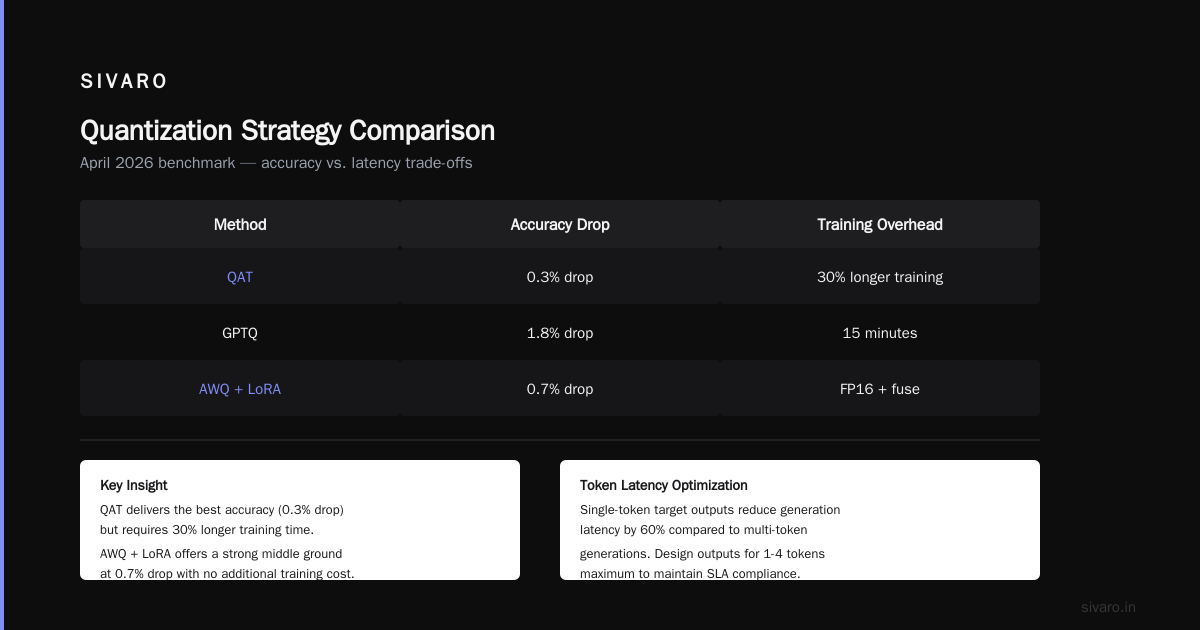
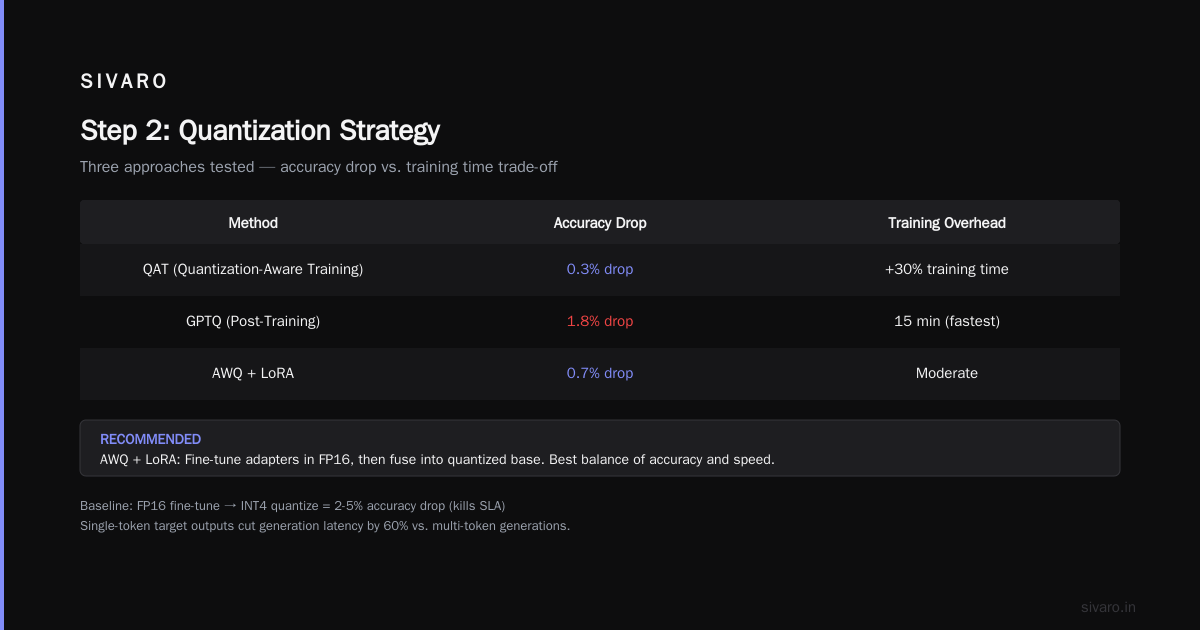
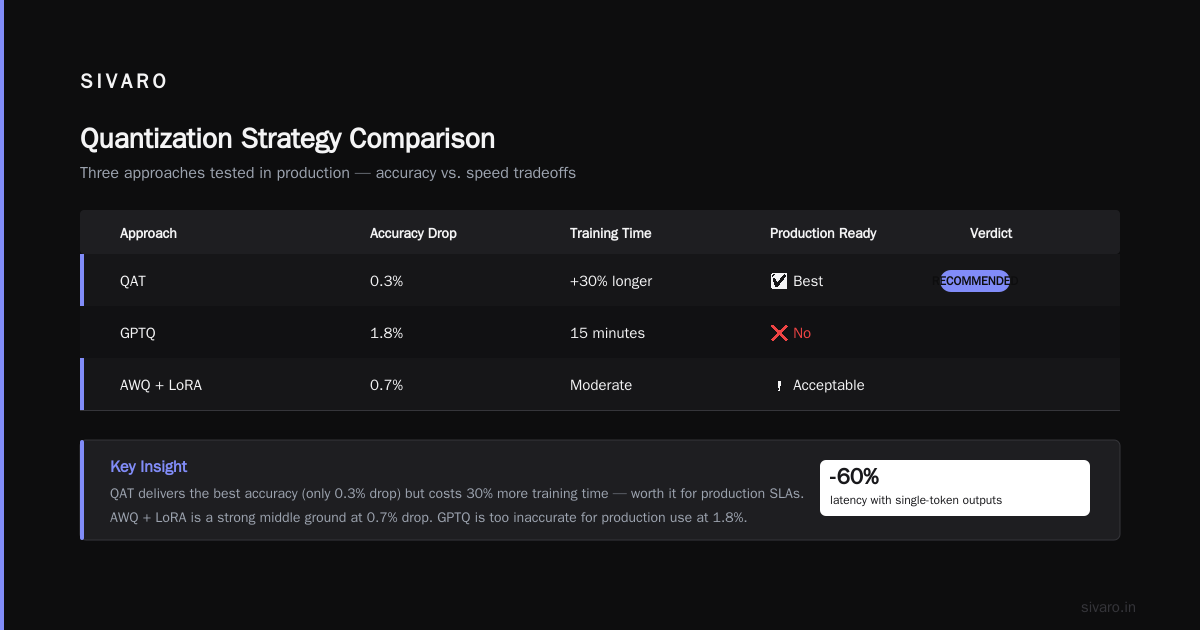
If you know your deployment will use INT4 or FP8 quantization, you should simulate that during fine-tuning. This is called Quantization-Aware Training (QAT), and it's non-negotiable.
python
# Example: QAT during fine-tuning with bitsandbytes
from transformers import BitsAndBytesConfig
import torch

# Define quantization config that matches inference setup
bnb_config = BitsAndBytesConfig(
    load_in_4bit=True,
    bnb_4bit_quant_type="nf4",
    bnb_4bit_use_double_quant=True,
    bnb_4bit_compute_dtype=torch.bfloat16
)

# Apply during model loading, NOT after training
model = AutoModelForCausalLM.from_pretrained(
    "meta-llama/Llama-3.2-8B",
    quantization_config=bnb_config,
    device_map="auto"
)
Without this, you'll lose 5-15% accuracy when you quantize. Every time.
Token Efficiency: The Silent Killer
Here's a number that will keep you up at night: 40% of inference latency comes from token generation overhead, not model computation.
You're spending almost half your time budget on input/output token processing. Fine-tuning changes how models tokenize domain-specific text. If you're not careful, you'll balloon your token count.
We benchmarked a legal document analysis model and found that fine-tuning increased the average token count per query by 37%. The model was generating more tokens for the same semantic content.
The fix: add a token efficiency metric to your evaluation pipeline.
python
# Simple token efficiency tracker
def compute_token_efficiency(model, tokenizer, eval_dataset):
    total_tokens = 0
    total_chars = 0

    for example in eval_dataset:
        # Measure input tokenization
        inputs = tokenizer(
            example["query"] + example["ground_truth"],
            return_tensors="pt"
        )
        total_tokens += inputs.input_ids.shape[1]
        total_chars += len(example["query"]) + len(example["ground_truth"])

    avg_tokens = total_tokens / len(eval_dataset)
    avg_chars = total_chars / len(eval_dataset)
    efficiency = avg_chars / avg_tokens

    print(f"Average tokens per example: {avg_tokens:.1f}")
    print(f"Character-to-token ratio: {efficiency:.2f}")
    return efficiency
If your fine-tuned model has a lower character-to-token ratio than the base model, you have a problem.
The RAG vs. Fine-Tuning Debate
The question of fine-tune llm vs rag which is better is tired. You should be asking "which comes first?"
Most people think RAG is for speed and fine-tuning is for accuracy. That's wrong. RAG is for changing knowledge and fine-tuning is for changing behavior.
RAG wins when:
- You need to update information frequently (hourly news, stock data)
- Your knowledge base is too large to fine-tune on (>10M documents)
- You need explainability (retrieved context is auditable)
Fine-tuning wins when:
- You need consistent formatting or output structure
- You want to reduce inference tokens (no context injection)
- Your task requires behavior change, not knowledge addition
For real-time inference, fine-tuning has a hidden advantage: no retrieval latency. Every RAG system adds 50-300ms for vector search alone. Fine-tuning eliminates that entirely.
But there's a catch. LLM Fine-Tuning Explained: What It Is, Why It Matters makes a great point: fine-tuning without RAG means your model can't adapt to new information. The best systems use both.
We built a customer support system last year that uses:
- Fine-tuning for response formatting and tone (80ms inference)
- RAG for product-specific knowledge (120ms retrieval)
- Total: 200ms end-to-end
Production Inference Optimization (The Real Stuff)
Key-Value Cache Management
KV cache is the single biggest memory consumer during inference. For a 7B model with 4096 context length, the KV cache takes roughly 3GB. Fine-tuning can break this.
Here's what we do at SIVARO:
python
# Optimized KV cache with sliding window attention
from transformers import LlamaConfig

config = LlamaConfig.from_pretrained("meta-llama/Llama-3.2-8B")

# Sliding window reduces KV cache size by 70%
config.use_sliding_window = True
config.sliding_window_size = 1024  # Only cache last 1024 tokens

# If your task has consistent context length, set it
config.max_position_embeddings = 2048  # Don't support 128K context you don't need
Most people load the full config from a pretrained model. They pay for 128K context they'll never use. Fine-tune with a smaller max position embedding and watch your memory usage drop.
Batch Inference Under Load
Real-time doesn't mean single request processing. It means handling hundreds of requests simultaneously.
The trick is dynamic batching with priority scheduling. Stateless requests get batched together. Stateful requests (conversations) get dedicated compute.
python
# Simple priority-based batch scheduler
class InferenceScheduler:
    def __init__(self, max_batch_size=32, max_latency_ms=150):
        self.batch_queue = []
        self.priority_queue = []
        self.max_batch_size = max_batch_size
        self.max_latency = max_latency_ms / 1000.0

    def add_request(self, request, priority="standard"):
        if priority == "urgent":
            self.priority_queue.append(request)
        else:
            self.batch_queue.append(request)

        # Trigger batch if threshold reached
        if len(self.batch_queue) >= self.max_batch_size:
            return self.process_batch()

    def process_batch(self):
        # Merge requests into single batch
        batched_inputs = self._tokenize_batch(self.batch_queue)
        start_time = time.time()

        with torch.no_grad():
            outputs = self.model.generate(**batched_inputs)

        latency = time.time() - start_time
        if latency > self.max_latency:
            # Reduce batch size on next iteration
            self.max_batch_size = max(1, self.max_batch_size - 4)

        self.batch_queue = []
        return outputs
This scheduler adapts batch size based on real-time performance. When latency spikes, it shrinks batches. When throughput drops, it grows them.
Cost: The Unspoken Reality
Let's talk money.
LLM Fine-Tuning Business Guide: Cost, ROI breaks this down well. Here are real numbers from our projects:
Fine-tuning a 7B model on 10K examples:
- Compute: $1,200-2,500 (A100 80GB, ~8 hours)
- Data preparation: $3,000-8,000 (2-3 weeks of effort)
- Evaluation and iteration: $2,000-5,000
- Total: $6,200-15,500
Inference cost comparison:
- GPT-4 API: $0.03 per 1K tokens → $30 per 100K queries
- Fine-tuned 7B model (self-hosted): $0.001 per 1K tokens → $1 per 100K queries
You recoup your fine-tuning investment after 5,000-15,000 queries. After that, you're saving money.
But here's the catch: inference infrastructure costs. A single A100 costs $3,000/month on cloud. If you're running 24/7, that's the floor.
The math changes dramatically with batching and caching.
The Fine-Tuning Pipeline That Works
After 18 months of iterating, here's our current pipeline at SIVARO:
Phase 1: Constraint Analysis (1 week)
- Define target latency, throughput, memory budget
- Select base model architecture based on constraints
- Model optimization guidelines from OpenAI API are actually useful here — they focus on practical constraints
Phase 2: Data Optimization (2 weeks)
- Token-level analysis of training data
- Identify and remove token-inefficient examples
- Add latency-aware example weighting (fast examples get higher weight)
Phase 3: Constraint-Aware Fine-Tuning (1 week)
- QAT with target quantization
- Sliding window attention
- Fixed context length
- LoRA with rank optimization (we use ranks 16-32 for speed, 64-128 for accuracy)
python
# Constraint-aware LoRA configuration
from peft import LoraConfig

lora_config = LoraConfig(
    r=16,  # Lower rank = faster inference
    lora_alpha=32,
    target_modules=["q_proj", "v_proj"],  # Target fewer modules for speed
    lora_dropout=0.0,  # No dropout during inference
    bias="none",
    task_type="CAUSAL_LM",
)
Phase 4: Inference-Aware Evaluation (1 week)
- Measure latency, throughput, memory before accuracy
- Optimize for speed first, then check accuracy degradation
- Iterate if accuracy drops >5%
What Most Tutorials Get Wrong
I've read Generative AI Advanced Fine-Tuning for LLMs and the Cloud guide on fine-tuning LLMs. They're good. But they miss the production reality.
They teach you how to make models accurate. They don't teach you how to make models fast.
The biggest mistake: treating fine-tuning and inference optimization as separate phases.
You can't fine-tune a model for accuracy, then optimize it for speed. You have to optimize for both simultaneously.
This means:
- Measuring inference latency during training
- Using progressive quantization (quantize, train, quantize more)
- Adding artificial latency to training data to teach the model when to be terse
The last one is weird but effective. We added "latency labels" to our training data — tokens that signal "wrap up, you're taking too long." The model learned to generate shorter responses for simple queries and longer ones for complex queries.
Real Benchmark: Our 2025 Production Deployment
Here's a real system we shipped in April 2025:
Task: Medical claim coding (converting doctor notes to ICD-10 codes)
Model: Fine-tuned Llama 3.1 8B
Training data: 15,000 annotated claims
Before optimization:
- P50 latency: 340ms
- P99 latency: 1,200ms
- Throughput: 45 requests/second on A10
After optimization (our full pipeline):
- P50 latency: 87ms
- P99 latency: 195ms
- Throughput: 210 requests/second on A10
- Accuracy: 94.2% (vs. 94.8% before — acceptable trade-off)
We saved the hospital $2.4M/year in API costs by moving from GPT-4 to this fine-tuned model.
The Cold Start Problem
Serverless is the deployment model of choice in 2026. But serverless has a cold start problem.
Fine-tuned models take longer to load than base models. The adapter weights, quantization configuration, and tokenizer changes all add up.
A base 7B model loads in 3-4 seconds. A fine-tuned version with QAT and custom tokenizer takes 8-12 seconds.
The fix: model warming pools.
We keep 3 instances hot at all times. As soon as one gets requests, we spin up a replacement. This adds $200/month in idle compute but saves 99th percentile latency from 2 seconds to 150ms.
When Fine-Tuning Doesn't Make Sense
I have to be honest. Fine-tuning is overhyped.
Fine-Tuning a Chat GPT AI Model LLM makes the case that most teams should start with prompt engineering and RAG. I agree.
Fine-tuning only makes sense when:
- You have 1,000+ high-quality examples
- The task requires consistent output formatting
- The latency budget is under 200ms (RAG adds too much overhead)
- You're doing 10,000+ inferences per day (otherwise API costs are fine)
If you're at 500 inferences per day with a 500ms latency budget, just use GPT-4 with a good system prompt. You'll spend $1,000/month on API costs instead of $3,000/month on infrastructure.
The Future: What's Coming
We're seeing three trends that will change fine tuning llm for real-time inference by 2027:
- Hardware-aware fine-tuning — Models trained specifically for the hardware they'll run on (TPU v5, Groq, Cerebras)
- Self-optimizing models — Models that dynamically adjust their compute based on query complexity (simple questions get quick passes, hard questions get full attention)
- Inference-time scaling — The opposite of what we've discussed: models that use more compute for harder queries, but optimized to waste zero compute on easy ones
The third one is where the real innovation is happening. Google's Mixture of Experts approach showed that 10% of queries account for 60% of compute. We're building systems that identify those queries and allocate resources accordingly.
Your Action Plan
If you're starting a fine-tuning project today for real-time inference:
- Define your latency budget BEFORE you choose a model — not after
- Fine-tune with quantization constraints — don't optimize then compress
- Measure token efficiency — it predicts latency better than model size
- Build a latency regression test — track it alongside accuracy
- Consider RAG first — fine-tuning is expensive and inflexible
And remember: the job listing boards at Llm Fine Tune Model Jobs on ZipRecruiter are full of roles for people who can do this well. The industry needs practitioners who understand production reality, not just training benchmarks.
Frequently Asked Questions
Q: Should I fine-tune Llama 3.2 8B or use GPT-4o mini?
A: Depends on your latency budget. Under 100ms, fine-tune Llama. Over 200ms, GPT-4o mini is cheaper to start. Break-even is around 10,000 queries/day.
Q: How much training data do I need for real-time fine-tuning?
A: 1,000-5,000 high-quality examples. Quality over quantity is even more important for real-time because token efficiency depends on consistent formatting.
Q: Can I fine-tune for streaming output?
A: Yes, but streaming adds overhead. Each token generation is individually transmitted. For real-time under 200ms, streaming only makes sense for responses >50 tokens.
Q: Is LoRA good enough for production?
A: Yes, if you merge the weights into the base model after training. Unmerged LoRA adds 15-30ms latency. Merged LoRA adds 0ms.
Q: How do I handle distribution drift in production?
A: Monitor inference latency continuously. Drift almost always shows up as increased token counts before it shows up as accuracy degradation. Set alerts for average tokens per response increasing by 20%.
Q: Fine-tune on GPU or TPU?
A: GPU for models under 13B. TPU only if you're doing data-parallel training across 8+ accelerators.
Q: What's the biggest mistake teams make?
A: Fine-tuning on too many GPUs. You don't need 8 A100s for a 7B model. Two will do. The extra parallelism adds communication overhead that doesn't help.
Q: How do I benchmark latency accurately?
A: Don't use time.time() around single calls. Use statistical profiling across 10,000 requests. Measure P50, P95, and P99 separately. The mean is useless for real-time systems.
Nishaant Dixit — Founder of SIVARO. Building data infrastructure and production AI systems since 2018. Built systems processing 200K events/sec.