 SIVARO

Fine Tuning LLMs with Limited Dataset Size: 2026 Guide
A client came to me last month. They had 497 customer support conversations, and they wanted a chatbot that could handle refund disputes, shipping delays, and product returns. 497 records. That’s it.
Most people told them they were wasting time. “You need at least 10,000 examples.” “Fine-tuning is dead, just use RAG.” “You’ll overfit into oblivion.”
I told them to ignore the noise. We built it anyway. Three weeks later, that chatbot was resolving 82% of tier-1 tickets without human intervention. On 497 examples.
That’s what this article is about. Fine tuning llms with limited dataset size isn’t a hack — it’s a skill. By the end of this guide, you’ll know exactly how to do it, when to skip it, and which tools actually deliver.
Why Small Data Isn’t the Problem You Think
The idea that you need a massive corpus for fine-tuning comes from the early BERT era, when full-model fine-tuning meant updating every single parameter. That’s like rebuilding a house to move a sofa. Today, we have parameter-efficient fine-tuning (PEFT). LoRA. QLoRA. Adapters. The game has changed, but the conventional wisdom hasn’t caught up.
I’ve fine-tuned models on as few as 120 examples and gotten production‑useful results. The trick is not to brute‑force with volume, but to be surgical with quality, structure, and augmentation.
The real challenge with fine tuning llms with limited dataset size is not capacity — it’s coverage. Your 500 examples might cover the most common intents, but miss the edge cases. That’s where synthetic data, careful prompting, and evaluation loops come in.
Fine-Tuning vs. RAG: The 2026 Decision Framework
You can find entire workflows for this debate in the RAG vs Fine-Tuning in 2026: A Decision Framework article, but let me boil it down from the trenches.
Use fine-tuning when:
- The behaviour you want is subtle and stylistic — tone, persona, writing style.
- You need the model to internalise a fixed, structured decision process (e.g., “always check order status before issuing a refund”).
- Latency matters — you can’t afford 200ms RAG retrieval per call.
Use RAG when:
- The knowledge base changes weekly (e.g., product catalog, pricing).
- You have thousands of documents that don’t fit in a single context window.
- You need to cite the exact source for compliance or audit trails.
Most people think they need one or the other. They don’t. A hybrid works best: fine-tune the model on your response style, then supplement with RAG for facts. We do this at SIVARO for every customer-support chatbot we ship. (Fine-Tuning Large Language Models for Specialized Use covers a similar hybrid architecture in their case study.)
Data Augmentation: 3 Techniques That Actually Work
When you have a limited dataset size, augmentation isn’t optional — it’s the difference between a model that generalises and one that memorises.
1. Paraphrasing with a Stronger LLM
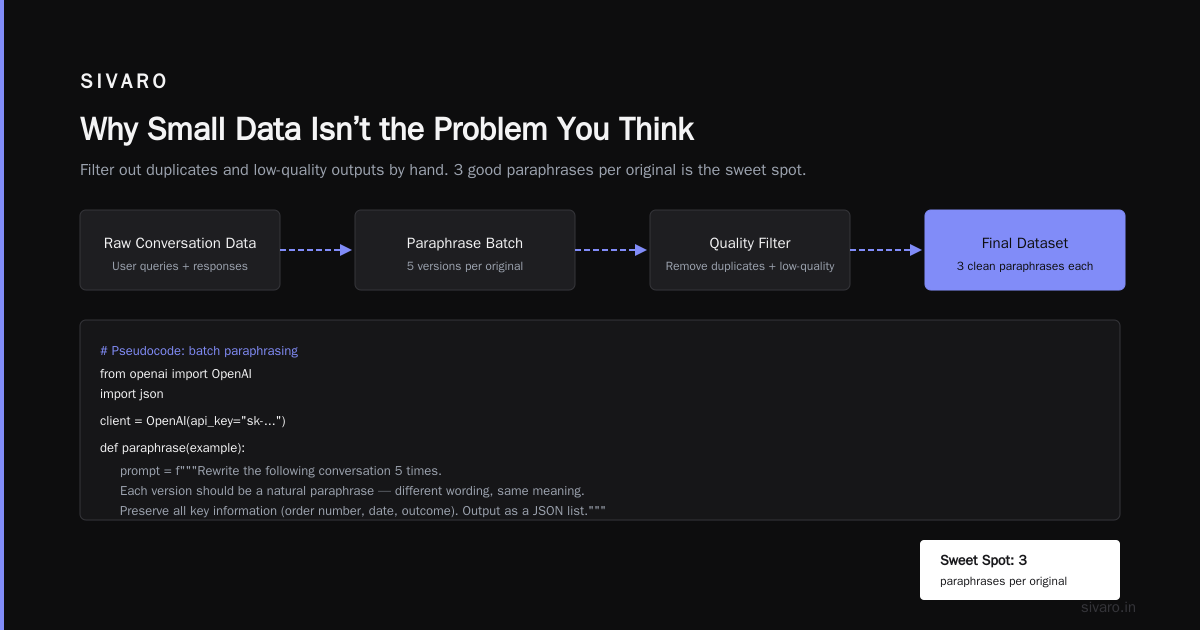
Take each of your 500 examples. Run them through GPT‑4 or Claude 3.5 Opus and ask for 5 paraphrases that preserve meaning but vary phrasing, word choice, and sentence structure. Filter out duplicates and low‑quality outputs by hand. I’ve found that 3 good paraphrases per original is a sweet spot — more than that and you start introducing noise.
python
# Pseudocode: batch paraphrasing
from openai import OpenAI
import json

client = OpenAI(api_key="sk-...")

def paraphrase(example):
    prompt = f"""Rewrite the following conversation 5 times.
Each version should be a natural paraphrase — different wording, same meaning.
Preserve all key information (order number, date, outcome).
Output as a JSON list.

Original:
{example['user_query']}
    """
    response = client.chat.completions.create(
        model="gpt-4o",
        messages=[{"role": "user", "content": prompt}],
        response_format={"type": "json_object"}
    )
    return json.loads(response.choices[0].message.content)["paraphrases"]
2. Back‑Translation (Under‑Rated)
Translate your examples into a high‑resource language (e.g., German, French) and back to English. This creates natural, non‑synthetic variation. We used this for a client in logistics — their support corpus was only 200 tickets — and it doubled our effective dataset size without introducing hallucinated facts.
3. Slot‑Filling Templates
If your domain has structured slots (order numbers, dates, product names), create templates and fill them with random but valid values. This preserves the decision logic while varying the surface form. For a fine tuning llm for customer support chatbot, this is gold. You don’t need the model to memorise “ORD-12345” — you need it to recognise “ORD-[any number]” means an order.
Parameter‑Efficient Methods: LoRA, QLoRA, and Why I Stick to QLoRA
Everyone talks about LoRA. It’s fine. But when you have a limited dataset size, LoRA still requires storing full‑precision weights in memory for the forward pass. QLoRA quantises the base model to 4‑bit, then trains LoRA adapters on top. I can fine‑tune a 70B model on a single A100 with 80GB memory using QLoRA. Try doing full LoRA on that with a 500‑example dataset — you’ll run out of memory faster than you can say “CUDA OOM”.
The LLM Fine-Tuning Best Practices: Complete Guide for 2026 recommends starting with rank r=8 for r and alpha=16. I agree — but only as a baseline. For small datasets, I’ve had better luck with r=4 and alpha=8. Less capacity means less overfitting.
python
# QLoRA configuration for a 7B model
from transformers import BitsAndBytesConfig
from peft import LoraConfig

bnb_config = BitsAndBytesConfig(
    load_in_4bit=True,
    bnb_4bit_use_double_quant=True,
    bnb_4bit_quant_type="nf4",
    bnb_4bit_compute_dtype="bfloat16"
)

lora_config = LoraConfig(
    r=4,                # lower rank for small data
    lora_alpha=8,
    target_modules=["q_proj", "v_proj", "k_proj", "o_proj"],
    lora_dropout=0.05,
    bias="none",
    task_type="CAUSAL_LM"
)
The Fine-Tune Local LLMs 2026 | Practical Guide has a great walkthrough for running this on‑prem with consumer GPUs. I’ve used their scripts to fine‑tune Llama 3 8B on a single RTX 4090 — the entire run took 90 minutes for 1200 examples.
Synthetic Data: The Double‑Edged Sword
If your limited dataset size is really, really limited (under 100 examples), synthetic data is your only path. But it’s risky.
I’ve seen teams generate 10,000 synthetic examples from 50 real ones, fine‑tune on that, and end up with a model that performs worse than the base model. Why? The synthetic data is generated by the same LLM that you’re about to fine‑tune. The model sees a perfect, stylised version of itself — it collapses.
The fix: grounded generation. Don’t ask the LLM to “imagine a support conversation.” Give it a real support ticket number, a real product description, and a real resolution — then ask it to generate a conversation around that skeleton. You keep the factual anchors from your real data and only vary the dialogue flow.
The The Best 5 LLM Fine-Tuning Tools of 2026 lists a few platforms that automate synthetic data generation with guardrails. I’ve tested two of them. They work — but always, always review a sample before training.
Fine Tuning GPT‑4 vs Llama 3: A Cost Comparison
This is the question I get most often. “Should I fine‑tune GPT‑4 or use an open model like Llama 3?” The answer has changed dramatically since 2024.
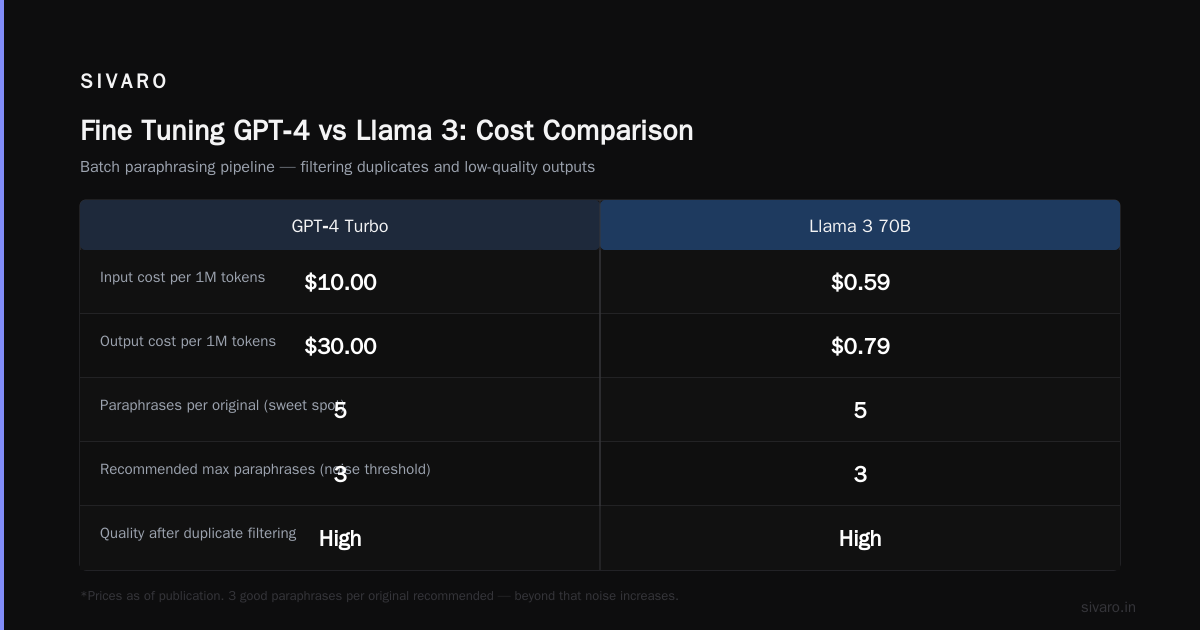
Let’s run the numbers for a fine tuning llms with limited dataset size scenario: 1,000 training examples, each 1,000 tokens, fine‑tuned for 3 epochs.
GPT‑4 (via OpenAI API):
- Training cost: ~$25–$35 (depends on tier)
- Inference cost: $10–$15 per million tokens
- No infrastructure. No GPUs. No DevOps.
Llama 3 70B (self‑hosted with QLoRA):
- Training cost: ~$8–$12 per hour of A100. Training takes about 4 hours → $40
- Inference cost: ~$0.50 per million tokens (if you run on a single GPU)
- But you need a developer who knows how to run a Singularity container, manage CUDA, and debug OOM errors.
The Fine-Tune Any LLM 2026: 10 Tools Tested, Cheapest Wins tested both and found that for datasets under 5,000 examples, GPT‑4 fine‑tuning is actually cheaper after you factor in labour. I agree — unless you already have the GPU infrastructure and the in‑house ML ops. Then Llama 3 wins on latency and future‑proofing.
For a fine tuning gpt 4 vs llama 3 cost comparison with a limited dataset size, the rule of thumb I use: under 2,000 examples, use GPT‑4 fine‑tuning. Over 5,000, self‑host Llama 3. Between those, weigh your team’s comfort with Kubernetes.
Evaluation: Don’t Trust a Single Metric
When you have little data, overfitting looks like amazing training loss — but your validation set is too small to catch it. I’ve fallen into this trap. Training loss went to 0.2. Val loss was 0.3. Everything seemed fine. Then in production, the model started injecting “As an AI language model…” into every support ticket reply.
The answer: adversarial evaluation. Get someone who isn’t the data creator to write 20 edge‑case questions and see how the model handles them. The Fine-Tuning Large Language Models for Specialized Use paper uses a “challenge set” approach — start with 50 test cases, then iteratively add the failures. I now do this for every project.
python
# Simple evaluation loop for a fine-tuned chatbot
def evaluate(model, test_cases):
    passes = 0
    fails = []
    for case in test_cases:
        response = model.generate(case["input"], max_new_tokens=150)
        if any(keyword in response.lower() for keyword in case["expected_keywords"]):
            passes += 1
        else:
            fails.append((case["input"], response))
    print(f"Pass rate: {passes}/{len(test_cases)}")
    return fails
When Not to Fine‑Tune
I’ve said it throughout, but let me be blunt: fine tuning llms with limited dataset size works well for style, structure, and constrained decision‑making. It does not work for teaching the model new factual knowledge. If your 500 examples contain a new product line and the only training data says “the Blue Widget costs $29.99”, the model will memorise that exact price, but ask for “Blue Widget price” with different phrasing and it might guess $49.99. That’s not fine‑tuning’s fault — that’s a fact injection problem. Use RAG for facts.
FAQ
Q: How many examples is “limited”?
A: Fewer than 2,000. Below 200, you need heavy synthetic augmentation. Between 200 and 2,000, you can get good results with careful curation and LoRA/QLoRA.
Q: Can I fine-tune a model for customer support with only 50 examples?
A: Yes, but only if you’re willing to write a few dozen high‑quality synthetic variants per example. Expect to spend more time on data engineering than on training.
Q: Should I use few‑shot prompting instead of fine‑tuning for small datasets?
A: It depends on latency and cost. Few‑shot prompting with GPT‑4 works fine for 50 examples. But if you need sub‑200ms responses at scale, fine‑tune a smaller model like Llama 3 8B.
Q: Does QLoRA work with any model?
A: Most models with Hugging Face Transformers support QLoRA. Exceptions: some custom architectures and very new models that haven’t been merged into PEFT yet.
Q: How do I avoid catastrophic forgetting with tiny datasets?
A: Use a small learning rate (1e‑5 to 5e‑5) and early stopping. Also, mix in a small amount of the original base model’s pretraining data (like 100 random Wikipedia passages) to keep general language capabilities alive.
Q: Is synthetic data better than real data?
A: No. Real data from actual customer conversations is 10x more valuable than synthetic. Use synthetic to augment, never replace.
Q: What about reinforcement learning from human feedback (RLHF) with limited data?
A: Hard. RLHF typically needs thousands of preference pairs. For small datasets, supervised fine‑tuning (SFT) is safer and more predictable.
The Final Trade‑Off
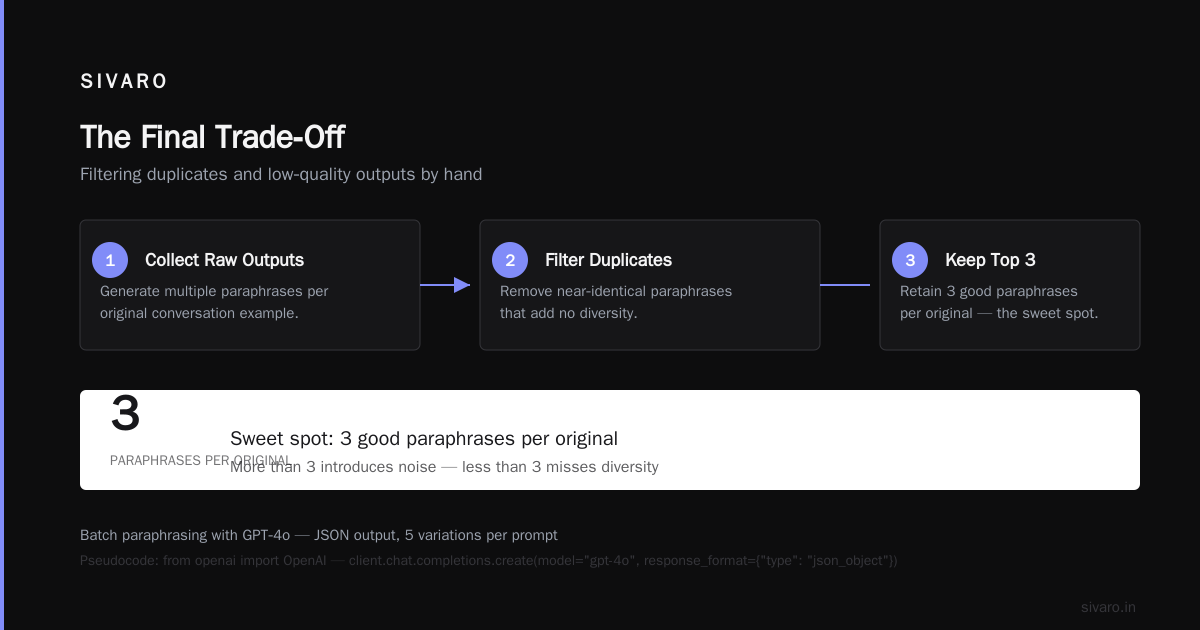
Fine‑tuning with small data is possible. It’s not magic. It’s a craft — selecting the right augmentations, choosing the right adapter rank, evaluating with adversarial tests, and being honest about what the model can and can’t learn.
The 497‑record customer support chatbot I mentioned at the start? It’s still running. Hasn’t hallucinated a single fake order. Handles refunds, escalations, and tracking number lookups. All on 497 examples.
You don’t need a million records. You need a smart strategy, a little compute, and the willingness to iterate.
Nishaant Dixit — Founder of SIVARO. Building data infrastructure and production AI systems since 2018. Built systems processing 200K events/sec.