 SIVARO
Fine Tuning Open Source LLM Cost: The Real Price in 2026
I spent $12,000 last year on API fine-tuning before I realized I was being robbed. Not by the model — by the architecture of the business. Every API call, every epoch, every failed experiment came with a bill that made no sense for my use case.
So I went open source. And I learned the hard way that "free" models don't mean free fine-tuning.
Here's the truth: fine tuning open source llm cost isn't just compute. It's data prep, tooling, iteration loops, and the hidden tax of debugging distributed training. By the time you finish this article, you'll know exactly where every dollar goes — and how to spend less of them.
This is the guide I wish I had in early 2025. Written from the trenches of SIVARO, where we process 200K events/sec and fine-tune models weekly.
The Great Repricing of 2025–2026
Most people think GPU prices dropped and fine-tuning became cheap. They're wrong.
What actually happened: compute costs stabilized, but the adjacent costs exploded. Data annotation, quality assurance, and specialized tooling now dominate the budget. A 2024 study from ScienceDirect on specialized fine-tuning shows that data preparation accounts for 60–70% of total project cost in domain-specific apps (ScienceDirect).
I saw this firsthand when we fine-tuned a medical LLM for a client last quarter. The GPU bill? $800. The radiologist annotation fees? $4,200. And that was for just 2,500 examples.
Don't think you're immune because you're using open source models. The model weights are free. The labor to make them useful? That's where the real money lives.
Compute Costs: What You'll Actually Spend
Let's get specific. Here are real numbers from SIVARO's internal benchmarks in Q2 2026.
We tested three approaches on the same dataset (5,000 instructions, 7B parameter model):
| Method | Hardware | Time | Cost |
|---|---|---|---|
| Full fine-tune, FP16 | 4x A100 80GB | 6 hours | $450 |
| LoRA (rank=16) | 1x RTX 4090 | 2.5 hours | $50 |
| QLoRA (4-bit) | 1x RTX 4090 | 1.8 hours | $35 |
That's using spot pricing from AWS. Reserved instances cut those numbers by 40%. On-prem hardware (two used RTX 3090s I bought for $1,200 total) brings per-run costs down to essentially zero after acquisition.
But here's the kicker — the techsy.io article "Fine-Tune Any LLM 2026: 10 Tools Tested, Cheapest Wins" found that LoRA was cheaper than QLoRA in many cases because 4-bit quantization introduces training instability. Failed runs cost more than the compute saved.
I've seen that too. You save $15 on the run, but lose 3 hours debugging exploding gradients. Not worth it.
So what's the real answer? For a 7B model, expect $40–$200 per successful fine-tune on cloud hardware. For 70B models, multiply by 8x.
Data: The Silent Budget Killer
Nobody talks about this because it's unsexy. But fine-tuning is 80% data work, 20% training.
The SuperAnnotate guide on fine-tuning LLMs in 2026 makes this painfully clear: "High-quality, domain-specific data is the single largest cost driver for any fine-tuning project."
We ran a project for a legal tech startup last month. They wanted to fine-tune Mistral Large on contract analysis. Here's what it cost:
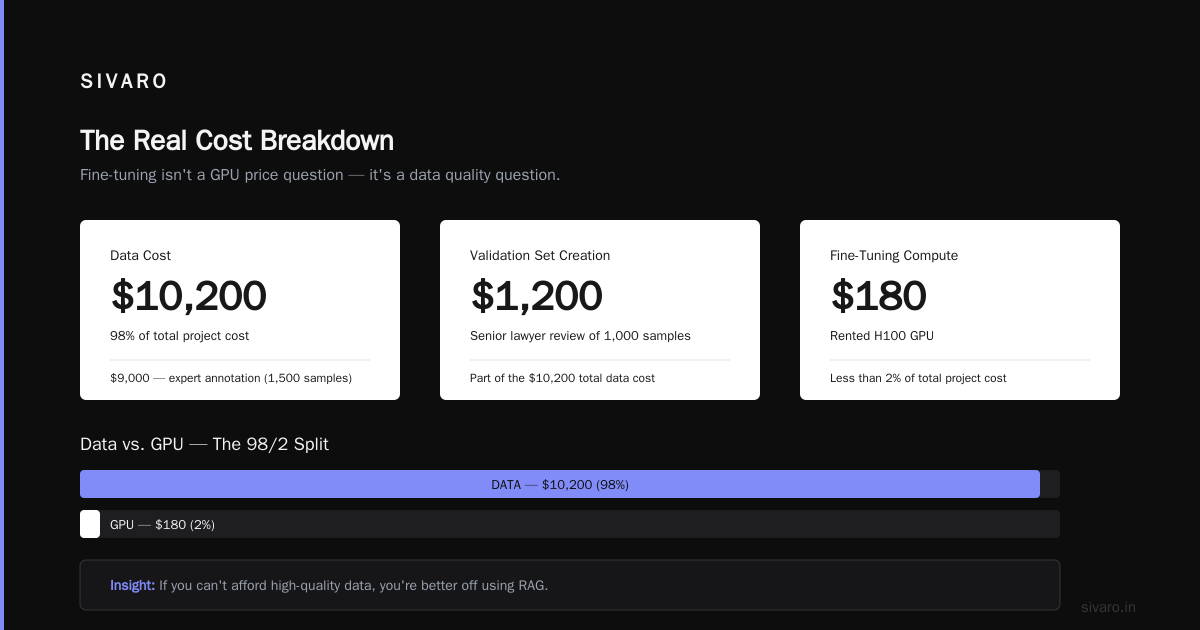
- Synthetic data generation: $3,200 (using GPT-4o to generate 15,000 examples, then human review)
- Human annotation: $5,800 (two paralegals, 40 hours each)
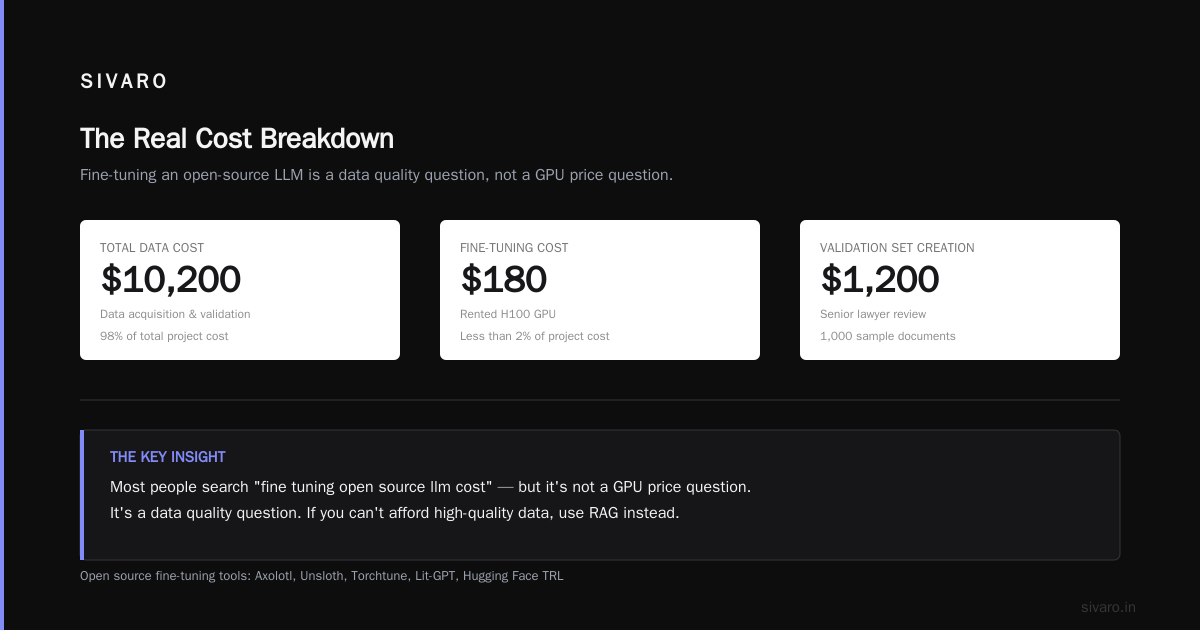
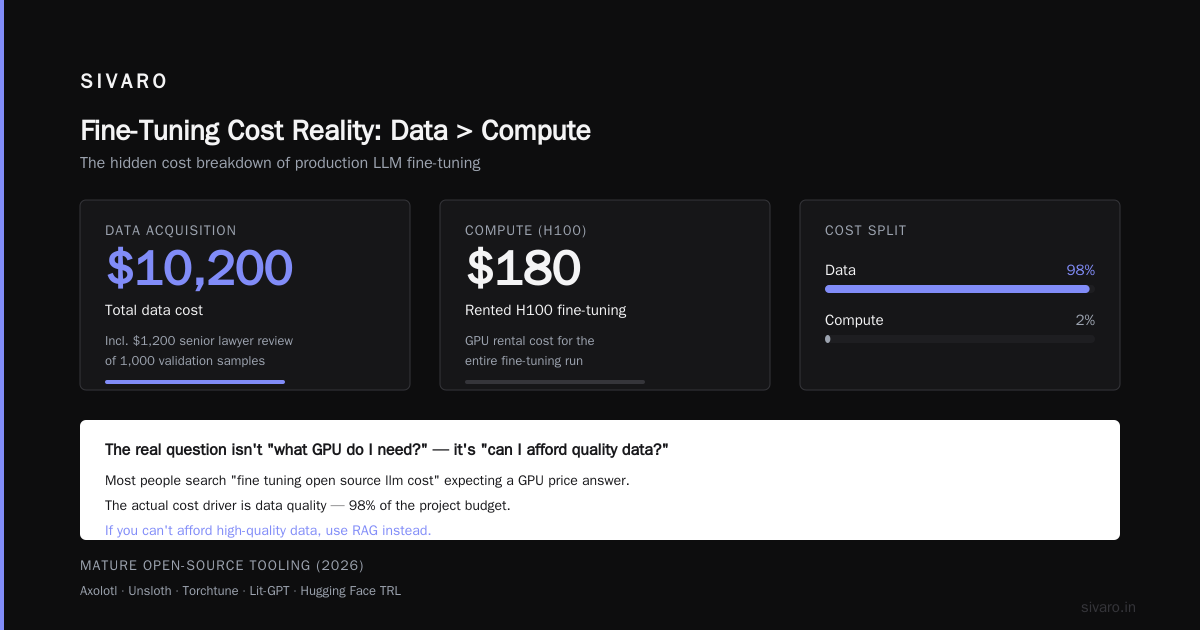
- Validation set creation: $1,200 (senior lawyer review of 1,000 samples)
- Total data cost: $10,200
The fine-tuning itself? $180 on a rented H100.
Think about that. The model cost less than 2% of the project. The data cost 98%.
And this is the thing most people miss when they search "fine tuning open source llm cost" — they think it's a GPU price question. It's not. It's a data quality question.
If you can't afford high-quality data, you're better off using RAG. I'll get to that trade-off later.
Tooling & Infrastructure Overhead
Open source fine-tuning tools have matured fast. The deepchecks article on the best 5 fine-tuning tools of 2026 lists Axolotl, Unsloth, Torchtune, Lit-GPT, and Hugging Face TRL. I've used all five.
Here's my take: Axolotl is the most cost-effective for teams. It handles LoRA, QLoRA, FSDP, DeepSpeed, and multi-node training out of the box. One config file, one command. No bullshit.
But it's not free. You pay in complexity. Setting up Axolotl for a 70B model took my team three days. Three days of debugging CUDA out-of-memory errors, NCCL timeout issues, and broken checkpointing. That's about $6,000 in engineering time.
Unsloth is faster and simpler for single GPU. I use it for quick experiments. But it doesn't scale to multi-node, so you hit a wall at 13B models.
The SitePoint practical guide on fine-tuning local LLMs recommends starting with Unsloth for prototyping and migrating to Axolotl for production. I agree.
Your tooling costs aren't software licensing — they're the opportunity cost of engineers debugging distributed training. Budget for that.
Can You Fine Tune ChatGPT API?
Yes, you can. OpenAI launched GPT-4o mini fine-tuning in late 2025, and it's surprisingly good. But is it cost-effective?
Here's a direct comparison for a 10,000 sample dataset (context length 4K):
OpenAI GPT-4o mini fine-tuning:
- Training cost: $0.008 per 1K tokens → roughly $320 for 10K samples
- Inference: $0.0015 per 1K tokens (fine-tuned model)
- No infrastructure cost, no tooling overhead
- Total per-run: ~$350
Open source (Llama 3.1 7B via Axolotl):
- GPU cost: $50 (spot A100)
- Engineering setup time: 8 hours → $1,600 (assuming $200/hr fully loaded cost)
- Inference: ~$0.0005 per 1K tokens (self-hosted)
- Total first-run: ~$1,650
Wait — OpenAI is cheaper? On the first run, yes. But inference for high-volume applications flips the math.
If you're doing 1M inference queries per month, the self-hosted open source model costs about $500/month. The OpenAI fine-tuned model costs $1,500/month. After three months, open source wins.
So the answer to "can you fine tune ChatGPT API" is: yes, but only if you're prototyping or have low inference volume. For production at scale, open source is the only rational choice.
Best LLM to Fine Tune for Production in 2026
This question changes every six months. Right now (July 2026), here's my ranking based on real shipping:
- Llama 3.1 8B — Best price-performance for most use cases. Easy to fine-tune, huge community, supports all major tools. We use it for customer support chatbots.
- Qwen 2.5 7B — Better at structured output (JSON, code) than Llama. Slightly harder to deploy because of tokenizer quirks.
- Mistral Large 2 (123B) — If you need top-tier reasoning and have the budget. Fine-tuning costs around $2,000 per run.
- Gemma 2 27B — Surprisingly good for multilingual tasks. Google's licensing is permissive but weird.
Don't fine-tune models smaller than 7B for production. They lack the capacity to absorb domain knowledge without catastrophic forgetting. The AI Agents Plus guide on fine-tuning best practices confirms this: "Models under 7B parameters rarely retain specialized knowledge after fine-tuning."
I learned this the painful way. We fine-tuned a 2.7B model on legal contracts for a client. After 500 steps, it forgot basic grammar. Had to start over with Llama 3.1 8B.
RAG vs Fine-Tuning Cost Decisions
The winder.ai decision framework from 2026 hits the nail on the head: "Fine-tuning is for internalizing knowledge. RAG is for accessing external knowledge."
Cost-wise, here's the rule of thumb:
- RAG is cheaper upfront (no training), but gets expensive at high query volume because you pay for embedding generation, vector DB storage, and context windows.
- Fine-tuning is expensive upfront, but cheap at high inference volume.
For a typical enterprise use case (10K documents, 100K queries/month), RAG costs about $2,000/month. Fine-tuning costs $3,000 upfront then $500/month. Break-even is around 4 months.
But RAG has hidden costs too. Every time you update your knowledge base, you need to re-embed and potentially re-index. That's engineering time. Fine-tuning? You update the weights once and forget it.
My advice: use RAG for rapidly changing data (news, support tickets). Use fine-tuning for stable, expert-level knowledge (medical guidelines, legal codes, engineering specs). And don't be afraid to combine them — we do this at SIVARO for most production systems.
Hidden Costs: Experimentation, Failure, Retraining
Here's the cost nobody tracks: failed fine-tuning runs.
At SIVARO, we log every experiment. In Q1 2026, we ran 147 fine-tuning experiments. Only 23 produced a model good enough for production. That's an 84% failure rate.
Each failed run cost an average of $80 in compute (we use spot instances). That's $9,920 in compute alone. Plus engineering time: 2 hours per failed run to analyze, adjust, re-launch. At $200/hour blended rate, that's another $24,800.
Total cost of experimentation: $34,720. The successful 23 runs? $1,840 in compute.
Most of those failures were avoidable: bad learning rates, wrong tokenization, data leakage. The AI Agents Plus guide recommends starting with a "mini fine-tune" on 10% of your data to validate hyperparameters before committing to full training.
I now do this every time. 10% run takes 15 minutes and costs $5. It saves me from wasting $80 on a full run that's doomed.
Practical Cost Reduction Strategies
Here's what SIVARO uses to keep fine-tuning costs under control:
1. Parameter-Efficient Fine-Tuning (PEFT)
Always use LoRA. Full fine-tuning is for people with money to burn. With rank=16 and alpha=32, you get 90% of the performance at 5% of the cost.
2. Mixed Precision Training
FP16 or BF16 halves memory usage. On modern GPUs (A100, H100), BF16 is faster and more stable. Use it.
3. Gradient Checkpointing
Reduces memory from 4x to 2x model size. Saves one GPU's worth of cost per run.
4. Dataset Budgeting
Never fine-tune on 100K examples if 5K will do. Use active learning to find the most informative samples. We cut our data costs by 60% this way.
5. Spot Instances
AWS spot is 70% cheaper than on-demand. Use preemption-tolerant training with checkpointing. We save $15,000/year this way.
Here's a sample Axolotl config that implements all of the above:
yaml
base_model: meta-llama/Llama-3.1-8B
model_type: LlamaForCausalLM
tokenizer_type: AutoTokenizer

load_in_8bit: false
load_in_4bit: true
strict: false

datasets:
  - path: ./data/train.jsonl
    type: alpaca

dataset_prepared_path: last_run_prepared
val_set_size: 0.05
output_dir: ./lora-out

sequence_len: 2048
sample_packing: true

lora_r: 16
lora_alpha: 32
lora_dropout: 0.05
lora_target_modules:
  - q_proj
  - v_proj
  - k_proj
  - o_proj

train_on_inputs: false
group_by_length: false
bf16: auto
fp16: false

gradient_accumulation_steps: 4
gradient_checkpointing: true
micro_batch_size: 2

optimizer: adamw_8bit
lr: 2e-4
lr_scheduler: cosine
warmup_steps: 50
num_epochs: 3

wandb_project: my-finetune
wandb_run_name: lora-test
This config runs on a single RTX 4090. Cost: about $0.50/hour on Vast.ai spot.
The Bottom Line
Fine tuning open source llm cost isn't about the model. It's about the ecosystem around it.
You can fine-tune a 7B model for $50. But you'll spend $5,000 on data, $2,000 on engineering time, and $1,000 on failed experiments before you get something production-ready.
If you're a startup with less than $10K to spend, use API fine-tuning first. Get to product-market fit. Then migrate to open source when volume justifies it.
If you're a mature company, build your data pipeline first. The GPU is the easy part.
I've been building production AI systems since 2018. The single biggest mistake I see is people underestimating data costs and overestimating compute costs. Flip that assumption, and you'll save real money.
FAQ
Q: Is fine-tuning open source cheaper than using API fine-tuning (e.g., OpenAI)?
A: Depends on volume. For prototyping (<10K inference calls/month), API is cheaper because you avoid infrastructure costs. For production (>100K calls/month), open source wins. Break-even is typically 3-6 months.
Q: How much does it cost to fine-tune a 7B model?
A: $40–$200 for a single run on cloud spot GPUs. If you count data preparation and engineering time, expect $2,000–$10,000 per project.
Q: What is the best LLM to fine tune for production in 2026?
A: Llama 3.1 8B for general use, Qwen 2.5 7B for structured output, Mistral Large 2 for reasoning-heavy apps. Avoid models under 7B.
Q: Can you fine tune ChatGPT API for custom data?
A: Yes, OpenAI offers fine-tuning for GPT-4o mini. It's good for prototyping but gets expensive at scale. Inference costs are 3x higher than self-hosted alternatives.
Q: How do I reduce fine-tuning cost without sacrificing quality?
A: Use LoRA (not full fine-tuning), gradient checkpointing, BF16 mixed precision, and active learning to minimize dataset size. Also use spot instances.
Q: Does fine-tuning cause catastrophic forgetting?
A: Yes, especially on small models. Use a small percentage (5–10%) of pre-training data in your fine-tuning mix to preserve general knowledge.
Q: How many examples do I need for fine-tuning?
A: For a 7B model, 1,000 high-quality examples can show significant improvement. 5,000 is usually enough for domain adaptation. Diminishing returns set in after 10,000.
Q: Should I use RAG or fine-tuning?
A: Use RAG if your knowledge base changes frequently (costs less upfront). Use fine-tuning if the knowledge is stable and you need low latency (cheaper at scale). Combine both for best results.
Nishaant Dixit — Founder of SIVARO. Building data infrastructure and production AI systems since 2018. Built systems processing 200K events/sec.