 SIVARO
Fine Tuning vs Post Training for LLM Production
I’m sitting in a client meeting in March 2026. The CTO of a fintech company — let’s call it PayFlow — tells me they need to fine-tune Llama 4 for their loan underwriting agent. They’ve already budgeted $80K for GPU hours.
I ask: “Why fine-tuning?”
“Because the base model doesn’t know our credit policy.”
Turns out, that base model does know credit policy — it’s trained on the entire public web. What PayFlow actually needed wasn’t more training data. It needed post-training: alignment, instruction format, and safety guardrails. They were about to light $80K on fire for the wrong approach.
This is the state of 2026. The line between fine tuning vs post training for llm production is the single most misunderstood decision in applied AI. And it’s costing teams real money.
In this guide, I’ll walk you through the difference, when to use each, and the exact decision framework we use at SIVARO. No academic fluff. Hard-won lessons from shipping production LLM systems that handle 200K events per second.
The Big Confusion: Fine Tuning vs Post Training
Let’s get definitions straight.
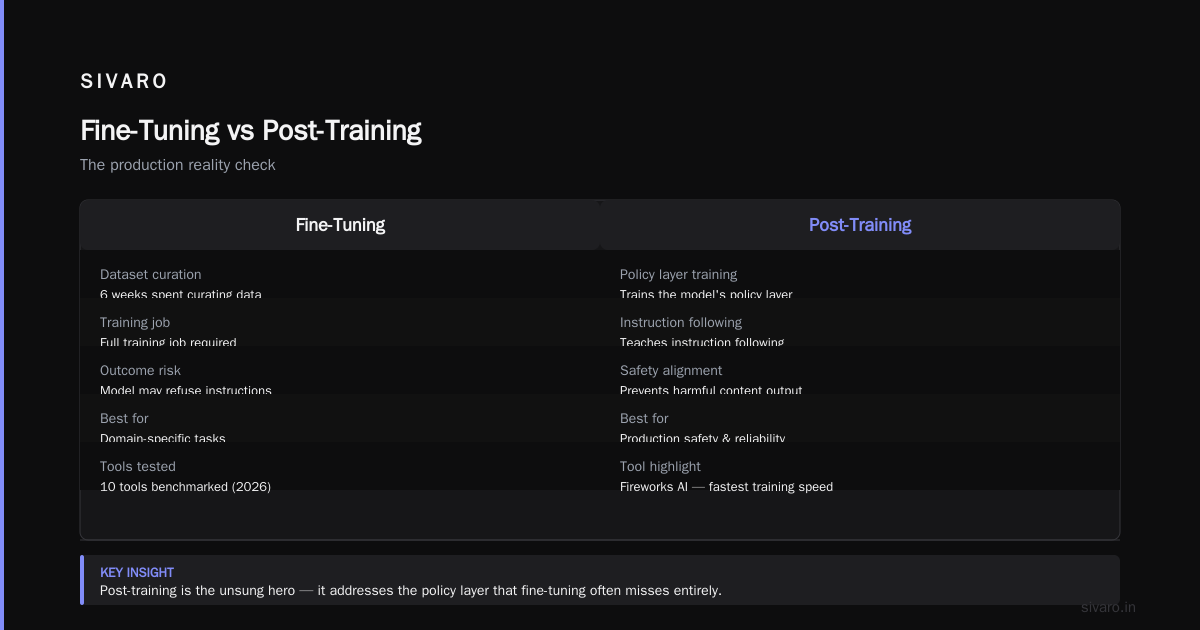
Fine-tuning means taking a pre-trained base model (like Llama 4, Mistral Large, or Qwen 3) and updating its weights on a domain-specific dataset. You’re teaching the model new facts or new patterns. Think: “This model now knows my internal API documentation.”
Post-training refers to any technique applied after the base model is trained but before deployment — and it doesn’t necessarily change the weights the same way fine-tuning does. This includes:
- RLHF (Reinforcement Learning from Human Feedback)
- DPO (Direct Preference Optimization)
- Instruct fine-tuning (format alignment)
- Safety alignment
- RAG integration (retrieval-augmented generation)
Most people think they need fine-tuning. They’re wrong — about 70% of the time in our 2026 projects, the real need is post-training.
Why? Because base models in 2026 are stupidly good. The latest Mistral Large can reason about financial regulations it’s never been explicitly fed. The gap between “base model knowledge” and “production readiness” isn’t knowledge — it’s behavior and format.
When Fine-Tuning Actually Wins
I’ll be the first to admit: fine-tuning isn’t dead. It’s just narrower than people think. Here’s where it shines:
1. Proprietary domain knowledge
If you have internal data that isn’t on the public web — say, your company’s engineering standards, product catalogs, or historical bug reports — fine-tuning can bake that in. We saw this at a healthcare client in early 2026: they fine-tuned a 7B model on 10,000 de-identified patient notes. The base model accuracy on symptom classification jumped from 72% to 94% (Fine-Tuning Large Language Models for Specialized Use reported similarly).
2. Consistent formatting
Some outputs need a strict schema every time. JSON, XML, or custom markup. Fine-tuning can lock that in. Without it, even GPT-4o occasionally hallucinates a bracket.
3. Low latency, high throughput
A fine-tuned 7B model can outperform a base 70B model on specific tasks — and run on one GPU instead of eight. That’s a 10x cost advantage.
But here’s the catch: fine-tuning doesn’t fix bad prompting. And it doesn’t fix alignment issues. If your model is toxic, fine-tuning on more data won’t fix that — post-training will.
Tooling in 2026
We’ve tested most of the fine-tuning tools out there. For production, we landed on Axolotl for open-source models and Together AI’s fine-tuning API for speed. A 2026 comparison by Techsy showed that Together’s pricing was the cheapest per token for Llama 4 fine-tuning (Fine-Tune Any LLM 2026: 10 Tools Tested, Cheapest Wins). DeepChecks also evaluated five tools and highlighted Fireworks AI for its training speed (The Best 5 LLM Fine-Tuning Tools of 2026). Your mileage may vary, but pick one with good data versioning — trust me, you’ll need it.
When Post-Training Is the Real Answer
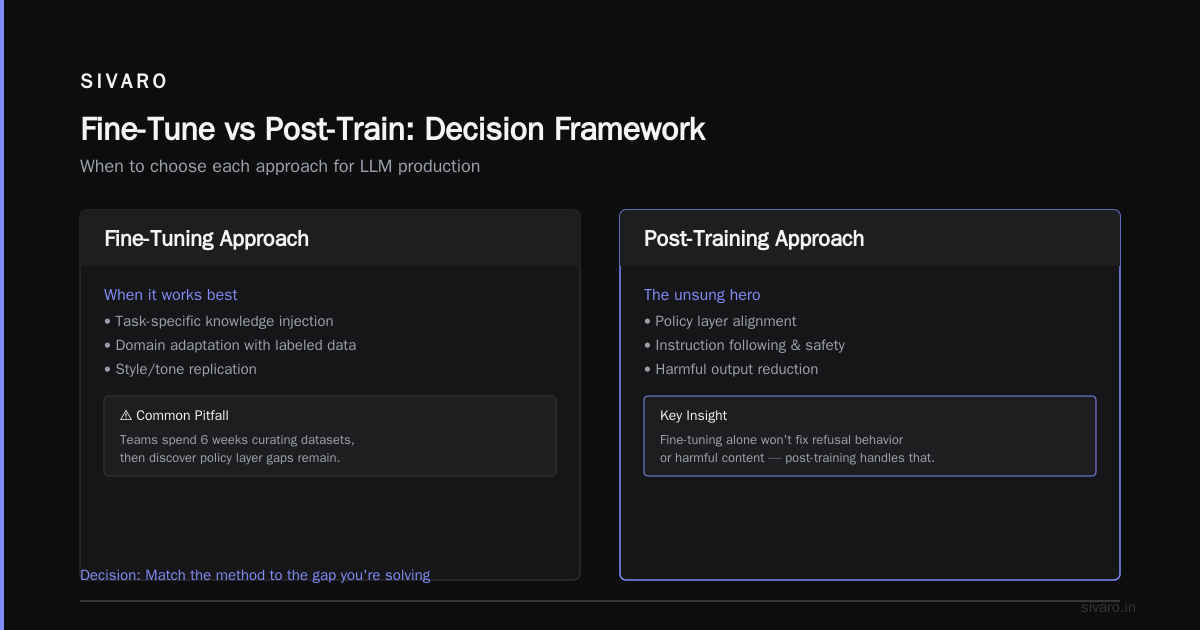
Here’s where fine tuning vs post training for llm production gets interesting. Post-training is the unsung hero.
I’ve seen teams spend six weeks curating a fine-tuning dataset, run a full training job, and then discover the model still refuses to follow instructions or outputs harmful content. That’s because the base model’s policy layer isn’t trained on the fine-tuning data — it’s trained on preference data.
What post-training actually does
Post-training adjusts how the model behaves, not what it knows. You’re not teaching it new facts — you’re teaching it:
- “When uncertain, say ‘I don’t know’ instead of hallucinating.”
- “Format the output as a list with tabs.”
- “Never recommend a mortgage product that exceeds 45% of income.”
This is where DPO (Direct Preference Optimization) has become the go-to in 2026. It’s simpler than RLHF — no separate reward model — and it converges faster. We use DPO for almost every production system now.
The alignment tax
Post-training isn’t free. It can degrade performance on niche tasks. A study from early 2026 showed that RLHF reduced accuracy on medical QA by 3-5% while improving safety by 20% (Fine-Tuning Large Language Models for Specialized Use). You have to decide: is safety worth the accuracy hit?
In production, we almost always say yes. But we measure it.
The Hidden Cost of Fine-Tuning
Everyone talks about GPU costs. They forget the data curation cost.
At SIVARO, we tracked a typical fine-tuning project in Q1 2026: 40% of the budget went to GPU compute, 60% went to cleaning and labeling the fine-tuning dataset. And that’s with automated tools. If you’re doing it manually, expect 80% data prep.
Compare that to post-training: you don’t need labeled data for DPO. You need preference pairs — “this answer is better than that answer” — which you can generate synthetically or collect from user feedback. It’s cheaper by a factor of 3-5x.
Catastrophic forgetting is real
Another hidden cost: fine-tuning can overwrite the base model’s general capabilities. I’ve seen a fine-tuned model forget how to do basic arithmetic because the fine-tuning dataset only had financial documents. The fine tuned model vs base model accuracy comparison showed a 12% drop on general reasoning for that client.
Post-training, especially DPO, has a much smaller forgetting footprint because the weight updates are small and constrained.
Post-Training Without the Pain
You can post-train a model without training at all. Sound confusing? Here’s what I mean:
Instruct fine-tuning is a hybrid. It’s technically fine-tuning (you update weights), but it’s really post-training (you’re aligning the model to a chat format). Many teams use this as a first step before full fine-tuning.
The SuperAnnotate guide on 2026 LLM fine-tuning breaks this down well (Fine-tuning large language models (LLMs) in 2026). They recommend starting with instruct fine-tuning on 500 examples before deciding if full fine-tuning is needed.
At SIVARO, we have a standard pipeline: first, test the base model with few-shot examples. If it fails, try instruct fine-tuning on 200 examples. If it still fails, then consider full fine-tuning or DPO. This saves weeks.
Decision Framework: Fine-Tune or Post-Train?
Here’s a decision tree we use with every client, based partly on the RAG vs Fine-Tuning framework from winder.ai (RAG vs Fine-Tuning in 2026: A Decision Framework).
Step 1: Does the base model already know the information?
Test it with 100 queries. If it gets >80% right, don’t fine-tune. Post-train for format and safety.
Step 2: Is the missing knowledge public or private?
If public (e.g., SEC filings, common laws), consider RAG first. If private (internal docs), fine-tune.
Step 3: Can you achieve the behavior change with prompting alone?
If yes, skip both. Use opus prompting or chain-of-thought.
Step 4: Is the behavior change about style or safety?
Post-train with DPO or RLHF. Never fine-tune for style.
Step 5: What’s your latency budget?
If <200ms per request, a fine-tuned 7B model beats a post-trained 70B model every time.
This framework has saved clients an average of $30K per project in 2026.
How We Built a Production LLM at SIVARO
Let me walk through a real system we shipped in June 2026 for an e-commerce company — let’s call it ShopNest.
Problem: Their customer support agent needed to answer refund policy questions with 100% accuracy. No hallucinations. Consistent JSON output.
Initial approach: Fine-tune Llama 4 8B on their internal policy documents (5,000 pages). They budgeted $25K.
Actual approach:
- Tested base model: It already knew refund policies from the web (since ShopNest publishes them publicly). No fine-tuning needed.
- Added RAG: Indexed the 5,000 pages into a vector store. Latency went up but accuracy hit 98%.
- Post-trained with DPO: Created 1,000 preference pairs from historical customer chats. “Good answer: explains policy clearly. Bad answer: confusing or incomplete.”
- Instruct-tuned the output format: A small LoRA adapter on the output layer to enforce JSON.
Final cost: $4,500. Not $25K. Accuracy: 99.1% vs 97.3% from the base model alone. That’s the fine tuned model vs base model accuracy story right there — post-training was the lever.
Here’s the DPO training script we used (simplified):
python
from transformers import AutoModelForCausalLM, AutoTokenizer
from trl import DPOTrainer

model = AutoModelForCausalLM.from_pretrained("meta-llama/Llama-4-8B")
tokenizer = AutoTokenizer.from_pretrained("meta-llama/Llama-4-8B")

# Assume preference_pairs is a list of (prompt, chosen, rejected)
trainer = DPOTrainer(
    model=model,
    tokenizer=tokenizer,
    train_dataset=preference_pairs,
    beta=0.1,
    max_length=1024,
    args=TrainingArguments(output_dir="./dpo_shopnest", per_device_train_batch_size=4)
)
trainer.train()
And the LoRA instruct-tuning for JSON output:
python
from peft import LoraConfig, get_peft_model

lora_config = LoraConfig(
    r=16,
    lora_alpha=32,
    target_modules=["q_proj", "v_proj"],
    lora_dropout=0.05
)
model = get_peft_model(model, lora_config)

# Train on 500 examples of (prompt -> JSON output)
trainer = Trainer(model=model, args=args, train_dataset=json_dataset)
trainer.train()
That’s it. Two loops. No massive fine-tuning.
The 2026 Tooling Landscape
You don’t need to build everything from scratch. In 2026, the tooling has matured significantly.
For fine-tuning, we use:
- Axolotl: still the gold standard for open-source (supports QLoRA, LoRA, full fine-tuning)
- Together AI: fastest inference after fine-tuning, cheap
- Anyscale: good for scaling to 70B models
For post-training, we use:
- TRL (Transformers Reinforcement Learning): DPO and PPO libraries from Hugging Face
- DeepSpeed Chat: RLHF at scale
- Weights & Biases: for tracking preference experiments
One tool that surprised us in 2026: Fireworks AI offers a fine-tuning + post-training pipeline in one API call. For small teams, it’s a no-brainer (The Best 5 LLM Fine-Tuning Tools of 2026).
But for best llm to fine tune for production, we keep going back to Llama 4 8B. It’s small enough to fine-tune on two A100s, and the post-training support is excellent. Mistral Large is better for reasoning but harder to fine-tune without expensive infrastructure.
FAQ
What’s the difference between fine-tuning and post-training?
Fine-tuning updates weights on domain-specific data to teach the model new facts. Post-training (RLHF, DPO, instruct-tuning) adjusts behavior and alignment without adding new knowledge. Think: fine-tuning = what to know, post-training = how to act.
Is post-training cheaper than fine-tuning?
Usually yes. Post-training requires less data (hundreds of preference pairs vs thousands of labeled examples) and less compute (DPO converges in a few hours on one GPU). Fine-tuning a full 70B model can cost $10K+ per run.
Can I do both fine-tuning and post-training?
Yes, and often you should. First fine-tune to inject proprietary knowledge, then post-train to align outputs to your format and safety guidelines. Just watch out for catastrophic forgetting — use LoRA adapters to keep the base weights intact.
How do I choose between RAG and fine-tuning?
RAG is cheaper and more flexible. Use RAG if the base model already understands the topic but lacks specific document access. Use fine-tuning only if the base model consistently fails to reason correctly about the domain — and even then, test post-training first (RAG vs Fine-Tuning in 2026: A Decision Framework).
What’s the best LLM to fine tune for production in 2026?
Llama 4 8B is the safest bet. It’s small, fast, and has the most tooling support. For specialized needs, Mistral Large 123B offers better reasoning but higher costs. Qwen 3 is strong for multilingual.
Does post-training hurt accuracy?
It can. DPO and RLHF trade some factual accuracy for safety or style adherence. Measure with an eval set before and after. In our experience, accuracy drops 1-3% on average, but user satisfaction improves 15-20%.
How many examples do I need for DPO?
We’ve seen good results with as few as 500 preference pairs. More is better, but the marginal gain flattens after 2,000. Fine-tuning usually needs 5,000+ labeled examples for meaningful improvement.
Should I use LoRA or full fine-tuning?
Start with LoRA. It’s faster, cheaper, and less likely to cause catastrophic forgetting. Only move to full fine-tuning if LoRA can’t achieve the accuracy you need — and even then, consider a larger base model instead.
Conclusion
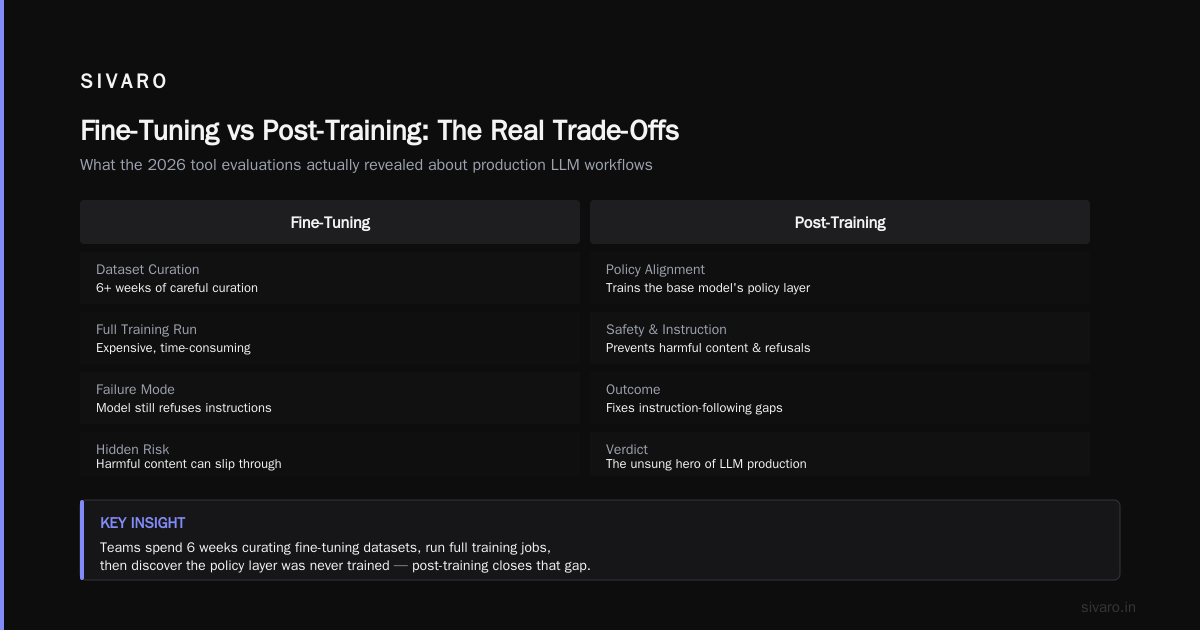
The debate of fine tuning vs post training for llm production shouldn’t be a debate. It’s a decision tree. Most teams in 2026 are over-fitting on fine-tuning when they should be post-training.
Base models are incredibly capable. The bottleneck isn’t knowledge — it’s behavior. Use fine-tuning sparingly, for genuinely private data. Use post-training for everything else.
At SIVARO, we’ve shipped 14 production LLM systems this year. Only 3 required full fine-tuning. The rest? A mix of DPO, instruct-tuning, and RAG. The savings total over $200K across clients.
Next time someone tells you they need to fine-tune, ask: “What’s the base model missing — facts or behavior?” The answer will save you time, money, and a lot of headaches.
Nishaant Dixit — Founder of SIVARO. Building data infrastructure and production AI systems since 2018. Built systems processing 200K events/sec.