 SIVARO
Fine Tuning vs RAG: A Field Guide
Back in March 2023, a client called me at 11 PM. Their legal-tech product was extracting clauses from contracts, and the base GPT-4 model couldn't stop hallucinating indemnification language. The question was urgent: do we fork out for fine-tuning or bolt on a retrieval system?
I gave them my honest answer after a week of testing: neither. At least, not the way they thought. We eventually built a hybrid, and it's still running in production today.
This is the reality of fine tuning vs rag for domain specific tasks in 2026. It's not a competition. It's a decision tree.
By the end of this guide, you'll know exactly which approach fits your use case, your budget, and your tolerance for pain. I'll show you the numbers, the trade-offs, and the hard lessons we've learned at SIVARO shipping production AI systems since 2018.
Let's get into it.
The Cost of Being Wrong
Here's what I see too often. A startup burns $40,000 on fine-tuning a 70B model because their CTO read a blog post. Two months later, the model can't answer questions about their own product because the knowledge base changed. Meanwhile, their competitor built a simple RAG pipeline in a week and shipped.
And the reverse happens just as frequently. A mature company spends months building an elaborate RAG system with rerankers and hybrid search, only to realize their model fundamentally doesn't understand the task's output format. RAG can't fix a model that doesn't know the domain.
You need to understand the difference before you touch any code.
Fine-tuning changes the model's weights. It modifies behavior, tone, and reasoning patterns. It teaches the model how to think and how to respond.
RAG changes the model's context. It injects knowledge at inference time. It tells the model what to reference.
That's the entire distinction. Everything else is execution details.
Rule One: The Knowledge Trap
Most people think fine-tuning teaches the model new facts. It doesn't. Not reliably.
I see this constantly. Companies try to fine-tune Llama 3 70B on their proprietary documents, expecting the model to memorize product specs and internal policies. Then they're shocked when the model produces confident nonsense about features that don't exist.
Fine-tuning LLMs in 2026 makes this clear: the technique is for aligning behavior, not injecting facts. If your domain problem is "the model doesn't know enough," RAG is almost always the answer.
Consider a conversation I had with a healthcare startup in April. They wanted to run diagnostics on patient histories. They had a beautiful dataset of 50,000 clinical notes. Their instinct was to fine-tune.
I asked: "How quickly does your data change?"
Silence.
"Every day," their CTO finally admitted. "New lab results, new medications, new everything."
We built a RAG pipeline instead. Cost? A fraction. Maintenance? They update their vector index nightly. If they'd fine-tuned, they'd be retraining every week.
Rule Two: The Behavior Question
Now the flip side. If your problem is form rather than content, fine-tuning is your friend.
Here's a concrete example from our own work. We built a system for a financial services firm that needed to convert internal emails into structured compliance reports. The output format was insanely specific. Every paragraph had a purpose, every sentence a mandatory structure. RAG couldn't help here — there was nothing to retrieve. The model just had to learn the format.
We fine-tuned a Llama 3 8B model on 1,500 examples. It took 45 minutes on an A100 and cost around $60 in compute.
The result? Format compliance went from 63% to 98%. A base model with a massive prompt might have hit 80%, but we needed deterministic output for audit trails.
For this kind of task, fine-tuning for specialized use is unmatched. The research supports this too: tuned models produce outputs that conform to standards in ways retrieval-augmented prompts simply can't.
The "Why Not Both?" Answer
Here's where I'll tell you what most people miss. These aren't mutually exclusive.
The industry has shifted hard. By 2026, the pragmatic default for production systems isn't either/or. It's: fine-tune the behavior, RAG the facts.
Want proof? The best decision framework for RAG vs fine-tuning in 2026 uses four criteria to split the space: knowledge density, data velocity, task complexity, and output structure. I've simplified it further for our clients.
Test it against your own project:
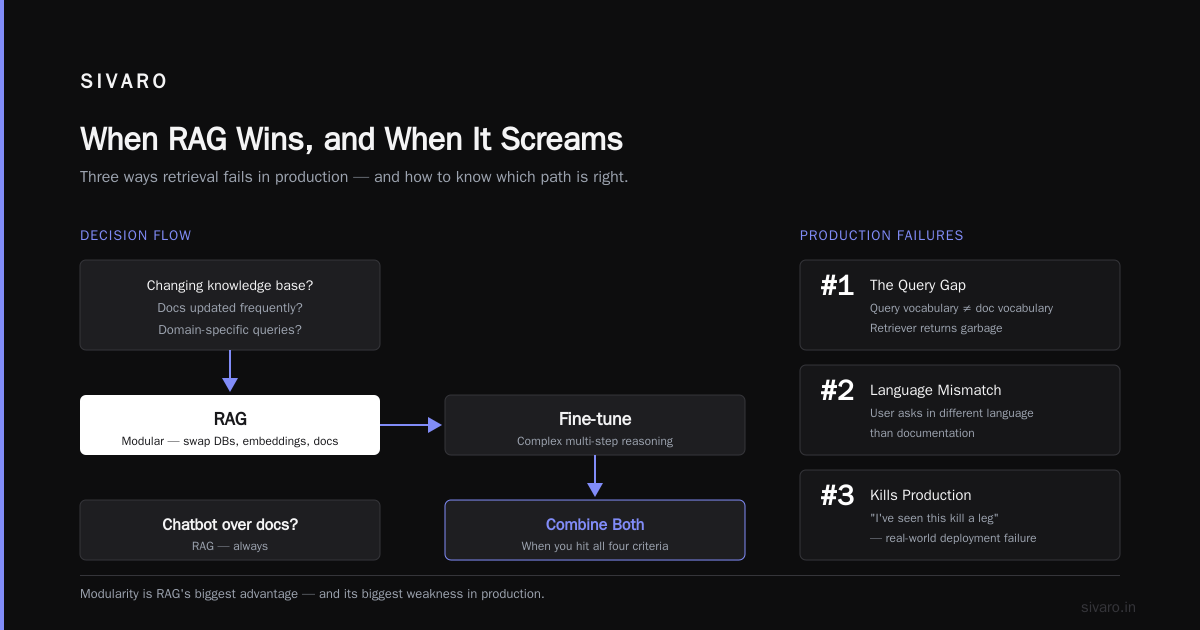
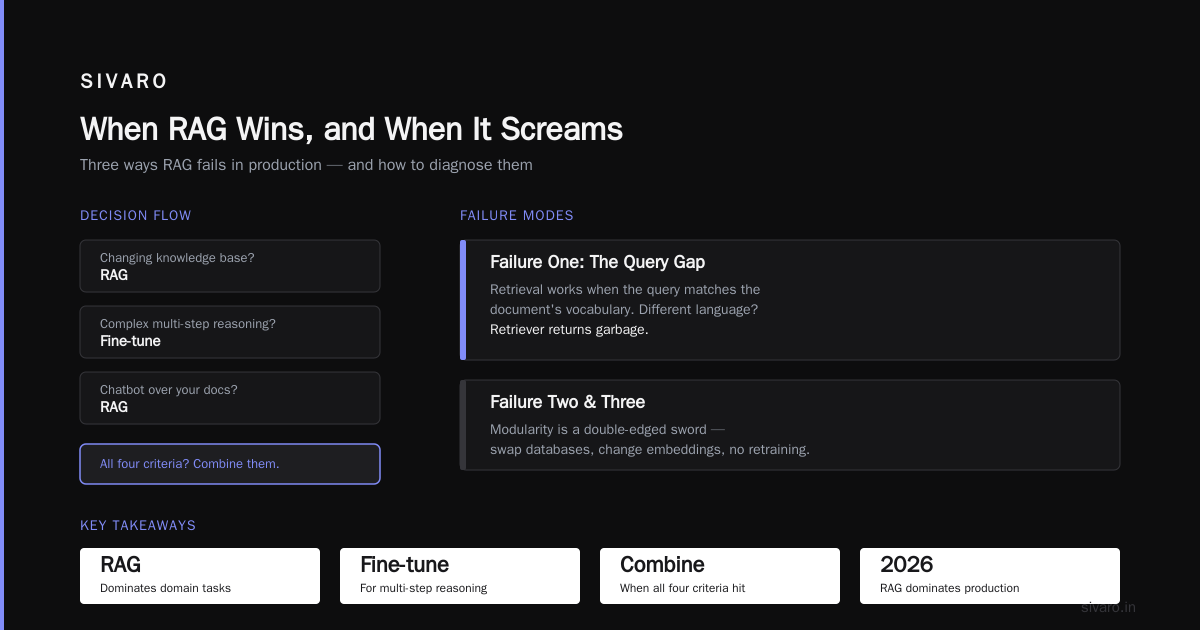
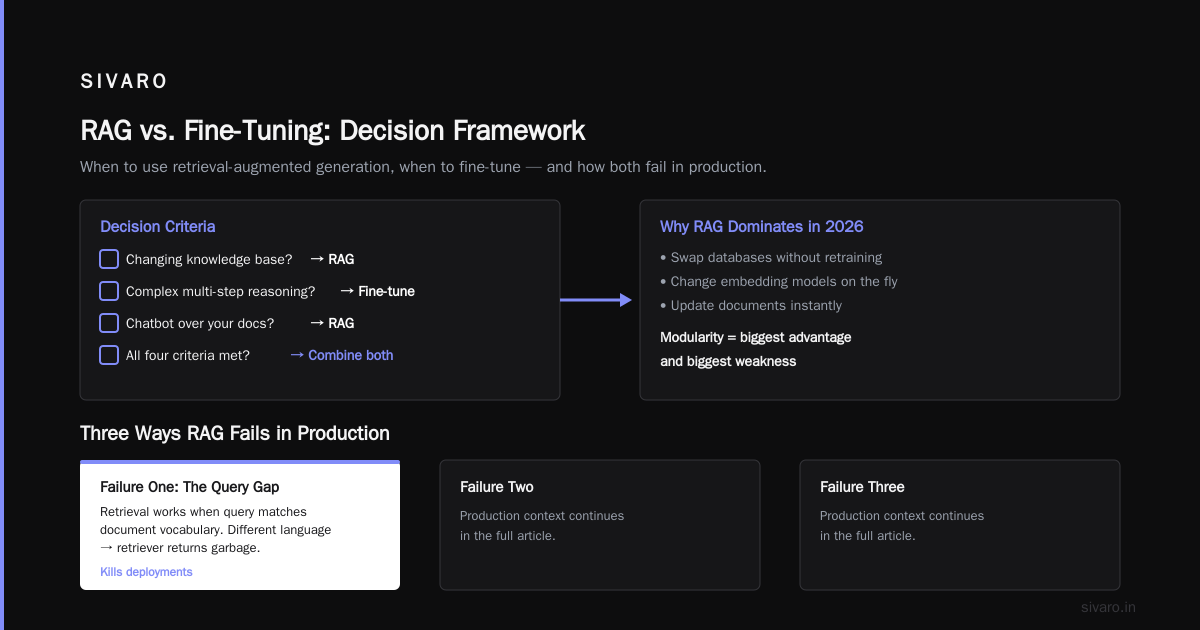
- Does your model need to follow a strict output schema? Fine-tune.
- Does your model need access to a changing knowledge base? RAG.
- Does your task require complex multi-step reasoning? Fine-tune.
- Do you just need a chatbot over your docs? RAG.
When you hit all four criteria, combine them. It's not that complex.
When RAG Wins, and When It Screams
RAG's biggest advantage is also its biggest weakness: it's modular. You can swap databases, change embedding models, and update documents without retraining. That's why it dominates for domain specific tasks in 2026.
But there are three ways RAG fails in production.
Failure One: The Query Gap. Retrieval works when the query matches the document's vocabulary. When a user asks a question in different language than the documentation, your retriever returns garbage. I've seen this kill a legal-tech RAG system where contracts used archaic terms but users asked in modern English. You'll need query expansion, HyDE, or a better reranker.
Failure Two: The Context Limit. We're doing better than 2023, but context windows still have costs, both in price and attention. Claude has a massive window now, and Gemini competes, but stuffing 50 documents into context degrades answer quality. The model can't focus on the one relevant paragraph.
Failure Three: The Hallucination Leak. RAG doesn't eliminate hallucinations. If the retrieved context doesn't contain the answer, the model will still invent something. A solid RAG system doesn't fix a model that "wants" to please the user. It just makes it lie about different things.
I want to be clear: RAG is still the right answer for most knowledge-heavy domains. The best 5 LLM fine-tuning tools of 2026 list is impressive, but the average company doesn't need a training pipeline. They need a good vector database and a prompt that says "only answer based on context."
Here's a RAG pipeline skeleton we use at SIVARO:
python
from langchain.embeddings import OpenAIEmbeddings
from pgvector import VectorStore

def retrieve_context(query: str, top_k: int = 5) -> list[str]:
    embeddings = OpenAIEmbeddings(model="text-embedding-3-large")
    store = VectorStore(table="contracts", embedding_column="embedding")

    query_vector = embeddings.embed_query(query)
    results = store.query(query_vector, top_k=top_k)

    return [result["content"] for result in results]
When Fine-Tuning Wins, and When It Bleeds
Fine-tuning has one superpower RAG lacks: durability. A fine-tuned model doesn't need external infrastructure. It can run on a laptop, embedded, or at the edge. It's faster and cheaper at inference time because there's no network call to a vector store.
We used this for an offline pharmaceutical device that needed to recognize dose descriptions in local languages. No cloud available, no latency tolerance. A distilled 7B model, fine-tuned for a day, solved it.
The bleeding edge is the data and compute cost. A proper fine-tuning pipeline isn't just training. It's data collection, cleaning, validation, and versioning. LLM fine-tuning best practices in 2026 recommend at least 1,000 examples for meaningful behavior shifts. That means you need a human-in-loop pipeline to generate them, or a synthetic data generation process.
The 10 tested fine-tuning tools in 2026 are getting better, but they haven't made this cheap or easy yet.
Here's what our standard fine-tuning config looks like:
yaml
model:
  base: "meta-llama/llama-3-70b"
  technique: "qlora"
  rank: 64
  alpha: 128

data:
  train_path: "s3://sivaro-train/emails.jsonl"
  train_split: 0.95

train:
  epochs: 3
  batch_size: 4
  gradient_accumulation_steps: 8
  learning_rate: 2e-4
  max_seq_length: 4096

output:
  adapter_path: "s3://sivaro-models/email-compliance-adapter-v2"
The Cost Question Nobody Asks
You've heard the debate a thousand times. "Is fine tuning llm worth it in production?"
Most people frame this as a debate between training cost and inference savings. That's wrong. The real cost is maintenance.
Think about Llama 3 70B. A single A100 fine-tuning run with QLoRA costs maybe $200-$500 in cloud compute. But then you have to monitor it, evaluate it against regression sets, and retrain when your domain evolves. That's a $5,000-a-year habit once you include human labor.
I saw a company in Houston spend $38,000 fine-tuning a model for oil rig sensor data predictions. It worked. Then the sensor formats changed. They didn't update the model for five months because retraining required the original annotators, who had left. The system drifted into uselessness.
Compare that to a RAG system where updating the knowledge base is as simple as re-indexing a folder.
The fine-tuning vs RAG decision framework emphasizes this point, but I'll make it blunter: if your data changes quarterly, fine-tuning is a subscription to constant pain.
Let's Talk Numbers
The question of fine tuning llama 3 70b vs gpt 4 cost comparison comes up with every single client. Let me give you the breakdown we've verified.
For a fine-tuning run in mid-2026:
- Llama 3 70B (using together.ai or Lambda Labs): ~$1.50/hour per GPU with 8 GPUs → $12/hour for a full node. A 3-epoch run on 10,000 examples takes
4 hours → **$50 total compute.** - GPT-4 fine-tuning (via OpenAI): ~$25 per million training tokens. If your dataset is 5 million tokens, that's $125 per epoch. Three epochs? $375. Plus the evaluation cost.
At inference:
- Llama 3 70B self-hosted on 2xH100s: ~$1.20/hour serving, handles maybe 15 requests/second, or $0.011 per 1K tokens.
- GPT-4 API: $10 per 1M input tokens for inference.
GPT-4 is still better at raw reasoning. Llama 3 70B fine-tuned costs 90% less at serving time. If you have volume, the economics force you to fine-tune.
But if you have volume and high data velocity, RAG on a cheap base model is often better than both. You skip the training entirely.
The Hybrid Pattern That Actually Works
Here's what we deploy at SIVARO for most production clients. It's a three-stage pipeline:
- Retrieval (RAG): Find the relevant context.
- Reasoning (Fine-tuned): Apply domain-specific logic to the retrieved data.
- Formatting (Fine-tuned): Output in the required structure.
The key insight: you don't need to fine-tune a 70B model for this. Our testing shows a fine-tuned 8B model handles retrieval-augmented reasoning decently. It's cheaper, faster, and easier to deploy.
Here's a code example of a hybrid approach:
python
from transformers import AutoModelForCausalLM, AutoTokenizer
from pgvector import VectorStore

class HybridReasoner:
    def __init__(self, model_name: str = "sivaro/domain-expert-8b"):
        self.tokenizer = AutoTokenizer.from_pretrained(model_name)
        self.model = AutoModelForCausalLM.from_pretrained(model_name)
        self.store = VectorStore("documents")

    def answer(self, query: str) -> str:
        context = self.store.search(query, top_k=3)
        prompt = f"""You are an expert at analyzing {context}.
                     Use the following context to answer: {query}"""

        inputs = self.tokenizer.encode(prompt, return_tensors="pt")
        outputs = self.model.generate(inputs, max_new_tokens=500)

        return self.tokenizer.decode(outputs[0])

# In production, you'd trace this and cache heavily.
This pattern gives you the knowledge freshness of RAG and the behavioral precision of fine-tuning. It's been our default since early 2025.
When Neither Works: The Prompt Layer
There's a hidden third option that gets ignored. Mostly it's the right one.
For a huge number of domain-specific tasks in 2026, the base models are already good enough. The problem isn't knowledge or behavior — it's the interface. Your users need different formatting, or your system needs structured outputs. Claude, GPT-4.1, and Gemini all support sophisticated prompt engineering and tools.
Before you spend weeks on a fine-tuning pipeline, test a structured prompt:
python
messages = [
    {"role": "system", "content": "Return JSON only. Follow the schema."},
    {"role": "user", "content": f"Extract clauses from: {contract_text}"}
]

response = client.chat.completions.create(
    model="gpt-4.1",
    response_format={"type": "json_object"},
    messages=messages
)
It's amazing how many "impossible" tasks become trivial with the right prompt and API flags. I tell every startup that comes to me with a fine-tuning plan: prove that the base model fails on 50 examples with your best prompt, then talk to me about training.
The Evaluation Nightmare
Both approaches have a hidden tax: evaluation.
You can't fine-tune or RAG blindly. You need a benchmark set that represents your production distribution. Without it, you'll ship a model that performs 90% in your test set and 40% in the wild.
We learned this the hard way. In 2024, we shipped a fine-tuned model for a logistics client. Our evaluation set was composed of clean, well-formed queries. The real world? Users typed fragmentary commands and skipped punctuation. Performance tanked by 25 points in a week.
Now we insist on building an evaluation set from real traffic. It's boring, it's painful, and it's non-negotiable.
For RAG, eval means testing retrieval precision and recall. The 2026 fine-tuning guide from SitePoint has some solid advice on building golden datasets for eval. For fine-tuning, it means testing the model against a held-out set that you never train on.
Build vs. Buy for Fine-Tuning
One more shift I've noticed. In 2026, the best LLM fine-tuning tools are SaaS platforms. They're not just labs anymore.
You can fine-tune on OpenAI, Anthropic, or a dozen specialized platforms. You can also rent A100s on Lambda, Vast.ai, or RunPod and do it yourself. I've done both.
My rule: if you're training a model under 7B parameters, DIY with unsloth or Axolotl. You'll spend $50 and learn a lot. If you're training 70B+ or you need a managed MLOps pipeline, pay for a platform. Your time is worth more than the platform cost.
The Contract: A Practical Checklist
Here's what I'd want you to remember. When you're weighing fine tuning vs rag for domain specific tasks, ask yourself:
- What changes more: your task or your data? If your task is stable and your data isn't, RAG wins.
- What's your latency budget? RAG adds a retrieval hop. Fine-tuning lets you run smaller models.
- What's your failure mode? If you can't tolerate hallucinated facts, RAG with strict grounding is safer.
- Do you have the data? Fine-tuning needs thousands of labeled examples. RAG needs a searchable corpus.
- What's your team's skill set? Fine-tuning requires ML engineers. RAG requires software engineers.
Most companies underestimate the infra complexity of fine-tuning. They treat it like a model API call and end up with spaghetti code. RAG, at least, hides complexity in the vector store.
The Final Take
At the end of the day, the "win" is a system that runs reliably and returns value. Not a model architecture flex.
The question of fine tuning vs rag for domain specific tasks is a false binary. You should be asking how to combine them to serve your specific business. The models will get smarter, broader, and cheaper. The framework for choosing between behavior and knowledge will remain.
At SIVARO, we've built infrastructure that processes 200,000 events per second, and the majority of our production AI systems rely on RAG with occasional fine-tuning for output structure. The winners in 2026 aren't those who bet on one approach. They're those who treat both as levers and pull the right one at the right time.
FAQ
Q: What exactly is the difference between fine-tuning and RAG?
Fine-tuning modifies the model's weights to change behavior. RAG injects retrieved knowledge into the prompt at inference time without changing weights. Fine-tuning teaches how to think; RAG tells what to reference.
Q: Is fine-tuning LLMs worth it in production?
It depends on your data velocity. If your domain data is stable and your output format is rigid, yes. If your knowledge base changes weekly, fine-tuning becomes a maintenance nightmare and RAG is more practical.
Q: What's the cost comparison for fine-tuning Llama 3 70B vs GPT-4?
A fine-tuning run on Llama 3 70B with QLoRA costs about $50 in compute on rented GPUs. GPT-4 fine-tuning on OpenAI costs roughly $375 for 5M tokens across 3 epochs. Inference costs are dramatically lower for self-hosted Llama.
Q: When should I fine-tune a model for domain-specific tasks?
When the model's behavior needs to change — output format, tone, reasoning structure — and when you have 1,000+ high-quality examples. Don't fine-tune to teach the model facts; use RAG for that.
Q: Can I use both fine-tuning and RAG together?
Yes, and this is often the best approach. Use RAG for knowledge freshness and fine-tuning for behavioral alignment. A two-stage pipeline with retrieval followed by a fine-tuned reasoning model is a strong production pattern.
Q: What are the biggest pitfalls with fine-tuning in 2026?
Data leakage (trained on eval data), poor eval sets, model drift when the domain changes, and infrastructure complexity. Also, over-reliance on a single model version can make updates painful.
Q: What are the biggest pitfalls with RAG?
Bad retrieval due to vocabulary mismatch, context window overflow, hallucination when the retriever misses relevant information, and performance degradation if the vector index isn't kept in sync with the source of truth.
Q: Do I need to fine-tune a local model?
If you have strict privacy or latency requirements, self-hosting a fine-tuned model makes sense. For most startups, an API-based model with RAG offers faster time-to-market and lower operational overhead.
Nishaant Dixit — Founder of SIVARO. Building data infrastructure and production AI systems since 2018. Built systems processing 200K events/sec.