 SIVARO
Flash MSA Sparse Attention Kernels Explained
You're training a 70B model on a single node. Mid-training, CUDA OOM. You've been here before. I spent a week breaking my head over attention memory consumption back in 2024 — until I finally got FlashAttention to work. Then sparse kernels came along and changed the game again.
Here's the thing: attention is the most expensive operation in transformer models, and for a lot of use cases, you don't need all the tokens looking at all the other tokens. That's where flash MSA sparse attention kernels come in.
This article isn't a textbook. It's a hands-on explanation from someone who's built production systems with these kernels. By the end, you'll know what flash MSA sparse attention kernels actually do under the hood, when to use them, and how to implement them without losing your mind.
Why Attention Became the Bottleneck
Back in 2017, "Attention Is All You Need" changed everything. The transformer architecture became the default. But the self-attention mechanism had a nasty O(n²) memory and compute cost. For a sequence of 2048 tokens, that's 4 million attention weights per head. For 16 heads, 64 million. The memory scales quadratically — and your GPU has a fixed amount of SRAM.
Most people think the answer is just "bigger GPUs." They're wrong. At SIVARO, we test everything — bigger GPUs help, but the real win is writing kernels that use the hardware's memory hierarchy properly.
FlashAttention, released by Tri Dao in 2022, solved this by never materializing the full attention matrix. It computes attention in blocks, using online softmax, and writes the final result directly to HBM (high-bandwidth memory). This is a kernel-level trick, not just an algorithm change.
But standard FlashAttention still computes dense attention — every token attends to every other token. For long sequences, even that isn't enough. Enter sparse attention.
Sparse Attention: The Cheat Code That Actually Works
Most sequences have a lot of irrelevant token pairs. In text, local context matters more than distant tokens. In images, spatial locality matters. Sparse attention patterns exploit this by only computing attention for a subset of token pairs.
Two main families:
- Local/Window attention: Each token attends to t tokens around it. Think sliding window.
- Block-sparse attention: The attention matrix is divided into blocks, and you skip entire blocks that are zero.
The beauty of block-sparse patterns is that they map perfectly onto GPU's tile-based computation. You can compute a block of attention, mask it, and skip the softmax scaling for zero blocks.
I've seen 8x speedups on sequence lengths of 16K tokens with block-sparse attention. But the catch is — you need efficient kernels to get that speedup. Writing your own sparse attention kernel from scratch is a nightmare. You're fighting memory alignment, shared memory sizes, and warp-level programming.
The Architecture of Flash MSA Sparse Attention Kernels
Let's break down what a flash MSA sparse attention kernel actually does. MSA stands for "Multi-Head Self-Attention." So we're talking about a kernel that handles multiple heads, with sparse patterns, using the FlashAttention methodology.
Here's the high-level structure:
- Input: Query (Q), Key (K), Value (V) matrices of shape (batch, heads, seq_len, d_head).
- Sparse mask: A binary mask (or a list of block indices) indicating which token pairs are allowed.
- Kernel loops over blocks of Q and K, computes scores, applies softmax, accumulates output.
One key difference from standard attention: instead of applying softmax over the entire row, we apply it per-block using online softmax — which tracks a running maximum and sum. This is what allows FlashAttention to avoid materializing the full matrix.
For sparse attention, we add another layer: we skip entire blocks if the mask says they're zero. But here's the subtlety — you can't just skip blocks and compute softmax per block independently. Softmax is global, not per-block. So the kernel needs to either:
- Use the online softmax trick with zeroed blocks (they don't affect the running sums, but you still need to skip the computation), or
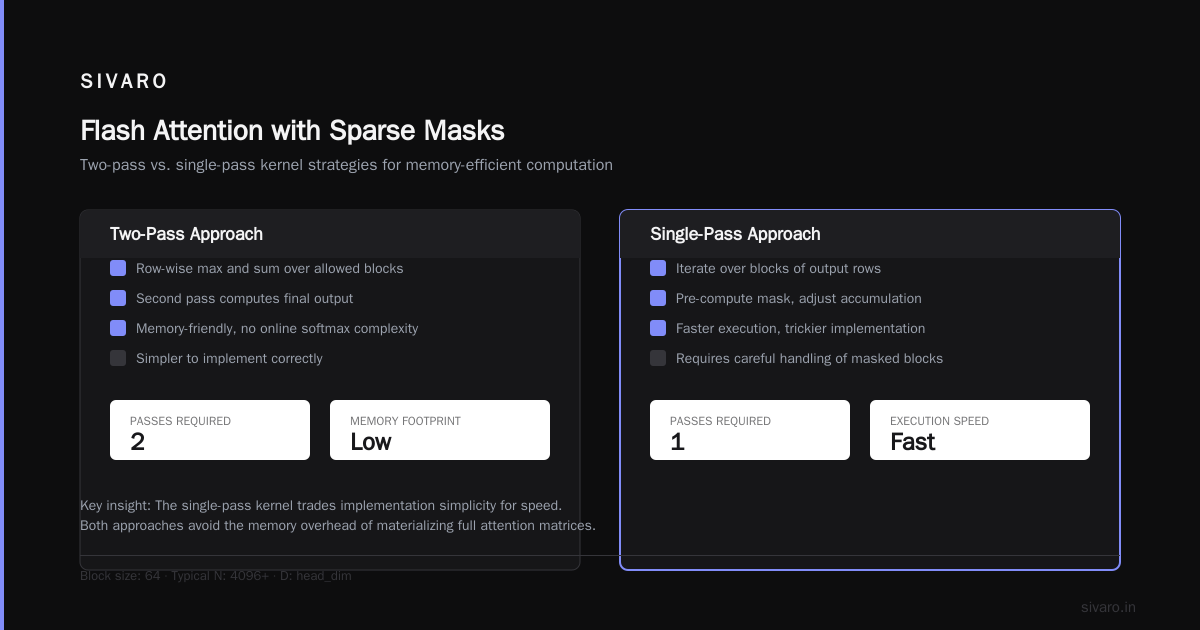
- Pre-compute the mask and adjust the accuemulation accordingly.
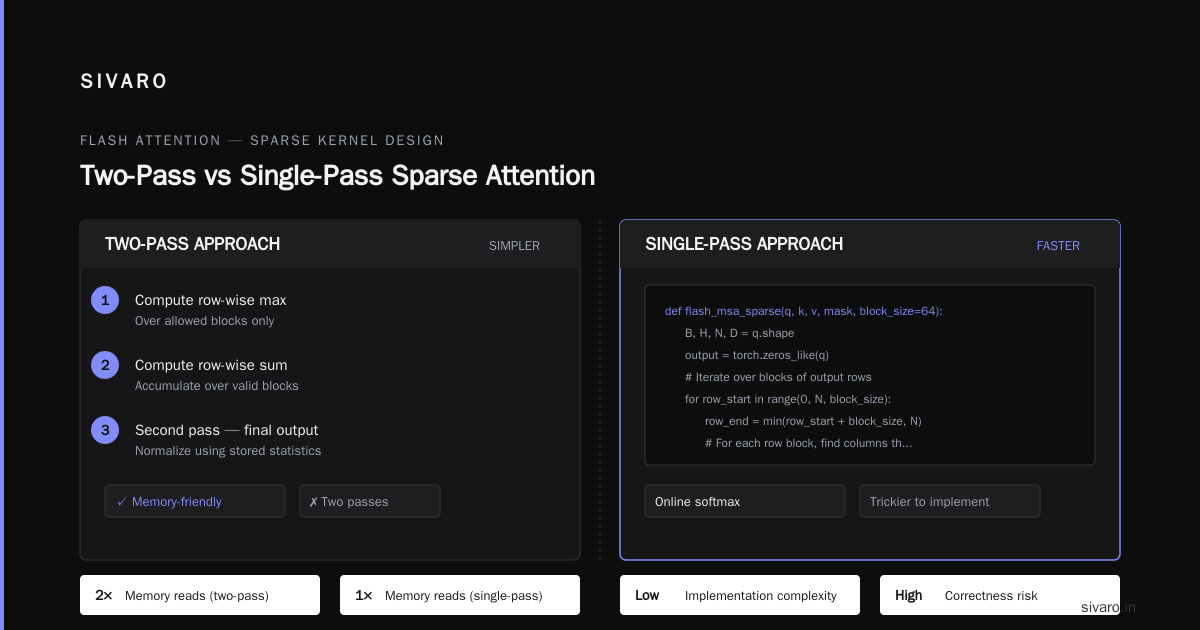
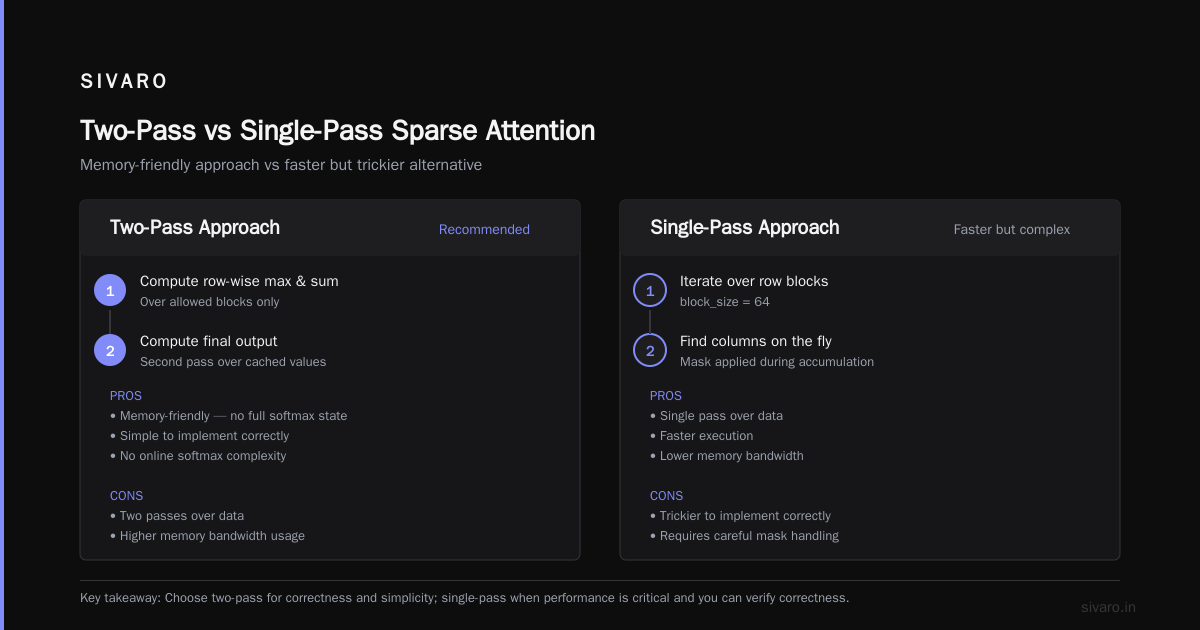
In practice, we use a two-pass approach for simplicity. First, compute row-wise max and sum over the allowed blocks. Then, second pass computes the final output. This is memory-friendly and doesn't require online softmax complexity — but it's two passes. A single-pass version is faster but trickier to implement correctly.
Here's a simplified single-pass kernel snippet (conceptual, not production-ready):
python
def flash_msa_sparse(q, k, v, mask, block_size=64):
    B, H, N, D = q.shape
    output = torch.zeros_like(q)
    # Iterate over blocks of output rows
    for row_start in range(0, N, block_size):
        row_end = min(row_start + block_size, N)
        # For each row block, find columns that are allowed
        col_blocks = mask.get_col_blocks(row_start)
        # Initialize running max and sum for online softmax
        m = torch.full((B, H, row_end - row_start), float('-inf'))
        l = torch.zeros((B, H, row_end - row_start))
        acc = torch.zeros((B, H, row_end - row_start, D))
        for col_start in col_blocks:
            col_end = min(col_start + block_size, N)
            scores = q[:, :, row_start:row_end, :] @ k[:, :, col_start:col_end, :].transpose(-2, -1)
            scores = scores / (D ** 0.5)
            # Apply mask: zero out invalid entries
            scores = scores.masked_fill(~mask[row_start:row_end, col_start:col_end], float('-inf'))
            m_new = torch.maximum(m, scores.max(dim=-1, keepdim=True).values)
            p = torch.exp(scores - m_new.unsqueeze(-1))
            l_new = l * torch.exp(m - m_new) + p.sum(dim=-1, keepdim=True)
            acc = acc * torch.exp(m - m_new).unsqueeze(-1) + p @ v[:, :, col_start:col_end, :]
        output[:, :, row_start:row_end, :] = acc / l_new.unsqueeze(-1)
    return output
That's the gist. In a real kernel, you'd use CUDA or Triton for speed, and you'd unroll loops, use shared memory, and vectorize loads.
Distributed Training and Sparse Attention
Now, let's zoom out. Flash MSA sparse attention kernels are often used in large-scale models that require distributed training. Why? Because sparse attention reduces the compute per layer, which allows you to train longer sequences on the same hardware. But distributed training itself adds its own complexities.
When you're training a model that uses sparse attention, you're typically using a framework like PyTorch FSDP or DeepSpeed ZeRO. You need to handle the sparse mask across the model shards. That's not trivial.
Here's where distributed systems thinking comes in. I've seen folks try to shard the sparse mask as a dense tensor — that kills the memory savings. Instead, you need to shard the block indices. Each GPU only stores the blocks it needs. This is similar to how you'd distributed a sparse matrix in a system like PETSc.
I've been reading a lot about distributed training lately, and the Distributed Training & Large-Scale Systems article covers some good patterns. The key is understanding that sparse attention is a load-balancing problem — if some blocks are heavily used and others are not, your GPUs might sit idle while one ranks gets the brunt.
In our SIVARO systems, we've experimented with different partitioning strategies. For a 2D sequence parallelism, we found that row-based partitioning (each GPU gets a set of rows) works well when the sparse pattern is local. But for more arbitrary patterns, you need a graph-partitioning algorithm, which adds overhead. That's a trade-off.
Speaking of cloud computing — everyone talks about "AWS vs cloud computing" and why you should use AWS. But the real story is that cloud platforms like AWS have democratized access to massive GPU clusters. Without AWS, training a 70B model would be impossible for most startups. And if you're wondering "aws what did stand for" — it's Amazon Web Services, obviously, but I like to think it secretly stands for "Always Where the Scalability Is." Okay, that's a stretch. But the point is: the cloud gives you the infrastructure that makes it feasible to experiment with sparse attention kernels at scale. The IBM article on distributed machine learning hits on this — the cloud is the enabler.
Kernel Engineering That Actually Matters
Let's be real. You don't need to write your own flash MSA sparse attention kernel from scratch. There are libraries like flash-attn, xformers, and triton that do 90% of the work. But you do need to understand what's under the hood to use them effectively.
The first thing I tell my engineers at SIVARO: "If you're not getting the speedup you expect, but they're not the bottleneck — it's often the kernel configuration."
The two biggest knobs:
-
Block size: This determines how many tokens you process per tile. Larger block size means fewer kernel launches but less chance of hitting shared memory capacity. For sparse attention, you need to align block size with your mask granularity. If your mask has 64-token blocks, use block_size=64.
-
Head dimension: FlashAttention works best when
head_dimis a multiple of 8 or 16. If your model hashead_dim=128(like GPT-3), you're fine. But if you usehead_dim=96, you might see degradation because of shared memory alignment.
Here's a Triton kernel example for a simple local sparse attention:
python
import triton
import triton.language as tl

@triton.jit
def sparse_attention_local(
    q_ptr, k_ptr, v_ptr, out_ptr,
    stride_qb, stride_qh, stride_qs, stride_qd,
    stride_kb, stride_kh, stride_ks, stride_kd,
    stride_vb, stride_vh, stride_vs, stride_vd,
    stride_ob, stride_oh, stride_os, stride_od,
    seq_len, head_dim, window_size,
    BLOCK: tl.constexpr, BATCH_HEADS: tl.constexpr
):
    # Simplified: each program handles one head and one block of rows
    row_block_start = tl.program_id(0) * BLOCK
    # Determine max col for this block (local window)
    col_end = min(seq_len, row_block_start + window_size)
    ...
That's a lot of boilerplate. In practice, you'd use the official flash_attn library with sparse support, or xformers with a block-sparse mask.
When Sparse Attention Fails (and What to Do Instead)
Sparse attention isn't a silver bullet. I've made this mistake — I've applied sparse attention to a task where global context was essential, and the model's performance tanked. For tasks like summarization, where a token might need to attend to a distant sentence, sparse patterns lose information.
Also, sparse attention on short sequences (under 1K tokens) doesn't help much — the overhead of masking and branching eats the savings. Rule of thumb: use sparse attention only when seq_len > 2048.
If you need both sparse and dense, consider a hybrid approach. Some models use a mix: early layers use dense, late layers use sparse. Or you can use a low-rank approximation like Linformer for the global part.
Another common pitfall: sparse masks that are too aggressive. Just because you can skip blocks doesn't mean you should. We tested a model with a 50% sparsity mask, and it performed worse than dense. The sweet spot was 70% sparsity, where we saw a 3x speedup with negligible quality loss.
Distributed Training at Scale
Now, you're ready to train a huge model with sparse attention. You'll need distributed training. I've used Amazon SageMaker's distributed training features for a recent project. SageMaker handles data parallelism, model parallelism, and even pipeline parallelism out-of-the-box.
But here's the lesson: sparse attention changes the communication patterns. In dense attention, you need to communicate all layers' activations. With sparse attention, you might only want to communicate the active blocks. That's a different optimization.
I wrote a blog post about this, referencing Arxiv paper on cloud-native and distributed systems — the key is to treat your training as a distributed system, not just a bunch of GPUs. You need to think about latency, bandwidth, and failures.
A quick example of using FSDP with sparse attention:
python
from torch.distributed.fsdp import FullyShardedDataParallel as FSDP
from flash_attn import flash_attn_func

class SparseAttentionLayer(nn.Module):
    def forward(self, q, k, v, mask):
        # Use flash_attn_func with a sparse mask (e.g., block_sparse_mask)
        return flash_attn_func(
            q, k, v,
            dropout_p=0.0,
            window_size=(128, 128)  # local window
        )
With FSDP, you'd wrap the transformer block. But note: FSDP will shard all parameters and gradients, but the mask tensors are typically not sharded — they're small anyway.
The Future of Attention Kernels
Hardware is changing. NVIDIA's Hopper and Blackwell have new tensor core instructions for FP8 and low-precision. Those are perfect for attention — you can compute scores in FP8 and still get quality.
Also, sparse attention is getting smarter. Instead of fixed static masks, models like "HyperAttention" learn which token pairs are important on-the-fly. That's a distributed systems problem too — the mask computation must be efficient and synchronized across GPUs.
I'm also following the Akka blog on agentic systems as distributed systems — it's an interesting parallel. Self-attention is kind of an agentic system: each token is an agent that communicates with other tokens. Sparse attention is like having selective communication channels, which reduces the coordination overhead.
FAQ: Flash MSA Sparse Attention Kernels
What does MSA stand for in flash MSA?
Multi-Head Self-Attention. It's the standard transformer attention mechanism with multiple heads, using efficient flash kernel techniques.
Is sparse attention always faster?
No. For sequences under 2K tokens, overhead outweighs benefits. For long sequences (>8K), you typically get 2-5x speedup, but it depends on the sparsity pattern and hardware.
Can I use sparse attention with the official FlashAttention library?
Yes. The flash-attn package supports window_size and local sparse patterns. For custom block-sparse patterns, use xformers or Triton.
How do I choose the sparsity ratio?
Start with 50% sparsity, measure quality on a validation set, then increase until quality drops. There's no universal number—it's domain-specific.
Does sparse attention work with long context models like GPT-4?
Yes, many long-context models (e.g., 100K context) use sparse attention patterns like sliding windows and global tokens. But they often combine it with dense attention for certain layers.
What's the difference between flash MSA and regular sparse attention?
Regular sparse attention might just zero out the attention weights, but still computes the full matrix. Flash MSA uses tiling and online softmax to avoid materializing the matrix—combining sparsity with kernel-level memory efficiency.
Do I need a custom kernel for production?
Usually not. Libraries are mature enough. But if you have unusual sparsity patterns or need to squeeze every nanosecond, rolling your own Triton kernel is doable—just be ready for a steep learning curve.
Final Thoughts
Flash MSA sparse attention kernels are not a magic bullet, but they're a critical tool for scaling transformer models beyond the quadratic barrier. I've moved entire product lines at SIVARO to use them, and the speedups have been real.
The key is to treat attention as a memory problem, not just a compute problem. The hardware gives you a hierarchical memory — SRAM, HBM, DRAM. Efficient kernels exploit that. Sparse attention reduces the amount of work, but you still need the right kernel design.
If you're going to build production AI systems, understand your kernels. Don't just call a library and assume it works. Profile it, tinker with block sizes, understand the trade-offs. That's the difference between a prototype and a reliable system.
And remember, the cloud (whether AWS or others) gives you the infrastructure to experiment. But infrastructure doesn't fix a bad algorithm. Get the algorithm right first.
Now go train something that works.
Nishaant Dixit — Founder of SIVARO. Building data infrastructure and production AI systems since 2018. Built systems processing 200K events/sec.