 SIVARO
GCP Certification Path for Beginners: A 2026 Roadmap
You're staring at five different GCP certifications wondering which one won't waste your time. I've been there. Three years ago, I watched our team at SIVARO spend six months chasing the wrong cert while our competitors shipped production AI systems. The mistake wasn't studying hard — it was studying the wrong thing first.
Let me save you that pain.
Google Cloud certifications aren't like college exams. They're expensive ($200 per attempt), time-consuming (I've seen engineers burn 300 hours on a single cert), and the wrong path can teach you architecture patterns you'll never use in real production.
This guide walks you through exactly which certifications to take, in what order, and — more importantly — which ones to skip until you've built something real.
I'm writing this in July 2026. The cloud landscape has shifted since the AI boom of 2024-2025. AWS vs Azure vs GCP 2026: Same App, 3 Bills | TECHSY showed us that cost structures have diverged dramatically. And What's the Difference Between AWS vs. Azure vs. Google ... still holds the core truth: choose your cloud based on your workload, not certification hype.
What you'll learn: The exact certification path. What each test actually covers. Where to focus (and where to ignore). And the one thing most certification guides won't tell you — when to stop studying and start building.
Why GCP? The 2026 Reality Check
Let's be blunt. AWS has 32% market share. Azure has 23%. GCP has 11%. AWS vs Microsoft Azure vs Google Cloud vs Oracle ... lays out the numbers cleanly.
But market share isn't everything.
Google Cloud dominates in three specific areas:
- Data engineering (BigQuery, Dataflow, Pub/Sub)
- AI/ML infrastructure (Vertex AI, TPUs, Gemini integration)
- Kubernetes (GKE is still the gold standard, and Google literally invented Kubernetes)
If your career is heading toward any of these three pillars, GCP certification is worth more than an AWS cert. AWS vs. Azure vs. Google Cloud for Data Science confirms this — data science teams using GCP consistently ship faster on data pipelines.
Contrarian take: Most people chase GCP certs because they think it'll get them a better job. They're wrong. Companies hire for what you've built, not what you've passed. The certification is a signal, not a destination.
The Certification Jungle: Which Ones Matter
Google Cloud currently offers 12 certifications. You need maybe four.
Here's the hierarchy based on what I've seen working for our engineers at SIVARO:
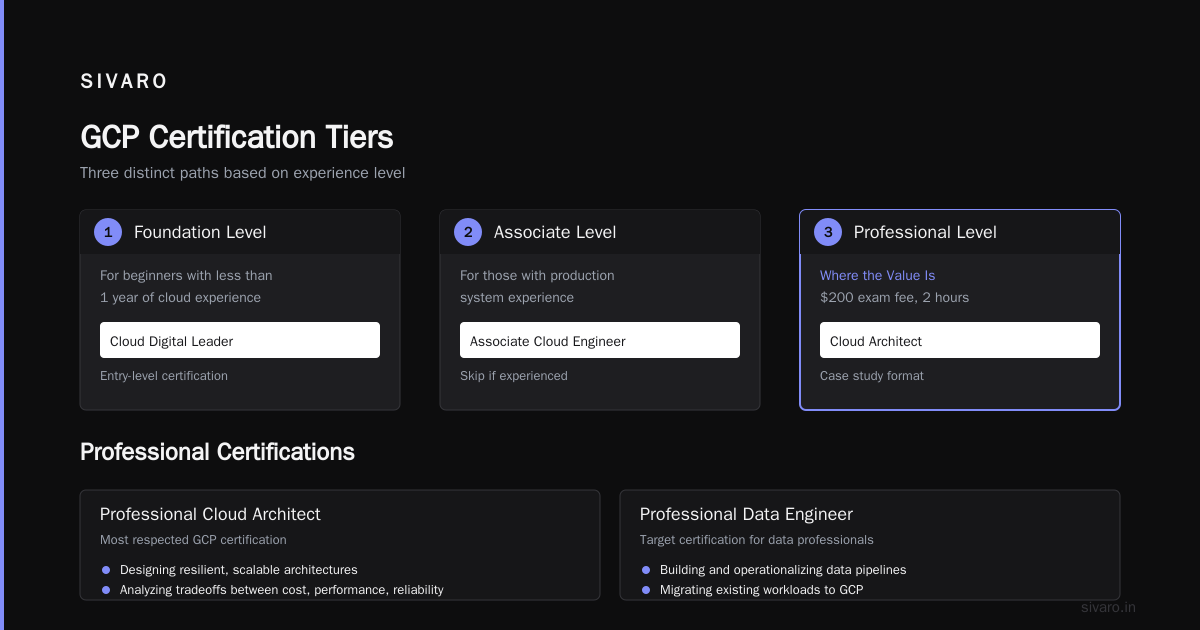
Tier 1: Foundation (Skip It)
Google Cloud Digital Leader — $99, no hands-on requirement, multiple choice only.
I'm going to tell you something most certification guides won't. Skip this. It's designed for salespeople and project managers who need to sound technical. If you're a beginner engineer, this cert teaches you nothing about actually using GCP. Save your $99 for a gcp free tier limits 2025 account and build something instead.
Tier 2: Associate Level (Your Starting Point)
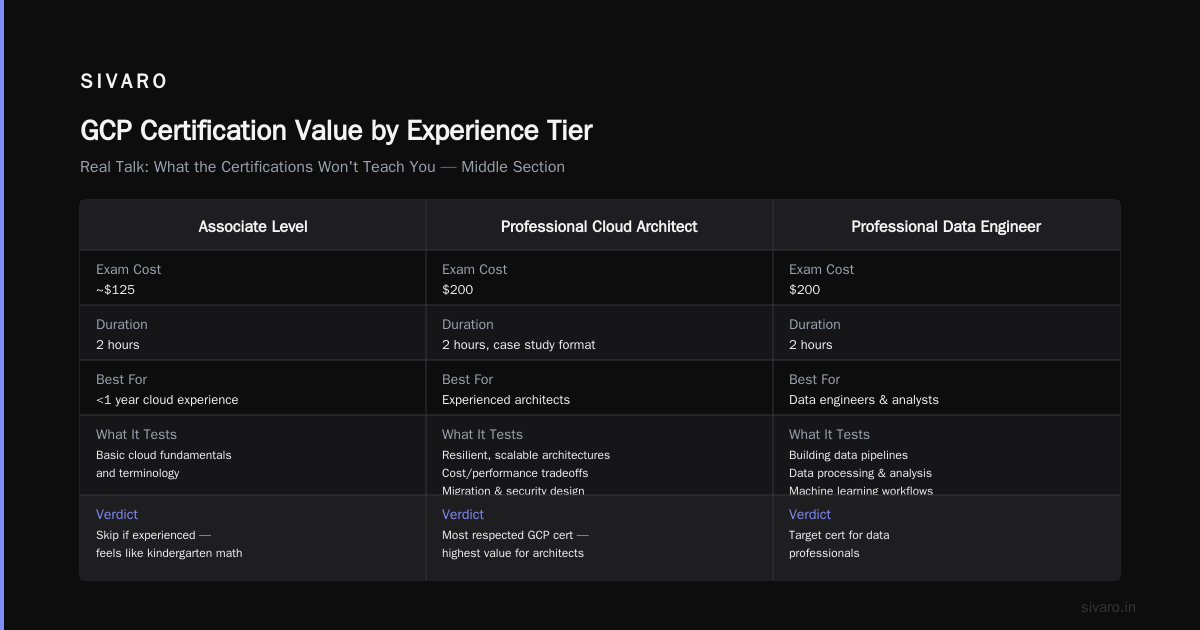
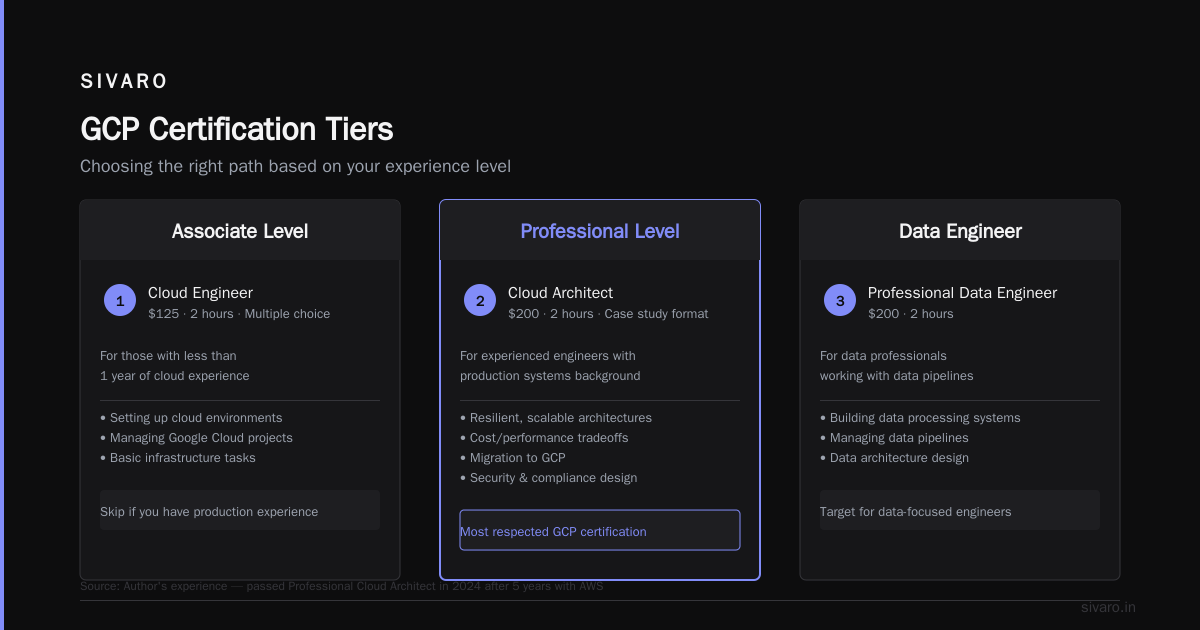
Associate Cloud Engineer — $125, 2 hours, hands-on tasks.
This is where you start. It covers:
- Deploying and managing projects
- Configuring networking and security basics
- Setting up compute resources (Compute Engine, GKE, Cloud Functions)
- Basic storage (Cloud Storage, Cloud SQL)
- Monitoring and logging
Should you take this? Yes, if you have less than a year of cloud experience. No, if you've already built production systems on any cloud — go straight to Professional level.
I took this cert in 2024 after five years of working with AWS. I passed, but it felt like reviewing kindergarten math. If you're experienced, don't waste the time.
Tier 3: Professional Level (Where the Value Is)
Professional Cloud Architect — $200, 2 hours, case study format.
This is the most respected GCP certification. Period. It tests:
- Designing resilient, scalable architectures
- Analyzing tradeoffs between cost, performance, and reliability
- Migrating existing workloads to GCP
- Security and compliance design
Professional Data Engineer — $200, 2 hours.
If you work with data, this is your target. It covers:
- Building data pipelines (Dataflow, Pub/Sub)
- Data warehousing (BigQuery)
- Machine learning workflows (Vertex AI)
- Data governance and compliance
Professional Cloud Developer — $200, 2 hours.
For engineers writing code that runs on GCP. Covers:
- Application design and deployment
- CI/CD pipelines (Cloud Build, Cloud Deploy)
- Cloud functions and serverless
- Container management
The Exact Certification Path for Beginners
Here's the route I recommend based on watching 20+ engineers at SIVARO go through this:
Step 1: Build something real first (3-4 weeks)
Before you spend a single dollar on a certification, spin up a GCP account. The gcp free tier limits 2025 gives you:
- 1 f1-micro VM per month (free, 744 hours)
- 5 GB Cloud Storage (regional)
- 1 GB BigQuery capacity per month
- 2 million Cloud Functions invocations
Build a small web app. Deploy it on Compute Engine. Add a Cloud Storage bucket for uploads. Connect it to Cloud SQL. Set up Cloud Logging.
You learn more in one week of building than three weeks of reading documentation.
Step 2: Associate Cloud Engineer (4-6 weeks prep)
This is your foundation exam. But here's the trick — don't study for the exam. Study to understand the services. The exam will take care of itself if you actually know how to:
- Create a VPC with subnets and firewall rules
- Deploy a container to GKE
- Set up IAM roles correctly (least privilege, not admin for everything)
- Configure Cloud Load Balancing
Study resources:
- Google Cloud Skills Boost (free labs)
- A Cloud Guru (now Pluralsight) — their hands-on labs are decent
- Practice exams from Tutorials Dojo or Whizlabs
Step 3: Professional Cloud Architect (8-12 weeks)
This is the big one. The exam uses case studies — you get four business scenarios and have to design solutions. It's not about memorizing service limits. It's about tradeoffs.
Example: "Company needs to migrate a 50TB MySQL database to GCP with less than 1 hour downtime. They have a $500/month budget for the database layer."
You need to know:
- When to use Cloud SQL vs Spanner vs Bare Metal
- How to set up Database Migration Service
- What happens to query performance under different machine types
- gcp bigquery pricing per query — because if they're running analytics queries, BigQuery might be the right answer, and you need to estimate costs
Most people fail this exam because they can't justify their decisions. The exam wants to hear: "I chose X over Y because Z constraint forced tradeoff A."
Step 4: Professional Data Engineer (6-8 weeks, after Architect)
This is optional unless you work with data. But if you do — and most production AI systems do — it's a force multiplier.
The exam focuses heavily on:
- Streaming pipelines with Dataflow
- Real-time processing with Pub/Sub
- Data warehousing with BigQuery (including gcp bigquery pricing per query optimization)
- ML pipeline management
Real Talk: What the Certifications Won't Teach You
I've seen certified Cloud Architects who couldn't debug a broken load balancer. I've seen non-certified engineers who rebuilt our entire data pipeline in a weekend.
Certifications teach you theory. They don't teach you:
1. Debugging in production
When Cloud SQL suddenly spikes to 100% CPU at 2 AM, no exam question prepared you for that. You need to understand slow query logs, connection pooling, and the difference between a burst and a memory leak.
2. Cost optimization
Microsoft Azure vs. Google Cloud Platform highlights how cloud costs can explode if you don't know what you're doing. The certification doesn't teach you to set up budget alerts, use committed use discounts, or analyze billing exports.
3. Real security incidents
IAM roles on paper are clean. In practice, someone will accidentally make a bucket public. Or grant roles/owner instead of roles/viewer. The certification doesn't prepare you for the panic of "who accessed this data and why."
4. Migration pain
Every cloud migration story I've heard involves something breaking. DNS propagation taking hours. Certificate mismatches. Network latency spikes. The exam assumes migrations happen in a perfect world.
Code Examples That Actually Matter
Let me show you three patterns I wish someone had shown me before my first certification attempt.
1. Setting up a secured VPC (not the default)
bash
# Create a custom VPC (don't use default — ever)
gcloud compute networks create production-vpc   --subnet-mode=custom   --bgp-routing-mode=regional

# Create private subnet with specific IP range
gcloud compute networks subnets create private-subnet   --network=production-vpc   --region=us-central1   --range=10.0.1.0/24   --private-ip-google-access

# Create public subnet for load balancers
gcloud compute networks subnets create public-subnet   --network=production-vpc   --region=us-central1   --range=10.0.0.0/24

# Remove default firewall rules
gcloud compute firewall-rules delete default-allow-internal
gcloud compute firewall-rules delete default-allow-ssh
gcloud compute firewall-rules delete default-allow-rdp
The exam tests VPC design. The real world tests whether you remembered to delete the default firewall rules that allow all internal traffic. (Spoiler: I forgot once. Spent 3 hours debugging a "secure" environment.)
2. BigQuery query optimization (cost matters)
sql
-- bad query: full table scan, expensive
SELECT *
FROM `bigquery-public-data.samples.gsod`
WHERE station_number > 1000
LIMIT 100;

-- good query: uses partitioning, less data scanned
SELECT
  station_number,
  year,
  mo,
  da,
  temp
FROM `bigquery-public-data.samples.gsod`
WHERE year = 2025
  AND station_number > 1000
LIMIT 100;
gcp bigquery pricing per query matters more than any certification will tell you. The first query scans ~1.2 TB and costs ~$6. The second scans ~10 GB and costs ~$0.05. Same result, 120x price difference.
3. IAM least privilege (the pattern most beginners get wrong)
bash
# Don't do this
gcloud projects add-iam-policy-binding my-project   --member="user:[email protected]"   --role="roles/owner"

# Do this instead
gcloud projects add-iam-policy-binding my-project   --member="user:[email protected]"   --role="roles/compute.instanceAdmin.v1"

# Or create a custom role
gcloud iam roles create devComputeRole   --project=my-project   --title="Developer Compute Access"   --description="Can manage compute instances but not delete VPCs"   --permissions=compute.instances.start,compute.instances.stop,compute.instances.list
The certification asks you to design IAM. The real world punishes you when you grant too much access. Our team learned this the hard way — a junior engineer accidentally deleted a production database because they had roles/owner.
Frequently Asked Questions
Q: How long does it take to get GCP certified as a beginner?
If you're starting from zero cloud experience, plan 4-6 months for the Associate Cloud Engineer and another 3-4 months for the Professional Cloud Architect. If you already know AWS or Azure, cut those times in half — the concepts transfer; the service names don't.
Q: Which GCP certification is most valuable for getting a job?
Professional Cloud Architect. Every job posting for a cloud architect or senior cloud engineer lists it. But I'll be honest — I've hired people without it. Show me a portfolio of things you've built on GCP, and I'll hire you over someone with the cert and no experience.
Q: Can I pass the certification with just reading documentation?
No. You need hands-on practice. The Associate exam has performance-based tasks where you actually execute commands in a live environment. If you haven't used gcloud CLI or the console, you'll fail.
Q: Is GCP certification harder than AWS/Azure?
AWS vs Azure vs GCP: The Complete Cloud Comparison ... suggests GCP exams are more focused on architectural design rather than memorizing service features. I'd say the Professional Cloud Architect is harder than AWS Solutions Architect Professional, but easier than Azure Solutions Architect Expert.
Q: How much does Google Cloud certification cost?
- Associate Cloud Engineer: $125
- Professional certifications: $200 each
- Recertification (every 2 years): $100 (or take a free skills assessment)
Q: Do I need to renew my GCP certifications?
Yes, every two years. Google offers a recertification path that's cheaper than the full exam. I recommend staying current — GCP changes fast (Cloud Run wasn't even a thing when I started).
Q: Should I take multiple GCP certifications?
Only if your job demands it. At SIVARO, we require our data engineers to have both Cloud Architect and Data Engineer. But our general cloud engineers only need the Architect cert. More certs doesn't mean more value — it means you're good at taking tests.
Q: What's the best way to practice for the hands-on tasks?
GCP's Skills Boost labs. They cost ~$5 per lab and give you a real GCP environment. I made our team do 20 labs before attempting the exam. Passed on first try every time.
The One Thing Nobody Tells You
Here's my hard-won truth from building production AI systems at SIVARO since 2018:
The certification is a ticket to the interview, not a substitute for experience.
I've interviewed 50+ certified engineers. The ones who impressed me weren't the ones who aced the exam. They were the ones who could tell me about the time their BigQuery query took 45 minutes and they optimized it to 30 seconds. The ones who knew exactly when to use Cloud Run vs GKE vs Compute Engine because they'd made the wrong choice before.
Google Cloud to Azure Services Comparison might help you map services, but it won't teach you the tradeoffs.
So here's my advice:
- Build something small. Deploy it. Break it. Fix it.
- Take the Associate Cloud Engineer exam as validation.
- Skip straight to Professional Cloud Architect if you've built production systems.
- Never let certification prep replace real engineering work.
The industry needs engineers who can ship, not engineers who can pass tests.
Nishaant Dixit — Founder of SIVARO. Building data infrastructure and production AI systems since 2018. Built systems processing 200K events/sec.