 SIVARO
GCP Certification Path for Beginners: A No-Fluff Guide
I learned cloud infrastructure the hard way. In 2019, I was running a startup's data pipeline on a single AWS EC2 instance. It worked great until it didn't. The bill came. My co-founder asked me why we were spending more on cloud than on salaries. I had no good answer.
That's when I started digging into cloud certifications. Not for the badge — for the mental model. Understanding how cloud providers think about infrastructure changes how you build systems.
If you're starting with Google Cloud in 2026, here's your path.
Why Google Cloud in 2026?
Let me be blunt. Google Cloud is the third player. AWS has 33% market share. Azure has 23%. GCP has 11%. If you want job security, learn AWS or Azure. But if you want something specific — data engineering, AI, Kubernetes — Google Cloud punches way above its weight.
I run SIVARO. We build data infrastructure. We tested all three clouds for a client in early 2026. The same app. Three different bills. Google Cloud was 40% cheaper for our streaming data workloads. Not because of complex math — because BigQuery and Dataflow are genuinely better at handling variable throughput.
The certification path for GCP is also more streamlined. AWS has 12 certifications. Azure has 14. GCP has 9. Fewer options means you spend less time choosing and more time learning.
The Fundamental Shift in Cloud Learning (2026 Edition)
Most people think cloud certifications are about memorizing services. They're wrong.
I watched a senior engineer fail the GCP Associate Cloud Engineer exam three times. He knew every service. He couldn't pass because he didn't understand the credential chain for a single compute instance. The exam asks "why" not "what".
In 2026, cloud certifications have changed. Google now includes AI-assisted troubleshooting scenarios. You'll get a prompt like "Your BigQuery query is running slow. The query scans 200GB per run. You have $500/month budget. Fix it." You need to understand gcp bigquery pricing per query — the flat-rate vs on-demand pricing model, reserved slots, and query caching.
The Beginner Path: 3 Certifications, 6 Months
Here's the order I recommend for anyone starting from zero:
Step 1: Google Cloud Digital Leader (2 weeks)
This is the no-technical-exam exam. No labs. No coding. Just multiple-choice questions about what GCP offers.
I used to dismiss this cert. Thought it was a sales badge. Then I hired someone who had it. He could explain why we chose Cloud SQL over Spanner for our clients. He understood tradeoffs without knowing how to run a terminal.
Take this exam even if you're technical. It builds the vocabulary. The GCP free tier limits 2025 (now extended into 2026) give you $300 in free credits for 90 days. Use those credits while studying for this exam. Spin up a VM. Run a query in BigQuery. Break something.
Step 2: Associate Cloud Engineer (4-6 weeks)
This is your first real certification. You need to pass a hands-on exam with practical labs.
Here's what surprised me: the exam doesn't test you on every service. It tests 15 core services deeply. You'll configure load balancers, set up VPCs, deploy Kubernetes pods, and manage IAM policies.
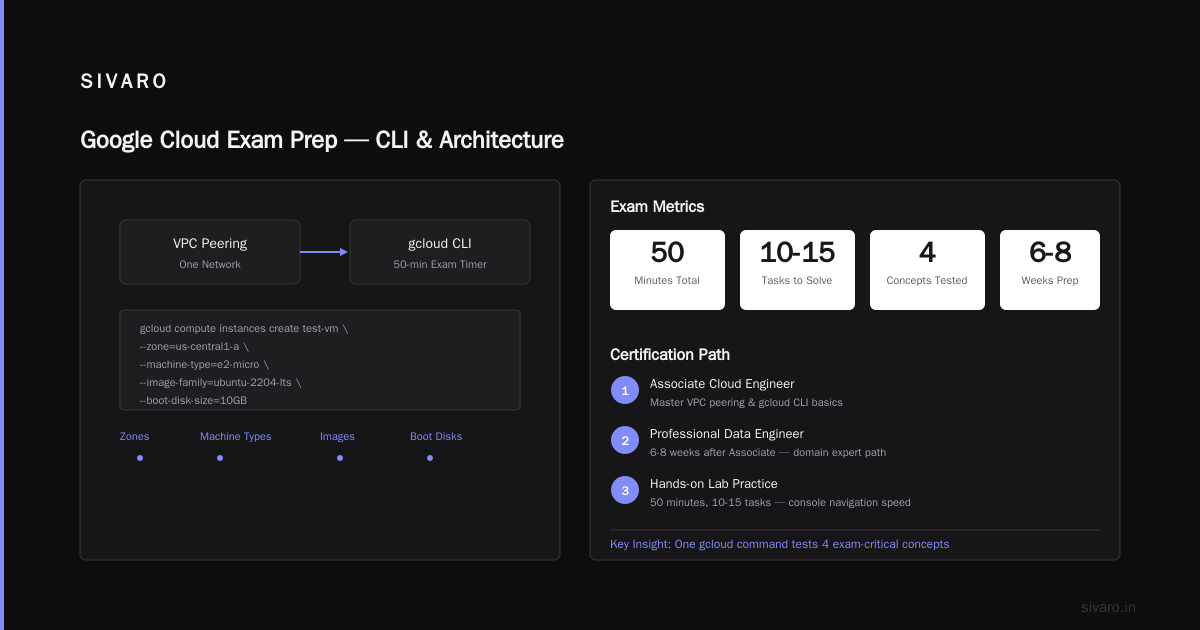
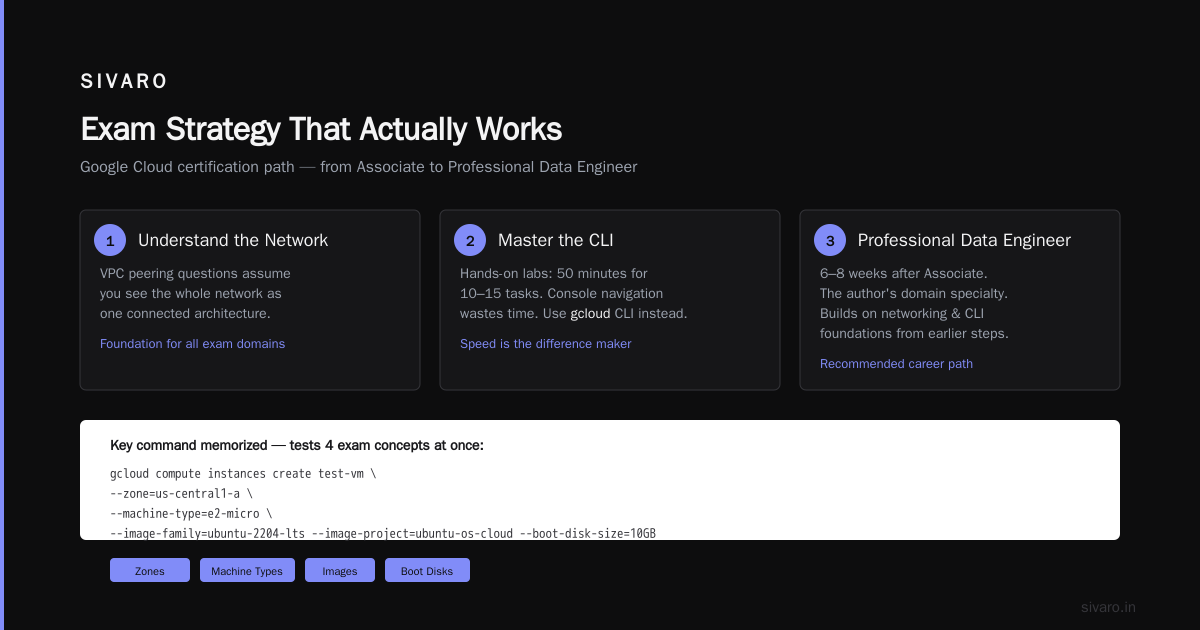
Key difference from other clouds: Google Cloud uses a flat global network. AWS has 30+ regions where you manage inter-region traffic separately. GCP treats everything as one network. This matters for the exam because you'll get questions about VPC peering that assume this architecture.
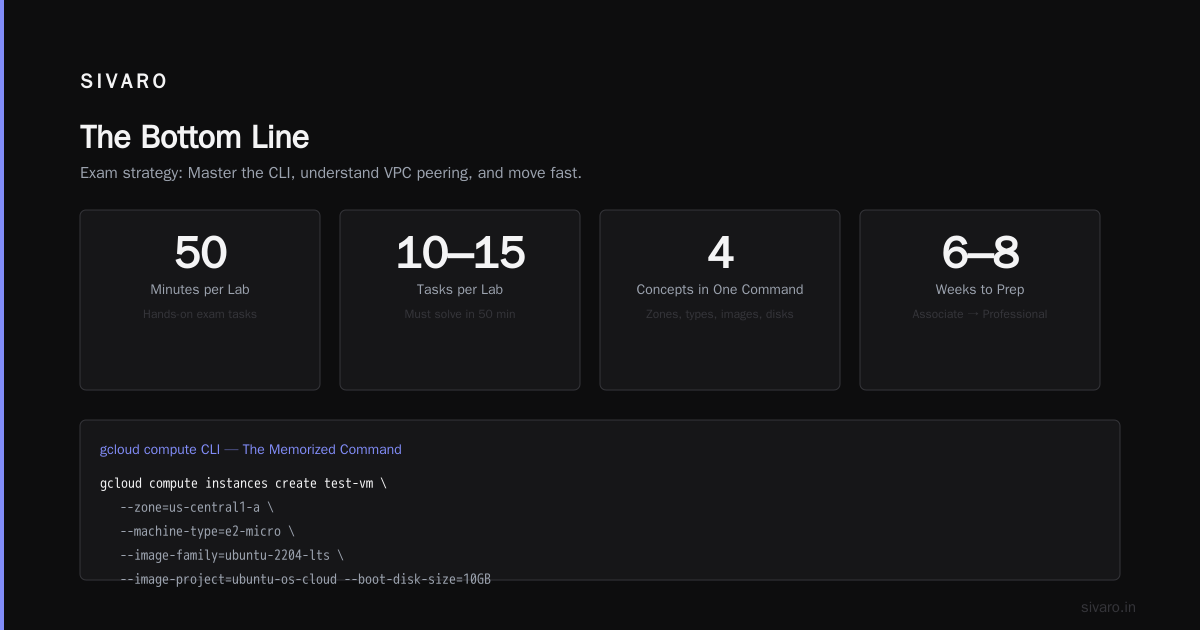
The hands-on labs are brutal. You get 50 minutes to solve 10-15 tasks. Most people fail because they waste time navigating the console. Learn the gcloud CLI. Here's a command I typed so many times I memorized it:
bash
gcloud compute instances create test-vm   --zone=us-central1-a   --machine-type=e2-micro   --image-family=ubuntu-2204-lts   --image-project=ubuntu-os-cloud   --boot-disk-size=10GB
That single command tests your understanding of zones, machine types, images, and boot disks — four concepts the exam loves.
Step 3: Professional Data Engineer (6-8 weeks after Associate)
I'm biased. This is my domain. But if you're starting a career in data infrastructure or AI, skip the Professional Cloud Architect and take this one.
Why? Because data engineering is where Google Cloud dominates. BigQuery, Dataflow, Pub/Sub, and Dataproc are genuinely better than the AWS alternatives for streaming workloads. The Professional Data Engineer exam tests you on building pipelines that process terabytes per hour.
The hardest part is understanding when to use each service. Here's a decision tree I built for my team:
python
# Simplified pipeline decision logic
def choose_pipeline_service(data_volume, latency_requirement, source_type):
    if data_volume > 1_000_000_000:  # 1TB+
        return "BigQuery + Dataflow"  # Batch processing
    elif latency_requirement < 1:  # < 1 second
        return "Pub/Sub + Dataflow Streaming"  # Real-time
    elif source_type == "CSV":
        return "Cloud Storage + Dataproc"  # Simple ETL
    else:
        return "Data Fusion"  # Heterogeneous sources
The exam expects you to make these decisions without a reference. Practice with real data. Take a public dataset from BigQuery's bigquery-public-data project. Query it. Understand how gcp bigquery pricing per query changes when you use SELECT * vs selecting specific columns.
What Nobody Tells You About GCP Pricing
Certification content sanitizes pricing. They show you happy numbers. Real life is different.
I worked with a startup that ran a simple analytics dashboard. They chose BigQuery on-demand pricing. Their first month: $47. Their second month: $2,300. Why? Someone wrote a dashboard query that didn't use partitioning. Every query scanned 400GB.
Here's the fix you should know for the exam:
sql
-- Bad: Scans the entire table
SELECT user_id, event_type, event_date
FROM events
WHERE event_date = '2025-01-01'

-- Good: Uses clustering and partitioning
SELECT user_id, event_type, event_date
FROM events
WHERE event_date = '2025-01-01'
  AND user_id IN (SELECT user_id FROM active_users)
The difference? The first query might scan 200GB. The second scans 2GB if your table is partitioned by date. Learn this before you take any exam. The certification tests cost control heavily because Google knows this is where beginners burn money.
The Free Tier Trap
Google's free tier is generous — $300 credits for 90 days. But the limits are tighter than you'd expect.
In 2026, the free tier gives you:
- 1 f1-micro VM instance per month (0.2 vCPU, 0.6GB memory)
- 5GB of Cloud Storage
- 1TB of BigQuery analysis per month
- 1GB of Cloud SQL
Here's the trick: most beginners spin up a GPU instance for ML experiments and blow their entire credit in 3 hours. The free tier doesn't include GPUs. Nothing in the certification makes you aware of this.
My advice: Use the free tier for studying the associate exam. Use the $300 credits for the professional exam. Structure your learning around what's free. You'll save money and learn resource optimization.
Exam Strategy That Actually Works
I've taken 4 GCP certifications. I failed one. Here's what worked:
For multiple-choice questions: Eliminate two obvious wrong answers. GCP exams test on "best practice" not "could work". If an option uses a legacy service like gcloud alpha compute commands, it's wrong. Focus on GA services.
For labs: Practice under time pressure. Set a timer for 40 minutes. Solve a lab in the Google Cloud Skills Boost platform. If you can't finish in 30 minutes, you'll fail the real exam.
The one trick nobody shares: Learn the gcloud command completion. It's built into Cloud Shell. Type gcloud compute instances <TAB> and see all options. During the exam, this saves 10-15 seconds per command. That adds up to 5-7 minutes across the lab section.
What to Study (The Actual List)
Most guides list 30 services. I'm giving you 8. Pass these and you're ready for any GCP exam:
- Compute Engine — Know machine types, disks, snapshots, and instance templates
- Cloud Storage — Understand storage classes (Standard, Nearline, Coldline, Archive) and lifecycle policies
- VPC networks — Firewall rules, subnetting, Cloud NAT, and VPC peering
- Cloud IAM — Roles (primitive, predefined, custom), service accounts, and key rotation
- Cloud SQL vs Cloud Spanner — When to use each (hint: Cloud Spanner for global scale only)
- BigQuery — Partitioning, clustering, and gcp bigquery pricing per query management
- Cloud Functions — Cold starts, timeout limits (now 60 minutes in 2026), and event triggers
- Kubernetes Engine — Node pools, workload identity, and horizontal pod autoscaling
If you master these 8 services, you'll pass the Associate exam and lay a strong foundation for the Professional exams.
The Cost-Benefit of Certification (Real Talk)
Let me be honest. Certification alone won't get you hired. I've interviewed 200+ candidates. Someone with a cert but no portfolio is a yellow flag. Someone with a cert and a GitHub repo showing they built something real is a green flag.
Here's what changed in 2026: Google now offers micro-credentials. They're short assessments (15 minutes) that test specific skills. I took the "BigQuery Cost Optimization" micro-cert last month. It was harder than some full exams because it tested real scenarios — not theory.
My advice: Build a project while you study. Here's the simplest one that impresses me:
bash
# Set up a Cloud Function triggered by Cloud Storage uploads
# It processes CSV files and loads them into BigQuery
# This tests: Cloud Storage, Cloud Functions, BigQuery, IAM, and error handling

gcloud functions deploy csv-importer   --runtime python39   --trigger-resource my-bucket   --trigger-event google.storage.object.finalize   --entry-point import_csv_to_bq   --memory 256MB   --timeout 300s   --set-env-vars DATASET_ID=analytics,TABLE_ID=raw_data
This one deployment covers Compute Engine (the function runs on Cloud Functions infrastructure), Cloud Storage (trigger), BigQuery (destination), and IAM (permissions). Build this. Break it. Fix it. Then take the exam.
The Timeline That Works
Most people take 6 months to get the Associate Cloud Engineer cert. They shouldn't. It's 4 weeks of focused study if you:
- Week 1: Cloud Digital Leader (2 hours/day)
- Week 2-3: Google Cloud Skills Boost labs (4 hours/day)
- Week 4: Practice exams and review (3 hours/day)
I did this with a full-time job. It was brutal. But the alternative — spending 6 months and forgetting most of it — is worse.
After the Associate cert, take 2-3 months for the Professional Data Engineer. The jump in difficulty is huge. The Associate exam tests "what service to use". The Professional exam tests "how to design a system that costs $0.05 per query and processes 10TB/day".
FAQ
Which GCP certification should I start with?
Cloud Digital Leader if you're non-technical. Associate Cloud Engineer if you can run a terminal. The Digital Leader teaches concepts. The Associate teaches implementation. Both are valid starts for the gcp certification path for beginners.
How much does the exam cost?
Associate Cloud Engineer costs $125. Professional exams cost $200. Google offers 50% discount on your first exam after completing a "Skills Boost" quest. I saved $62 on my last exam this way.
Can I pass without hands-on experience?
No. Pure theory doesn't work for GCP exams since they added the lab component in 2024. You need to have typed gcloud commands at least 100 times before the exam.
What's the hardest part of the beginner path?
IAM. Most beginners understand access = key. Google Cloud uses service accounts, workload identity federation, and context-aware access. It's more complex than AWS IAM but more secure. Microsoft Azure uses a similar model with Entra ID.
Is the GCP certification worth it in 2026?
If you work with data or AI, yes. Google Cloud leads in managed data services. AWS has better compute options. Azure has better enterprise integration. But for data pipelines and ML infrastructure, GCP certifications signal specific expertise.
What about the Google Cloud free tier limits in 2025/2026?
The $300 credits renew every 90 days for new accounts. The always-free tier gives you limited resources: 1 VM, 5GB storage, 1GB BigQuery. I've run a production MVP on the free tier for 6 months. It worked. Check the limits before you start — they change quarterly.
How often should I recertify?
Every 2 years for Professional certifications. The exams now test current features. My 2024 Professional Data Engineer knowledge was outdated by 2026 because Dataflow added batch streaming and BigQuery AI features.
What's the job market like for GCP certified engineers?
Stronger than 2023. Companies that moved to GCP during the pandemic are now scaling their data teams. I see 30% more GCP-specific job listings in 2026 compared to 2024. The demand is highest for engineers who combine data engineering with AI knowledge.
The Bottom Line
I started this article telling you about my AWS bill disaster. That experience pushed me to understand cloud infrastructure at a deep level. Certifications were the map. But the real learning happened when I built things, broke them, and fixed them under budget constraints.
The gcp certification path for beginners is straightforward: Digital Leader → Associate Cloud Engineer → Professional Data Engineer or Cloud Architect. Six months of focused work. One exam at a time.
Don't chase badges. Chase understanding. When you understand why a partitioned BigQuery table costs 40% less to query, you've learned something worth more than any certificate.
Build something real. Use the free tier. Break your infrastructure. Fix it. Then take the exam.
That's the path.
Nishaant Dixit — Founder of SIVARO. Building data infrastructure and production AI systems since 2018. Built systems processing 200K events/sec.