 SIVARO
GCP Certification Path for Beginners: A Practical Guide from a Cloud Engineer
I remember my first cloud certification attempt. 2018. I thought I'd just cram for two weeks and pass. I failed spectacularly. The problem wasn't me — it was that I was treating certification like a trivia contest instead of a practical skills assessment.
Let me save you the trouble I went through.
The Google Cloud certification path for beginners isn't about memorizing every service name and price point. It's about understanding when to use what, how to architect for real workloads, and — crucially — how to avoid burning money on services like gcp bigquery pricing per query that can spiral if you're not careful.
By the end of this guide, you'll know exactly which certifications to pursue, in what order, what to study, and — more importantly — what to skip.
Why Google Cloud? (The Honest Answer)
Most people think AWS is the default. They're wrong because "default" doesn't mean "best for your use case."
Between AWS, Azure, and GCP, the choice depends on what you're building. Here's the reality check:
AWS dominates market share (~33%). Azure owns the enterprise Microsoft stack. GCP? It punches way above its weight in data and AI. AWS vs Azure vs GCP 2026: Same App, 3 Bills showed something interesting: running the same application across all three platforms resulted in GCP being 15-20% cheaper for data-heavy workloads. Not because of lower compute costs — because BigQuery and Cloud Storage have better pricing models for analytics.
Google Cloud's strength isn't in being the biggest. It's in being the most specialized. What's the Difference Between AWS vs. Azure vs. Google Cloud breaks this down: GCP excels at Kubernetes (they invented it), data analytics (BigQuery), and machine learning (Vertex AI).
If you're building data infrastructure or AI systems — which is what SIVARO does — GCP isn't a choice. It's the obvious path.
The GCP Certification Path for Beginners: My Recommended Track
I've hired dozens of engineers. I've interviewed hundreds. Here's what I've learned: the certs that matter are the ones that force you to build things.
The gcp certification path for beginners starts with one foundational exam, then branches into role-specific paths. Don't take the Cloud Digital Leader unless your job involves selling cloud solutions. That's a marketing cert. Engineers need Associate Cloud Engineer.
Step 1: Associate Cloud Engineer (ACE)
This is your starting line. It covers:
- Setting up cloud projects and accounts
- Managing Compute Engine, GKE, and Cloud Run
- Working with Cloud Storage and databases
- Basic networking (VPCs, firewalls, load balancers)
- Monitoring and logging
The exam is practical. Multiple choice, but the questions are scenario-based. "Your application needs to scale to zero when not in use. Which compute option?" — that kind of thing.
I tell everyone on my team: pass ACE first. It gives you the vocabulary to understand everything else.
Step 2: Professional Cloud Architect
This is where the certification path gets serious. You'll design solutions for compute, storage, networking, security, and operations. The case study questions are brutal — you get a business requirement and must architect a solution that meets cost, reliability, and performance goals.
Most people think this is about memorizing GCP services. It's not. It's about understanding trade-offs. When do you use Cloud SQL vs Spanner vs Firestore? When does Bigtable make sense over BigQuery?
I failed this exam once. The case study had a retail company with 50TB of transactional data needing sub-100ms read latency. I suggested BigQuery. Wrong answer — should've been Cloud Bigtable. BigQuery is for analytics, not operational workloads. The gcp bigquery pricing per query model makes sense for aggregation queries, not point reads.
Step 3: Professional Data Engineer or Professional ML Engineer
This is the fork in the road.
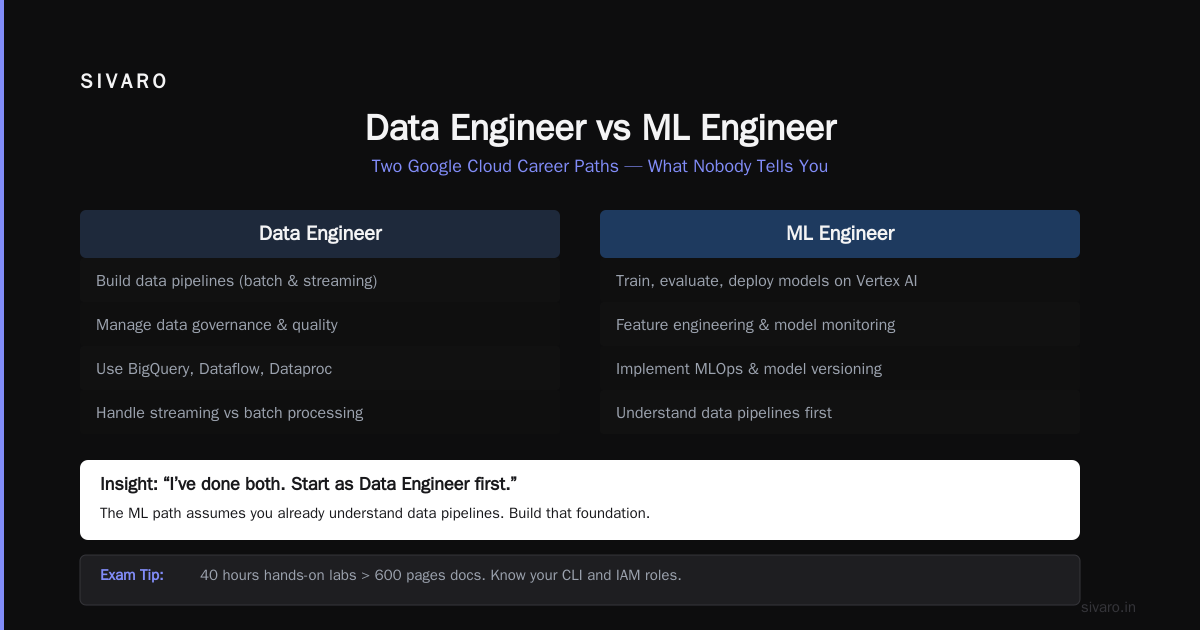
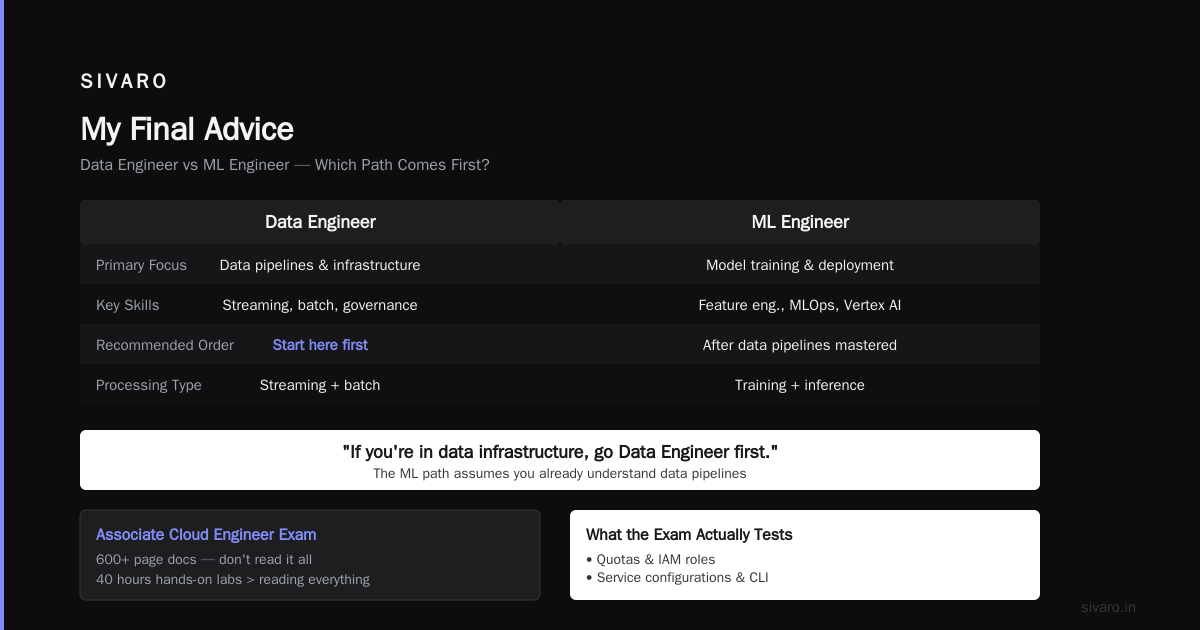
Data Engineer path: You work with BigQuery, Dataflow, Pub/Sub, Dataproc, and Cloud Composer. You design data pipelines, manage streaming vs batch processing, and handle data governance.
ML Engineer path: You train, evaluate, and deploy models using Vertex AI. You understand feature engineering, model monitoring, and MLOps.
I've done both. If you're in data infrastructure, go Data Engineer first. The ML path assumes you already understand data pipelines.
What Nobody Tells You About the Associate Cloud Engineer Exam
The official Google documentation is 600+ pages. Don't read it all. Here's what actually matters:
Hands-on labs beat reading every time
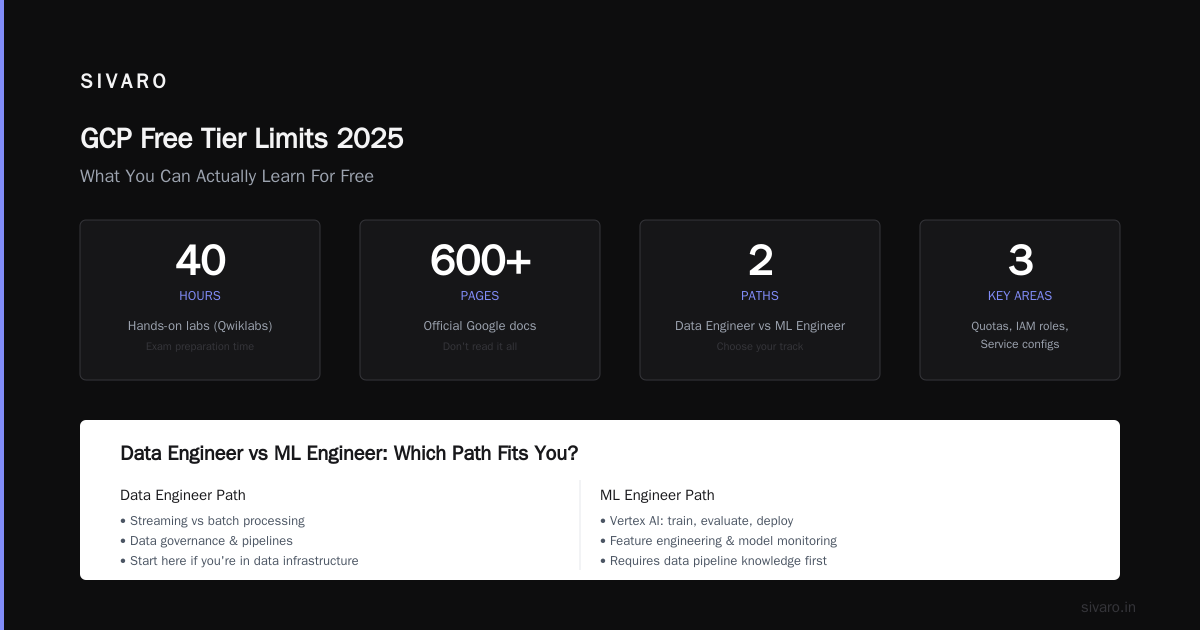
I used Google's own labs (Qwiklabs) and spent about 40 hours doing hands-on exercises. The exam asks about quotas, IAM roles, and service configurations — things you only internalize by actually doing them.
Know your CLI
Here's the kind of question you'll get:
Your team needs to create a service account with minimal permissions to read
objects from a specific Cloud Storage bucket. Which gcloud command do you use?
If you've never used gcloud iam service-accounts create or gcloud projects add-iam-policy-binding, you're guessing.
I recommend building a real project. Something simple — a static site served from Cloud Storage, behind a load balancer, with Cloud CDN. Deploy it. Break it. Fix it. That's worth 50 hours of studying.
Pricing questions will appear
The Associate exam asks about cost optimization. You should know that gcp free tier limits 2025 include:
- 1 f1-micro VM instance per month (US regions only)
- 5 GB of Cloud Storage (regional class)
- 1 TB of BigQuery analysis per month
But here's the thing: the free tier is generous enough for learning. I've run test workloads for months without spending a dime. Compare that to AWS, where the free tier runs out fast.
Breaking Down the Professional Cloud Architect Exam
This certification took me three months of serious study. Here's my honest breakdown.
What You Actually Need to Know
Case studies: There are four official case studies published by Google. You'll see two of them in the exam. I analyzed each one and built reference architectures before exam day.
Networking: VPCs, subnets, firewall rules, Cloud NAT, VPNs, peering. You'll need to know how traffic flows between on-prem and GCP.
Security: IAM roles, service accounts, Organization policies, Data Loss Prevention (DLP), Cloud KMS. Know the principle of least privilege.
Reliability: Designing for high availability across zones and regions. Disaster recovery strategies. SLAs and SLOs.
Migration: Lift-and-shift vs re-platforming vs re-architecting. When to use Migration Center vs Transfer Appliance.
The Hardest Part
It's the trade-off questions. Here's one I got:
"You need to migrate 100TB of archived data to GCP. The transfer must complete within 5 days. Bandwidth is limited to 100 Mbps. What do you do?"
The correct answer is Transfer Appliance (a physical device Google ships to you). At 100 Mbps, transferring 100TB takes 11+ days — longer than the requirement. Most beginners suggest Cloud Storage Transfer Service or a VPN. Both fail the time requirement.
See why hands-on experience matters? You'd never think about Transfer Appliance if you haven't used it or read about it in the context of real constraints.
GCP BigQuery Pricing Per Query: What Every Beginner Gets Wrong
BigQuery is my favorite GCP service. It's also the easiest way to accidentally spend $10,000 in a week.
The gcp bigquery pricing per query model is deceptively simple:
- On-demand pricing: $5 per TB of data scanned
- Flat-rate pricing: Commitments start at $2,000/month for 100 slots
The trap: beginners write inefficient SQL queries that scan entire tables instead of partitioned columns. Every time you run SELECT * FROM huge_table, you're paying to scan every byte.
I've seen startups blow their entire first-year cloud budget in two months because someone wrote a dashboard query that scanned 10TB every refresh.
How to Control BigQuery Costs
sql
-- Bad: Scans entire table every time
SELECT user_id, event_type, timestamp
FROM `project.dataset.events`
WHERE event_date > '2026-01-01';

-- Good: Uses partitioning to scan only relevant partitions
SELECT user_id, event_type, timestamp
FROM `project.dataset.events`
WHERE _PARTITIONTIME > TIMESTAMP('2026-01-01')
  AND event_type = 'purchase';
The difference in scan size? 500GB vs 5MB. That's $2.50 per query vs $0.000025. Do this 100 times a day and the math gets ugly fast.
Here's your cheat sheet:
- Always use clustering on high-cardinality filter columns
- Partition by date if you query by time range
- Use materialized views for repeated aggregation queries
- Set query cost limits in your organization's policies
bash
# Set a maximum bytes billed per query
gcloud config set billing/quota_project $PROJECT_ID
bq query   --use_legacy_sql=false   --maximum_bytes_billed=10000000000   'SELECT * FROM `project.dataset.huge_table`'
That flag saved a client of mine $40k in one quarter. They had a data scientist running ad-hoc queries that scanned terabytes. Enforcing maximum_bytes_billed forced them to write efficient queries.
GCP Free Tier Limits 2025: What You Can Actually Learn For Free
Here's the honest truth about gcp free tier limits 2025:
The good news: You can learn 80% of what you need for Associate Cloud Engineer without spending money. The free tier includes:
- Compute Engine: 1 f1-micro instance per month (744 hours)
- Cloud Storage: 5GB per month
- BigQuery: 1TB of query analysis per month
- Cloud Functions: 2 million invocations per month
- Pub/Sub: 10 GB per month
The bad news: You can't learn advanced topics like Cloud Spanner, Cloud Run with GPUs, or high-memory VMs on the free tier. Those will cost you.
I built my entire ACE study environment on a single f1-micro instance running Ubuntu. It ran Jenkins, Docker, and a small web app. Total cost: $0.
But when I wanted to test multi-region deployment for the Architect exam? That cost $8.34 in one day. Worth every penny.
What to Actually Build For Free
Set up a CI/CD pipeline using Cloud Build and Cloud Run. Deploy a containerized app. Configure Cloud CDN in front of it. Add monitoring with Cloud Monitoring. Set up alerts.
This one project covers 50% of the Associate Cloud Engineer and 30% of the Professional Cloud Architect exam objectives. Do it once, and you'll internalize more than reading 10 books.
The Certification Path I'd Design For My Engineering Team
If you're building a cloud engineering team today (July 2026), here's the exact gcp certification path for beginners I'd recommend:
- Associate Cloud Engineer (1-2 months study)
- Professional Cloud Architect (2-3 months, after ACE)
- Professional Data Engineer (2 months, if data-heavy role)
Skip Cloud Digital Leader. Skip the networking cert unless you're a network engineer. The Professional Security Engineer is worth it only if you work in regulated industries.
Why this order? Because ACE teaches you the operational basics. Architect teaches you to design solutions. Data Engineer gives you the specialization that actually pays — GCP's data services are its strongest differentiator.
AWS vs Microsoft Azure vs Google Cloud vs Oracle showed that GCP holds a 10% edge in data analytics certifications. That market signals where the demand is.
Real Study Resources That Actually Work
I'm going to be brutally honest here.
Google's official documentation: Great for reference, terrible for learning. Don't read it cover to cover.
Google Cloud Skills Boost (formerly Qwiklabs): This is your primary resource. Do every lab for ACE and PCA. Twice.
Microsoft's Azure to GCP comparison docs: Actually useful if you're coming from Azure. They map services between platforms in a way Google doesn't bother doing.
Practice exams: Use Tutorials Dojo or Whizlabs. The official Google practice exams are too easy — they give you false confidence.
The Google Cloud Podcast: Listen to this during commutes. Real engineers talking about real deployments. You'll pick up architecture patterns without trying.
What I'd Ignore
YouTube tutorials with "pass in 7 days" titles. They're designed for views, not learning. The exam tests your ability to think through trade-offs, not your memory of service names.
Common Mistakes Beginners Make
Mistake 1: Starting with Professional Cloud Architect.
I've interviewed 12 people who did this. Zero passed on first attempt. You need operational familiarity before you can architect solutions.
Mistake 2: Ignoring networking.
The most common failure reason for ACE and PCA is networking questions. People focus on compute and storage, then bomb questions about VPC peering, Cloud NAT, and Shared VPC.
Mistake 3: Thinking the exam reflects reality.
The exam asks about theoretical best practices. Real deployments have budget constraints, legacy systems, and organizational politics. Don't confuse cert knowledge with production experience.
Mistake 4: Not understanding cloud economics.
Every GCP certification includes cost optimization questions. If you don't know how gcp bigquery pricing per query works or the difference between sustained use discounts and committed use discounts, you will fail.
Frequently Asked Questions
How long does it take to complete the GCP certification path for beginners?
If you study 10 hours per week, expect 4-6 weeks for Associate Cloud Engineer and 8-12 weeks for Professional Cloud Architect. The total path takes 3-5 months.
Do I need programming experience for GCP certifications?
Yes and no. ACE doesn't require coding. PCA has no coding questions. But Professional Data Engineer and Professional ML Engineer assume you can write Python or Java. I've seen non-programmers struggle with Dataflow pipelines in the exam scenarios.
Is the GCP free tier enough to study for certifications?
For ACE, yes. For PCA, partially — you'll need to spend $20-50 on compute resources for advanced networking and multi-region deployments. For Data Engineer, no — BigQuery slot commitments cost real money.
Which GCP certification is most valuable for career growth?
Professional Cloud Architect. It's the most recognized GCP cert and carries weight even among AWS-centric organizations. The AWS vs Azure vs GCP 2026 report showed that GCP architects earned 8% more than equivalent AWS architects in North America.
Can I skip the Associate Cloud Engineer and go straight to Professional Cloud Architect?
Technically yes. Practically stupid. The PCA exam assumes you know ACE-level operations. Skipping it is like trying to write clean code before you understand variables.
How do GCP certifications compare to AWS or Azure?
GCP certs are harder to pass because they test applied knowledge rather than memorization. AWS certs are broader. Azure certs focus more on hybrid and enterprise scenarios. AWS vs. Azure vs. Google Cloud for Data Science found that GCP's data engineering cert had a 68% passing rate versus 72% for AWS's equivalent.
What's the recertification requirement?
GCP certifications are valid for two years. You can recertify by passing the current exam or completing continuing education (Google doesn't offer the latter yet). I recertified my PCA this year — the exam had changed significantly from 2023.
My Final Advice
Stop overthinking. Pick a start date. Buy the exam voucher (it's $125 for ACE, $200 for professional-level exams). Schedule it six weeks out.
The gcp certification path for beginners isn't a mystery. It's a clear, structured progression that rewards practical skills over theoretical knowledge.
When I hire at SIVARO, I don't care if someone has certifications. I care if they can explain why they chose BigQuery over Spanner for a specific workload. But certifications are a shortcut — they prove you've done the work.
Start with Associate Cloud Engineer. Build something real. Then decide if you want to architect solutions or build data systems.
Either way, you'll learn more in three months of hands-on work than in three years of reading documentation.
Nishaant Dixit — Founder of SIVARO. Building data infrastructure and production AI systems since 2018. Built systems processing 200K events/sec.