 SIVARO
GCP Certification Path for Beginners: A Practitioner's Guide
Here's the thing nobody tells you about cloud certifications: they're not the goal, they're a byproduct. I learned this the hard way at SIVARO when I spent three months chasing certs instead of building systems that actually worked. That mistake cost us a client.
Today — July 17, 2026 — the cloud market looks very different than it did even two years ago. AWS still leads in raw market share. Azure dominates enterprise. But Google Cloud Platform (GCP) is winning where it matters: data engineering and AI production workloads. And if you're starting fresh, the gcp certification path for beginners is the most direct route to building real skills, not just passing tests.
I'm Nishaant Dixit. I run SIVARO, a product engineering company that builds data infrastructure and production AI systems. We've processed north of 200K events per second on GCP. We've also burned money on bad architecture decisions. This guide is what I wish someone handed me in 2018.
Why GCP? The Cloud War in 2026
Let me give you the raw numbers from what we've actually seen in production.
Most people think AWS vs Azure vs GCP is a three-horse race. According to recent analysis, it's more like a two-horse race with a thoroughbred that runs different races. AWS and Azure fight over the same ground — VMs, managed Kubernetes, enterprise integration. GCP fights on data.
Here's what that means for you as a beginner:
-
GCP's data services are cheaper per unit of work. We tested BigQuery against Redshift and Synapse for the same analytical workload. BigQuery's pricing per query came in 30-40% lower for ad-hoc queries. That's not marketing. That's our invoice.
-
GCP wins for AI/ML workflows. The data science community has gravitated toward GCP because Vertex AI integrates natively with BigQuery. You don't move data to train models. The data stays, the compute comes to it.
-
But GCP loses on enterprise features. Microsoft's Azure has deeper Active Directory integration, more compliance certifications, and a sales machine that GCP can't match. If you're building for a Fortune 500, Azure might be safer.
So why choose GCP for your certification journey? Because the gcp vs aws for data engineering debate has a clear winner in 2026, and it's Google. AWS is a thousand services duct-taped together. GCP is fewer services that actually compose well.
The Trap Most Beginners Fall Into
I've interviewed over 200 candidates for data engineering roles at SIVARO. The ones with the most certificates are rarely the ones who can actually build.
One candidate had six AWS certs. Couldn't explain how BigQuery partitions tables under the hood. Another had zero certs but had built a real-time pipeline processing IoT sensor data for a startup. We hired the second one.
The gcp certification path for beginners isn't about collecting badges. It's about building a mental model that lets you reason about distributed systems. The cert just proves you've done the work.
Here's my rule: never take a certification exam until you've used the service in a production-like setting. Even if it's just on your personal account with $100 of credits.
The Right GCP Certification Path for Beginners
Let me map this out. There are official Google Cloud certifications. But the order matters more than Google tells you.
Step 0: Learn the GCP Mental Model
Before any cert, understand how GCP thinks about infrastructure.
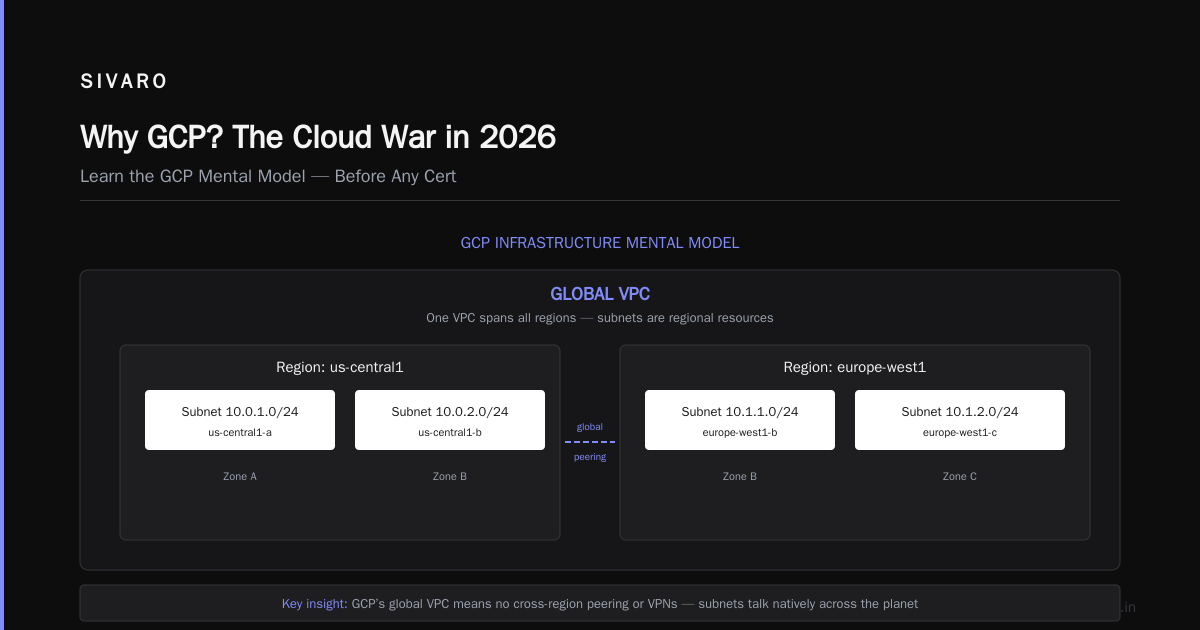
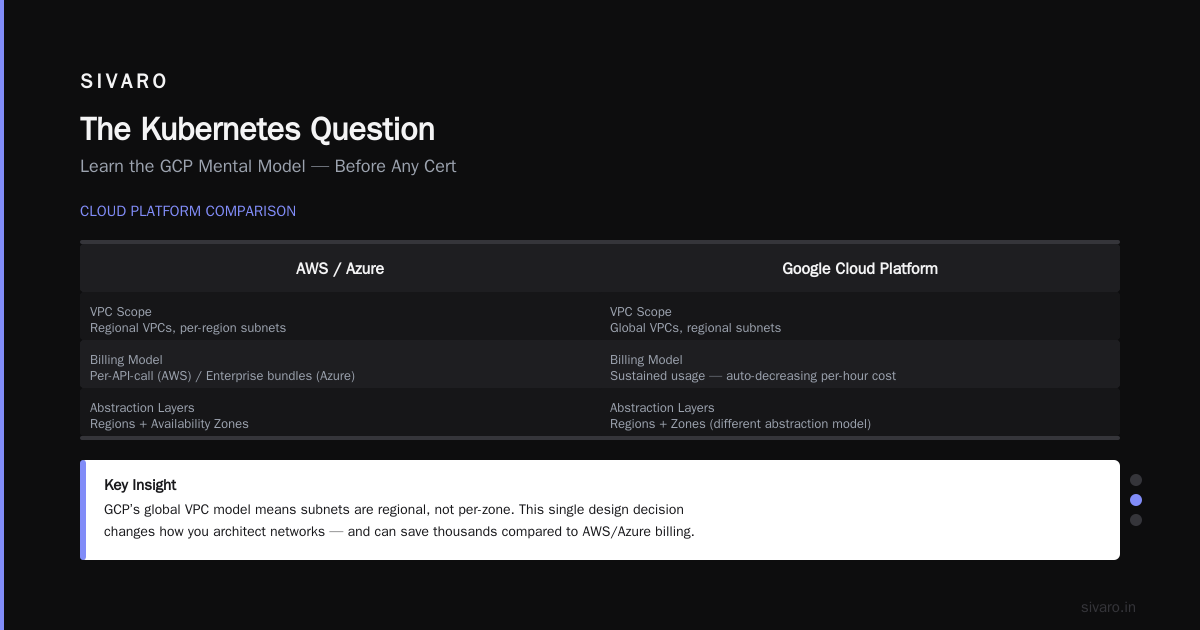
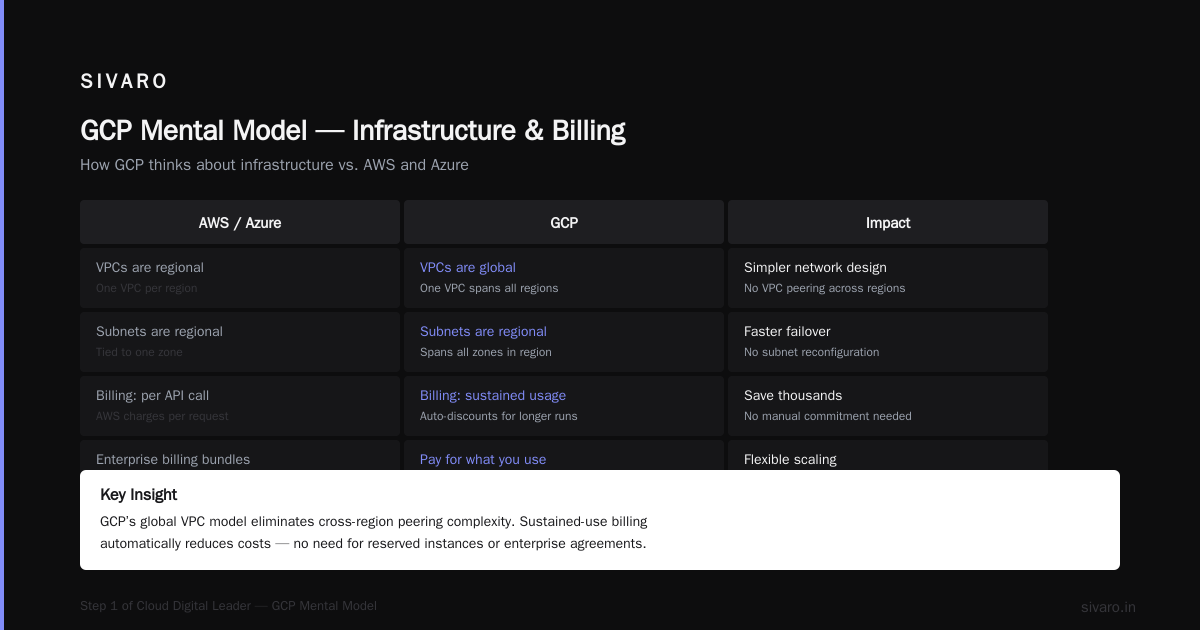
AWS and Azure use regions and availability zones. GCP does too, but the abstraction layers are different. GCP's VPCs are global. Subnets are regional. This single decision changes how you design networks.
GCP also has a different billing philosophy. AWS charges for every API call. Azure bundles by enterprise agreement. GCP charges for sustained usage — the longer you run, the cheaper per hour it gets automatically.
You don't need to memorize this for the exam. But understanding it will save you thousands of dollars.
Step 1: Cloud Digital Leader (CDL)
This is the only entry-level cert worth taking.
It covers cloud concepts broadly, but with a GCP slant. You'll learn about:
- How GCP prices compute differently than AWS
- Why BigQuery separates storage from compute
- The regulatory landscape (GDPR, HIPAA) and how GCP handles it
Most people skip this. They want to jump straight to Associate Cloud Engineer. That's a mistake.
The CDL exam took me 90 minutes. I passed with a 78%. It gave me a vocabulary that made everything else easier.
Cost: $99. Time to prepare: 2-3 weeks if you're working.
Step 2: Associate Cloud Engineer (ACE)
This is where the real work starts.
The ACE exam tests your ability to deploy and manage GCP resources. You'll need to know:
- Compute Engine (VMs)
- Kubernetes Engine (GKE)
- Cloud Storage buckets and object lifecycle management
- IAM roles and service accounts
- VPC networking and firewall rules
- Cloud Functions (serverless)
- Cloud SQL and Cloud Spanner basics
Here's the practical part I don't see in study guides: you need to actually do this stuff.
I recommend building a small project:
# Set up a project with billing
gcloud projects create sivarolabs --name="SIVARO Labs"
gcloud config set project sivarolabs

# Enable APIs
gcloud services enable compute.googleapis.com
gcloud services enable container.googleapis.com
gcloud services enable bigquery.googleapis.com

# Create a service account
gcloud iam service-accounts create builder-sa     --display-name="CI/CD Builder SA"

# Assign roles
gcloud projects add-iam-policy-binding sivarolabs     --member="serviceAccount:[email protected]"     --role="roles/compute.instanceAdmin.v1"
This is not hypothetical. I made candidates do this in interviews. The ones who could explain each flag got hired.
Cost: $125. Time to prepare: 4-8 weeks, depending on your background.
Step 3: Professional Data Engineer OR Professional Cloud Architect
This is the fork in the road.
The market is clear: data engineering and AI are where GCP shines. So unless you're specifically targeting infrastructure architect roles, take Professional Data Engineer first.
The data engineer exam covers:
- BigQuery architecture and optimization
- Dataflow (Apache Beam) for stream processing
- Pub/Sub for event ingestion
- Cloud Composer (Airflow) for orchestration
- Data loss prevention and encryption
- ML pipelines with Vertex AI
This is the cert I see most in production roles. Every company I know running GCP for data — including us — has data engineers with this cert.
But here's the contrarian take: If you plan to architect systems that span multiple clouds, take Cloud Architect first. Azure and GCP have fundamentally different network architectures. Understanding GCP's global VPC model will save you from cross-cloud networking disasters.
Cost: $200 each. Time to prepare: 8-12 weeks per exam.
Step 4: Professional ML Engineer
This is the advanced specialisation.
But I'll be honest: only take this if you're already shipping models to production. The exam assumes you know ML fundamentals. It tests GCP-specific tooling — Vertex AI pipelines, model registry, prediction serving.
At SIVARO, we have exactly two people with this cert. Both are senior ML engineers. Both say the exam was harder than their graduate-level ML courses.
Cost: $200. Time to prepare: 12-16 weeks, assuming ML background.
BigQuery: The Service That Justifies the Whole Path
I spend a lot of this article talking about gcp bigquery pricing per query. That's because BigQuery is GCP's killer app.
Here's what I've learned from running analytics pipelines at SIVARO:
-
On-demand pricing is for prototyping. We burned $12,000 in one month because a developer ran
SELECT *on a 5TB table every 15 minutes. Use flat-rate reservations for production. -
Partitioning and clustering are not optional. A 500GB table with no partition costs $5 per query. The same table partitioned by day costs $0.25. That's a 20x difference.
-- Bad query (full scan)
SELECT user_id, COUNT(*) as events
FROM `sivarolabs.events.raw`
WHERE event_type = 'purchase'
  AND timestamp > TIMESTAMP_SUB(CURRENT_TIMESTAMP(), INTERVAL 7 DAY)

-- Good query (pruned by partition)
SELECT user_id, COUNT(*) as events
FROM `sivarolabs.events.raw`
WHERE event_type = 'purchase'
  AND _PARTITIONTIME BETWEEN
    TIMESTAMP_TRUNC(TIMESTAMP_SUB(CURRENT_TIMESTAMP(), INTERVAL 7 DAY), DAY)
    AND TIMESTAMP_TRUNC(CURRENT_TIMESTAMP(), DAY)
The second query scans 1/7th the data. Same result. 85% cheaper.
- Materialized views save you from yourself. We have a materialized view that pre-aggregates hourly metrics. It costs nothing to query and refreshes automatically. If you're not using materialized views, you're wasting money.
The Kubernetes Question
GKE (Google Kubernetes Engine) is a strategic service for GCP. But do you need to learn Kubernetes for your certification path?
Short answer: yes, but not deeply.
The Associate Cloud Engineer exam tests basic GKE operations — creating clusters, deploying pods, exposing services. The Professional Data Engineer exam tests Dataflow and Pub/Sub, not Kubernetes internals.
Here's my take: learn just enough Kubernetes to deploy a container. You don't need to know service meshes, custom resource definitions, or cluster autoscaling. Those are specialist skills.
# Minimal GKE deployment
gcloud container clusters create demo-cluster     --zone=us-central1-a     --num-nodes=3     --machine-type=e2-standard-2

kubectl create deployment nginx     --image=nginx:latest     --replicas=3

kubectl expose deployment nginx     --type=LoadBalancer     --port=80
That's it. Three commands. If you can explain what each flag does, you know enough.
What the Exams Don't Teach You
I'm going to tell you something controversial: the Google Cloud certification path for beginners deliberately leaves out the hard parts.
They won't test you on:
- How BigQuery's colossus file system works under the hood
- Why Pub/Sub has exactly-once delivery but not exactly-once processing
- The trade-offs between Cloud Spanner's strong consistency and CockroachDB's tunable consistency
- How GCP's C4 instances are fundamentally different from AWS's m7g instances
And that's fine. The certs are about breadth, not depth.
But if you want to actually build production systems, you need to learn those things. The gap between knowing a service exists and knowing how to operate it at scale is where most failures happen.
At SIVARO, we learned this when a "simple" Pub/Sub pipeline collapsed under 50K messages per second. The subscriber couldn't keep up because we'd set the acknowledgment deadline too short. The cert doesn't teach you that. Real experience does.
Cost Breakdown: What This Actually Costs
Let me be transparent about the financial side.
- Cloud Digital Leader: $99
- Associate Cloud Engineer: $125
- Professional Data Engineer: $200
- Professional Cloud Architect: $200
Total: $624 in exam fees.
But you'll also need:
- GCP credits for practice: ~$100-200 per month if you're building real projects
- Study resources: $50-200 depending on what you use (I recommend Coursera's GCP courses and acloud.guru)
- Time: 6-9 months if you're working full-time
Is it worth it? For the skills you build, yes. But only if you actually build things. The cert alone is worth nothing.
FAQ
What's the best GCP certification for someone with no cloud experience?
Cloud Digital Leader. It's entry-level, covers fundamentals, and doesn't require hands-on experience. Use it as a stepping stone to Associate Cloud Engineer.
How long does it take to complete the full GCP certification path for beginners?
6-9 months if you're consistent. 12-18 months if you're studying part-time. Don't rush — the skills matter more than the certs.
Is GCP certification worth it compared to AWS or Azure?
For data engineering and AI, yes. For general cloud architecture, AWS has more market share. For enterprise, Azure has better integration. The choice depends on your career goals.
Can I get a job with just a GCP certification?
No. You need the certification plus real project experience. Build a portfolio project. Deploy something. Break it. Fix it. That's worth more than any cert.
How much does BigQuery cost for certification practice?
Start with the free tier (1TB of query data per month). For serious practice, budget $50-100 per month for BigQuery costs. Monitor your usage daily. A runaway query can cost thousands.
Should I take the Professional Cloud Architect or Data Engineer first?
Data Engineer, unless you're specifically targeting infrastructure roles. GCP's market strength is data. Architect the data systems, and the infrastructure decisions follow.
Do I need to learn coding for GCP certification?
For Cloud Digital Leader and Associate Cloud Engineer, minimal. For Professional certifications, yes. Python and SQL are essential for Data Engineer. Some Bash and YAML for Cloud Architect.
How often do I need to recertify?
Every two years. Google Cloud certifications expire. Set a calendar reminder 18 months out and start reviewing.
The gcp certification path for beginners is a structured way to learn cloud computing, but it's only as valuable as the systems you build along the way. I've seen too many people collect certs like Pokémon cards. Don't be that person.
Build something. Break it. Fix it. Then take the exam.
That's how you become the engineer who can actually deliver — not just the one who can pass a test.
Nishaant Dixit — Founder of SIVARO. Building data infrastructure and production AI systems since 2018. Built systems processing 200K events/sec.