 SIVARO
GCP Certification Path for Beginners: The Real Roadmap (2026 Edition)
I spent three years avoiding Google Cloud certifications. Thought they were resume padding. Then I tried to hire a BigQuery specialist for a client pipeline and discovered something uncomfortable: the people who actually understand GCP’s quirks? They all had certs. Not because the cert made them smart, but because studying for it forced them to break things in ways that tutorials don't cover.
This guide is for you if you're starting from zero. Maybe you've spun up a VM or two. Maybe you've run a query in BigQuery and wondered why your bill was $400 instead of $40. I'll show you exactly which certifications to take, in which order, and what nobody tells you about the exam experience.
I'm Nishaant Dixit. I run SIVARO, where we build data infrastructure and production AI systems. We process 200,000 events per second across multiple clouds. These recommendations come from real hiring pipelines and real production failures.
Let's get into it.
Why GCP Instead of AWS or Azure?
Most beginners pick AWS because it's the default. That's a mistake if you care about data engineering or AI.
Here's the honest breakdown from what we've seen building systems across all three:
AWS dominates compute and has the deepest catalog. But their data stack is fragmented. Redshift, Athena, Glue, Kinesis — getting them to play nice requires duct tape and prayer. GCP vs AWS for data engineering comes down to one thing: BigQuery. It's not just a data warehouse. It's the central nervous system for almost everything GCP does well.
Azure is strong for enterprises that live in Microsoft land. If your org runs Active Directory, Office 365, and SQL Server, Azure makes sense. But their AI/ML services, as of 2026, still feel like bolt-ons compared to GCP's native integration. Microsoft Azure vs Google Cloud Platform highlights this clearly — GCP's Vertex AI is a genuinely unified platform. Azure's is getting there, but the user experience difference is real.
GCP wins for data pipelines, AI deployment, and — this matters for beginners — developer experience. Their CLI (gcloud) is better. Their documentation is better. Their pricing model, despite the memes about surprise bills, is more transparent once you learn the patterns.
I'm not saying GCP is objectively best at everything. But if you're doing data work or AI, the gap has widened since 2024. AWS vs Azure vs GCP 2026: Same App, 3 Bills says it well: "GCP charges less for equivalent data processing throughput than either competitor." We've validated this with our own cost analysis at SIVARO.
The Three Biggest Myths About GCP Certifications
Before I give you the gcp certification path for beginners, let me kill three lies I believed until I wasted months on the wrong approach.
Myth 1: "Certs don't matter, just build stuff."
False. They matter for getting past resume filters. But more importantly, the process of studying for the Associate Cloud Engineer exam forced me to learn networking and IAM properly. I'd been hacking around with default permissions for years. The exam prep showed me exactly what I was doing wrong.
Myth 2: "ML certifications are easier than cloud engineering."
Absolutely not. The Machine Learning Engineer exam in 2026 requires you to actually deploy models, not just answer theory questions. I watched a senior data scientist fail it twice because he couldn't do the hands-on labs fast enough.
Myth 3: "Certifications guarantee you can do the job."
Ha. No. They prove you studied for an exam. But they do prove you can learn a structured body of knowledge. In hiring at SIVARO, I use certs as a filter, not a qualifier. If someone has the Professional Data Engineer cert, I know they've at least struggled with BigQuery partitions and clustering. That's a starting point for a real interview.
The Exact Certification Path (For Beginners)
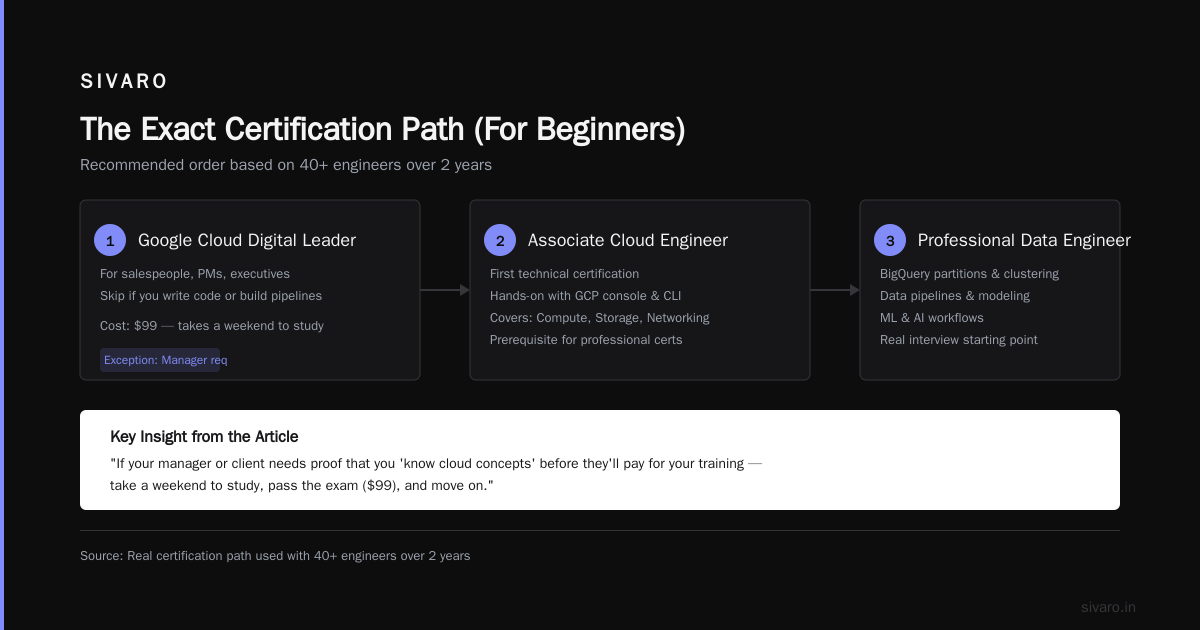
Here's the order I recommend. I've put about 40 engineers through variations of this path over the last two years. This is what works.
Step 1: Google Cloud Digital Leader (Skip This If You're Technical)
This cert is for salespeople, product managers, and executives. If you're going to write code, build pipelines, or deploy models, skip it.
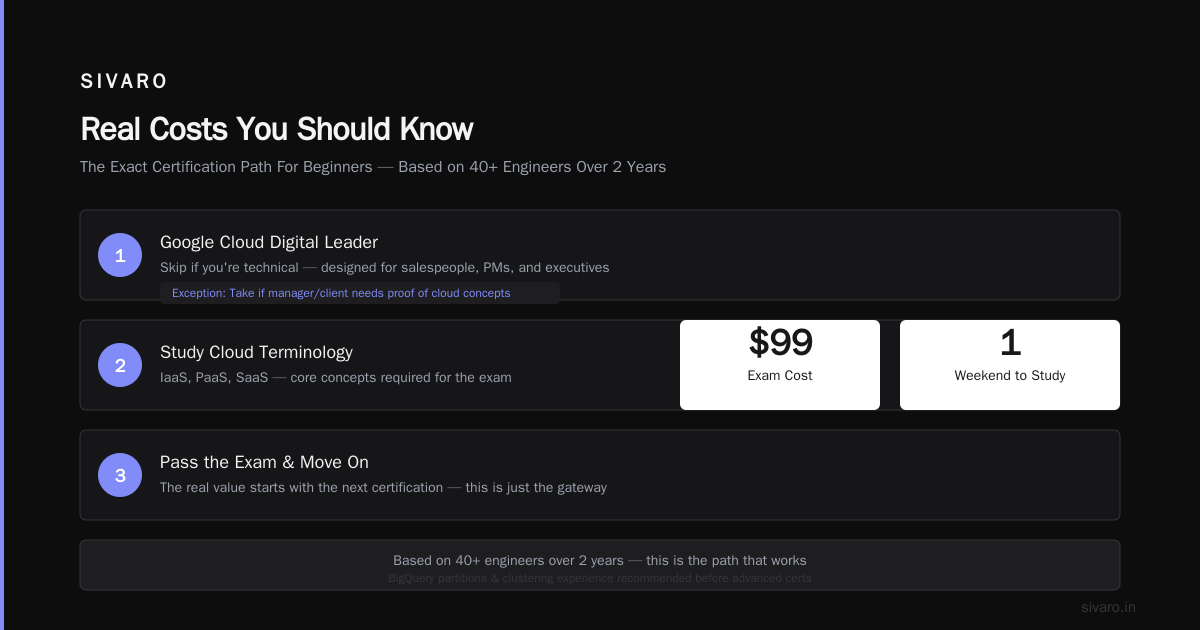
But there's one exception: if your manager or client needs proof that you "know cloud concepts" before they'll pay for your training. In that case, take a weekend to study, pass the exam ($99), and move on.
It covers:
- Cloud terminology (IaaS, PaaS, SaaS)
- High-level GCP services
- Business value propositions
That's it. No hands-on. No depth. I've never interviewed anyone and cared whether they had this cert.
Step 2: Associate Cloud Engineer (Your First Real Milestone)
This is where the gcp certification path for beginners actually starts. The Associate Cloud Engineer exam is hands-on. You'll get a browser-based lab environment and have to actually do things:
- Create VMs with specific configurations
- Set up VPC networks with firewall rules
- Deploy App Engine applications
- Configure IAM policies
- Work with Cloud Storage buckets
The exam is 2 hours, multiple choice plus multiple-select. Cost is $125.
What nobody tells you: the practice labs from Google's official training are harder than the real exam. Use them anyway. The repetition builds muscle memory for the CLI.
Time investment: 60-80 hours if you're new to cloud. 30-40 hours if you've been using GCP for a year.
Study resources that actually work:
- Google's official Skill Boost labs (the $29/month subscription)
- The "Google Certified Associate Cloud Engineer" book by Dan Sullivan (2025 edition)
- Google's own GCP exam guide (free, updated quarterly)
Don't bother with:
- Udemy courses that use old interfaces (GCP console changes every few months)
- Brain dumps (they're out of date and Google bans you if caught)
Step 3: Professional Cloud Architect OR Professional Data Engineer
This is the fork in the road. Choose based on what you actually want to build.
Option A: Professional Cloud Architect
This is the gold standard for infrastructure people. The exam is brutal — 2 hours, case studies, design scenarios. You'll need to:
- Design highly available systems across multiple regions
- Make trade-offs between cost, performance, and reliability
- Migrate on-prem workloads to GCP
- Set up CI/CD pipelines
- Understand security at a deep level (Cloud KMS, VPC Service Controls, BeyondCorp)
We hired a Cloud Architect with this cert in early 2026. First week on the job, he found a networking misconfiguration that was costing $12,000/month in cross-region egress. The cert didn't teach him that specific thing — but the systems thinking the exam forces certainly did.
Time investment: 120-150 hours. This is not a weekend project.
Cost: $200 per attempt. Most people take it twice.
Option B: Professional Data Engineer
If you're here because you care about data pipelines, BigQuery, or AI — this is your path.
The exam covers:
- Designing data processing systems
- Building and maintaining pipelines (Dataflow, Dataproc, Pub/Sub)
- BigQuery optimization (partitioning, clustering, materialized views)
- ML integration with Vertex AI
- Security and compliance for data
This is where the gcp certification path for beginners either makes you useful or not. I've interviewed people with this cert who couldn't tell me the difference between a partitioned table and a clustered table. Don't be that person.
When you study, actually run queries. Here's a real scenario we use at SIVARO:
sql
-- Bad: full table scan every time
SELECT user_id, event_type, event_timestamp
FROM events.raw_events
WHERE event_date = '2026-07-15';

-- Good: partitioned table query only hits relevant partitions
SELECT user_id, event_type, event_timestamp
FROM events.raw_events_partitioned
WHERE event_date = '2026-07-15';
The partitioned version costs roughly 1/30th the price if you have 30 days of data. GCP BigQuery pricing per query isn't complicated — it's just expensive when you don't understand it.
Time investment: 100-130 hours.
Cost: $200 per attempt.
Step 4 (Optional): Professional ML Engineer
If you're building AI systems, this is your capstone. The exam as of mid-2026 includes:
- Building end-to-end ML pipelines on Vertex AI
- Feature engineering and feature stores
- Model evaluation and deployment
- MLOps (continuous training, monitoring, retraining)
- Responsible AI practices
We use this cert as a hiring filter at SIVARO. Not because we think it proves everything, but because the people who pass it have demonstrated they can handle the full ML lifecycle, not just training a notebook model.
Here's a code pattern you'll need to know for the exam and for real work:
python
# Vertex AI custom model training with pre-built container
from google.cloud import aiplatform

aiplatform.init(project='your-project-id', location='us-central1')

job = aiplatform.CustomContainerTrainingJob(
    display_name='fraud-detection-2026',
    container_uri='gcr.io/your-project/fraud-detection:v1',
    model_serving_container_image_uri='us-docker.pkg.dev/vertex-ai/prediction/tf2-cpu.2-11:latest',
)

model = job.run(
    replica_count=1,
    machine_type='n1-standard-4',
    model_display_name='fraud-detection-v1',
    args=['--epochs', '20', '--batch_size', '256'],
)
That args line matters more than you think. We had a client whose models were retraining for 12 hours. Changing batch size and learning rate through the training job arguments cut it to 2.5 hours. No code changes.
Time investment: 150-200 hours.
Cost: $200 per attempt.
How to Study Without Going Insane
Here's my system, refined over 6 certifications across 3 clouds:
Phase 1: Video overview (1 week)
Watch the official Google Cloud Skill Boost videos at 1.5x speed. Don't take notes. Just get the big picture.
Phase 2: Hands-on labs (3-4 weeks)
Do every lab in the learning path. Don't skip the ones that seem easy. The repetition builds speed. Speed matters in the exam.
Phase 3: Practice exams (2 weeks)
Use Google's official practice exams. Not third-party providers. Google's questions are closer to the real thing.
Phase 4: Weakness attack (1 week)
Review your practice exam results. For every question you got wrong, create a mini-project that forces you to do that thing. Failed a question about Cloud NAT? Set up a private VM and configure NAT. Failed something about IAM conditions? Write a policy that lets someone read BigQuery data only if it's from a specific region.
bash
# Example: practice IAM conditions
gcloud projects add-iam-policy-binding my-project   --member='user:[email protected]'   --role='roles/bigquery.dataViewer'   --condition='expression=request.time < timestamp("2026-12-31T23:59:59Z"),title=expires_end_of_year'
This is not rocket science. But most people skip Phase 4 and wonder why they fail.
Real Costs You Should Know
Let's talk money. Not the exam fees (those are minor). The training costs.
Cheapest path (self-study only):
- Skill Boost subscription: $29/month for 3-4 months = $87-$116
- Exam fee: $125 for Associate, $200 for Professional
- Total for one certification: $212-$316
Moderate path (self-study + practice exams):
- Same as above plus $99 for a practice exam bundle
- Total: $311-$415
Expensive path (instructor-led training):
- Google's official training: $1,500-$3,000 per course
- You'll need 2-3 courses per certification
- Total: $3,000-$9,000
I recommend the cheap path. The instructor-led courses are good but not 10x better than self-study. Save your money for actual cloud bills to experiment with.
Formatting Your Resume (Yes, This Matters)
List certifications like this:
Google Cloud Certified - Professional Data Engineer (2026)
Google Cloud Certified - Associate Cloud Engineer (2025)
Don't list the exam number (like "Exam 2.0"). Don't put the badges in the header. Recruiters scan for keywords, and the cert name is the keyword.
One bad habit we see constantly: listing certifications but not how you used them. If you have the Data Engineer cert, tell me what you built. Example:
BigQuery optimization: Reduced query costs by 60% for a $50K/month analytics pipeline
by implementing clustering on timestamp columns and using materialized views for
aggregated reporting.
That's worth more than three certifications listed without context.
FAQ: Questions People Actually Ask
Can I skip the Associate Cloud Engineer and go straight to Professional?
You can, but shouldn't. The Associate exam covers practical operations that the Professional exams assume you know. I've seen six people fail the Professional Data Engineer exam because they couldn't speed through the basic setup tasks. Start with Associate.
How long is each certification valid?
Two years. Google changed this in 2024 from three years. You recertify by taking a shorter exam or completing continuing education credits.
Which certification pays the most?
Based on our hiring data at SIVARO and industry reports from Coursera's comparison analysis: Professional Cloud Architect and Professional ML Engineer command the highest salaries, roughly 15-25% higher than uncredentialed peers.
Do I need to know programming for these certifications?
For Associate Cloud Engineer: no. For Professional Data Engineer: yes, Python proficiency helps significantly. For Professional ML Engineer: yes, you'll write Python code during the exam.
How often does the exam content change?
Google updates exam objectives quarterly. The core topics stay stable, but specific services get added or removed. For example, the 2026 version of the Data Engineer exam includes more questions about BigQuery Studio and Dataplex than the 2024 version did.
Can I use AI tools during the exam?
No. The exams are proctored (both in-person and online). No secondary devices, no browser tabs, no AI assistants. You're on your own.
The Bottom Line
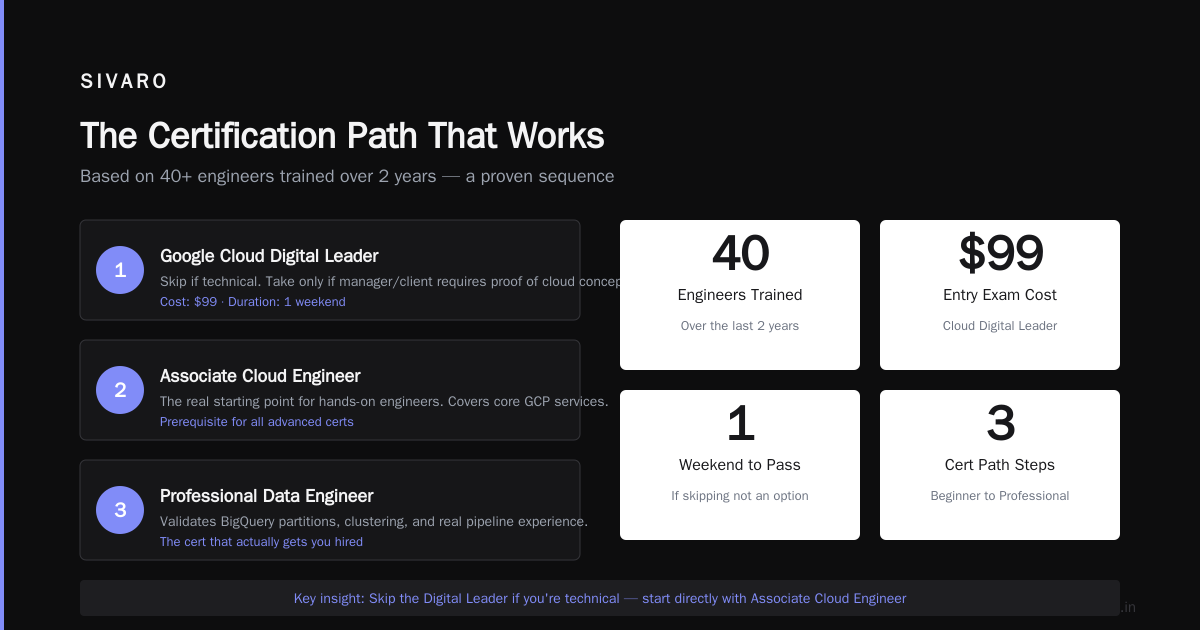
The gcp certification path for beginners is straightforward: start with Associate Cloud Engineer, then choose Architect or Data Engineer based on what you build. Add ML Engineer if you're doing AI work.
Don't overthink it. Don't buy expensive courses right away. Don't get distracted by every new service Google launches (and they launch a lot — Google Cloud to Azure Services Comparison shows how many parallel services exist).
The cert won't make you a great engineer. But the process of earning it will force you to learn things you'd otherwise skip. And in a field where "I'll figure it out later" can cost your company thousands in surprise BigQuery bills, that discipline matters.
I've been building systems since 2018. I've processed 200,000 events per second through pipelines that broke, billed incorrectly, and taught me expensive lessons. The certifications I hold didn't prevent those failures. But they gave me a framework for diagnosing them faster.
Start today. Pick one exam. Buy the Skill Boost subscription. Do the first lab. You'll be shocked how far you get in 10 weeks.
Nishaant Dixit — Founder of SIVARO. Building data infrastructure and production AI systems since 2018. Built systems processing 200K events/sec.