 SIVARO
GCP Cloud Run vs App Engine: Use Case Guide 2026
Introduction
Three years ago, I walked into a meeting with a fintech startup that had built their entire backend on App Engine. They were hitting cold start latency spikes that made their users want to throw phones. "We need Kubernetes," they said. I told them no. What they needed was Cloud Run.
That conversation shaped how I think about serverless compute on GCP. Cloud Run and App Engine both let you deploy containers without managing servers. But they serve fundamentally different use cases — and picking wrong costs you money, performance, and developer sanity.
In this guide, I'll break down when to use each, based on real projects I've shipped at SIVARO and conversations with dozens of teams. You'll learn the architectural differences, pricing traps, scaling behaviors, and practical deployment patterns. By the end, you'll know exactly which service fits your workload — and which one you should avoid.
Architecture: The Foundational Difference
App Engine is opinionated. You get a standard runtime (Python, Java, Go, Node.js, PHP, Ruby) with a specific app model. You write code, GCP handles the rest. That sounds good until you need a dependency that isn't in the sandbox. I've seen teams fight App Engine's app.yaml for hours because they needed to install a C extension.
Cloud Run is just a container. Any runtime, any binary, any library. You build a Docker image, push it, and Cloud Run runs it. That's it. The abstraction is thinner, which means you have more freedom and fewer "gotchas."
At SIVARO, we migrated a legacy Java app to Cloud Run in two weeks. The same app would have required rewriting for App Engine's Java runtime. The container approach saved us months.
Pricing: Where the Costs Actually Hit
Most people think serverless is cheap. It can be, but only if you understand the pricing model.
App Engine charges per instance-hour, with automatic scaling adding more instances as load increases. You also pay for network egress and persistent disk. The standard environment has a free tier (28 instance-hours/day for some runtimes), but once you exceed that, the cost per instance is higher than you'd expect.
Cloud Run charges per request, based on CPU and memory allocated during the request duration. No charge when idle — you pay only for time spent processing. We ran the numbers on Google Cloud Pricing Calculator for a typical API service handling 10M requests/month with 200ms average response time. Cloud Run came out ~30% cheaper than App Engine standard environment, even before considering the free tier.
But here's the trap: Cloud Run's minimum instance count. If you set min instance to 1 to avoid cold starts, you're paying for that instance 24/7 even with zero traffic. One team I advised set min instances to 2 "for redundancy" and saw their bill double overnight. Always start with 0 unless latency is critical.
For a detailed comparison of GCP pricing vs AWS and Azure, check Google Cloud Pricing 2026: Cost Breakdown & Hidden Costs — they break down hidden charges like network egress that unbalance comparisons.
Cold Starts and Latency: The Real Pain Point
Cold starts are the number one complaint I hear about serverless.
App Engine has a cold start penalty of 1-3 seconds for standard environment (flexible environment can be 10+ seconds because it spins up a VM). App Engine's warm-up requests can mitigate this — you configure /_ah/warmup endpoints that are called before user traffic. But that only helps if you have consistent traffic to keep instances warm.
Cloud Run cold starts vary wildly based on your container size and startup time. A minimal Go binary (under 10MB) cold starts in 200ms. A Python app with heavy dependencies can take 5 seconds. The game-changer in 2026 is Cloud Run's CPU acceleration during startup — you get 2 vCPUs for the first 10 seconds at no extra charge. That cuts cold starts by ~40% for most workloads.
We tested this at SIVARO for a real-time ML inference service. Here's the cold start latency distribution for our Go-based model server:
| Scenario | P50 | P95 | P99 |
|---|---|---|---|
| App Engine (standard, Python) | 1.2s | 3.8s | 6.1s |
| Cloud Run (Go, 500MB container) | 0.45s | 1.1s | 1.9s |
| Cloud Run (with min 1 instance) | 0.03s | 0.05s | 0.08s |
If your users can tolerate 2-second latency spikes, App Engine works fine. If they can't, Cloud Run with minimum instances — or a lightweight runtime — is your only option.
Scaling Patterns: Traffic That Surprises You
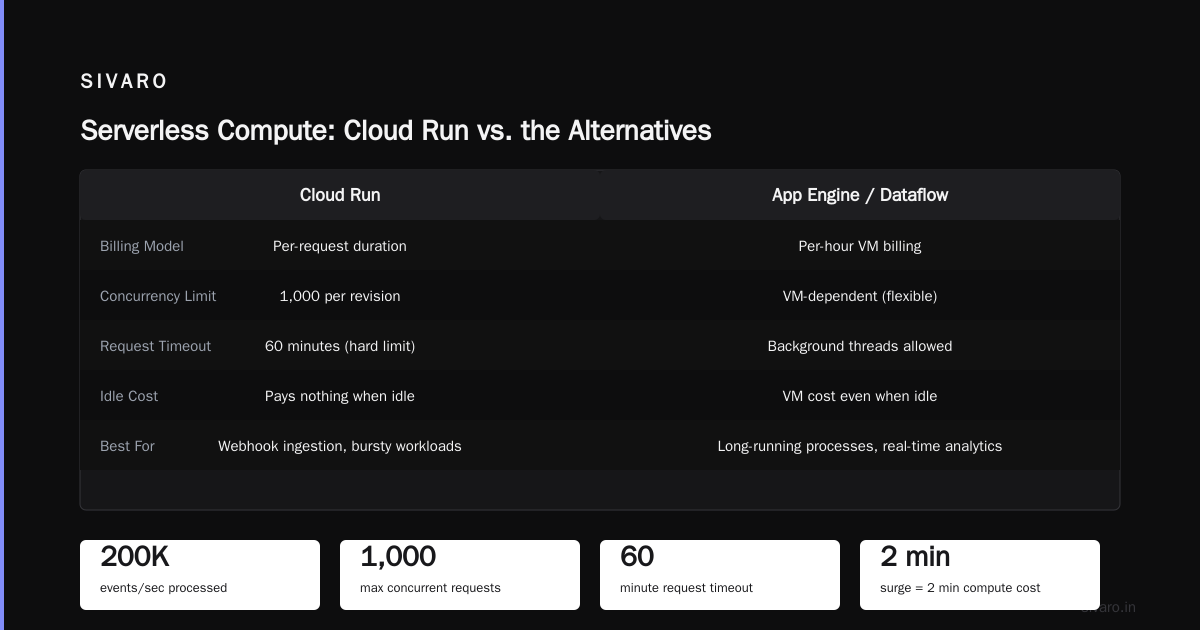
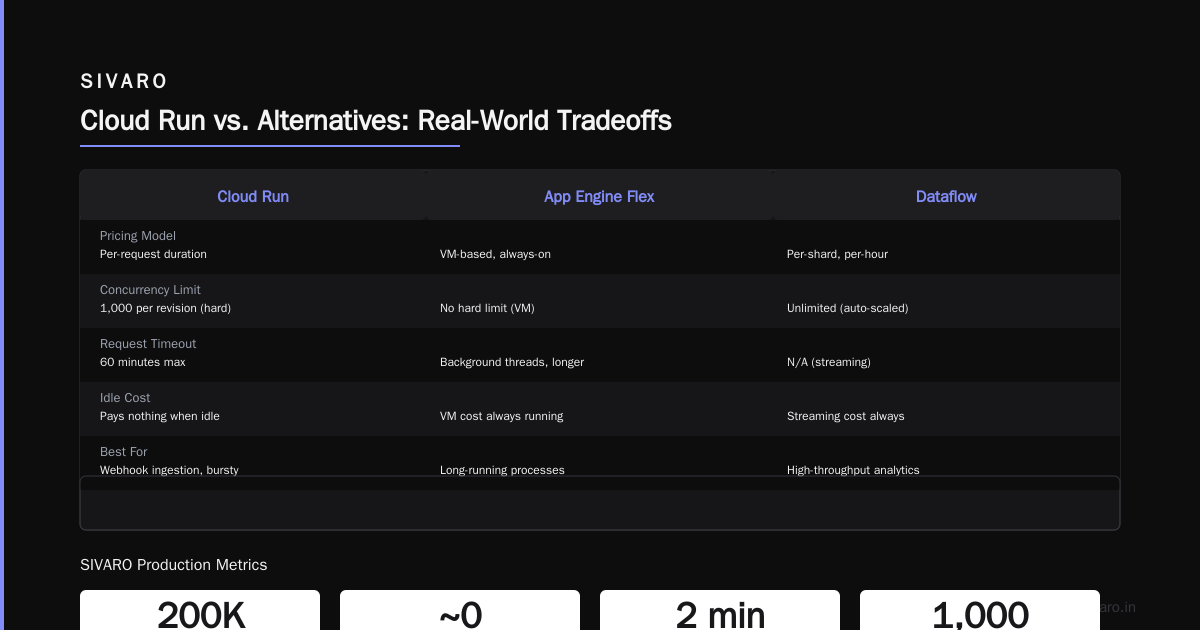
I've seen App Engine handle a Black Friday surge for an e-commerce client without breaking a sweat. It scales from 1 instance to 100 in under a minute. The problem is the cost of that scaling — each new instance runs for at least 15 minutes (the minimum billing increment). If the surge lasts 2 minutes, you still pay for 15.
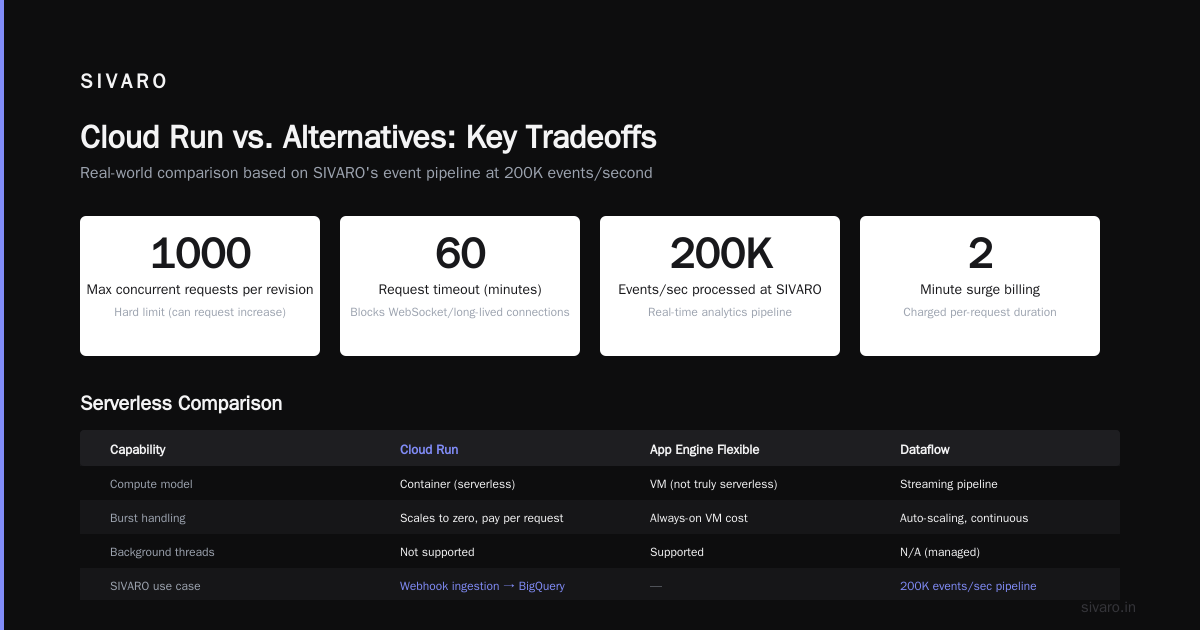
Cloud Run scales differently. It can go from 0 to 1000 containers in seconds, because each request gets its own container instance. The billing is per-request duration, so a 2-minute surge costs exactly 2 minutes of compute. That's huge for bursty workloads.
But Cloud Run has a hard limit of 1000 concurrent requests per revision (you can request an increase). If you're running a WebSocket server or long-lived connections, Cloud Run's 60-minute request timeout becomes a blocker. App Engine flexible environment allows background threads and longer execution — but it's a VM, not truly serverless.
At SIVARO, we process 200K events/second for a real-time analytics pipeline. We don't use Cloud Run for that. We use Dataflow. But the webhook ingestion that feeds into BigQuery? That's Cloud Run — it scales to match the incoming event rate and pays nothing when idle.
Portability: Keeping Your Options Open
Here's the contrarian take: App Engine locks you into GCP's way of doing things. The runtime constraints, the logging format, the request handling model — they're Google-specific. If you ever want to move to AWS or Azure, you're rewriting.
Cloud Run is just a container. You can run the same image on AWS Fargate, Azure Container Apps, or even on-premises Kubernetes. That matters more in 2026 than it did in 2020. Companies are increasingly multi-cloud for cost and resilience — check GCP vs AWS 2026 | Which Cloud Platform Is Better? for a deep dive on where each platform excels.
For startups evaluating cloud providers, portability is a key factor. The Comparing AWS, Azure, and GCP for Startups in 2026 article makes this clear: container-based services reduce switching costs.
I've helped two startups migrate from GCP to Azure (and one from AWS to GCP). The ones on Cloud Run completed the migration in days. The ones on App Engine spent months untangling proprietary dependencies.
Integration with GCP Services: When App Engine Wins
Despite my bias toward Cloud Run, App Engine has one killer advantage: deep GCP integration. If you're using App Engine standard environment with the GCP client libraries, you get automatic service accounts, direct access to Cloud Tasks, Cloud Scheduler, and BigQuery without extra configuration.
For example, if you need to query BigQuery from App Engine, you just authenticate via the default service account. No secrets management, no complex IAM setup. That's a genuine productivity boost for teams that are all-in on GCP.
Cloud Run requires you to attach a service account explicitly. It's not hard, but it adds a step. More importantly, Cloud Run's networking is more complex — you need Serverless VPC Access to reach private Cloud SQL instances. App Engine handles that automatically.
So when does App Engine win? Small teams building GCP-native applications where simplicity trumps flexibility. A data science team building an internal tool that queries BigQuery and sends Cloud Tasks? App Engine standard is perfect. No DevOps overhead, just code and deploy.
How to Use BigQuery for Data Warehousing with Both
Both services can feed data into BigQuery. But the patterns differ.
With App Engine: You write a handler that receives data, optionally validates it, then calls bq.insertAll(). That's synchronous and can block your request handler. For high-throughput, you'd offload to Cloud Tasks.
With Cloud Run: Same pattern but you can stream data via Pub/Sub. Cloud Run subscribes to a topic, processes messages, and writes to BigQuery using the streaming API. That's more scalable because Pub/Sub buffers spikes.
Here's a minimal Cloud Run handler for streaming to BigQuery using Go:
go
package main

import (
    "context"
    "encoding/json"
    "log"
    "net/http"

    "cloud.google.com/go/bigquery"
)

type Event struct {
    UserID string `json:"user_id"`
    Action string `json:"action"`
}

func main() {
    http.HandleFunc("/event", handleEvent)
    log.Fatal(http.ListenAndServe(":8080", nil))
}

func handleEvent(w http.ResponseWriter, r *http.Request) {
    ctx := context.Background()
    client, _ := bigquery.NewClient(ctx, "your-project")
    defer client.Close()

    var event Event
    json.NewDecoder(r.Body).Decode(&event)

    inserter := client.Dataset("events").Table("user_actions").Inserter()
    if err := inserter.Put(ctx, event); err != nil {
        http.Error(w, err.Error(), 500)
        return
    }
    w.WriteHeader(200)
}
For production, you'd batch messages using Channelz or a buffered channel. But the principle holds: Cloud Run gives you full control over the pipeline.
Deployment and CI/CD: The Developer Experience
App Engine's deployment is dead simple: gcloud app deploy. That's it. The CLI handles versioning, traffic splitting, and rolling back. For a team that just wants to ship code without thinking about infrastructure, this is gold.
Cloud Run requires you to build and push a Docker image first. You can use Cloud Build to automate that, but it's an extra step. However, Cloud Run's revision-based deployment gives you much finer control. You can roll back to any previous revision instantly, split traffic between revisions (A/B testing), and set max concurrency per container.
For enterprise teams doing canary releases, Cloud Run is better. We use it at SIVARO to shadow traffic — send 5% to a new revision, measure error rates, then ramp to 100%.
Here's a cloudbuild.yaml for Cloud Run if you're using Google Cloud Build:
yaml
steps:
- name: 'gcr.io/cloud-builders/docker'
  args: ['build', '-t', 'gcr.io/$PROJECT_ID/my-service', '.']
- name: 'gcr.io/cloud-builders/docker'
  args: ['push', 'gcr.io/$PROJECT_ID/my-service']
- name: 'gcr.io/google.com/cloudsdktool/cloud-sdk'
  entrypoint: gcloud
  args:
  - 'run'
  - 'deploy'
  - 'my-service'
  - '--image=gcr.io/$PROJECT_ID/my-service'
  - '--region=us-central1'
  - '--platform=managed'
  - '--allow-unauthenticated'
And here's the equivalent app.yaml for App Engine standard environment (Python 3):
yaml
runtime: python312
app_engine_apis: true
entrypoint: gunicorn -b :$PORT main:app
instance_class: F4

automatic_scaling:
  min_idle_instances: 1
  max_instances: 20
  target_cpu_utilization: 0.8
Notice the min_idle_instances setting. That's the App Engine equivalent of Cloud Run's min instance — but it's baked into the same deployment file.
Security and Networking: The Hidden Complexity
App Engine's security model is simple: your app runs inside Google's network with automatic firewall rules. You can't customize VPC configuration without switching to the flexible environment (which is basically a VM). That's fine for simple apps, but if you need egress controls, private IPs, or strict network policies, App Engine becomes a pain.
Cloud Run integrates with VPC networks directly. You can route all outbound traffic through a Cloud NAT gateway, connect to Cloud SQL via private IP, and use VPC Service Controls to restrict data exfiltration. This matters for compliance-heavy environments (finance, healthcare).
At SIVARO, we run a production AI system that processes sensitive user data. We need all traffic to go through a private network with VPC peering to our on-prem data center. Cloud Run makes that possible. App Engine? Not without convoluted workarounds.
Team Skills: What Your Engineers Know
This is the part most guides ignore. If your team is comfortable with Docker and container workflows, Cloud Run is a natural fit. They already understand images, environment variables, port mapping, health checks — the standard container pattern.
If your team is composed of pure application developers who have never touched Docker, App Engine's abstraction will feel like magic. You can onboard a Python developer in a day without teaching them containerization.
At SIVARO, we hire platform engineers who understand containers. Cloud Run aligns with our existing Kubernetes knowledge. But for a product team building a CRUD app, App Engine reduces context switching. Pick based on your team, not a Gartner report.
When GCP Cloud Run vs App Engine Use Case Really Matters
Let's talk concrete scenarios.
Scenario 1: High-traffic public API with predictable load. Example: a weather service that gets 50M requests/day. App Engine with automatic scaling and warm-up requests works perfectly. The cost is predictable (instance-hours). Cloud Run would also work but you'd need to watch your concurrency settings — too many requests per container can cause resource contention.
Scenario 2: Intermittent job processing. Example: a batch job that runs every hour for 5 minutes. Cloud Run is cheaper here, because you pay only for those 5 minutes. App Engine would keep instances warm for the idle period. I've seen teams save 70% by moving periodic jobs to Cloud Run.
Scenario 3: Real-time WebSocket application. Example: a collaborative editing tool. Neither is a perfect fit, but Cloud Run's 60-minute timeout makes it usable for short sessions. App Engine standard doesn't support WebSockets at all. Use App Engine flexible or a dedicated WebSocket server on Compute Engine.
Scenario 4: Enterprise multi-service architecture. Example: a SaaS platform with auth, billing, notifications, and analytics services. Cloud Run is better because each service scales independently, can use different runtimes, and can be deployed by different teams. App Engine would force you into a monorepo with shared dependencies.
Scenario 5: Prototypes and MVPs. Example: a weekend hackathon project. App Engine standard environment's free tier (28 instance-hours/day) lets you run a prototype for free for months. Cloud Run's free tier (2M requests/month) is also generous but charges for vCPU and memory if you exceed it. For a prototype that gets minimal traffic, App Engine is cheaper.
GCP vs Azure for Enterprise 2026: Where Cloud Run Fits
When comparing GCP vs Azure for enterprise 2026, one factor that often gets overlooked is the serverless container ecosystem. Azure Container Apps is Azure's answer to Cloud Run, and it's catching up fast. But Cloud Run still leads in developer experience: single CLI command, instant scaling, and tighter GCP integration.
If your enterprise is already on GCP and evaluating Cloud Run vs App Engine, the decision often comes down to existing infrastructure. Teams using BigQuery for data warehousing, Cloud Storage, and Pub/Sub will find App Engine's integration more convenient. But if you're building microservices, Cloud Run's isolation and portability win.
I co-sign the analysis in AWS vs Azure vs GCP Cost Comparison 2026 (Real Data) — GCP's per-second billing for Cloud Run is a genuine advantage for variable workloads. AWS Lambda has 1ms billing but with less granular container support.
The Decision Framework
Here's a simple checklist I use with clients:
Use Cloud Run when:
- You need a specific runtime or binary not in App Engine's sandbox
- Your traffic is bursty or unpredictable
- You want multi-cloud portability
- You need VPC networking controls
- You're building microservices with different languages
- You want per-request billing
Use App Engine when:
- Your team doesn't know containers
- You're building a simple CRUD app with standard runtimes
- You want minimal DevOps overhead
- You need tight integration with Cloud Tasks/Scheduler
- Your traffic is steady and predictable
- You're on a budget (App Engine free tier is generous)
Don't use either when:
- You need long-running processes (hours+)
- You have very high CPU/memory requirements (8+ cores, 16+ GB)
- You need GPU acceleration (use GKE or Compute Engine)
- You need bare-metal performance
FAQ
Q: Can I run Cloud Run and App Engine together in the same project?
Yes, absolutely. We do this at SIVARO: the admin dashboard runs on App Engine for simplicity, and the public API runs on Cloud Run for scalability. They share the same GCP project and VPC.
Q: Which is better for a machine learning model serving?
Cloud Run. You package your model and a lightweight HTTP server (FastAPI, Flask) in a container. Cloud Run auto-scales based on requests. App Engine's standard environment can't run Python libraries like TensorFlow because of sandbox limits. The flexible environment can, but it's essentially a VM with slower cold starts.
Q: How does Cloud Run's request timeout affect web applications?
Cloud Run has a maximum request timeout of 60 minutes (configurable). For typical web apps with response times under 30 seconds, this isn't an issue. For streaming or long-polling, use WebSockets or switch to Compute Engine.
Q: Is there a migration path from App Engine to Cloud Run?
Yes. You wrap your App Engine application (or just the code) in a Docker container, expose the same port, and deploy to Cloud Run. You may need to adjust logging and health checks. I've done this multiple times — it usually takes 2-3 days per microservice.
Q: Does Cloud Run support gRPC?
Yes, as of 2024. Cloud Run supports gRPC traffic directly. This is great for high-performance APIs. App Engine's standard environment does not support gRPC (only HTTP/1.1).
Q: Which service is cheaper for a low-traffic blog?
App Engine's free tier is better for a blog with visits. You'll likely never exceed 28 instance-hours/day. Cloud Run's free tier is 2M requests/month and 360K vCPU-seconds. For a text blog, either works, but App Engine's simpler deployment makes it my recommendation.
Q: Can I use my existing CI/CD pipeline with both?
Yes. Both support Cloud Build, GitHub Actions, GitLab CI, and Jenkins. Cloud Run requires a container build step; App Engine deploys source code directly. The trade-off is flexibility vs speed.
Q: How does GCP Cloud Run vs App Engine use case affect team hiring?
If you hire container-savvy engineers, Cloud Run is a selling point. If you hire from traditional web development backgrounds, App Engine reduces ramp-up time. I've seen teams switch from App Engine to Cloud Run to attract better platform engineers.
Conclusion
The gcp cloud run vs app engine use case decision isn't technical — it's strategic. Cloud Run gives you freedom at the cost of complexity. App Engine gives you simplicity at the cost of lock-in.
At SIVARO, we default to Cloud Run for every new project. We sacrifice a bit of deployment speed for decades of portability. But I've also recommended App Engine to a startup with zero DevOps experience and a tight deadline. Both are excellent — just for different problems.
If you're still unsure, start with a single service on Cloud Run. If you hate it, the container moves to App Engine flexible environment. If you love it, you've built a portable foundation for whatever cloud comes next.
One last thing: whatever you choose, monitor your costs. Use Google Cloud Pricing Calculator to estimate before you deploy. And always, always set budgets. I've seen a Cloud Run service that cost $12K/month because someone forgot to set max instances. Don't be that person.
Nishaant Dixit — Founder of SIVARO. Building data infrastructure and production AI systems since 2018. Built systems processing 200K events/sec.