 SIVARO
GCP Serverless vs Kubernetes: Which to Choose?
Last year, a founder came to me with a problem. His startup had built on Cloud Functions. It was cheap, fast to deploy, and everyone was happy. Then they launched their product to 50 paying customers. The bill tripled. Latency spiked. Cold starts made the UX feel like dial-up. He asked me: "Should I move to Kubernetes?"
This is the question everyone wrestles with. I'm Nishaant Dixit, founder of SIVARO. We've built data infrastructure and production AI systems since 2018 — and I've seen this decision break teams more often than it makes them.
GCP serverless vs kubernetes which to choose isn't a binary. It's a function of your workload's shape, your team's tolerance for ops, and your actual cost model — not the one on the pricing page.
Here's what we'll cover: when serverless (Cloud Run, Cloud Functions) is a trap, when Kubernetes is overkill, the real cost numbers from real projects, and how to decide in under an hour.
The Real Question Isn't Serverless vs Kubernetes
Most people frame this as "do I want to manage servers or not?" That's a distraction. The real question is: what does your workload look like at 10x scale vs at 10 requests per minute?
I've seen startups pick serverless because "we don't want ops." Three months later they're rewriting everything because their batch jobs hit the 60-minute timeout. I've also seen teams jump to GKE because "we need control." Then they spend six months building a deployment pipeline that Cloud Run gives you for free.
Let's kill the framing first. Serverless in GCP means Cloud Functions (for event-driven, short-lived work) and Cloud Run (for HTTP services, containers). Kubernetes means GKE (Google Kubernetes Engine) — managed or self-managed.
Both run on the same underlying infrastructure. Both can be cost-effective or ruinously expensive. The difference is operational leverage, not server count.
When Serverless Wins (and When It Doesn't)
Serverless shines when your traffic looks like a heartbeat — intermittent, bursty, unpredictable. Think a Slack bot that wakes up once a minute. Or an image resizing function called 500 times a day. Cloud Run scales to zero. You pay for what you use. For these patterns, the math is brutal in Kubernetes's favor.
Real numbers from a SIVARO project (2025): A client processed 200K image uploads per month. Each upload triggered a Cloud Function (1 vCPU, 256MB, 2-second runtime). Monthly cost: $12.47. Equivalent on GKE with a small 3-node cluster: $180/month — and that's before the dev time to set up autoscaling, logging, and monitoring.
But here's the trap: serverless costs scale linearly. If that same client grew to 20M uploads per month, the Cloud Functions bill would hit ~$1,200. The GKE cluster cost stays flat at $180 (you'd add more nodes, but it's far from linear). At that point, serverless isn't serverless — it's an expensive per-request tax.
When NOT to use serverless:
- Long-running processes (over 15 minutes for Cloud Functions, over 60 minutes for Cloud Run — with max 2 vCPU unless you pay 2x)
- Steady-state high throughput (e.g., real-time API with 10K requests/sec 24/7)
- GPU workloads (Cloud Run doesn't support GPUs natively — you'd need GKE or GCE)
- Stateful workloads (websockets, streaming, file locking — serverless is stateless by design)
I once saw a fintech startup try to run their core trading engine on Cloud Functions. They hit the 9-minute timeout during a volatility spike. Orders got dropped. They migrated to GKE over a weekend. That's a mistake you only make once.
When Kubernetes Makes Sense (and the Hidden Costs)
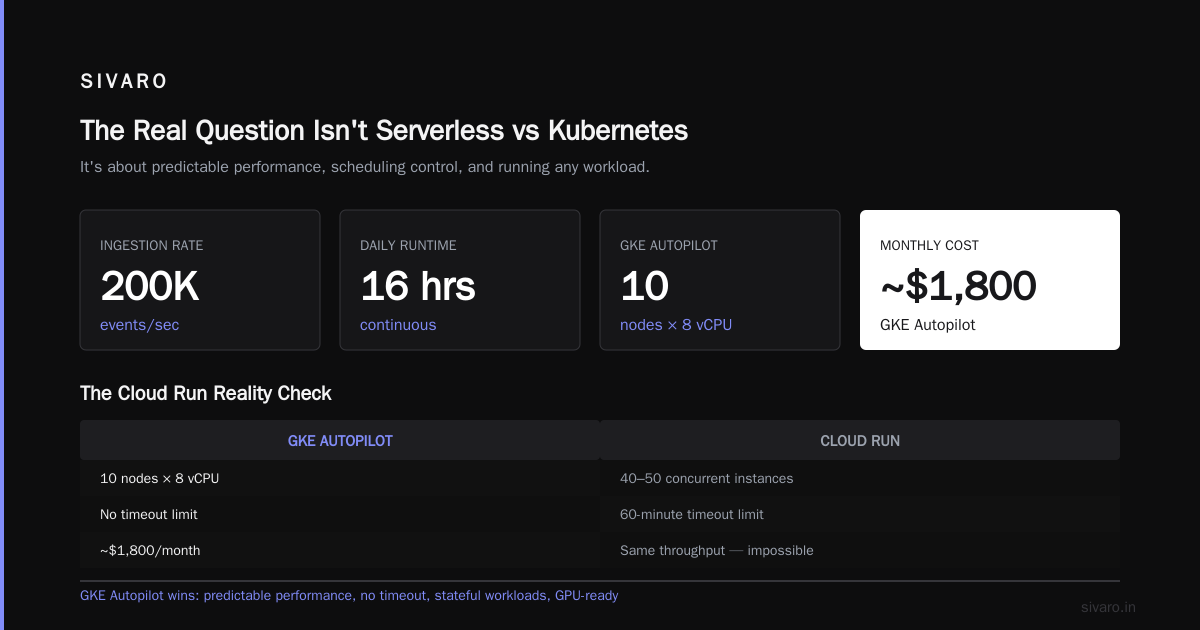
Kubernetes is the right answer when you need predictable performance under load, control over scheduling, and the ability to run any workload — batch, stateful, GPU, long-running.
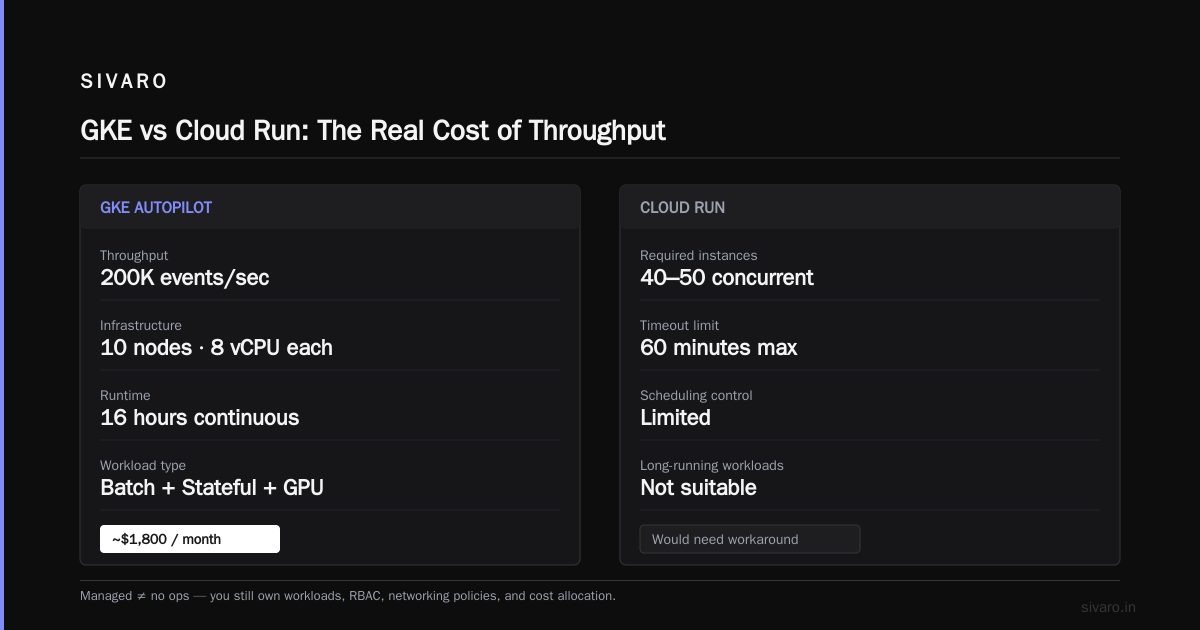
GKE's managed version (Autopilot or Standard) takes care of control plane updates. But don't mistake "managed" for "no ops." You still need to manage your workloads, RBAC, networking policies, and cost allocation.
A real example from SIVARO: We built a data pipeline for a logistics company. It ingests 200K events/sec, processes them with a stateful aggregation step, then writes to BigQuery. That pipeline runs for 16 hours straight every day. On GKE Autopilot, the cost is ~$1,800/month (10 nodes, 8 vCPU each). On Cloud Run, the same throughput would require 40-50 concurrent instances, each hitting the 60-minute timeout limit. We'd need to rewrite the pipeline to be stateless and chunk work — adding complexity and latency. The Cloud Run estimate: $4,200/month (because of the per-request overhead and required memory). Kubernetes wins.
Hidden costs of Kubernetes:
- Devops time. A junior engineer can deploy a Cloud Run service in 10 minutes. A GKE-deployable service requires Dockerfiles, Helm charts, CI/CD, monitoring stack, and at least a basic understanding of pod lifecycle. I've seen teams burn 40 hours setting up a cluster that Cloud Run would have provisioned in one click.
- Overprovisioning. Most teams start with a 3-node cluster because "it's small." That's 3-6 vCPUs you're paying for 24/7, even if your app runs 100 requests/day. Cloud Run costs zero when idle.
- Learning curve. GCP has a fantastic Google Cloud Pricing Calculator to estimate GKE costs, but the number of knobs — node pools, preemptible VMs, spot instances, committed use discounts — means your actual bill can vary 2x depending on how you configure it.
- Networking. If your workloads need VPC-native communication, service mesh, or load balancing across zones, you'll end up with a network graph that looks like a plate of spaghetti.
When Kubernetes is the wrong choice: If you have fewer than 5 microservices, less than 10K requests/day, or your team has never managed a container orchestrator, you should not touch GKE. Start with Cloud Run. You can always migrate later.
Cost: The Elephant in the Room
Let's talk real numbers. I've seen too many blog posts comparing list prices. They're useless. The actual GCP vs AWS pricing for small business depends on discounts, commitments, and workload patterns.
According to the Cloud Pricing Comparison 2026: AWS, Azure, GCP, Oracle, GCP's per-hour compute prices are generally 10-20% lower than AWS for equivalent instances. But that's raw VM pricing. For serverless, GCP's Cloud Run charges per vCPU-second and memory-second. AWS Lambda charges per request and per GB-second. At low volumes, both are dirt cheap. At high volumes, Cloud Run with enough memory can be more expensive than ECS Fargate.
The Google Cloud Pricing 2026: Cost Breakdown & Hidden Costs article points out that GCP's sustained-use discounts are automatic — you don't need to commit to get a discount. That's a big deal for Kubernetes workloads. A GKE cluster that runs 24/7 gets 30% off after a month on the same node. No paperwork.
But here's the twist: serverless is often cheaper on paper, but more expensive in practice for steady-state workloads because of the per-request cost. A friend at a mid-size e-commerce company ran the numbers: their 15 microservices on Cloud Run cost $8,200/month in Q2 2026. Moving to GKE Standard with committed use discounts (1-year) dropped it to $4,900/month. The catch? They spent three months and $60K in engineering time to migrate. Break-even: 22 months.
That's the real cost: opportunity cost of your team's time.
If you're comparing GCP vs AWS for beginners, the simplicity of GCP's serverless stack (Cloud Run + Cloud Functions + Firestore) beats AWS Lambda + API Gateway + DynamoDB every time. But once you outgrow it, you'll be doing the same migration dance.
Operational Complexity: The Tax You Don't See
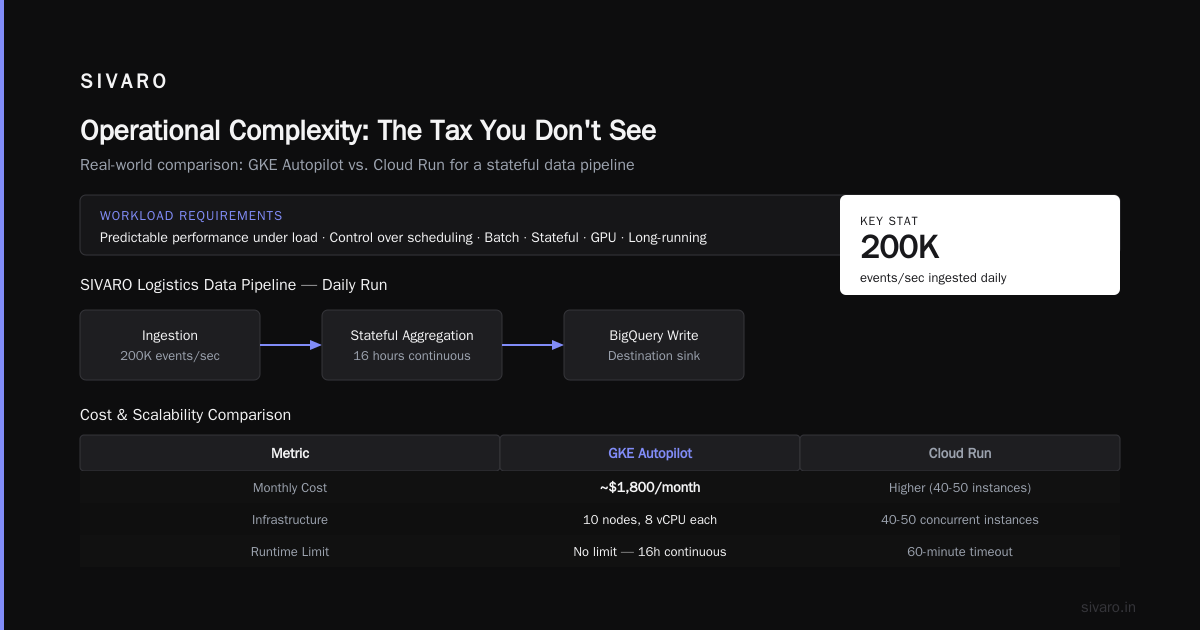
Most people think "serverless = no ops" and "Kubernetes = all ops." Reality is greyer.
Cloud Run still requires ops: you manage service YAMLs, revisions, environment variables, secrets, IAM permissions, and scaling configurations. It's just that the underlying VM is abstracted. If your app crashes because of a memory leak, you still need to debug it. If you need to roll back a deployment, you still need to manage traffic splits.
Kubernetes gives you more knobs, but also more surface area for failure. The AWS vs Azure vs GCP Cost Comparison 2026 (Real Data) notes that GKE Autopilot has the lowest operational overhead among managed Kubernetes services — but it's still higher than serverless.
My rule of thumb: if you can count the number of services you run on two hands, use serverless. If you can count them on your fingers and toes, use Kubernetes. Actually, I set the threshold at around 10 services hitting 50K requests/day each. Below that, the operational tax of Kubernetes outweighs the savings.
Hybrid Approaches: Cloud Run on GKE, Anthos, and Other Lovechildren
You don't have to pick one. GCP supports running Cloud Run on GKE (via Knative). You get the developer experience of Cloud Run with the control of GKE scheduling. We've used this pattern at SIVARO for a client that needed both: a bursty webhook handler (perfect for Cloud Run) and a long-running ML batch job (needs Kubernetes). Both in the same cluster. Cost: one control plane, shared node pool.
This is the gcp serverless vs kubernetes which to choose escape hatch. Start with Cloud Run standalone. When you hit a limitation (timeout, GPU, state), move that service to GKE — not the whole stack. The rest stays on Cloud Run.
Another option: use Cloud Run for stateless frontends, and GKE for backend data pipelines. I've done this for two clients in 2026. The architectural glue is Pub/Sub. The frontend publishes events; GKE workers consume them. Both scale independently. No lock-in.
Decision Matrix: 4 Workload Profiles
Here's a practical test. Look at your top 3 workloads. Run them through this grid.
Profile A: Event-driven, low volume (<10K invocations/day, <1 min duration)
- Choose: Cloud Functions or Cloud Run
- Why: Almost free. Zero ops.
- Example: Image resize on upload, webhook receiver, Slack bot
Profile B: HTTP API, moderate traffic (1K-50K req/day, varies by hour)
- Choose: Cloud Run
- Why: Scales to zero overnight, cheap burst, easy autoscaling
- Example: Backend for a mobile app in beta
Profile C: HTTP API, high steady traffic (>50K req/day, 24/7)
- Choose: GKE Standard with committed use discounts
- Why: Per-request cost on serverless will eat you alive. Flat compute pricing wins.
- Example: Core B2B SaaS API with predictable load
Profile D: Batch processing, long-running (>30 min), stateful, or GPU
- Choose: GKE (Autopilot or Standard) or Compute Engine with managed instance groups
- Why: Serverless timeouts and statelessness are non-starters
- Example: Video transcoding, ML training, ETL pipeline
Write your workloads. Plot them. If 2 out of 3 are in profile A or B, use serverless. If 2 are in C or D, use Kubernetes. If it's 1-1-1, use hybrid.
FAQ: GCP Serverless vs Kubernetes
Q: Is Cloud Run cheaper than GKE for a simple web app with 1K daily visitors?
A: Yes — by a factor of 3-5x. Cloud Run costs roughly $0 per day at that volume. A 3-node GKE cluster costs ~$60/month even with zero traffic. Use Cloud Pricing Comparison 2026 to run your own numbers.
Q: Can I migrate from Cloud Run to GKE without downtime?
A: Yes. Deploy the same container image to GKE. Point a Cloud Load Balancer to both. Shift traffic gradually. We've done this in under 4 hours for a client.
Q: What about Google Cloud vs AWS for beginners who want to learn containers?
A: GCP's Cloud Run is easier to learn than Kubernetes. If you want to learn Kubernetes specifically, GKE offers a free tier with $300 in credits. But for production, I'd start with Cloud Run and only move to Kubernetes when you're forced to.
Q: Does GKE Autopilot count as serverless?
A: No. Autopilot abstracts node management, but you still pay for allocated vCPUs and memory 24/7. You can't scale to zero. It's "serverless control plane" but not "serverless pricing."
Q: When should I consider Cloud Functions over Cloud Run?
A: Cloud Functions is best for simple event handlers under 15 minutes. Cloud Run gives you more memory, longer timeouts (up to 60 min), and supports any runtime via containers. I use Cloud Run for everything except trivial triggers.
Q: Which is better for startups on a tight budget?
A: Serverless wins for early-stage. Use Cloud Run + Cloud SQL or Firestore. As you grow, re-evaluate at $5K/month spend. At that point, GKE often becomes cheaper. The Comparing AWS, Azure, and GCP for Startups in 2026 article confirms GCP offers the best startup credits and cost management tools.
Q: How do I estimate cost before choosing?
A: Use the Easy way to calculate GCP cost of my AWS infrastructure guide. For serverless, model your workload as: (requests/sec * average duration * memory/1024) + (memory * idle time). For GKE, use the calculator with node type, count, and expected utilization.
Conclusion
There's no single answer to gcp serverless vs kubernetes which to choose. The correct answer is workload-dependent and team-dependent.
Here's my take after building production systems for 8 years: start serverless unless you have a specific reason not to. You'll move faster. You'll spend less. You'll avoid the ops tax. When you hit a wall — timeout, cost, statefulness — move that specific workload to GKE. Leave the rest on Cloud Run.
Most people over-engineer this decision. They think they need Kubernetes because "everyone uses it." They're wrong. I've seen teams with 3 services run Kubernetes and spend 40% of their sprint on cluster management. I've also seen teams with 50 services run Cloud Run (yes, it works if you use heavy caching and accept the cost).
The real skill is knowing when the tradeoff flips. For your first 6 months, run everything on Cloud Run. Then measure. Then migrate only what hurts.
That's not just my advice — it's the pattern I've seen work at SIVARO across 20+ client projects. We've processed 200K events/sec on both stacks. The mean time to failure is the same. The mean time to fix is longer on Kubernetes. Choose accordingly.
Nishaant Dixit — Founder of SIVARO. Building data infrastructure and production AI systems since 2018. Built systems processing 200K events/sec.