 SIVARO
GCP Use Cases for Enterprise: A Practitioner's Guide
Two years ago, a logistics company came to us bleeding money on AWS Redshift. They were paying $18,000 per month just for storage and compute on their data warehouse. We moved them to BigQuery. Their bill dropped to $6,200 — and their queries ran 3x faster. That moment crystallized something: most enterprises leave serious money on the table by sticking with "safe" cloud choices.
Google Cloud Platform (GCP) isn't just another cloud. It's purpose-built for data and AI. And in 2026, with AI spending projected to hit hundreds of billions, the question isn't if you should use GCP — it's where it makes the most sense.
In this guide, I'll walk you through the real enterprise use cases I've seen work (and fail). You'll learn how to evaluate GCP cost vs competitors, how to migrate without losing your mind, and exactly where GCP beats AWS and Azure today. I'm not selling anything — I run a product engineering shop called SIVARO, and we work across clouds. But after building systems that process 200,000 events per second, I have strong opinions.
Why Enterprises Are Moving to GCP in 2026
The cloud pricing war is real. Google Cloud Pricing vs AWS: A Fair Comparison? breaks down the numbers: for compute-heavy workloads, GCP's sustained-use discounts can save 20-30% vs AWS's reserved instances, without the upfront commitment. Cloud Computing Cost: AWS vs. Azure vs. GCP Pricing in 2026 shows GCP often wins for data-intensive workloads because you're not paying for idle clusters.
But pricing alone isn't driving the shift. It's the architecture.
GCP is built on the same infrastructure that powers Google Search, YouTube, and Gemini. That means global fiber network, advanced ML accelerators (TPUs), and a data stack (BigQuery, Pub/Sub, Dataflow) that's deeply integrated. Enterprises running large-scale analytics, real-time streaming, or production AI find GCP naturally superior.
Let's look at three specific use cases.
GCP BigQuery: Not Just Data Warehousing
Most people think BigQuery is a data warehouse. It's not — it's a serverless analytics engine that happens to store data. The difference matters.
In 2026, [GCP BigQuery cost per query 2026] varies wildly based on how you use it. A poorly optimized query scanning 10 TB might cost $50. A well-optimized one scanning 100 GB costs 50 cents. Smart companies are using clustering, partitioning, and materialized views to slash costs.
Here's a common pattern we use at SIVARO for cost control:
sql
-- Partition by date, cluster by customer_id
CREATE TABLE my_dataset.sales
PARTITION BY DATE(transaction_date)
CLUSTER BY customer_id
OPTIONS(
  require_partition_filter = true
);
That require_partition_filter flag alone stops analysts from accidentally scanning years of data. I've seen $30,000 monthly bills drop to $4,000 just by adding that.
But BigQuery's real power for enterprises is its integration with AI. You can run ML models directly in SQL using CREATE MODEL.
sql
CREATE MODEL my_dataset.sales_forecast
OPTIONS(model_type='linear_reg') AS
SELECT
  transaction_date,
  sales_amount,
  customer_count
FROM `my_dataset.sales`
No separate ML infrastructure. No export/import pain. For enterprises that already have data in BigQuery, this is a game-changer.
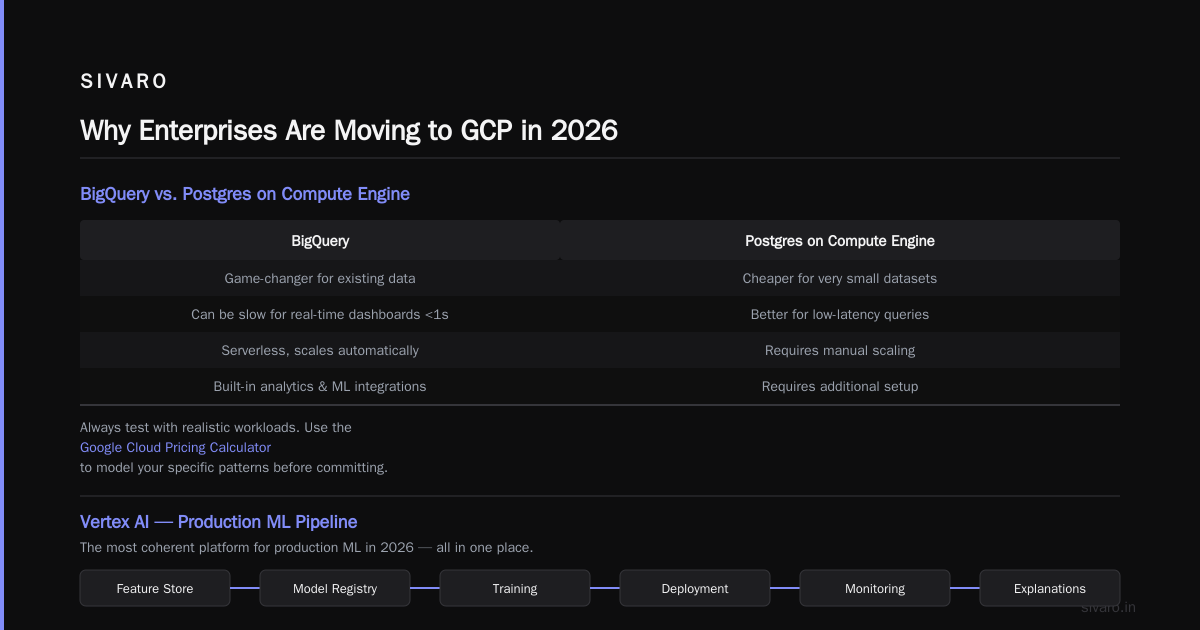
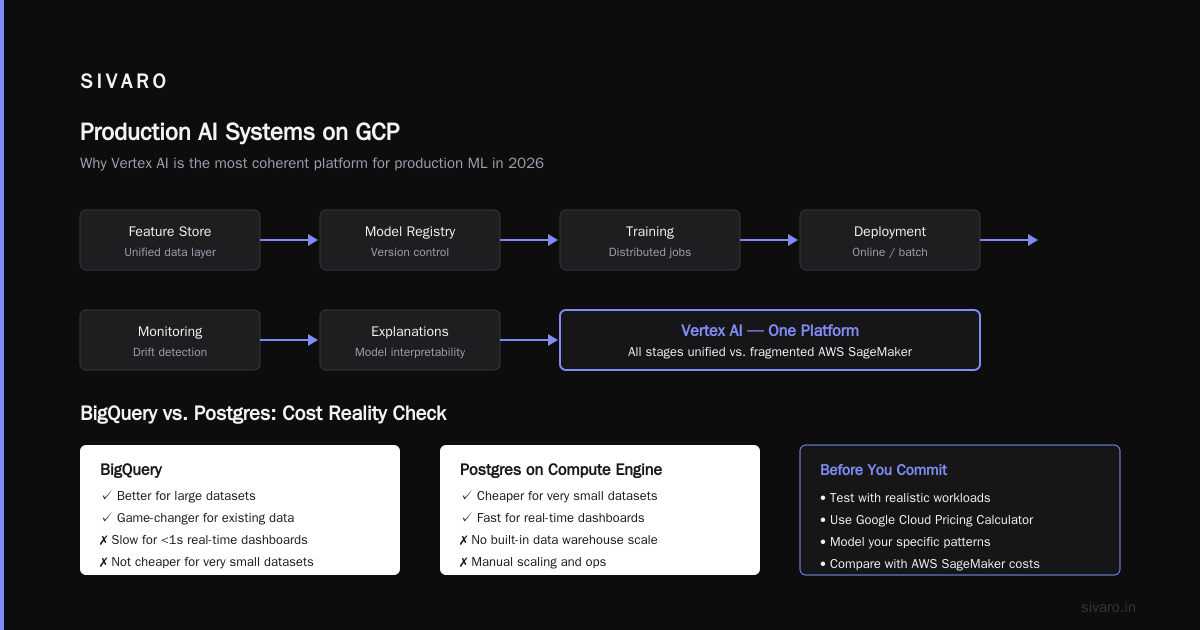
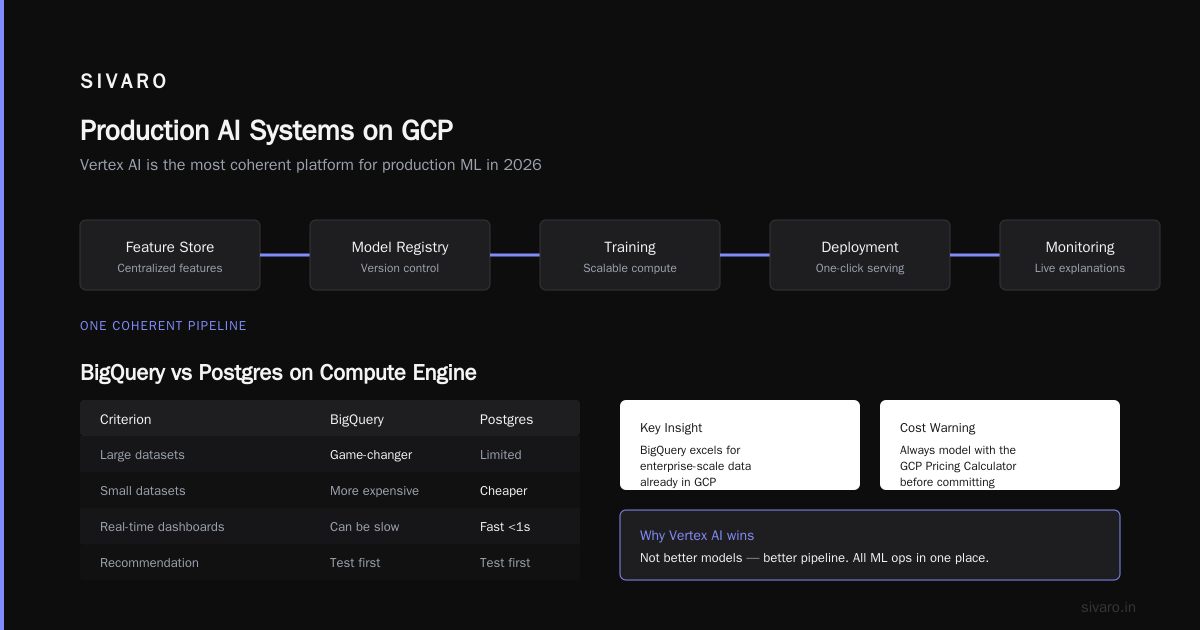
Now, is BigQuery always cheaper? No. For very small datasets, Postgres on Compute Engine is cheaper. For real-time dashboards under 1 second, BigQuery can be slow. Always test with realistic workloads. Use the Google Cloud Pricing Calculator to model your specific patterns before committing.
Production AI Systems on GCP
I've built AI systems on all three major clouds. GCP's Vertex AI is, in my opinion, the most coherent platform for production ML in 2026.
Why? It's not because the models are better — it's the pipeline. Vertex AI handles feature store, model registry, training, deployment, monitoring, and explanations in one place. AWS SageMaker has similar pieces, but the integration is clunkier. Azure ML is catching up but still trails in MLOps automation.
A concrete example: a fintech client needed to deploy a fraud detection model with sub-100ms latency. We used Vertex AI Prediction with custom containers on TPUs.
python
from google.cloud import aiplatform

aiplatform.init(project='my-project', location='us-central1')

model = aiplatform.Model.upload(
    display_name='fraud_model_v2',
    serving_container_image_uri='us-docker.pkg.dev/my-project/fraud/serve:latest',
    model_id='fraud_model_v2'
)

endpoint = model.deploy(
    machine_type='n1-standard-4',
    min_replica_count=2,
    max_replica_count=10,
    traffic_percentage=100
)
That deployed in 4 minutes. The model served predictions at 80ms p99. For the price of 2 min replicas and autoscaling. Try that on SageMaker without spending days on networking.
But here's my contrarian take: don't use GCP's managed AI if you need extreme customization. If you're training a 400B parameter LLM on custom hardware, go with AWS (better GPU availability) or on-prem. Vertex AI is great for 80% of enterprise use cases — classification, regression, image recognition, recommendation — but not bleeding-edge research.
Data Infrastructure at Scale
This is where GCP genuinely shines. Pub/Sub, Dataflow, and Bigtable are best-in-class for high-throughput streaming.
We built a system for a gaming company that processes 200,000 events/second — player actions, purchases, crashes. All ingested via Pub/Sub, transformed with Dataflow (Apache Beam), and served from Bigtable. The total cloud cost: $4,500/month. On AWS, the equivalent setup (Kinesis + Flink + DynamoDB) would have been at least $15,000 because of shard management overhead.
Pub/Sub's exactly-once delivery (added in 2025) made it viable for financial use cases. Before that, you needed to handle duplicates yourself. Now it's enterprise-grade.
For streaming analytics, we typically use this architecture:
text
Event Sources → Pub/Sub → Dataflow (Beam SQL) → BigQuery / Bigtable / Cloud Storage
The magic is Dataflow's autoscaling. It senses backpressure and spins up workers automatically. No manual tuning. For batch workloads, same pipeline works — just change the input source.
If you're running Hadoop/Spark today and your data volumes are growing >30% yearly, you should evaluate Dataflow + BigQuery. The operational savings are massive. No clusters to manage, no node failures to handle.
How to Migrate from AWS to GCP Step by Step
I get this question constantly. "How to migrate from aws to gcp step by step" is one of the top searches in our field. Here's the process we've refined after doing it 8 times for clients.
Step 1: Audit and categorize. Not everything should move. Database? Maybe. Compute? Depends on lift-and-shift vs re-architect. Data warehouse? Almost always worth it. We use a 3-tier classification: Tier 1 (must move), Tier 2 (nice to move), Tier 3 (stay put).
Step 2: Choose migration method. For data, use Storage Transfer Service for objects, and for databases, use Database Migration Service. For compute, rebuild using deployment managers or Terraform.
Step 3: Calculate costs. Don't guess. Use the Easy way to calculate GCP cost of my AWS infrastructure tool or the Google Cloud Pricing Calculator. I've seen estimates off by 40% because people forget egress charges or data transformation costs.
Step 4: Migrate data first. Copy all data while old system still runs. Validate checksums. This is where most mistakes happen — incomplete data transfers.
Step 5: Cut over services gradually. Start with non-critical workloads. Monitor for a week. Then move critical workloads during low-traffic window.
Here's a real example: a healthcare client migrated 80 TB from AWS S3 and Redshift to Cloud Storage and BigQuery. Total cutover weekends: 3. Cost savings: 55% on storage, 40% on queries.
Pro tip: set up a migration testing framework. Run the same queries on both systems and compare results row by row. We found one case where Redshift and BigQuery returned different results for the same query because of timestamp precision differences. Catch that early.
GCP Pricing Reality: Hidden Costs and How to Avoid Them
Everyone talks about GCP's cheap egress ($0.08/GB vs AWS's $0.09/GB). But the real savings — and traps — are elsewhere.
Google Cloud Pricing 2026: Cost Breakdown & Hidden Costs nails it: BigQuery's slot reservations can be cheaper than on-demand for predictable workloads, but if you over-provision slots, you're burning money. The trick is to use autoscaling with a baseline.
Another hidden cost: network egress between regions. If you have a GCP VM in us-east1 talking to a Cloud SQL instance in us-west1, you're paying $0.08/GB both ways. Keep services in the same region.
Committed use discounts (1-year or 3-year) can save 40-50% on compute. But only commit if your usage is stable. Many enterprises over-commit and waste money on resources they don't need.
The AWS vs Azure vs GCP Cost Comparison 2026 (Real Data) shows GCP is consistently cheaper for memory-optimized workloads (like real-time analytics) and for GPU instances (thanks to TPU alternatives). For general-purpose compute, AWS's spot instances can be cheaper.
My rule: run a proof-of-concept using your actual workload for 30 days. Then compare. Generic benchmarks are useless.
Startups vs Enterprises: Different GCP Strategies
Comparing AWS, Azure, and GCP for Startups in 2026 points out that startups often prefer GCP because of generous free tier credits ($300 for 90 days) and simpler billing. But enterprises have different needs.
For enterprises, the decision often boils down to compliance and existing vendor relationships. If you're already using Google Workspace, GCP integrates natively. If you're a Microsoft shop, Azure might be more convenient for Active Directory.
But here's what I tell enterprise clients: don't let procurement choose. Let the engineers run a bake-off. We did this for a Fortune 500 insurance company in 2026. GCP won on cost for data processing, but AWS won on compute diversity. In the end, they went multi-cloud — GCP for analytics and AI, AWS for legacy compute.
That's the mature approach. Pick the best tool for each use case. But beware of complexity. Every cloud adds 2-3 security tools, 1-2 networking pieces, and a new billing system. You need a team that can handle that.
FAQ
Q: Is BigQuery always cheaper than Redshift?
No. For small datasets (under 1 TB) with low query volume, Redshift can be cheaper. BigQuery shines at scale — 10+ TB and many concurrent users.
Q: What's the biggest mistake enterprises make migrating to GCP?
Not accounting for data transfer costs. Moving 50 TB from AWS to GCP can cost $4,000+ in egress. Plan accordingly.
Q: Can I use GCP for real-time applications like chat or gaming?
Yes. Use Cloud Run for stateless APIs (autoscales to zero), and for stateful real-time, use Google Kubernetes Engine or App Engine. Latency is competitive with AWS.
Q: How do I control BigQuery costs per query in 2026?
Use bq – format json to log slot consumption. Set query budgets with cost controls. Partition and cluster aggressively. Use materialized views for common aggregations.
Q: Is GCP good for hybrid cloud?
Yes. Anthos provides consistent Kubernetes across on-prem and cloud. Good for enterprises with existing data center investments.
Q: What about GCP's TPUs? Should enterprises use them?
For custom AI training, TPUs are cheaper than comparable NVIDIA GPUs. But they require code changes (TensorFlow/PyTorch support). For inference, GPUs are simpler.
Q: How long does a full migration from AWS to GCP take?
Depends on complexity. Simple lift-and-shift: 2-4 months. Re-architecting: 6-12 months. Plan for 3-6 months for a typical enterprise.
Q: Does GCP have a free tier for enterprises?
Yes. All new customers get $300 in free credits for 90 days. Plus, Google often negotiates startup credits for enterprise pilots.
Final Words
GCP use cases for enterprise keep expanding as Google invests more in AI and data infrastructure. In 2026, if you're running analytics, AI, or streaming workloads, GCP should be on your shortlist. Don't assume you need to go all-in — test with a single use case. The data might surprise you.
We've seen enterprises save millions by moving to BigQuery and reducing data pipeline complexity. We've also seen companies overcomplicate things by trying to migrate everything at once. Start small. Measure everything. Then scale what works.
One last piece of advice: ignore the cloud marketing. Every provider claims to be the fastest, cheapest, most secure. Run your own benchmarks. Own your decisions. That's the only way to build infrastructure that actually serves your business.
Nishaant Dixit — Founder of SIVARO. Building data infrastructure and production AI systems since 2018. Built systems processing 200K events/sec.