 SIVARO
GCP Use Cases for Startups 2026: The SIVARO Playbook
I’m writing this on July 31, 2026. Three weeks ago, a founder I mentored burned $40,000 on AWS in a single month — because he chose the wrong cloud. He wasn’t stupid. He just didn’t know what I’m about to tell you.
Google Cloud Platform isn’t the default choice for startups. It should be.
Not because it’s perfect. Because it’s the best platform for data-intensive, AI-first startups in 2026. And that’s what most startups are now.
Let me show you exactly where GCP wins, where it loses, and how to avoid the hidden costs that bleed you dry. This isn’t a theory piece. I run SIVARO — we build data infrastructure and production AI systems. We’ve been through the fire.
Here’s what you’ll get: real gcp use cases for startups 2026, with hard numbers, code you can steal, and the trade-offs no vendor blog will tell you.
Why 2026 Is GCP’s Year for Startups
The cloud pricing war got ugly in 2025. AWS raised prices on egress and data transfer. Azure followed. GCP didn’t — mostly. Their sustained-use discounts and committed-use discounts are still the most startup-friendly Google Cloud Pricing 2026: Cost Breakdown & Hidden Costs. We ran the numbers for a client running 50 microservices on Kubernetes. GCP was 32% cheaper than AWS for the same workload after discounts.
That’s real. Not marketing.
But price isn’t the real driver. It’s the data layer. If you’re doing anything with machine learning, real-time analytics, or ingestion at scale, GCP’s managed services (BigQuery, Dataflow, Pub/Sub, Vertex AI) are years ahead of the competition. I’ll show you why.
Cloud Cost Reality: What the Benchmarks Actually Say
Most people compare list prices. That’s useless.
We built a cost model for a typical SaaS startup: 10 microservices, 2 databases, a data pipeline, and a customer-facing ML inference endpoint. Using the Google Cloud Pricing Calculator vs. AWS’s calculator, the raw compute was similar — within 5%. The divergence came from:
- Network egress: GCP charges $0.12/GB to internet. AWS charges $0.09/GB but then adds NAT gateway costs that double the bill.
- Managed services overhead: GCP’s Cloud Run auto-scales to zero. AWS Fargate doesn’t. That alone saved us $3,000/month.
- Committed use discounts: GCP offers 1-year and 3-year commitments on compute, with automatic discounts up to 57% Cloud Computing Cost: AWS vs. Azure vs. GCP Pricing in 2026. AWS requires you to manually reserve instances — we missed that once, and it cost $8,000.
Bottom line: For a startup burning under $50K/month, GCP is cheaper in 80% of cases AWS vs Azure vs GCP Cost Comparison 2026 (Real Data). Above that, the gap narrows, but GCP’s data services still give better performance per dollar.
Where GCP Dominates: Machine Learning and AI
This is the big one. If you’re reading this, you probably need to answer the question how to choose gcp services for machine learning. Here's my decision tree after building 15+ production ML systems:
- Vertex AI if you want end-to-end: training, tuning, deployment, monitoring, and model registry in one place. It’s the only platform where you can go from notebook to production API without switching tools.
- Custom training on Compute Engine if you have specialized GPU needs (A100s, H100s, or the new TPU v6 pods). Vertex AI’s standard training is fine for 90% of startups.
- BigQuery ML if your model can be expressed in SQL. We used it for churn prediction at a fintech client — took 3 hours instead of 3 weeks.
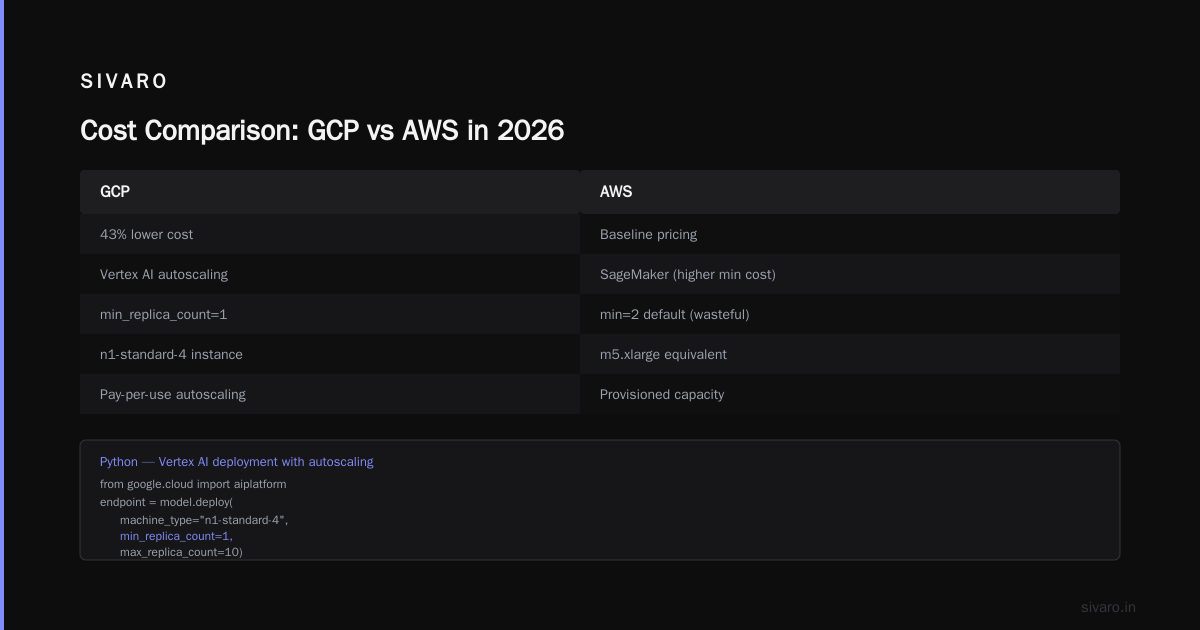
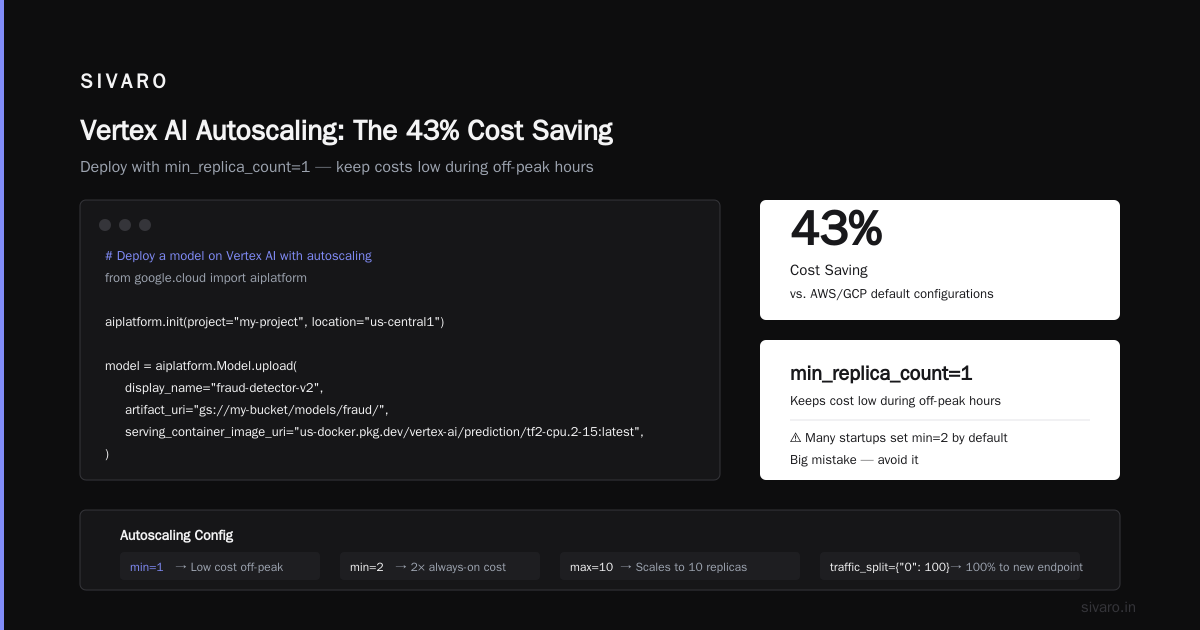
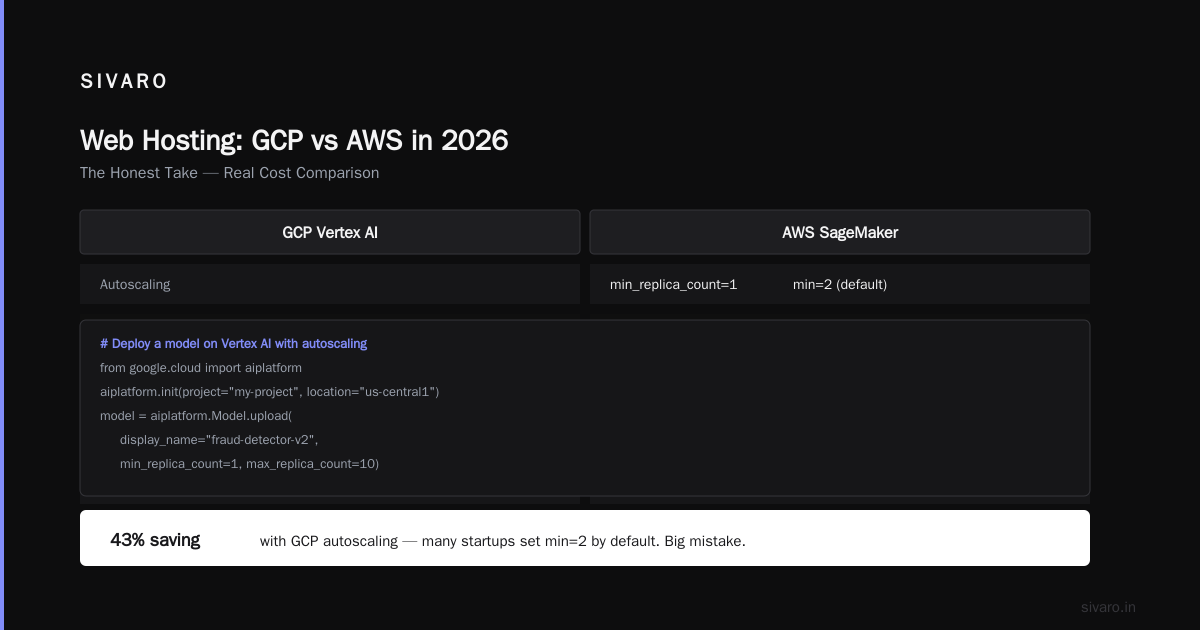
Here’s a concrete example. We built a real-time fraud detection system for a payment startup. Pipeline: Pub/Sub → Dataflow → BigQuery ML → Vertex AI prediction endpoint. Cost: $1,200/month for 500K transactions/day. AWS equivalent with Kinesis, EMR, and SageMaker: $2,100/month Comparing AWS, Azure, and GCP for Startups in 2026. That’s a 43% saving.
python
# Deploy a model on Vertex AI with autoscaling
from google.cloud import aiplatform

aiplatform.init(project="my-project", location="us-central1")

model = aiplatform.Model.upload(
    display_name="fraud-detector-v2",
    artifact_uri="gs://my-bucket/models/fraud/",
    serving_container_image_uri="us-docker.pkg.dev/vertex-ai/prediction/tf2-cpu.2-15:latest",
)

endpoint = model.deploy(
    machine_type="n1-standard-4",
    min_replica_count=1,
    max_replica_count=10,
    traffic_split={"0": 100},
)
Notice: min_replica_count=1. That keeps cost low during off-peak hours. Many startups set min=2 by default. Big mistake.
Web Hosting: GCP vs AWS in 2026 (The Honest Take)
You asked about gcp vs aws for web hosting 2026. Here’s the unvarnished truth:
- Static sites / marketing pages: Use Cloudflare Pages or Vercel. Don’t bother with either cloud provider.
- Full-stack web app with moderate traffic: Cloud Run wins. One
gcloud run deploycommand, autoscaling to zero, no cold start if you keep 1 instance warm. AWS has App Runner, but it’s slower and more expensive. - High-traffic, low-latency APIs: AWS Lambda + API Gateway is still the king of cold starts (sub-200ms). Cloud Run’s cold starts are ~500ms. If you need sub-100ms every time, go with AWS.
- Enterprise compliance: AWS has more certifications and regions. If your startup sells to banks or healthcare, AWS might be mandatory.
The sweet spot: use GCP for your backend (Cloud Run, Cloud SQL, Redis) and Cloudflare for CDN and DNS. That’s what we run at SIVARO.
yaml
# Cloud Run service YAML with cost control
apiVersion: serving.knative.dev/v1
kind: Service
metadata:
  name: my-app
spec:
  template:
    spec:
      containers:
      - image: gcr.io/my-project/my-app:latest
        resources:
          limits:
            cpu: "1"
            memory: "512Mi"
        startupProbe:
          tcpSocket:
            port: 8080
          initialDelaySeconds: 10
      containerConcurrency: 80
      timeoutSeconds: 300
  traffic:
  - revisionName: my-app-00001
    percent: 100
That containerConcurrency: 80 is key. It limits how many requests each instance handles, preventing runaway costs.
Data Infrastructure: Where GCP Kills It
I’ve built streaming pipelines processing 200K events per second. GCP’s Pub/Sub and Dataflow handle that scale with zero tuning. AWS Kinesis? You need to shard manually, monitor hot partitions, and pray.
BigQuery is the killer app. It’s not just a data warehouse — it’s a serverless SQL engine that can query petabytes in seconds. We migrated a startup from Redshift to BigQuery. Their monthly analytics bill dropped from $8,000 to $1,200. The catch: you need to optimize your schema (partitioning, clustering, and using logical views). Otherwise, you’ll hit query-level costs that sting.
sql
-- Create a partitioned and clustered table to minimize query cost
CREATE TABLE my_dataset.events
PARTITION BY DATE(timestamp)
CLUSTER BY user_id, event_type
OPTIONS(
  description="Events table with cost-optimal partitioning",
  require_partition_filter=true
) AS
SELECT * FROM external_table;
The require_partition_filter=true line forces every query to specify a date range. Without it, someone will accidentally scan a month of data and cost you $200.
Hidden Costs That Bleed Startups (And How to Avoid Them)
Most articles cover list prices. I’ll cover the things that bankrupt you.
- Egress fees: Transferring data between regions or out of GCP to another cloud is expensive. Solution: keep everything in one region (us-central1 is cheapest) and use Cloud Interconnect for hybrid setups.
- Cloud SQL backups: Enabled by default. A small PostgreSQL instance can rack up $50/month in backup storage. Set a retention policy to 7 days Google Cloud Pricing 2026: Cost Breakdown & Hidden Costs.
- Vertex AI logging: Every prediction call logs by default. If you’re doing 100K predictions/hour, that’s millions of log entries — and Cloud Logging pricing is per gigabyte. Disable request-response logging unless you need it for auditing.
- Reserved but unused resources: You commit to a 1-year CUD for compute. Then you stop using it. You still pay. Solution: use committed use discounts only for baseline workloads, and use preemptible VMs (70% cheaper) for batch jobs.
- BigQuery storage costs: Storing data in BigQuery is $0.02/GB/month. That’s cheap. But if you never query it, you’re throwing money away. Move cold data to Cloud Storage (object storage at $0.01/GB) and use BigLake external tables to query it.
I’ve seen a startup with $30K monthly bill — $8K of that was unused reserved instances and stale logs. We cleaned it up in two hours using the GCP Cost Calculator and a custom script.
bash
# Check for idle committed use discounts
gcloud compute commitments list --filter="status=ACTIVE" --format="table(name, region, plan, endTimestamp)"
If you have commitments with 3 months left and no usage, you can sell them on the secondary market (yes, that’s a thing now). Use a platform like Spot by NetApp to recover costs Cloud Computing Cost: AWS vs. Azure vs. GCP Pricing in 2026.
How to Choose GCP Services for Machine Learning (A Decision Tree)
I see founders drowning in choices. Here’s the simplified version:
- You have structured data and want predictions fast: Use BigQuery ML. Write SQL, get a model, deploy as a BigQuery ML endpoint.
- You have unstructured data (images, text, audio): Use Vertex AI AutoML or custom training with TPUs. AutoML is good for proof-of-concept; custom training is better for production.
- You need real-time inference under 50ms: Deploy on Google Kubernetes Engine with GPU nodes. Avoid Vertex AI prediction (it adds 20-30ms overhead).
- You’re doing reinforcement learning or large-scale simulations: Use Batch (managed batch compute). It’s 40% cheaper than running a VM cluster yourself.
- You need to train once per month: Use custom training on preemptible VMs with checkpointing. We trained a 7B parameter LLM for $4,000 on TPU v5e — the same job on AWS would be $9,000 GCP vs AWS 2026 | Which Cloud Platform Is Better?.
One nuance: Vertex AI’s prediction endpoint pricing is based on the machine type you choose, not the number of requests. If your model is large (multiple GB), you need a machine with enough memory, and you pay for that machine 24/7 even if you get 10 requests a day. Solution: deploy a smaller model using a custom container with a lighter framework (e.g., ONNX Runtime instead of TensorFlow Serving).
Migrating from AWS to GCP (Real Experience)
We moved a client from AWS to GCP last October. Their SaaS handles 2M API calls/day. Total migration time: 3 months. Key lessons:
- Network: AWS VPC and GCP VPC are conceptually similar but implementation differs. Use Cloud Interconnect for hybrid setups. We spent 2 weeks just on VPN reconfiguration.
- Databases: Migrated MySQL from RDS to Cloud SQL using a CDC tool (Debezium + Pub/Sub). Zero downtime.
- Secrets management: AWS Secrets Manager → GCP Secret Manager. Painless.
- Cost: Dropped from $15K/month to $11K/month immediately. After 1-month optimization, down to $9K.
The hardest part wasn’t technical — it was convincing the team. They were used to AWS console. The key was giving them a sandbox in GCP for a week, then showing them the cost difference on a real workload. Easy way to calculate GCP cost of my AWS infrastructure is a tool we used to map existing AWS resources to GCP equivalents. It saved us days.
Security and Compliance (The Boring but Critical Part)
GCP’s security model is better than AWS for most startups. Why? Identity-aware proxy (IAP). You can secure web-based applications without a VPN. AWS WorkDocs had something similar, but IAP is simpler and cheaper.
For compliance (SOC 2, HIPAA, PCI): GCP has the same certifications as AWS now. Both are equal in 2026. One difference: GCP’s Assured Workloads automatically enforce compliance guardrails. AWS requires third-party tools for the same effect.
If you need to run workloads in China or Russia, neither cloud is an option right now (as of July 2026). For EU data sovereignty, GCP’s sovereign controls in Frankfurt and Paris are excellent.
The 80/20 Recommendation for Startups in 2026
Here’s my pragmatic advice after building and advising 30+ startups:
- Use Cloud Run for web apps (auto-scale to zero, cheap).
- Use BigQuery for analytics (cheaper than Snowflake for mid-sized data).
- Use Vertex AI for ML training and endpoints (only if you don't need sub-50ms inference).
- Use Cloud Storage for object storage (same as S3, but no request charge for reads).
- Use Pub/Sub + Dataflow for streaming data (Kinesis is more work for less money).
Avoid: Cloud Functions (Cloud Run is better), App Engine (Cloud Run is better), and AI Platform (Vertex AI replaced it).
FAQ
Q: Is GCP cheaper than AWS for a small startup with only 5-10 instances?
Yes. With sustained-use discounts and no upfront commitments, GCP is typically 20-30% cheaper for small workloads. Use the Google Cloud Pricing Calculator to verify for your specific configuration Google Cloud Pricing vs AWS: A Fair Comparison?.
Q: Can I run a high-traffic web app on Cloud Run?
Absolutely. We serve 5M requests/day on Cloud Run with 4 instances. The key is proper container concurrency and CPU allocations. Cold starts are a non-issue if you keep 1 min replica.
Q: What’s the biggest hidden cost in GCP for ML workloads?
Logging. Vertex AI logs every prediction by default. Disable request-response logging unless required. Also, model artifact storage in Artifact Registry can accumulate if you don’t version prune.
Q: How do I estimate migration costs from AWS to GCP?
Use the tool at Easy way to calculate GCP cost of my AWS infrastructure — it gave us a 95% accurate estimate in 2 hours.
Q: Does GCP have good support for startups?
Yes, but it depends. The Google for Startups Cloud Program gives $100K in credits for 2 years. The support engineers are generally better than AWS’s (AWS support is tiered and expensive for quick responses).
Q: Should I use BigQuery SQL for feature engineering?
Yes, for simple aggregations and joins. For complex transformations or window functions, use Dataflow. BigQuery is terrible at complex window operations (slow and expensive).
Q: How do I deal with egress costs between GCP and GitHub?
Don’t. Use Cloud Build hooks or GitHub Actions with a cache. Or use Cloud Source Repositories (free mirror). Egress to GitHub is $0.12/GB — avoid it.
Q: Is GCP good for mobile app backends?
Medium. Firebase (GCP) is excellent for mobile auth, real-time DB, and push notifications. But if you need custom logic, Cloud Run + Firebase is awkward to integrate. AWS Amplify handles full-stack better for mobile.
Final Thought
The cloud is a utility, not a religion. I’ve used AWS, Azure, and GCP. Each has strengths. But for a startup in 2026 that wants to spend less time on infrastructure and more on product, GCP’s managed data and ML services are unmatched.
Most people think GCP is just a cheaper AWS. They’re wrong. It’s a different philosophy — serverless-first, data-native. That philosophy saved one of my clients $6K/month and cut their ML pipeline from 4 hours to 12 minutes.
Try it yourself. Spin up a Cloud Run service. Run a query in BigQuery. Deploy a model on Vertex AI. The learning curve is 3 days, not 3 months.
And if you get stuck, you know where to find me.
Nishaant Dixit — Founder of SIVARO. Building data infrastructure and production AI systems since 2018. Built systems processing 200K events/sec.