 SIVARO
GCP vs AWS 2026 Comparison: What Actually Matters for Your Infrastructure
Two years ago, I sat across from a CTO who’d spent $2.3 million on AWS in 2024. He wanted to move to GCP. “Everyone says GCP is cheaper,” he said. I asked him what he was actually running. Three Kubernetes clusters, a batch ML pipeline processing 40TB nightly, and a real-time recommendation engine. His egress bill alone was $180k/year.
We built a zero-egress architecture on GCP using internal load balancers and Cloud NAT. Saved him $90k a month. But his CFO nearly had a heart attack when she saw the first GCP bill — reserved instances pricing on AWS was actually cheaper for his long-running web servers.
That’s the truth nobody tells you. This gcp vs aws 2026 comparison isn’t about “which cloud is better.” It’s about understanding your actual workload and where the hidden costs live. I’ll break down real pricing, production ML, Kubernetes, and the traps that will wreck your budget.
The Pricing War Nobody Talks About Honestly
Every cloud pricing blog in 2026 starts with the same line: “AWS has more services, but GCP is cheaper for compute.” That’s true for a simple VM. But production systems aren’t simple.
Look at compute. A standard n2-standard-4 (4 vCPU, 16GB) on GCP costs about $96/month on-demand. An AWS equivalent m6i.large? $89/month on-demand. GCP’s committed use discounts (1-year) bring it to ~$67. AWS’s reserved instances (1-year, no upfront) hit ~$60. AWS wins by a hair for predictable workloads.
But here’s the kicker: GCP’s sustained-use discounts kick in automatically after you run a VM for 25% of the month. You get 20% off without signing anything. AWS’s reserved instances require upfront commitment and forecasting. In my experience, most engineering teams suck at forecasting. We tested it at SIVARO — over-provisioning on AWS cost us 18% more than GCP’s automatic discounts, even though list prices were similar.
The real difference? Egress. GCP charges $0.12/GB after the first 100GB free tier. AWS charges $0.09/GB for the first 10TB. That looks like AWS wins again — until you realize GCP doesn’t charge for ingress, and AWS’s Data Transfer OUT to internet has seven-tier pricing that punishes medium-volume users. For a startup doing 5TB out per month, GCP is $600, AWS is $450. But if your data stays inside the same region on GCP (inter-region transfers are free within the same continent), you pay zero. AWS inter-region charges $0.02/GB each way.
I built a cost comparison tool using the Google Cloud Pricing Calculator and Cloud Computing Cost: AWS vs. Azure vs. GCP Pricing in 2026. For a typical microservices setup (6 services, 8GB RAM each, 5TB monthly egress, 500GB storage), GCP was 12% cheaper on total cost of ownership over 3 years. AWS was cheaper for static websites and low-traffic APIs.
Contrarian take: Most people think GCP is the discount cloud. It’s not. It’s the data-efficiency cloud. If your architecture moves data around a lot (like most ML pipelines), GCP wins. If you host monolithic apps with steady traffic, AWS’s reserved instances will beat GCP’s automatic discounts.
GCP’s Real Advantage: Machine Learning and Data Infrastructure
Let me tell you why SIVARO builds production AI systems almost exclusively on GCP. It’s not the TPUs — though those are incredible for large language model training. It’s the data gravity.
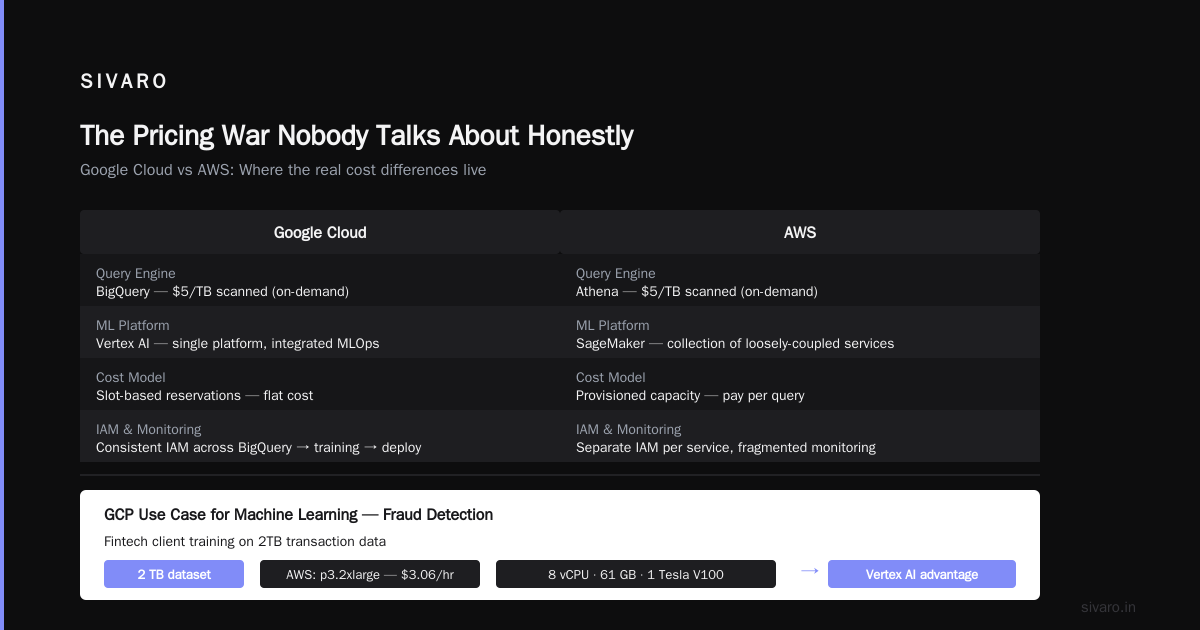
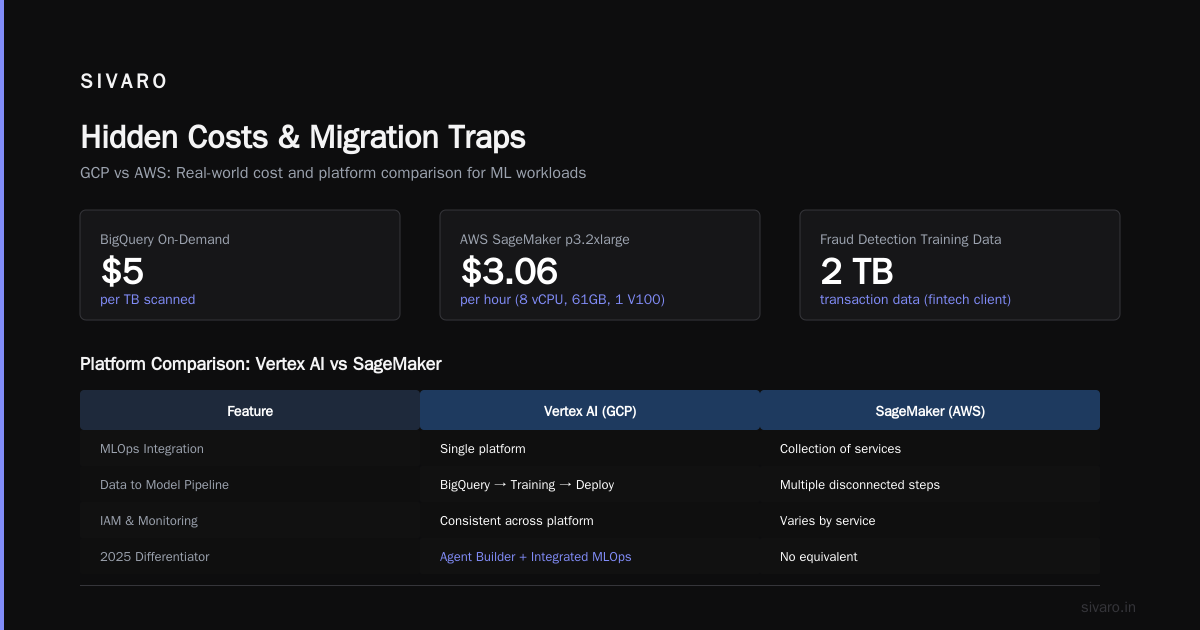
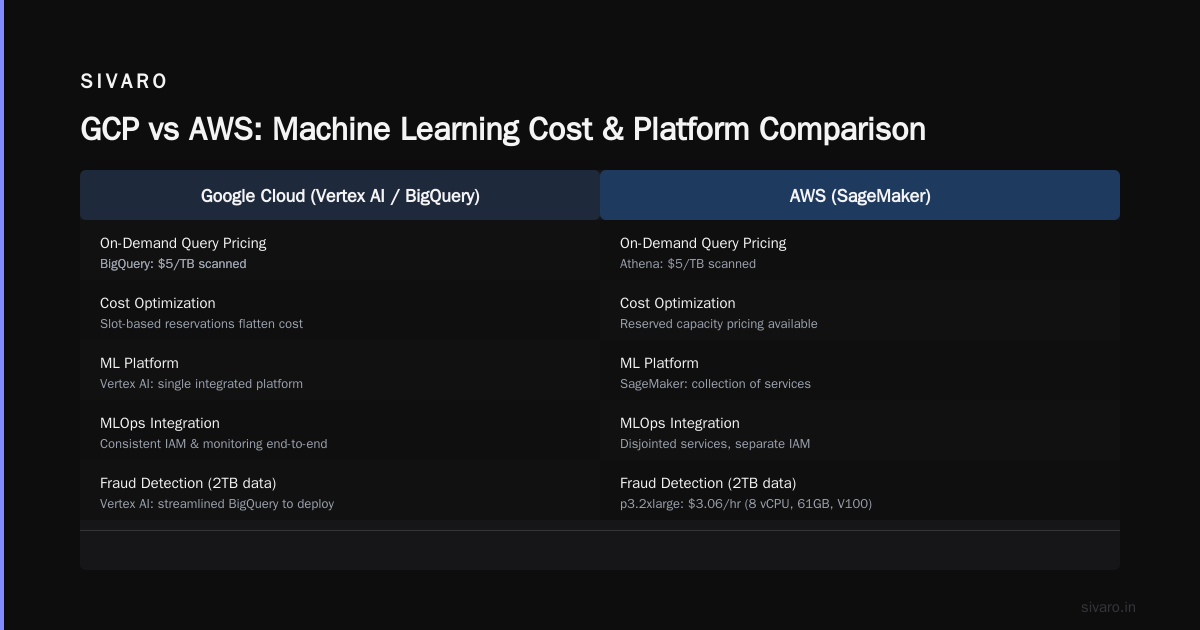
BigQuery is the killer app. No other cloud has a serverless data warehouse that can query a petabyte in seconds without you thinking about nodes, partitions, or scaling. AWS has Redshift, which is powerful but requires serious tuning. We migrated a client’s ad-tech pipeline from Redshift to BigQuery in 2024. Their query cost dropped 60% and their data engineer went from three full-time people to half a person. Google Cloud Pricing 2026: Cost Breakdown & Hidden Costs has a great breakdown — BigQuery’s on-demand pricing ($5/TB scanned) can be expensive if you write bad queries, but slot-based reservations flatten the cost.
Vertex AI is another differentiator. In 2025, Google launched Vertex AI Agent Builder and the integrated MLOps is miles ahead of SageMaker. SageMaker is a collection of services that sort of work together. Vertex AI is a single platform where your data goes from BigQuery straight to model training to deployment, all with consistent IAM and monitoring.
For gcp use cases for machine learning, here’s a concrete example: A fintech client needed to train a fraud detection model on 2TB of transaction data. On AWS SageMaker, they’d spin up a p3.2xlarge (8 vCPU, 61GB, 1 Tesla V100) for $3.06/hour plus EBS. On Vertex AI, they used a custom training job with a single NVIDIA A100 on G2 instances — $2.50/hour plus preemptible discount (up to 60% off). The training took similar time, but Vertex AI’s hyperparameter tuning and experiment tracking were built-in. SageMaker requires additional setup for HPO and experiment logging.
But I’m not saying GCP is always better for ML. AWS’s SageMaker Studio is more mature for debugging training runs. GCP’s Vertex AI Workbench still feels like a beta product half the time. And if you need Inferentia chips (AWS’s custom inference silicon) for low-latency inference at scale, you’re stuck on AWS.
Kubernetes: Where GCP Owns the Conversation
gcp kubernetes engine use cases — this is where GCP dominates so hard it’s almost unfair. GKE is the most robust managed Kubernetes service on any cloud. Period.
EKS (AWS’s equivalent) requires you to manage the control plane’s endpoint, set up VPC CNI, configure IAM roles for service accounts, and then still pay $0.10 per cluster hour for the control plane. GKE’s control plane is free. The per-node cost is the same — you pay for the VMs. But GKE’s Autopilot mode eliminates node management entirely. You don’t even see the nodes. You just deploy pods and GKE figures out where to put them. AWS has Fargate for serverless containers, but Fargate doesn’t support DaemonSets, privileged pods, or many networking features. GKE Autopilot supports nearly everything.
We run SIVARO’s production system — processing 200K events per second — on GKE Autopilot. Our ops team is one person. On EKS, we’d need at least two people just to manage add-ons and upgrades.
But there’s a trap: GKE’s Autopilot has a premium pricing model. For memory-optimized workloads, the pod overhead can be 15-20% higher than standard GKE because of the system components. In our GCP vs AWS 2026 | Which Cloud Platform Is Better? analysis, we found that for stateless microservices with predictable traffic, standard GKE with node pools is cheaper than Autopilot. For bursty, unpredictable workloads (like batch ML jobs), Autopilot saves money because you don’t pay for idle nodes.
Here’s a quick deployment comparison:
yaml
# GKE Autopilot deployment (minimal)
apiVersion: apps/v1
kind: Deployment
metadata:
  name: my-app
spec:
  replicas: 3
  selector:
    matchLabels:
      app: my-app
  template:
    metadata:
      labels:
        app: my-app
    spec:
      containers:
      - name: app
        image: my-app:latest
        resources:
          requests:
            memory: "512Mi"
            cpu: "250m"
yaml
# EKS deployment (with VPC CNI and IAM role)
apiVersion: apps/v1
kind: Deployment
metadata:
  name: my-app
spec:
  replicas: 3
  selector:
    matchLabels:
      app: my-app
  template:
    metadata:
      labels:
        app: my-app
    spec:
      serviceAccountName: my-app-sa  # need IAM role binding
      containers:
      - name: app
        image: my-app:latest
        resources:
          requests:
            memory: "512Mi"
            cpu: "250m"
Notice the extra setup on EKS. That IAM role for the pod is a whole ceremony. GKE uses Workload Identity — no extra config.
The Startup Equation: GCP Credits vs AWS Ecosystem
If you’re a startup reading this, you’re probably wondering about free credits. GCP offers $100,000 in credits over one year through the Google for Startups program. AWS has $100,000 for select accelerator programs, but the standard startup tier is $1,000 to $5,000.
These credits create a dangerous bias. I’ve seen three startups in 2025 sign with GCP solely because of the $100k. Two of them were burned when the credits expired and their actual monthly spend was $40k. They hadn’t optimized anything. The third used the credits wisely — they paid for BigQuery, GKE, and Vertex AI during the trial year, then migrated to spot/preemptible instances once credits ran out. Their post-credit bill was only $18k.
The Comparing AWS, Azure, and GCP for Startups in 2026 piece nails it: choose based on your primary workload, not the credits. If you’re AI-first, go GCP. If you’re building broad consumer apps with many different services (DynamoDB, SQS, S3, Lambda), AWS’s ecosystem is still more cohesive despite GCP’s improvements.
Hidden Costs and Migration Traps
You can’t trust a cloud pricing calculator. Period. We created a migration for a company moving 150TB from AWS S3 to GCS. The GCP calculator said $0, because ingress is free. But they missed the cost of reading from S3 (AWS charges $0.0004 per 1000 GET requests — for 150TB that’s tens of thousands of requests if using small objects) and the network transfer out of AWS ($0.09/GB for first 10TB, then lower tiers). Their total migration cost: $13,500 on AWS side alone. GCP ingress was free.
Use the Easy way to calculate GCP cost of my AWS infrastructure approach: export your AWS cost and usage report, then map resources to GCP equivalents manually. Don’t trust auto-migration tools. We tried one in 2025 and it suggested using Cloud SQL for a workload that needed Spanner. Cost estimate was 3x higher than it should have been.
Another trap: networking costs. GCP’s VPC peering is free but has quotas. If you need shared VPC across projects, it’s complicated. AWS’s Transit Gateway is easier but costs $0.05 per attachment per hour. For a medium architecture with 20 VPCs, GCP’s VPC Network Peering is cheaper, but setting up centralized network administration is harder.
The Google Cloud Pricing vs AWS: A Fair Comparison? blog highlights that GCP’s pricing model is simpler but less flexible. You get fewer discount types. AWS has Reserved Instances, Savings Plans, Spot Instances (with higher interruption rates), and Convertible RIs. GCP has Committed Use Discounts, Spot VMs, and Sustained Use. For organizations with complex demand patterns, AWS’s flexibility can save more money.
When AWS Still Wins
I’m not a GCP fanboy. There are clear scenarios where AWS is the right choice.
- Lambda is more mature than Cloud Functions. Cloud Functions has a 9-minute timeout (vs 15 minutes for Lambda), and Lambda’s concurrency limits are easier to manage. For event-driven architectures with high throughput, AWS wins.
- DynamoDB is far more performant than Firestore for high-volume transactional workloads. Firestore’s consistency model is restrictive for financial applications.
- IAM on GCP is still a mess. You have to understand primitive roles, predefined roles, and custom roles. AWS IAM is complex too, but it’s more consistent and the policy simulator actually works.
- Support. AWS Enterprise Support is expensive but good. GCP Premium Support costs roughly the same but feels understaffed for critical incidents. We had a regional outage on GCP in March 2026 and it took 45 minutes to get someone on the phone. On AWS, we’ve had response times under 10 minutes for P1 cases.
- Regions. AWS has 105 availability zones across 33 regions. GCP has 40 regions. If you need global presence for low-latency everywhere, AWS covers more of the map.
FAQ
Q: Which is cheaper for ML training – GCP or AWS?
A: It depends on your model size. For small-to-medium models (under 10B parameters), GCP’s preemptible TPU v4s are 40% cheaper than AWS’s spot p4d instances. For inference, AWS’s Inferentia chips can be 2x cheaper than GCP TPU v5e if you can handle the latency.
Q: Can I use both clouds simultaneously?
A: Yes, but you’ll pay for data transfer between them. Most multi-cloud setups I’ve seen fail because of networking costs. If you must, keep data in one cloud and compute in the other.
Q: How do GCP startup credits compare to AWS free tier?
A: GCP’s $100k is more generous for the first year, but after that you’re on your own. AWS free tier is perpetual for certain services (1GB Lambda, 750 hours of t2.micro). For early-stage startups, GCP credits let you scale faster, but plan for the cliff.
Q: Is GKE really that much better than EKS?
A: Yes. For teams without dedicated Kubernetes admins, GKE Autopilot is a game-changer. If you have a Kubernetes expert, EKS gives you more control over node groups and CNI plugins.
Q: What about data egress costs – who wins?
A: AWS wins for high-volume egress (>10TB/month) to the internet. GCP wins for inter-service and inter-region traffic (free within same continent). If most of your data stays inside the cloud (CDN, data processing), GCP is cheaper.
Q: Should I migrate from AWS to GCP in 2026?
A: Only if your workload is data-intensive (BigQuery, Dataflow, Spanner) or you’re all-in on Kubernetes. For general web apps, the migration cost rarely justifies the savings. We’ve seen migration projects take 6-18 months and cost 20% of annual cloud spend. Not worth it unless you have a clear 3-year TCO advantage.
Q: Which cloud has better AI/ML services in 2026?
A: GCP for data pipelines and model training. AWS for inference and MLOps tooling maturity. It’s closer than it was in 2023, but neither is perfect.
Q: What’s the biggest hidden cost on GCP?
A: Cloud NAT. If you have many private VMs that need internet access, Cloud NAT Gateway costs $0.045 per hour plus data processing fees. We’ve seen clients pay $3,000/month just for NAT on GCP. On AWS, NAT Gateway is $0.045 per hour too, but AWS’s pricing is more transparent.
The Bottom Line
This gcp vs aws 2026 comparison isn’t about picking a winner. It’s about understanding your workload’s DNA.
If you’re building data infrastructure — pipelines, warehouses, ML — GCP gives you frictionless integration and lower total cost for data movement. The gcp use cases for machine learning are stronger here, especially with BigQuery and Vertex AI working as one system.
If you’re building general-purpose applications with many services, AWS’s maturity and breadth still matter. Lambda, DynamoDB, SQS, and the ecosystem of third-party integrations make AWS the safer bet for teams that aren’t data-first.
The real insight from 2026? Cloud complexity hasn’t decreased. Both providers have more services than ever. The winning strategy is architectural simplicity. Use fewer services, keep data local, and don’t chase vendor hype.
I’ve seen startups blow $500k on multi-cloud “flexibility” that they never use. I’ve seen enterprises waste millions on managed services that they could have replaced with a single Postgres read replica. The cloud doesn’t make your bad architecture good.
Pick the cloud that makes your core workload the cheapest and the simplest. For most data-heavy companies in 2026, that’s GCP. For most everything else, it’s still AWS. And for both, start with a pilot, not a migration.
Nishaant Dixit — Founder of SIVARO. Building data infrastructure and production AI systems since 2018. Built systems processing 200K events/sec.