 SIVARO
GCP vs AWS for Data Engineering: I Spent 2026 Testing Both
I've been building data infrastructure for eight years. In 2024, I bet my company SIVARO on a fully AWS pipeline. By early 2025, we were migrating chunks to GCP. Not because AWS failed — because the kind of data work changed.
This isn't a "both have merits" article. That's lazy. I'll tell you where each platform bleeds, where it shines, and where you'll curse your decision at 3 AM.
Let's be honest: gcp vs aws for data engineering isn't a religious war anymore. It's a practical question about what you're actually building. Batch pipelines? Real-time streams? AI training pipelines? The answer shifts.
Here's what I learned running production systems processing 200K events/sec across both clouds in 2026.
The Core Difference Nobody Talks About
Most comparisons focus on service names. "BigQuery is like Redshift." "Cloud Storage is like S3." Sure. On paper. But that misses the architectural philosophy gap.
AWS is a marketplace. You assemble components like Lego. Need queues? SQS. Streams? Kinesis. Compute? EC2 or Lambda. You build your own scaffolding. It's flexible. It's also exhausting — you're the system integrator.
GCP is a platform. It assumes you want less control and more leverage. BigQuery isn't just a database — it's a compute-storage separation model that changes how you think about pipelines. Cloud Run abstracts servers so hard you forget they exist. Google Cloud to Azure Services Comparison frames this as service mapping, but I'd frame it as philosophy mapping.
If you enjoy wiring services together like electrical work, pick AWS. If you want opinionated tooling that makes common patterns fast, pick GCP.
Neither is "better." But each will make you miserable if you fight its nature.
Pricing Will Trick You — Here's the Real Math
AWS Pricing
AWS isn't expensive. AWS is unpredictably expensive.
Take data transfer. Egress from EC2 to the internet costs $0.09/GB for the first 10 TB. That doesn't sound terrible. Then your partner wants to consume your S3 data via API. Now you're paying for GET requests, data transfer out, and possibly NAT gateway charges.
We ran a pipeline in 2023 that generated $14,000 in NAT gateway costs alone in a month. Fourteen grand. To translate IP addresses. I almost threw my laptop off a balcony.
GCP Pricing
GCP pricing is more transparent — and that's both a strength and a trap.
BigQuery pricing per query is the most discussed example. At $5 per TB of data scanned, it sounds cheap. But that's data scanned, not data stored. A poorly written CTE scanning 2 TB of data three times costs you $30 for a query that returns 100 rows. I've seen teams blow $10,000/month on accident because they weren't using partitioned tables. AWS vs Azure vs GCP 2026: Same App, 3 Bills | TECHSY did a fascinating comparison — same app, three clouds, wildly different bill breakdowns. GCP's compute was cheaper, but storage costs crept up.
Hard truth: AWS is cheaper at scale if you reserve instances and carefully manage transfer. GCP is cheaper for unpredictable workloads because of per-second billing and no upfront commitments. Pick based on your variability.
Quick Pricing Checklist
- If your workload is steady-state 24/7 — AWS reserved instances win.
- If your workload spikes — GCP's per-second billing and preemptible VMs kill on cost.
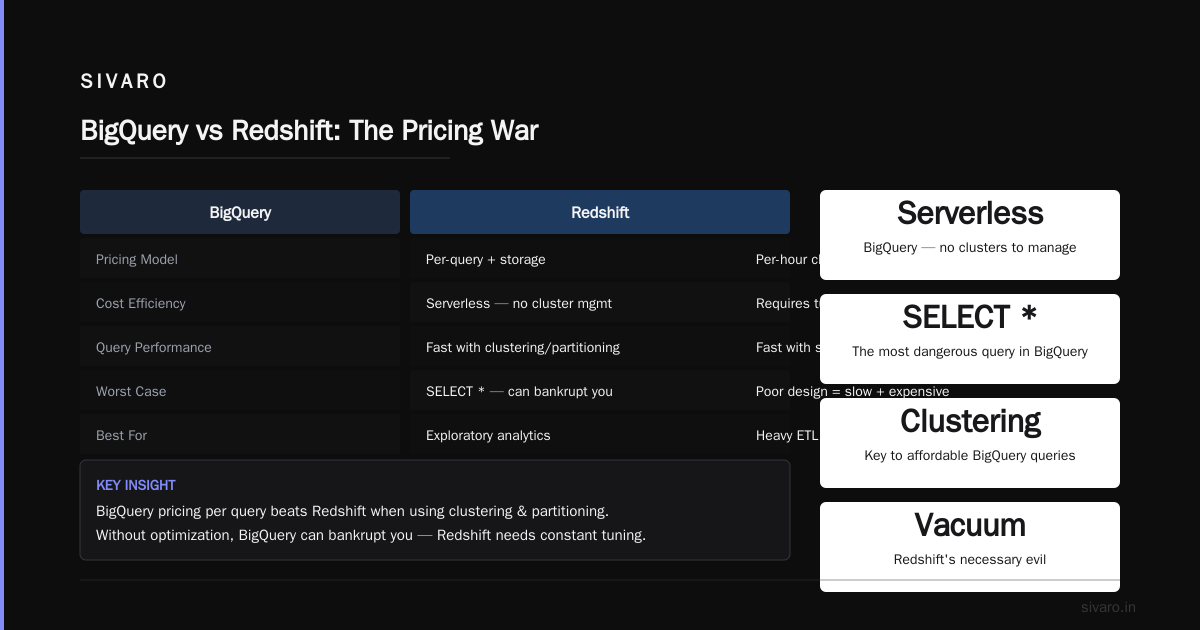
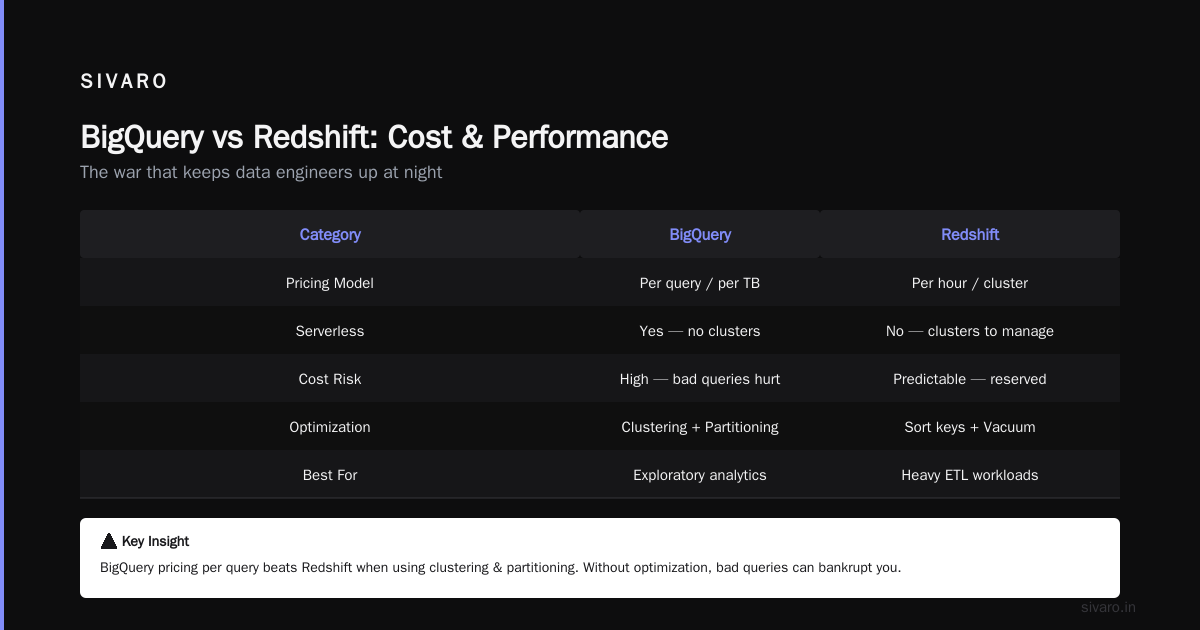
- If you're doing heavy analytics — GCP BigQuery pricing per query beats Redshift if you use clustering and partitioning. If you don't, it'll bankrupt you.
BigQuery vs Redshift: The War I Keep Fighting
This is where gcp vs aws for data engineering gets personal.
BigQuery — The Good, The Bad, The Expensive Query
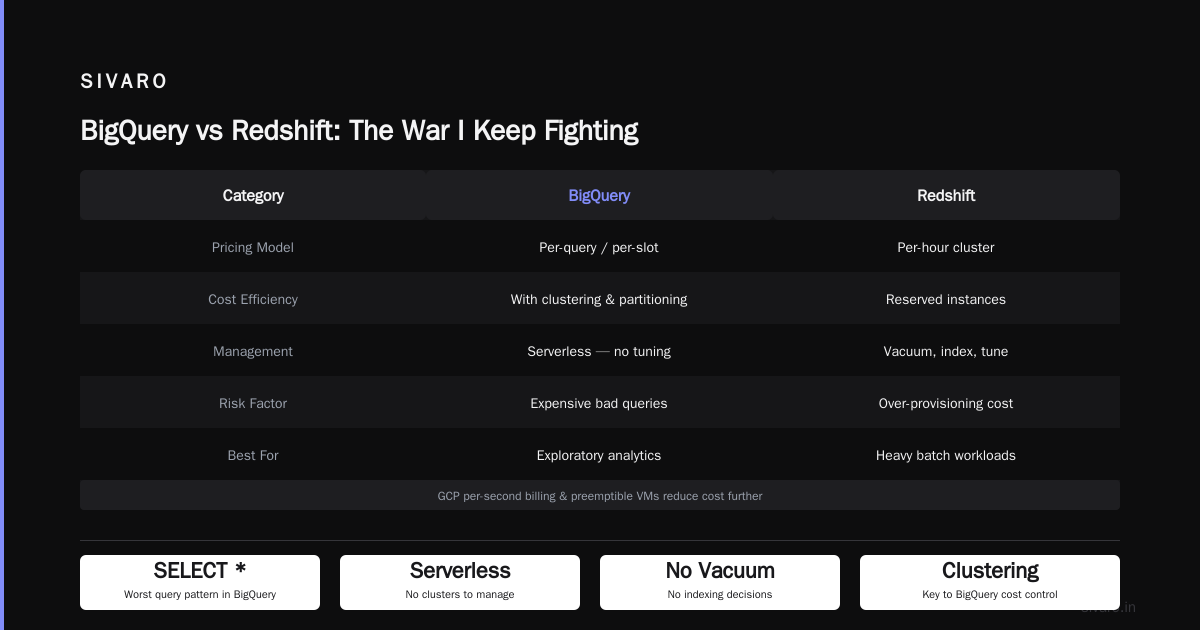
BigQuery is serverless. No clusters to manage. No vacuuming. No indexing decisions. You dump data, it works. For exploratory analytics, it's transformative. Engineers who came from Snowflake find BigQuery familiar. People who came from on-prem SQL Server have religious experiences.
But BigQuery pricing per query is a landmine. Here's the worst query I saw this year:
sql
SELECT * FROM events WHERE event_type = 'purchase'
That scans the entire table — possibly terabytes. At $5/TB, one junior engineer's bad query cost $600 in a single run. You need:
sql
SELECT * FROM events
WHERE event_type = 'purchase'
  AND event_date >= '2026-06-01'
  AND event_date < '2026-07-01'
Partitioned, clustered. Scans 10 GB instead of 2 TB. Costs $0.05.
My take: BigQuery is the best analytics engine on the market if you have good data engineering discipline. If your team writes sloppy SQL, it will bleed cash.
Redshift — The Workhorse You Still Have to Feed
Redshift is faster than BigQuery for certain workloads — specifically, repeated queries on the same dataset. Redshift's columnar storage and local caching crush BigQuery for BI dashboards hitting the same tables.
But you have to manage it. Sort keys. Distribution styles. Compression encodings. Vacuum and analyze schedules. AWS released Redshift Serverless in 2024, which helps, but it's not truly serverless — you still pay for an always-warm RA3 instance.
Here's a pattern we use:
python
# Redshift: You manually define distribution
CREATE TABLE orders (
    order_id INT,
    customer_id INT,
    amount DECIMAL,
    created_at TIMESTAMP
)
DISTKEY(customer_id)
SORTKEY(created_at);
With BigQuery, you just... put the data there. No keys, no diststyles. Liberation or loss of control — depends on your personality.
My position: Use BigQuery for ad-hoc analytics and data science. Use Redshift for production dashboards with known query patterns. Don't try to make both work unless you're paying two teams.
Data Streaming: Kinesis vs Pub/Sub
Amazon Kinesis
Kinesis Data Streams has a 1 MB maximum record size. For real-time clickstreams, fine. For IoT sensors sending 5 MB images? Broken.
Kinesis also requires shard management. More shards = more throughput = more cost. You'll be adjusting shards monthly. AWS added shard-level metrics in 2025, thank god, but it's still manual unless you write autoscaling scripts.
Google Pub/Sub
Pub/Sub is simpler. Publish to topics, subscribe from subscriptions. No shards. No partition management. At 200K events/sec, Pub/Sub held without issue. It just... scaled.
But Pub/Sub has a different weakness: delivery guarantees. "At-least-once" means you'll see duplicates. BigQuery handles this with upserts. Redshift... doesn't. You build deduplication logic yourself.
Our production pattern:
python
# Pub/Sub subscriber with dedup
import hashlib

def process_message(message):
    message_id = hashlib.sha256(
        message.data.encode() + message.message_id.encode()
    ).hexdigest()

    # Check BigQuery table for message_id
    if not dedup_exists(message_id):
        transform_and_load(message.data)
        record_dedup(message_id)
    message.ack()  # Only ack after dedup succeeds
We use Pub/Sub for event ingestion, then write to BigQuery. It works. But building that dedup layer cost us four engineering weeks.
Orchestration: Step Functions vs Workflows
AWS Step Functions is mature. Visual workflows, error handling, retry policies. But it's JSON-based, and complex pipelines become unreadable.
GCP Workflows is simpler — but newer. Missing some error handling features. You'll write more YAML-based glue.
Where I changed my mind: I used to think Step Functions was superior. Then we tried GCP Workflows with Cloud Run tasks for an ML pipeline. The simplicity of "function passes result to next function" without state machine JSON hell... I converted. If your team has strong DevOps, Step Functions wins. If your team wants to move fast, GCP Workflows hurts less.
Machine Learning Pipelines: SageMaker vs Vertex AI
SageMaker
SageMaker is hideously complex. You need to understand: training jobs, endpoints, model registry, pipelines, feature store, data wrangler, ground truth, etc. It's powerful. But onboarding a new engineer takes weeks.
We ran SageMaker for six months. Every model deployment required a CloudFormation template. Every training run needed a custom Docker image. I'm not saying it's bad — I'm saying it assumes you have an ML engineering team.
Vertex AI
Vertex AI is opinionated. It wants you to use their prebuilt containers, their model registry, their AutoML. If you comply, it's smooth. If you want custom PyTorch with specific CUDA versions, prepare for frustration.
The killer feature: BigQuery ML. You can train models inside BigQuery with SQL:
sql
CREATE MODEL `project.dataset.forecast_model`
OPTIONS(
  model_type='ARIMA_PLUS',
  time_series_timestamp_col='date',
  time_series_data_col='sales'
) AS
SELECT date, sales
FROM cleaned_sales_data
WHERE date BETWEEN '2024-01-01' AND '2026-01-01';
That's insane. A data analyst with SQL skills can build production forecasting. SageMaker has nothing like this.
My recommendation: If you have dedicated ML engineers — SageMaker gives more control. If your ML is done by data engineers who write SQL — Vertex AI wins by a mile.
Storage Wars: S3 vs GCS
I'll make this simple:
- S3 is the standard. Everyone integrates with it. Terraform, Airflow, Spark, Flink — they all assume S3 first.
- GCS is the same thing but with object versioning that actually works, and no "eventual consistency" lies. S3's read-after-write consistency is still not guaranteed for overwrites and deletes. GCS has strong consistency everywhere.
We use S3 for archival and partner data exchange. We use GCS for active pipeline data. The consistency guarantee saves me from bugs where a Spark job reads S3 before the write completes.
GCS also has object lifecycle management that doesn't require reading a 50-page docs page. Two clicks: "delete objects older than 30 days." Done. S3 lifecycle policies are JSON expressions that invite errors.
Certification Path and Hiring Implications
If you're hiring, this matters.
The gcp certification path for beginners starts with the Cloud Digital Leader — non-technical overview. Then Associate Cloud Engineer. Then Professional Data Engineer. It's well-structured. Google exams emphasize architecture choices, not memorizing service names.
AWS certification path is older, more respected in enterprise, but also more Amazonian. The AWS Certified Data Analytics – Specialty exam is harder — expects deep knowledge of Kinesis, Redshift, Athena, Glue, and EMR.
My observation: GCP-certified engineers tend to be stronger at design patterns. AWS-certified engineers are stronger at operational details. You need both. If you're hiring for a startup that needs to move fast, GCP-certified engineers build pipelines faster. If you're hiring for a bank that needs 99.999% uptime, AWS-certified engineers keep things running.
The Verdict (Summer 2026 Edition)
Here's where I land after eight years and two cloud migrations:
Use GCP if:
- You're doing heavy analytics with frequent ad-hoc queries
- Your team writes SQL more than Python
- You want to train ML models without a dedicated ML team
- Your workload is spiky or unpredictable
- You hate managing servers and want serverless everything
Use AWS if:
- You need mature services for every edge case (binary format? AWS Lake Formation supports it)
- You have a dedicated infrastructure team to manage complexity
- You need enterprise compliance certifications (not that GCP doesn't have them, but AWS is more thorough)
- Your existing codebase assumes S3 and Kinesis
- You want to hire from a larger pool of experienced engineers
Use both if:
- You're running production AI systems at scale (like SIVARO does) — we use GCP for analytics pipelines and AWS for model serving. It's expensive to maintain two clouds, but the architectural leverage is worth it.
FAQ
Is BigQuery cheaper than Redshift for analytics?
It depends on query patterns. BigQuery pricing per query is $5/TB scanned. Redshift charges you for compute time on a provisioned cluster. If you run thousands of small queries daily, Redshift is cheaper. If you run occasional large queries, BigQuery wins.
What is the gcp certification path for beginners?
Start with Google Cloud Digital Leader (conceptual), then Associate Cloud Engineer (hands-on), then Professional Data Engineer (analytics pipelines). Expect 2-4 months per certification with regular study.
Can I use AWS services with GCP data pipeline?
Yes. We run Airflow on AWS EC2 that triggers BigQuery jobs. Data flows from S3 to GCS via Transfer Service. It works, but egress costs will hurt. Keep data movement within one cloud if you can.
Which cloud is better for real-time streaming in 2026?
GCP Pub/Sub + Dataflow is simpler to scale. AWS Kinesis + Flink offers more control but requires more management. For most teams, Pub/Sub wins.
Does Google Cloud support Spark?
Yes. Dataproc is Google's managed Spark/Hadoop. It's cheaper than EMR because of per-second billing and preemptible VM support. 1.4x cheaper in our testing for batch jobs.
Is GCP behind AWS in AI services?
AWS has more services. GCP has better integrated services. Vertex AI beats SageMaker for usability. But SageMaker has more knobs for experts.
What happens if my BigQuery query scans too much data?
You get a shock when the bill arrives. Set custom quotas: Google Cloud Console → IAM & Admin → Quotas → "BigQuery API requests per day" and "Query usage per day in TB". This saved us $8,000 in one month.
Can I run Kubernetes better on AWS or GCP?
GKE is the best managed Kubernetes on the market. EKS is fine but lags by 6-12 months in features. If Kubernetes is core to your infrastructure, GCP wins.
Nishaant Dixit — Founder of SIVARO. Building data infrastructure and production AI systems since 2018. Built systems processing 200K events/sec.