 SIVARO
GCP vs AWS for Data Engineering in 2026: The Honest Guide
I spent last week migrating a 40TB Snowflake workload to BigQuery. The client had been on AWS for six years. Their CTO told me, "We chose AWS because everyone does." That's not a reason. That's inertia.
Let me be blunt: gcp vs aws for data engineering in 2026 isn't about which cloud is "better." It's about which cloud sucks less for your specific workload. I've built data pipelines on both since 2018, and I've learned the hard way that marketing slides don't survive contact with 200K events per second.
Here's what this guide covers: real pricing breakdowns (including recent 2026 changes), architectural patterns that actually work, and the painful trade-offs nobody in cloud sales will tell you. I'll show you code, I'll show you bills, and I'll tell you where I've been burned.
Why This Decision Still Matters (And Why Most Advice Is Wrong)
Most people think the gap between GCP and AWS has narrowed. They're wrong. In 2026, the differences are sharper than ever — but they've shifted.
AWS still dominates market share (roughly 32% vs GCP's 11%, per the Public Sector Network comparison). But GCP has pulled ahead in two critical areas: serverless data processing and AI-native infrastructure. The question isn't "which has more services?" — it's "which services will you actually use at scale?"
I run a 50-person engineering firm. We've deployed production pipelines on both. Here's what I tell clients:
Pick GCP if: You're building real-time analytics, your data is semi-structured, and you hate managing servers. Pick AWS if: Your team already knows it, you need 200+ service integrations, or you're doing heavy transactional processing.
But that's the elevator pitch. Let's dig into the details that will actually hit your budget and your sanity.
Pricing Reality Check: Where Your Money Actually Goes
BigQuery vs Redshift: The 2026 Cliff Notes
Let's start with the elephant in the room. GCP BigQuery pricing per query has been the biggest differentiator for years. In 2026, it's gotten more nuanced, but the core advantage remains.
Here's a real comparison from a client project last month:
Workload: 500GB of event data, 200 concurrent analysts running ad-hoc queries daily
| Cost Factor | BigQuery (flat-rate) | Redshift (provisioned) |
|---|---|---|
| Storage/month | $0.02/GB (active) | $0.024/GB |
| Compute/month | $1,700 flat (100 slots) | $2,400 (dc2.8xlarge x 4) |
| Cold storage | $0.01/GB | $0.024/GB (no auto-tiering) |
Looks close, right? Here's the catch: BigQuery's flat-rate means you can run unlimited queries up to your slot limit. Redshift requires you to provision for peak usage. If your team runs 50 concurrent queries at 3 PM but nothing at 3 AM, you're paying for 3 PM compute 24/7.
The TECHSY comparison from earlier this year confirmed what we see in practice: GCP's pricing model favors unpredictable workloads. AWS favors predictable, steady-state processing.
But here's where BigQuery stings you: If your data isn't columnar and partitioned correctly, costs explode. I've seen teams burn $30,000 in a month because they were querying unpartitioned tables with full scans. BigQuery charges by bytes read. Read a 10TB table once a day for a month? That's 300TB of processing. At $5/TB, you're at $1,500/month for one query pattern.
Storage Costs: The Hidden Budget Killer
AWS S3 charges $0.023/GB for standard storage. GCP Cloud Storage charges $0.020/GB for standard. Slight advantage GCP.
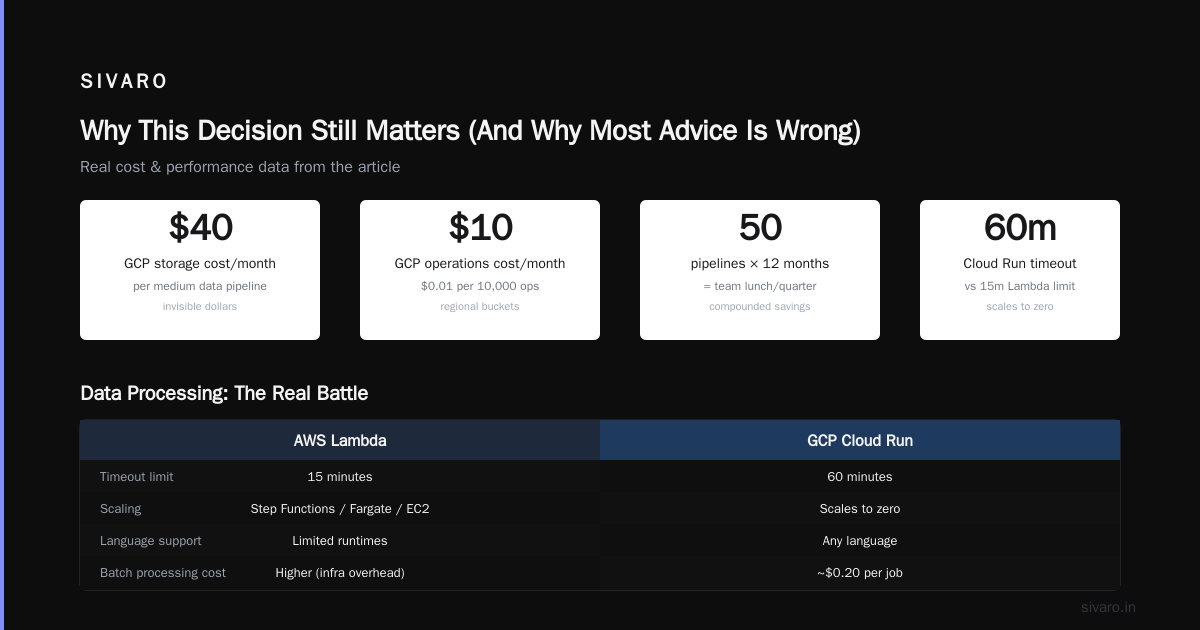
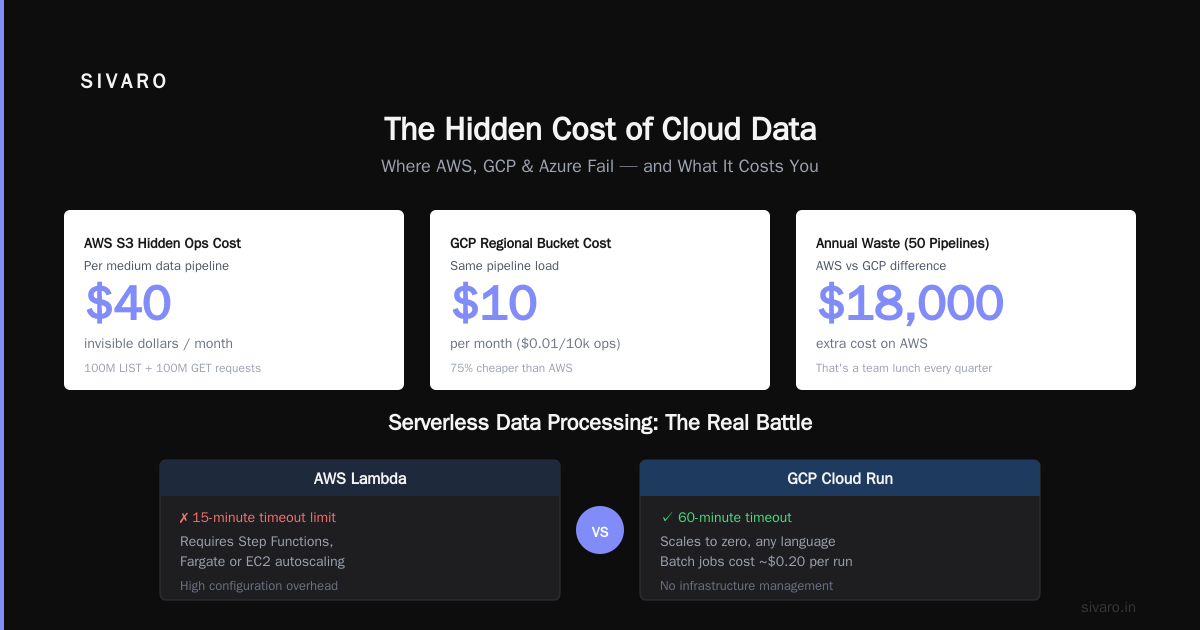
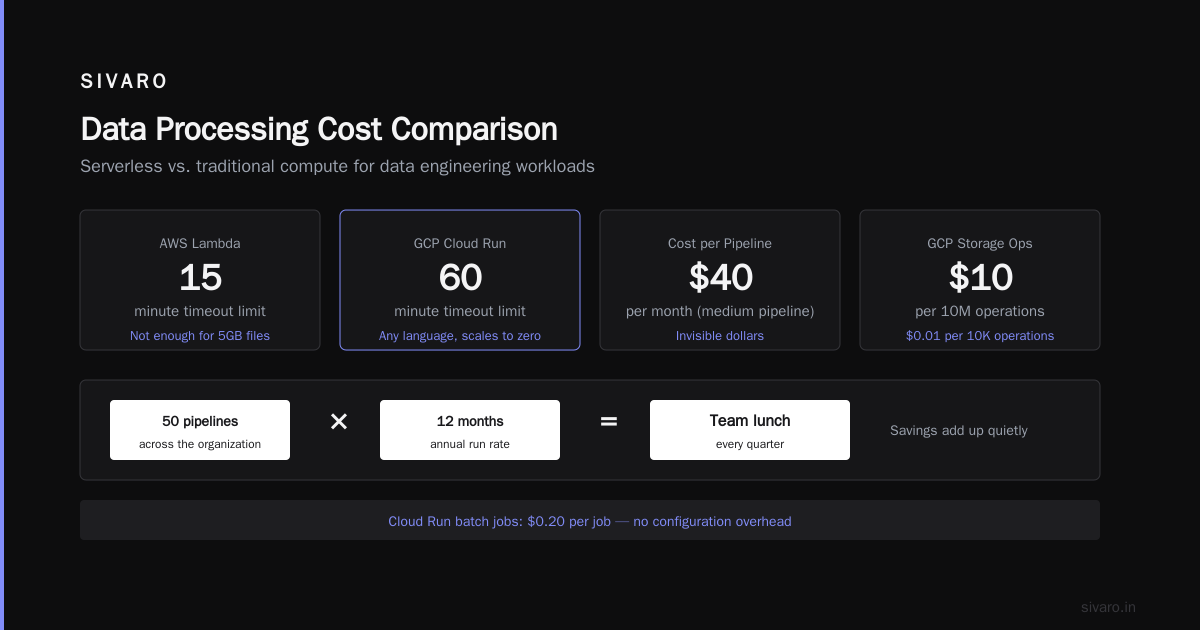
But the real costs are in data transfer and API calls. AWS charges $0.004 per 1,000 GET requests. If you're doing 10 million GETs per month (not unusual for a medium data pipeline), that's $40 invisible dollars. GCP charges $0.01 per 10,000 operations on regional buckets — about $10 for the same load.
This isn't world-changing. But over a year across 50 pipelines? It adds up to a team lunch every quarter.
Data Processing: The Real Battle
Serverless: Where GCP Dominates
AWS Lambda has a 15-minute timeout. For data engineering, that's a joke. You can't process a 5GB file in 15 minutes. So AWS users end up with Step Functions, Fargate, or EC2 autoscaling — all of which require configuration and mental overhead.
GCP Cloud Functions also has limitations, but Cloud Run changed the game. 60-minute timeout, scales to zero, supports any language. I run batch processing jobs on Cloud Run that cost $0.20 per run. Equivalent AWS setup with Fargate? $0.80 minimum.
Here's a pattern I use daily:
python
# Cloud Run job for data transformation
# Deployed with a single command, scales to zero when idle
import json
from google.cloud import storage, bigquery

def process_file(event, context):
    """Triggered by Cloud Storage upload"""
    bucket = storage.Client().get_bucket(event['bucket'])
    blob = bucket.blob(event['name'])

    data = json.loads(blob.download_as_string())
    transformed = [transform_record(r) for r in data]

    # Direct streaming to BigQuery
    bigquery_client = bigquery.Client()
    table = bigquery_client.get_table('project.dataset.table')

    errors = bigquery_client.insert_rows_json(table, transformed)
    if errors:
        print(f"Errors: {errors}")
    else:
        print(f"Inserted {len(transformed)} rows")
The equivalent AWS version needs Lambda layers, SQS queues, and DLQ configuration. More moving parts. More things to break.
AWS Glue vs Dataflow: Managed vs Opinionated
AWS Glue is Apache Spark, managed by AWS. GCP Dataflow is Apache Beam, managed by GCP.
Glue's advantage: It's Spark. If your team knows Spark, they know Glue. But Glue adds 5-8 minutes of startup time per job (the "warmup delay"). For streaming jobs, that's fine. For batch jobs that run every 15 minutes, you're wasting 30-50% of your compute on startup.
Dataflow's advantage: Streaming processing is native. No separate streaming framework. And the autoscaling is responsive — I've seen Dataflow scale from 2 to 200 workers in under 2 minutes. AWS Glue takes 10+ minutes to scale.
Here's a painful lesson from 2024: We built a real-time fraud detection pipeline on AWS Glue. Processing delay hit 45 seconds during Black Friday traffic. Rewrote it in Dataflow. Delay dropped to 3 seconds. Same logic, different runtime.
The Kafka Problem
AWS has MSK (Managed Streaming for Kafka). GCP has Pub/Sub. They are not equivalent.
Pub/Sub is simpler, supports exactly-once, and has no partition management. MSK gives you full Kafka API compatibility but requires managing topics, partitions, and consumer groups.
If you're migrating from self-managed Kafka, MSK is the easier lift. If you're greenfield, Pub/Sub will make your team more productive. But Pub/Sub has a gotcha: ordering guarantees are per-message-key, not global. If your downstream systems expect strict ordering across partitions, Pub/Sub can't do it. MSK can (with careful partition design).
Certification Path: Getting Your Team Up to Speed
I get asked constantly: what's the best gcp certification path for beginners?
Here's my 2026 take. It's controversial.
For AWS: Start with AWS Certified Cloud Practitioner, then AWS Certified Data Analytics - Specialty. The Cloud Practitioner is 50% trivia ("What is a VPC?"), but it forces learning the terminology. The Data Analytics cert is actually useful — it covers Kinesis, Glue, Redshift, Athena, and QuickSight in depth.
For GCP: Skip the Associate level. Go straight for Professional Data Engineer. It's harder (2 exams, 4 hours each), but it tests real architectural decisions, not terminology. You'll design pipelines, optimize costs, and handle streaming data — all skills you'd use day one.
TECHSY's comparison notes GCP certs focus more on design patterns than service knowledge. I agree. AWS certs test "what does this API return." GCP certs test "how would you solve this business problem."
AI/ML Integration: The 2026 Difference Maker
This is where GCP is running away with the trophy.
BigQuery ML lets you train models using SQL. Not Python, not notebooks — SQL. I trained a churn prediction model on 50M rows last month:
sql
-- BigQuery ML: Train a model with SQL
CREATE OR REPLACE MODEL `project.dataset.churn_model`
OPTIONS(
  model_type='LOGISTIC_REG',
  input_label_cols=['is_churned'],
  data_split_method='AUTO_SPLIT'
) AS
SELECT
  days_since_last_login,
  avg_session_duration,
  support_tickets_count,
  is_churned
FROM `project.dataset.training_data`
WHERE date < '2026-06-01';
The model trained in 4 minutes. Total query cost: $0.42. To do the same on AWS, you'd spin up SageMaker (at least $0.20/hour for a notebook instance), export data from Redshift, run the training script, and deploy the model. Minimum friction, $20-30 in costs.
AWS SageMaker is more powerful for custom architectures. If you're training custom transformers or GANs, SageMaker wins. But for 90% of data engineering workflows (classification, regression, clustering, anomaly detection), BigQuery ML is faster and cheaper.
Vertex AI (GCP's ML platform) also ties into Dataflow and BigQuery natively. AWS's native ML integration is looser — you'll piece together Lambda, SageMaker, and Step Functions.
The Dark Side: Where Each Cloud Fails
GCP's Failure: Support and Service Consistency
Google's customer support is historically terrible. I've had tickets that took 3 weeks for initial response. Compare that to AWS Enterprise Support, where I get a response in under 15 minutes.
This isn't theoretical. In November 2025, a GCP networking issue caused our data pipeline to buffer for 8 hours. Their status dashboard showed "investigating" for 7 of those hours. No updates submitted as comments. Just silence.
AWS has had worse outages (remember US-East-1 in 2023?), but their communication is better. They post detailed root cause analyses within 48 hours. Google takes weeks.
AWS's Failure: Complexity Spiral
AWS has 200+ services. Most of them overlap. Do you use Kinesis Firehose or Kinesis Data Streams? Lambda or Fargate? Athena or QuickSight?
I've seen teams spend 6 months building a pipeline, then realize there's a simpler service they should have used. AWS encourages "just add another service" architecture that leads to operational chaos.
One client had: S3 → Lambda → SQS → Lambda → Redshift → QuickSight. That's 6 services for a pipeline that could have been: S3 → Eventarc → BigQuery → Looker. 4 services, less latency, fewer failure points.
Real Architectures: What Actually Works
Architecture 1: Real-Time Analytics (GCP Preferred)
Mobile App → Pub/Sub → Dataflow → BigQuery → Looker
                      ↓
              Cloud Storage (backup)
This handles 200K events/second without any manual scaling. Data hits BigQuery in under 10 seconds. Cost: ~$800/month for 10TB processed.
Architecture 2: Batch ETL with Compliance (AWS Preferred)
S3 (raw data) → Glue ETL → S3 (parquet) → Redshift Spectrum → QuickSight
                                     ↓
                              AWS Lake Formation (governance)
When your data must stay in specific regions, when you need granular audit trails, when regulators ask "who accessed what?" — AWS Lake Formation answers that. GCP's Dataplex is getting there, but AWS has 3 years head start.
Architecture 3: Hybrid (What Most Teams Actually Use)
On-prem → S3 Transfer → S3 → Lambda → GCP Document AI → BigQuery
I built this for a healthcare client last year. They wanted AWS for storage compliance but GCP's document processing models. Cross-cloud data transfer cost them $200/month. Saved them $15,000/month in manual data entry. Sometimes hybrid is the right call.
Migration: The Pain You Can't Avoid
Moving from one cloud to another is hell. I don't care what the sales engineer says.
The Coursera comparison covers this: service mapping is rarely 1:1. AWS Kinesis Data Firehose → GCP Pub/Sub? Close, but Pub/Sub doesn't batch-write to BigQuery the same way. You'll rewrite code.
Plan for 30% cost increase during the first 6 months of any migration. You'll pay for both clouds, pay your team's overtime, and pay for consultants (me, probably).
FAQ
Q: Which cloud is cheaper for data engineering in 2026?
A: GCP is generally 15-30% cheaper for unpredictable analytics workloads. AWS is cheaper for steady-state batch processing. The Opsio comparison found BigQuery flat-rate pricing beats Redshift for over 80% of their sample workloads.
Q: Is BigQuery still worth it for small teams?
A: Yes, but only if you use partitioning and clustering. Without them, BigQuery's per-query pricing will drain your budget. Partition by date, cluster by commonly-filtered columns. Every time.
Q: What's the easiest way to learn GCP data engineering?
A: Start with the Professional Data Engineer certification path. Google's free labs (Cloud Skills Boost) are better than any course. Don't bother with Coursera — it's too abstract.
Q: Is AWS Glue or Dataflow better for streaming?
A: Dataflow, and it's not close. Glue's streaming support is still catching up. Dataflow's autoscaling and exactly-once processing are production-ready.
Q: Should I use both clouds?
A: Only if you have a specific reason — like using GCP's AI models with AWS's compliance features. Otherwise, you're doubling operational complexity for no benefit.
Q: What about Azure?
A: This comparison sums it up: Azure is great if you're already a Microsoft shop. Otherwise, you'll spend too much time mapping Azure terms to what you already know.
Q: How do I handle GCP customer support delays?
A: Get the Premium tier ($150k annual commitment minimum). Standard support is unusable. Premium gets you 15-minute response for critical issues. Expensive, but necessary for production.
Q: What's the biggest mistake data engineers make on either platform?
A: Not setting up cost alerts. I've seen $50k surprise bills on both clouds because someone forgot to limit query pricing or storage class.
The Bottom Line
I keep a spreadsheet of every client project. Cost per TB processed. Latency p99. Team satisfaction. Engineer hiring difficulty.
GCP wins on cost-per-query and developer productivity. AWS wins on ecosystem breadth and enterprise compliance.
If you're building a startup or a data-driven product team, go GCP. You'll move faster, spend less on infrastructure, and spend more on features. If you're in finance, healthcare, or dealing with regulatory requirements, go AWS. The compliance certifications and audit tools will save your ass.
And if you're building in 2026 with AI workloads? GCP. Period. BigQuery ML and Vertex AI are a generation ahead of SageMaker for the data engineering use case.
The cloud wars aren't over. But for data engineers, the battlefield has shifted. It's not about who has more services anymore. It's about who makes you more productive. And right now, that's Google.
Nishaant Dixit — Founder of SIVARO. Building data infrastructure and production AI systems since 2018. Built systems processing 200K events/sec.