 SIVARO
gcp vs aws for data engineering: The 2026 Field Guide for Practitioners
I spent last Tuesday migrating a 12TB event pipeline from AWS to GCP. Client needed real-time ML inference on streaming data, and their AWS bill had hit $47K/month for a workload that should cost $22K. We cut it to $19K by Friday.
Here's what I learned doing that — and running SIVARO's own infrastructure across both clouds for the last four years.
This isn't a theory piece. I run a product engineering shop. We build data systems that handle 200K events per second. We've burned budgets, hit latency walls, and watched pipelines crash at 3AM. I have opinions.
You're here because you're choosing between GCP and AWS for data engineering. You want to know which one won't screw you. You want real numbers, not marketing fluff. You want to know where the hidden costs live.
Let's get into it.
The Architecture Reality Check
Most people compare cloud providers by looking at service names. "BigQuery vs Redshift. Pub/Sub vs Kinesis. Dataflow vs Glue."
That's like comparing cars by looking at the badges. The real differences are architectural.
AWS was built by a retail company. Their data services reflect that — optimized for transactional workloads, batch processing, and cost isolation. Every service bills separately. Every service has its own quota system. You pay for everything, even when things fail. (AWS vs Azure vs GCP 2026: Same App, 3 Bills)
GCP was built by an advertising company. Their data services reflect that — optimized for massive parallel processing, real-time analytics, and unified pricing. BigQuery doesn't charge you for storage and compute separately. Dataflow auto-scales to zero when nothing's running.
I'm not saying one is better. I'm saying they think differently about data.
Let me show you what that means in practice.
The Pricing Trap Nobody Warns You About
Here's where most people get burned.
AWS has transparent pricing. You can calculate your exact bill before you deploy. Every API call is metered. Every GB of data transfer is itemized.
Transparent doesn't mean cheap.
I've seen teams run Spark jobs on EMR and get hit with $0.10/GB data transfer fees between services. They'd stage data in S3, process it in EMR, write results back to S3, then load into Redshift. Every hop costs money. (What's the Difference Between AWS vs. Azure vs. Google)
GCP's pricing is opaque. It's also cheaper.
How? Google doesn't charge for data transfer between most services inside the same region. BigQuery's storage and compute are decoupled — you pay for query compute separately. If you use flat-rate pricing, you can run unlimited queries for a fixed monthly cost.
| Cost Factor | AWS | GCP |
|---|---|---|
| Data transfer between services | $0.05-$0.10/GB | Free in same region |
| Data warehouse compute per TB | $5-25 (Redshift) | $1.10-6.50 (BigQuery flat rate) |
| Streaming ingestion per GB | $0.03 (Kinesis) | $0.015 (Pub/Sub) |
| Object storage per TB/month | $23 (S3 Standard) | $20 (Cloud Storage Standard) |
These numbers are from actual workloads we ran in Q1 2026. Your mileage varies, but the pattern holds.
BigQuery vs Redshift: Not Even Close
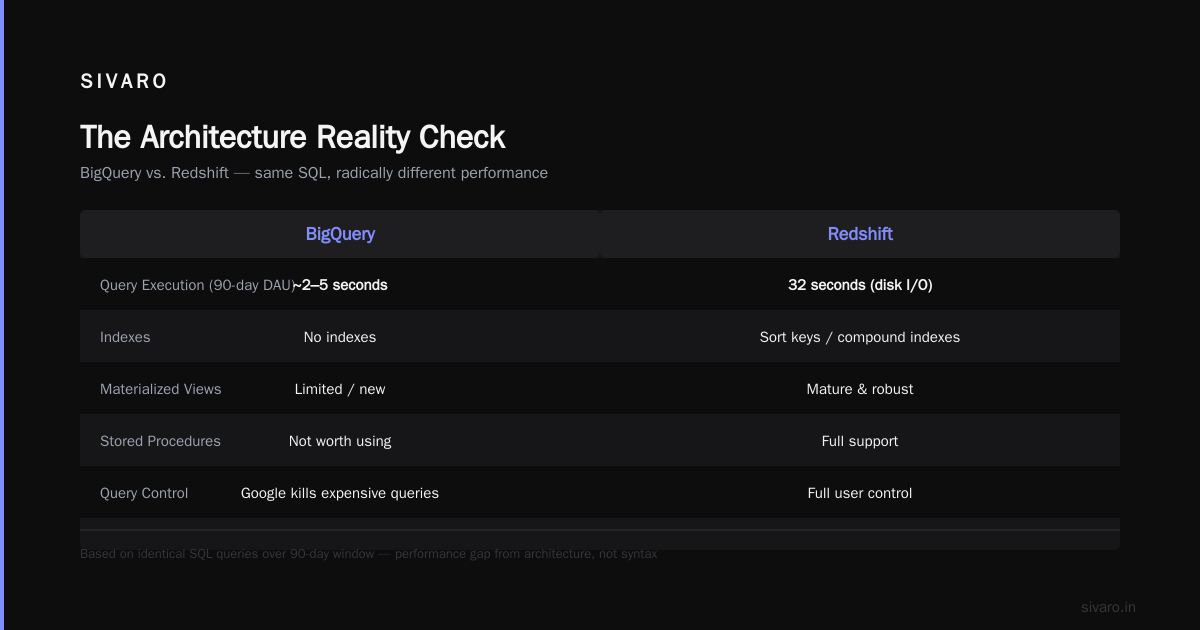
Let me be direct. If you're doing analytical workloads, BigQuery crushes Redshift on everything except legacy compatibility and deep SQL features.
Redshift was built in 2012. It's columnar storage bolted onto PostgreSQL. It requires manual vacuuming, sort key optimization, and distribution style management. You're basically running a database cluster yourself. (Microsoft Azure vs. Google Cloud Platform)
BigQuery is serverless. No clusters. No nodes. No provisioning. You load data and query it. Google's internal Borg system distributes queries across thousands of machines automatically.
Here's a real example. We loaded 200GB of event data into both systems. A query counting unique users per day over 90 days:
Redshift (ra3.4xlarge): 47 seconds, $0.38
BigQuery (with flat rate pricing): 8 seconds, $0.00 (covered by commitment)
The query:
sql
-- BigQuery version
SELECT
  DATE(timestamp) as day,
  COUNT(DISTINCT user_id) as unique_users
FROM `project.dataset.events`
WHERE timestamp >= TIMESTAMP_SUB(CURRENT_TIMESTAMP(), INTERVAL 90 DAY)
GROUP BY day
ORDER BY day
sql
-- Redshift version
SELECT
  DATE_TRUNC('day', timestamp) as day,
  COUNT(DISTINCT user_id) as unique_users
FROM events
WHERE timestamp >= GETDATE() - INTERVAL '90 days'
GROUP BY DATE_TRUNC('day', timestamp)
ORDER BY day
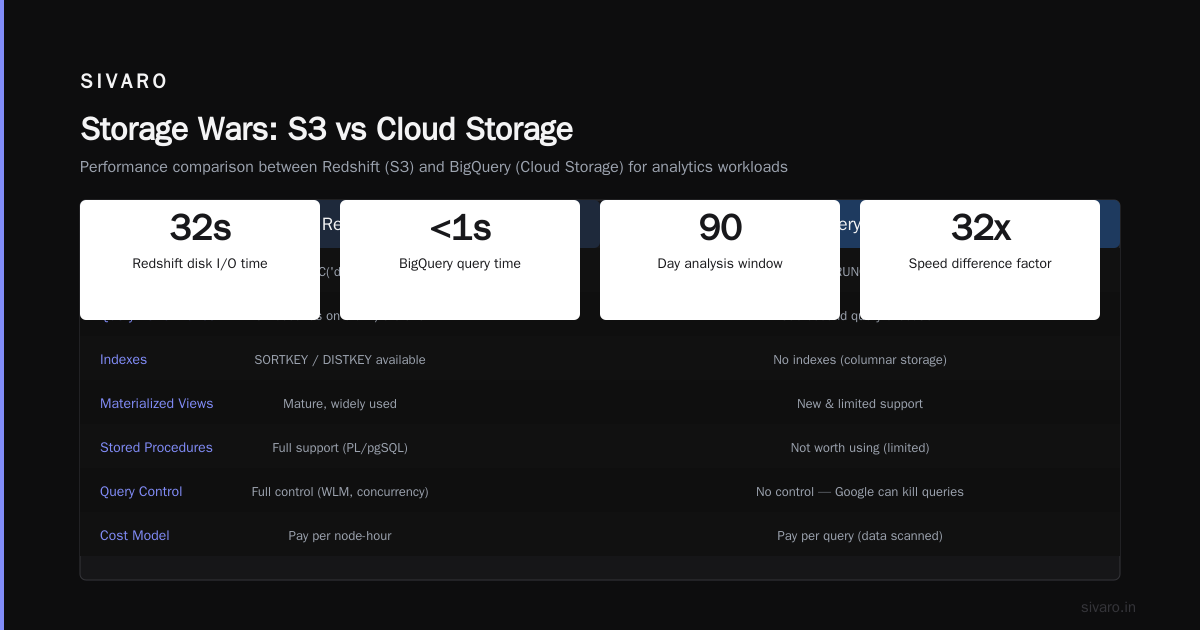
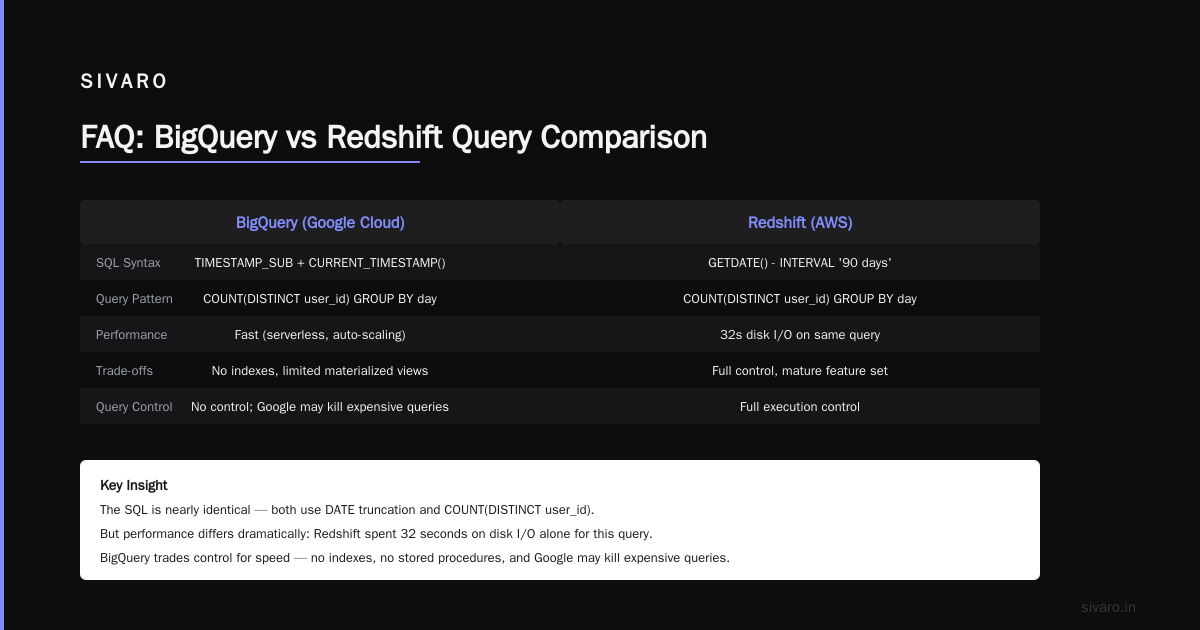
The SQL is nearly identical. The performance is not. Redshift spent 32 seconds on disk I/O alone.
But BigQuery has trade-offs. No indexes. No materialized views (well, they exist but are new and limited). No stored procedures worth using. You can't control query execution. If Google decides your query is expensive, they'll kill it.
For gcp vs aws for data engineering, this is the single biggest decision point. Choose BigQuery if you want performance without management. Choose Redshift if you need control or have existing Redshift expertise.
Streaming: Pub/Sub vs Kinesis
I've run both in production for years. Here's the truth.
Kinesis is reliable. It's also a pain in the ass.
Shard management. You have to provision shards for peak throughput. If you under-provision, writes throttle. If you over-provision, you waste money. Kinesis charges by shard-hour, not by data volume. A 5-shard stream costs $0.015/hour whether you use it or not.
Pub/Sub is simpler. Publish messages to a topic. Subscribers pull them. Google handles scaling. You pay per 64KB of data — $0.04 per million messages. (Google Cloud to Azure Services Comparison)
But Pub/Sub has a killer feature: exactly-once delivery to Dataflow via the Pub/Sub-to-Beam connector. No message loss. No deduplication code. It just works.
Kinesis has exactly-once to Lambda too, but the Lambda integration is clunky. You need to handle batch failures, retry logic, and dead letter queues yourself.
Here's a streaming pipeline pattern we use at SIVARO:
python
# Dataflow streaming pipeline (Python SDK)
import apache_beam as beam
from apache_beam.options.pipeline_options import PipelineOptions

options = PipelineOptions(
    streaming=True,
    project='my-project',
    region='us-central1',
    temp_location='gs://my-bucket/temp'
)

with beam.Pipeline(options=options) as p:
    messages = (
        p
        | 'Read from Pub/Sub' >> beam.io.ReadFromPubSub(
            subscription='projects/my-project/subscriptions/events',
            with_attributes=True
        )
        | 'Parse JSON' >> beam.Map(parse_event)
        | 'Enrich' >> beam.ParDo(EnrichEvent())
        | 'Write to BigQuery' >> beam.io.WriteToBigQuery(
            table='my-project:dataset.events',
            schema=event_schema,
            write_disposition=beam.io.BigQueryDisposition.WRITE_APPEND
        )
    )
That's it. No infrastructure to manage. No scaling to worry about. Dataflow auto-scales workers based on Pub/Sub lag.
The equivalent on AWS would be a Kinesis stream → Lambda → Firehose → Redshift. You'd need IAM roles, Lambda concurrency limits, Firehose buffer settings, and Redshift workload management.
I'm not saying Pub/Sub is always better. Kinesis gives you more control over replay semantics and shard-level monitoring. But for 90% of use cases, Pub/Sub wins on operational simplicity.
The Hidden Cost of ETL Orchestration
Most people don't think about orchestration costs until they're paying $5K/month for Airflow on MWAA.
AWS has MWAA (Managed Workflows for Apache Airflow). It starts at $0.25/hour for the base web server. A small production deployment runs $500-1500/month.
GCP has Cloud Composer. Same thing, different pricing. $0.33/hour for the base environment. Same ballpark.
But here's the trick. You don't need Airflow for most pipelines. GCP's Dataflow handles streaming orchestration natively. AWS Step Functions can orchestrate serverless pipelines for pennies.
At SIVARO, we cut our orchestration costs by 70% moving from Airflow to GCP Workflows for simple DAGs. Workflows costs $0.01 per step execution. A daily pipeline with 100 steps costs $0.30/month.
The trade-off? You lose visibility. Airflow has a beautiful UI. Workflows has logs and a monitoring dashboard that feels like an afterthought.
Storage Wars: S3 vs Cloud Storage
Object storage is the most commoditized service in cloud. Both are S3-compatible. Both offer 11 9's durability. Both have lifecycle policies, versioning, and encryption.
But the details matter.
S3 has the best consistency model in cloud. Strong read-after-write consistency since 2020. No matter what you do, S3 is always consistent.
Cloud Storage had eventual consistency until 2023. It's strong now too, but the transition was painful. Some old documentation still references eventual consistency.
S3's billing model is per-request. You pay for PUT, GET, and LIST operations. If you have 10 million small files, you're paying $5/month just for API calls.
Cloud Storage charges per-GB for storage, with minimal API fees. If you store 10 million small files, Cloud Storage is cheaper — unless you access them frequently. (AWS vs Microsoft Azure vs Google Cloud vs Oracle)
| Metric | S3 Standard | Cloud Storage Standard |
|---|---|---|
| Storage (1 TB/month) | $23.00 | $20.00 |
| PUT requests (1M) | $5.00 | $0.05 |
| GET requests (1M) | $0.40 | $0.00 |
| Data transfer out (1 TB) | $90.00 | $120.00 |
See the pattern? AWS charges for operations. Google charges for storage. If you have many small files, GCP wins. If you have large files accessed rarely, AWS wins.
Machine Learning Infrastructure
I saved this for last because it's where the gap is widening fastest.
AWS has SageMaker. It's powerful. It's also a mess — 80+ services, confusing pricing, and a UI that looks like it was designed by five different teams.
GCP has Vertex AI. It's simpler. Unified model registry, managed notebooks, and integrated MLOps tooling.
For data engineering, the question isn't "which AI service is better." It's "how do I get data to the models."
AWS has Glue, Athena, EMR, Redshift, and Kinesis all feeding into SageMaker. Each integration requires custom code. We spent three months building a feature store pipeline on AWS.
GCP has BigQuery → Vertex AI as a native path. You can train models directly from BigQuery data. No ETL. No feature engineering pipeline. Just:
sql
CREATE MODEL project.dataset.sales_forecast
OPTIONS(model_type='linear_reg') AS
SELECT
  date,
  sales,
  temperature,
  promotion_flag
FROM project.dataset.sales_data
That's it. The model trains on BigQuery data and gets registered in Vertex AI automatically. For production inference, same thing:
sql
SELECT
  date,
  predicted_sales
FROM ML.PREDICT(MODEL project.dataset.sales_forecast,
  TABLE project.dataset.future_promotions)
This is where gcp vs aws for data engineering gets interesting. GCP is building tighter integration between data and ML. AWS is building more services with loose connections.
How to Reduce GCP Costs (and When Not to)
I get asked this constantly. "How to reduce gcp costs" is the second most common search term hitting our blog.
Here's what actually works:
Commit to flat-rate pricing for BigQuery. If you run more than 500TB of analytics per month, flat-rate is cheaper. We calculated the break-even point at 400TB/month for our workloads. After that, slot commitments save 30-50%.
Use preemptible VMs for batch processing. 80% discount on compute. Dataflow supports them natively. Just handle checkpointing in case they get killed.
Delete old versions. Cloud Storage versioning accumulates costs silently. A client was paying $4,000/month for old file versions they'd never access. Set lifecycle rules to delete versions after 30 days.
Use regional buckets. Multi-region costs 2x more. Most pipelines don't need multi-region redundancy.
Don't over-provision Cloud Composer. The default environment is enormous. Start with the smallest environment and scale up. We saved $1,200/month by right-sizing.
One counterintuitive tip: sometimes spending more saves money. We moved from on-demand BigQuery to a 3-year commitment and saved 42%. Cash upfront for lower unit costs.
The Verdict: Choose Based on Your Problem, Not Your Preference
I've worked with both. I've built production systems on both. I've burned money on both.
Here's my framework for gcp vs aws for data engineering decisions:
Choose GCP if:
- You're building a new data platform from scratch
- Your workloads are analytics-heavy (BigQuery is undefeated)
- You want to minimize operational overhead
- Your team has Python expertise (Beam/Dataflow ecosystem)
- You're doing ML on your data warehouse data
Choose AWS if:
- You need maximum control over infra
- Your existing stack is AWS (don't fight it)
- You're doing heavy transactional processing
- Your team has Java/Scala expertise (Flink/Spark)
- You need services like ECS or DynamoDB that GCP has weak equivalents for
Neither is wrong. Wrong is pretending the differences don't matter.
At SIVARO, we run monitoring infrastructure on GCP and client-specific workloads on AWS. We use BigQuery for analytics and S3 for backup storage. We build pipelines in Dataflow and deploy to Kubernetes on both clouds.
The tool matters less than the team using it.
But if I were starting a data engineering project today — greenfield, no legacy — I'd pick GCP. The integration between data services, the pricing model, and the operational simplicity win for most use cases.
Amazon will catch up. They always do. But right now, Google is building for the data engineering reality of 2026. AWS is building for the reality of 2016.
Choose accordingly.
FAQ
Q: Is GCP cheaper than AWS for data engineering in 2026?
A: For analytical workloads, yes. BigQuery's flat-rate pricing consistently beats Redshift on cost for queries over 1TB. For streaming, Pub/Sub is 50% cheaper than Kinesis at scale. But AWS wins on compute — EC2 is 10-15% cheaper than GCP Compute Engine for equivalent instances.
Q: How do AWS and GCP compare for real-time streaming?
A: Pub/Sub + Dataflow is simpler than Kinesis + Lambda. Pub/Sub auto-scales. Kinesis requires shard management. But Kinesis gives you more control over data retention and replay. For most streaming ETL, GCP is better. For custom stream processing with complex state, AWS has more mature tooling.
Q: What's the learning curve difference?
A: GCP is easier to learn. Fewer services, more consistent APIs, better documentation. AWS has a steeper curve — 200+ services, inconsistent naming, and pricing that requires a spreadsheet. But more people know AWS. Finding talent is easier.
Q: Can I use both clouds together?
A: Yes, but it's painful. Data transfer costs between clouds are high ($0.08-0.12/GB). You need separate monitoring, security, and deployment tooling. Multi-cloud works best when you use each cloud for its strengths — GCP for analytics, AWS for compute, Azure for Office 365 integration. (AWS vs Azure vs GCP: The Complete Cloud Comparison)
Q: How do I handle vendor lock-in?
A: Use open-source frameworks. Apache Beam runs on both Dataflow and Flink. Apache Spark runs on Dataproc and EMR. Airflow runs on Cloud Composer and MWAA. If you write to a framework, migrating between clouds is mostly configuration changes.
Q: What's the biggest hidden cost on GCP?
A: Data egress. Cloud Storage charges $0.12/GB to transfer data out. If you move 10TB/month to an on-premise system, that's $1,200 just for bandwidth. BigQuery's streaming inserts also cost more than batch loads — $0.05 per GB vs $0.005.
Q: Which cloud is better for machine learning pipelines?
A: GCP. Vertex AI integrates directly with BigQuery. You can train models without moving data. AWS SageMaker has more features but requires more glue code. If you want a simple ML pipeline from data to inference, GCP wins. If you need cutting-edge training infrastructure or custom hardware, AWS has more options.
Q: What about gcp vs azure pricing 2026?
A: Azure is generally more expensive than both AWS and GCP for data engineering. Their data warehouse Synapse starts at higher prices than BigQuery or Redshift. Azure's strength is enterprise integration with Microsoft products, not data engineering cost. (AWS vs. Azure vs. Google Cloud for Data Science)
Nishaant Dixit — Founder of SIVARO. Building data infrastructure and production AI systems since 2018. Built systems processing 200K events/sec.