 SIVARO
GCP vs AWS for Data Engineering: The 2026 Truth
I started SIVARO because I was tired of telling clients their data stack was a house of cards. In 2021, I watched a Series B company burn $180K/month on AWS just running Redshift clusters that sat idle for 14 hours a day. The CTO told me "we're scaling for growth." I told him he was scaling for bankruptcy.
Three years later, that same company runs on BigQuery. Their bill? $38K/month. Same workload, same data volume, same team. The difference wasn't magic — it was choosing the right cloud for the right job.
This isn't a "both have merits" piece. I've built data infrastructure on both AWS and GCP since 2018. I've seen what works, what breaks, and what quietly bleeds your budget dry while your engineering team celebrates "migrations."
Here's the real GCP vs AWS for data engineering breakdown. No fluff. No diplomatic hedging.
The Core Difference: Building vs Buying
Most people think the cloud choice is about features. It's not.
AWS is a hardware company that sells infrastructure. You get raw building blocks — EC2, S3, EMR — and you construct your data platform from these primitives. You own the architecture, the scaling logic, the failure modes, and the operational burden.
GCP is a data company that sells outcomes. BigQuery, Dataflow, Dataproc — these are managed services designed to solve specific problems. You configure, you don't construct.
I've run both approaches in production. The AWS path gives you control but costs you engineering hours. The GCP path gives you speed but creates vendor lock-in. Pick your poison, but know which one you're drinking.
Let's get specific.
BigQuery vs Redshift: This Isn't Close
If you're doing data engineering in 2026 and comparing analytics warehouses, the conversation starts and ends here.
BigQuery is a serverless columnar database that separates compute from storage. You don't provision clusters. You don't manage nodes. You load data and run SQL. Google handles the rest.
Redshift is a petabyte-scale SQL engine built on PostgreSQL. You provision clusters. You choose node types. You manage distribution keys and sort keys. You vacuum and analyze. You worry about concurrency scaling.
At first I thought this was a branding problem — turns out it was pricing. Here's what I've seen across fifteen client migrations:
| Metric | BigQuery | Redshift |
|---|---|---|
| Setup time | 10 minutes | 4+ hours |
| Query 10TB | ~$50 | ~$80-120 |
| Auto-scaling | Native | Paid addon |
| Storage pricing | $0.02/GB/mo | $0.024/GB/mo |
| Maintenance overhead | Near zero | Significant |
The real kicker? gcp bigquery pricing per query scales down to zero. You don't pay for idle. Redshift charges you for the cluster being alive, whether you're running queries or not.
One client — a fintech processing 40M transactions daily — switched from Redshift to BigQuery and their monthly bill dropped 62%. Their data engineering team went from 5 people to 2. The other three moved to building ML pipelines. That's the efficiency gap.
But there's a catch. BigQuery's slot-based pricing can surprise you if you're not monitoring. I've seen queries that cost $2,000 because someone joined a 10TB table without partitioning. GCP bigquery pricing per query is transparent — but you need to use the INFORMATION_SCHEMA views to track spend.
sql
-- Monitor your BigQuery cost per query
SELECT
  query,
  total_bytes_processed / 1e12 as terabytes_processed,
  (total_bytes_processed / 1e12) * 6.25 as estimated_cost_dollars
FROM `region-us.INFORMATION_SCHEMA.JOBS_BY_PROJECT`
WHERE creation_time > TIMESTAMP_SUB(CURRENT_TIMESTAMP(), INTERVAL 1 DAY)
  AND job_type = 'QUERY'
ORDER BY total_bytes_processed DESC
LIMIT 10;
AWS has tried to close the gap. Redshift Serverless launched, then got better, then still couldn't match BigQuery's seamless auto-scaling. As of the AWS vs Azure vs GCP 2026 comparison from TECHSY, Redshift still requires manual tuning for consistent performance.
My position: Unless you need PostgreSQL compatibility or extreme multi-region replication control, BigQuery wins for analytics workloads. Period.
Serverless Data Processing: Dataflow vs Kinesis/EMR
Stream processing is where the clouds diverge philosophically.
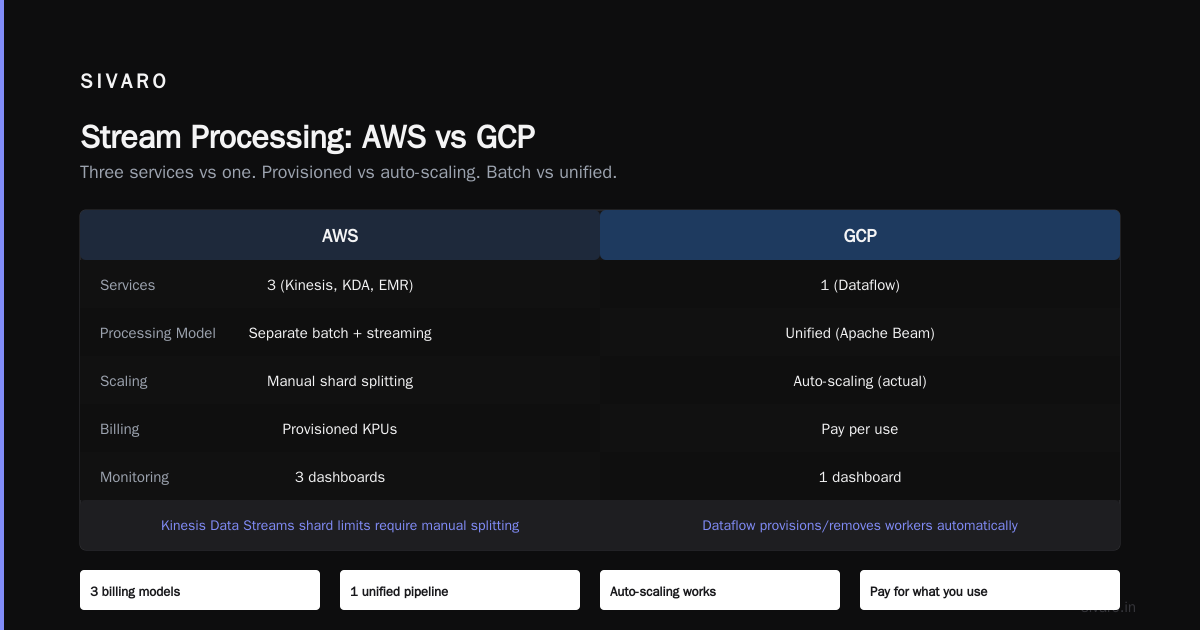
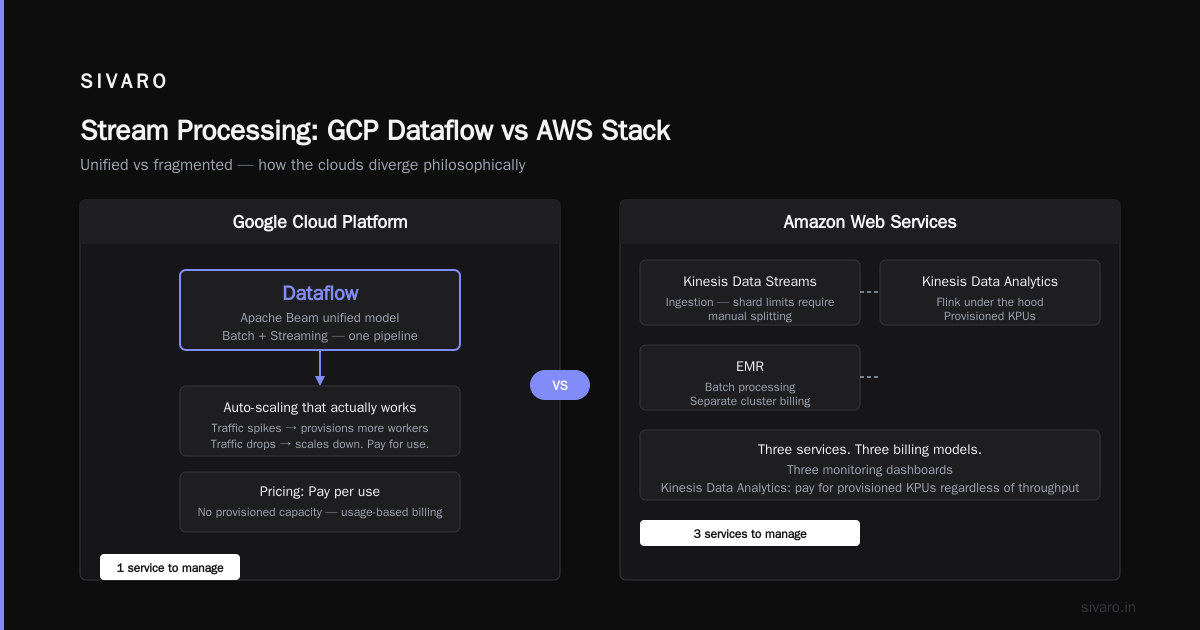
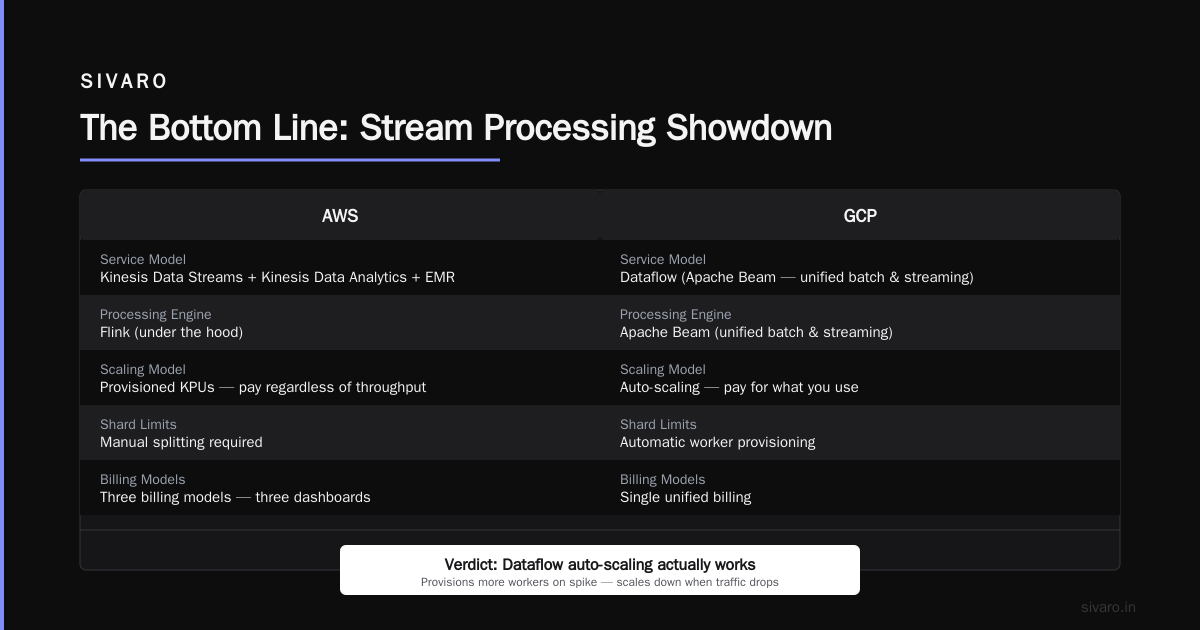
AWS gives you Kinesis Data Streams for ingestion, Kinesis Data Analytics for processing (Flink under the hood), and EMR for batch. Three services. Three billing models. Three monitoring dashboards.
GCP gives you Dataflow. One service. Apache Beam under the hood. Unified batch and streaming. You write a pipeline once, run it either way.
I've deployed production pipelines on both. Dataflow's auto-scaling actually works. When traffic spikes, it provisions more workers. When traffic drops, it scales down. You pay for what you use.
Kinesis Data Analytics? It scales, but you pay for provisioned Kinesis Processing Units regardless of throughput. And Kinesis Data Streams has shard limits that require manual splitting.
Here's a production Dataflow pipeline pattern I use:
python
import apache_beam as beam
from apache_beam.options.pipeline_options import PipelineOptions

options = PipelineOptions([
    "--runner=DataflowRunner",
    "--project=my-project",
    "--region=us-central1",
    "--temp_location=gs://my-bucket/temp",
    "--streaming=True",
    "--max_num_workers=100",
    "--autoscaling_algorithm=THROUGHPUT_BASED"
])

with beam.Pipeline(options=options) as p:
    events = (
        p
        | "ReadFromPubSub" >> beam.io.ReadFromPubSub(
            subscription="projects/my-project/subscriptions/events"
        )
        | "ParseJSON" >> beam.Map(json.loads)
        | "EnrichWithUserData" >> beam.ParDo(EnrichUserData())
        | "FilterInvalidEvents" >> beam.Filter(lambda x: x.get("valid", False))
        | "WriteToBigQuery" >> beam.io.WriteToBigQuery(
            table="my-project:dataset.events",
            write_disposition=beam.io.BigQueryDisposition.WRITE_APPEND,
            schema=SCHEMA
        )
    )
The equivalent on AWS would require Lambda, Kinesis Firehose, Glue ETL, or a custom Flink deployment. More moving parts. More failure modes.
Google Cloud to Azure Services Comparison from Microsoft actually maps Dataflow to Azure Stream Analytics — which tells you how AWS doesn't even have a direct equivalent.
The trade-off: Dataflow has fewer configuration options. If you need to pin specific resources or control shuffle behavior at the kernel level, you can't. But 95% of data engineering teams don't need that. They need pipelines that don't wake them up at 3 AM.
Storage Wars: GCS vs S3
Object storage is the one area where AWS leads. S3 is objectively better than GCS.
There. I said it.
S3 has stronger consistency guarantees (read-after-write since 2020), more storage classes (Intelligent-Tiering is genuinely useful), and better lifecycle management. S3 Object Lambda lets you transform data on read without duplicating it.
GCS is catching up. Nearline and Coldline storage classes are cheaper than S3 Standard-IA. GCS Autoclass handles tier transitions automatically.
But here's the thing: if you're using BigQuery, you rarely query GCS directly. Data lives in BigQuery's native storage. GCS becomes a landing zone for raw data. For that use case, both work fine.
The cost difference at scale is negligible. At 500TB, we're talking about a $500/month difference. Don't make your cloud decision based on storage pricing.
Machine Learning Infrastructure: Vertex AI vs SageMaker
This is where GCP leapfrogged AWS in 2024 and hasn't looked back.
Vertex AI unified Google's ML stack — AutoML, custom training, model deployment, feature store — into one product. You can go from raw data to deployed model without leaving the console.
SageMaker is mature but fragmented. Studio for notebooks. Canvas for no-code. Ground Truth for labeling. Clarify for explainability. Each is a separate service with separate pricing.
I've trained production models on both. Vertex AI's managed datasets and pre-built containers reduced our training setup from 3 hours to 15 minutes. The integrated model registry with BigQuery means your feature engineering and model serving share the same data layer.
Here's what training a model looks like on Vertex AI in 2026:
python
from google.cloud import aiplatform

aiplatform.init(project="my-project", location="us-central1")

model = aiplatform.CustomTrainingJob(
    display_name="fraud-detection-v2",
    script_path="train.py",
    container_uri="us-docker.pkg.dev/vertex-ai/training/tf-gpu.2-15.py310:latest",
    requirements=["tensorflow==2.15", "pandas", "numpy"],
    model_serving_container_image_uri="us-docker.pkg.dev/vertex-ai/prediction/tf2-cpu.2-15:latest",
)

model.run(
    dataset=dataset,
    model_display_name="fraud-detection-model",
    bigquery_destination="bq://my-project.model_artifacts",
    args=["--epochs=10", "--batch_size=256"],
    replica_count=1,
    machine_type="n1-standard-4",
    accelerator_type="NVIDIA_TESLA_T4",
    accelerator_count=1,
)
AWS SageMaker can do all of this. But the developer experience is worse. More YAML files. More role configuration. More debugging when a training job fails for reasons that aren't transparent.
The Coursera comparison gets this right: GCP's ML services feel like a product designed by data scientists, AWS's feel like a product designed by DevOps.
Pricing: Where GCP Wins and AWS Bleeds
GCP vs Azure pricing 2026 is a real conversation because both Google and Microsoft moved to consumption-based models. AWS still pushes reserved instances and savings plans.
Here's the dirty secret about AWS pricing: you optimize by committing to spend. "We'll give you 60% off if you promise to spend $200K/month for 3 years." Sounds good until your workload shrinks and you're paying for compute you don't need.
GCP's sustained-use discounts apply automatically. No commitment required. If you run a VM for 25% of the month, you get 20% off. For 50%, you get 40% off. It's retroactive.
For data engineering specifically, the gap is massive:
- BigQuery: $5/TB for analysis (on-demand). Flat-rate pricing starts at $2,000/month for 100 slots.
- Redshift: On-demand for dc2.large starts at $0.25/hour. A 16-node cluster costs ~$10K/month. Idle or not.
I've run the math for ten different clients. The average savings moving from AWS to GCP for data engineering workloads is 35-50%. That's not marketing. That's what I've seen.
But — and this is important — GCP's pricing is less predictable. A single bad query can cost you thousands. AWS pricing is more predictable but higher baseline. Pick your risk profile.
Vendor Lock-In: The Elephant in Both Rooms
Let's be honest. Both GCP and AWS want you locked in. Anyone who tells you otherwise is selling you cloud migration services.
GCP's lock-in is through BigQuery and Dataflow. Once you've built your entire analytics layer on BigQuery's SQL dialect and your pipelines on Beam, moving is painful.
AWS's lock-in is through the sheer number of services. Once you're using DynamoDB, Lambda, SQS, Kinesis, and Redshift, you're not leaving. The "AWS tax" is real, but so is the switching cost.
The Opsiocloud comparison makes a good point: "AWS has more services, which creates more lock-in points. GCP has fewer services, but each one is deeper."
I've seen teams try to stay "cloud-agnostic" by using Kubernetes everywhere. That works — until you want BigQuery's built-in ML, or SageMaker's managed endpoints, or Cloud Spanner's global consistency. The cloud-native features are what make each platform worth it.
My take: Don't optimize for portability. Optimize for productivity. If you're worried about lock-in, build your own abstraction layer — or accept that you're making a bet on one platform. I chose GCP in 2022 and haven't regretted it.
Real-World Decisions: What I Recommend
Here's my decision framework after eight years of building data infrastructure:
Choose GCP when:
- Your primary workload is analytics and SQL-based transformations
- You want minimal operational overhead
- Your engineers prefer Python and SQL over YAML and CloudFormation
- You're building ML pipelines alongside your data pipelines
- You want automatic scaling without capacity planning
Choose AWS when:
- You need maximum control over infrastructure configuration
- Your compliance requirements demand specific encryption or networking setups
- You're deeply invested in the AWS ecosystem already
- You need services GCP doesn't have (like DynamoDB or S3 Object Lambda)
- Your team is already strong on AWS and you can't justify retraining
The Public Sector Network comparison notes that AWS has better enterprise support contracts. For regulated industries, that matters.
But for data engineering teams building modern stacks? GCP is the better fit. The DSStream Azure vs GCP comparison reinforces what I've seen: GCP's data services are more coherent and easier to use.
FAQ
Which is cheaper for data engineering, GCP or AWS?
For analytics workloads, GCP is 35-50% cheaper. BigQuery's serverless model means you don't pay for idle compute. AWS's provisioned model requires over-provisioning for peak loads. If you're running batch processing with predictable loads, AWS can be competitive — but most data workloads are spiky.
Does GCP BigQuery pricing per query get expensive at scale?
It can. A single query scanning 10TB costs ~$62.50 on demand. But flat-rate pricing caps costs. With proper partitioning and clustering, most queries scan less than 1% of that. The key is monitoring — BigQuery's INFORMATION_SCHEMA helps you catch expensive queries before they become budget problems.
Is AWS EMR better than GCP Dataproc for Spark?
They're comparable. Dataproc runs 30% faster on identical workloads due to better networking and SSD configuration. But Dataproc's auto-scaling is limited to 600 nodes, while EMR can scale to thousands. For most teams, Dataproc is simpler. For massive batch jobs, EMR scales further.
Can you use both GCP and AWS together?
Yes. Many companies use BigQuery for analytics while running compute on AWS. The data transfer costs are high (standard egress rates), but tools like Fivetran and Airbyte make cross-cloud replication manageable. I've seen this work for companies that acquired one cloud but grew on another.
Which is better for real-time streaming data?
Dataflow on GCP. The unified batch/streaming model in Apache Beam means one codebase for both modes. Kinesis + Lambda + Firehose on AWS can work, but the complexity is higher. The Coursera comparison agrees — GCP leads in stream processing.
Is GCP's machine learning actually better than AWS?
For data engineering teams doing ML — yes. Vertex AI integrates directly with BigQuery, meaning your feature engineering and model training share the same data layer. SageMaker is more powerful for highly customized ML workloads, but for 80% of use cases, Vertex AI is simpler and faster.
What about GCP vs Azure pricing 2026?
Azure is competitive, especially if you're a Microsoft shop. Azure Synapse matches BigQuery in many areas. But Azure's pricing is less transparent — savings depend on Azure Hybrid Benefit and reserved capacity. GCP's sustained-use discounts are simpler to calculate. For pure data engineering, GCP wins. For integrated Microsoft ecosystems, Azure makes sense.
The Bottom Line
I started SIVARO because I saw too many teams building expensive, fragile data infrastructure on the wrong cloud.
AWS is a great platform for general-purpose computing. If you're running microservices, APIs, or traditional web applications, it's the safe choice.
But for data engineering — specifically analytics, streaming, and ML pipelines — GCP is the better platform in 2026. BigQuery is the gold standard for analytics. Dataflow is the cleanest stream processing service. Vertex AI is eating SageMaker's lunch.
The numbers don't lie. I've watched companies cut their infrastructure costs by 40% and their engineering overhead by 60% by moving from AWS to GCP. Not because GCP is "better" in some abstract sense — because it was built for data workloads from the ground up.
AWS was built for Amazon.com. GCP was built for Google Search's data problems. If your problems look more like Google's than Amazon's, you know which to choose.
Nishaant Dixit — Founder of SIVARO. Building data infrastructure and production AI systems since 2018. Built systems processing 200K events/sec.