 SIVARO
GCP vs AWS for Data Engineering: What Actually Works in 2026
I spent last week migrating a client's pipeline off BigQuery. The bill was $47,000 for a workload we'd sized at $12,000. The client was furious. I was embarrassed.
This is the reality of choosing between Google Cloud and AWS for data engineering. The marketing says one thing. The invoice says another.
Let me be blunt: I've run production data systems on both platforms since 2018. At SIVARO, we process 200K events per second for clients ranging from fintech startups to logistics companies moving millions of packages daily. I've made expensive mistakes on both clouds.
Here's what I wish someone had told me four years ago.
The Core Difference Nobody Talks About
Most comparison articles tell you that AWS has more services. Google has better AI. Azure has enterprise integration. That's true but useless.
The real difference? Google Cloud was built by the people who run the world's largest data infrastructure. YouTube, Search, Maps — Google runs these on internal tools that became BigQuery, Dataflow, and Pub/Sub. AWS was built by an online bookstore that needed to monetize excess server capacity.
You can feel this in every service.
BigQuery was designed for petabyte-scale analytics from day one. Redshift was a fork of PostgreSQL that took years to catch up. AWS vs Azure vs GCP 2026: Same App, 3 Bills shows how this architectural DNA shows up in pricing — GCP's network egress is 25-40% cheaper, but their compute costs can spike unpredictably.
I'll unpack why.
Storage: Where Google Wins (And Where It Doesn't)
Object storage is the foundation. You're putting data somewhere before you process it.
GCS vs S3 isn't close on performance. GCS single-region buckets hit 10-20 Gbps per object. S3 is slower per-object but has better multi-region consistency. Microsoft Azure vs. Google Cloud Platform ran benchmarks showing GCS 35% faster for sequential reads on data lake workloads.
But S3 has features GCS can't touch. S3 Object Lambda lets you transform data on read without copying. S3 Batch Operations processes billions of objects with a few clicks. GCS has Compose operations and... that's about it.
My rule: Use GCS for hot data you need to query fast. Use S3 for archival and workflows requiring complex lifecycle management.
Parquet files in GCS with BigQuery external tables? Fastest way to query a data lake I've found. But try doing 10,000 small writes per second to GCS — you'll hit rate limits. S3 handles that traffic pattern better.
Compute Costs: The Trap I Almost Fell Into
I moved a Spark pipeline from EMR to Dataproc thinking it'd be cheaper. The first month was. Month two? We'd gone over the free tier for persistent storage. Month three? Someone forgot to delete a cluster.
What's the Difference Between AWS vs. Azure vs. Google ... mentions GCP's sustained-use discounts kick in automatically. That's nice. But AWS's reserved instances for EMR are 50-60% cheaper than on-demand. You just have to commit.
Here's the hidden cost: Dataproc adds premium charges for high-memory and GPU instances. On AWS, EMR pricing is flat — you pay the same premium regardless of instance type. If you're doing memory-intensive data transformations, GCP can be 30% more expensive per core hour.
I ran the numbers for a client processing 5TB of logs daily. On AWS (c5.4xlarge instances), cost was $2,400/month. On GCP (n2-highmem-16), it was $3,100. The difference was non-preemptible VM requirements — GCP's preemptibles get killed more often than AWS's spot instances (roughly 15% vs 8% termination rate in our testing).
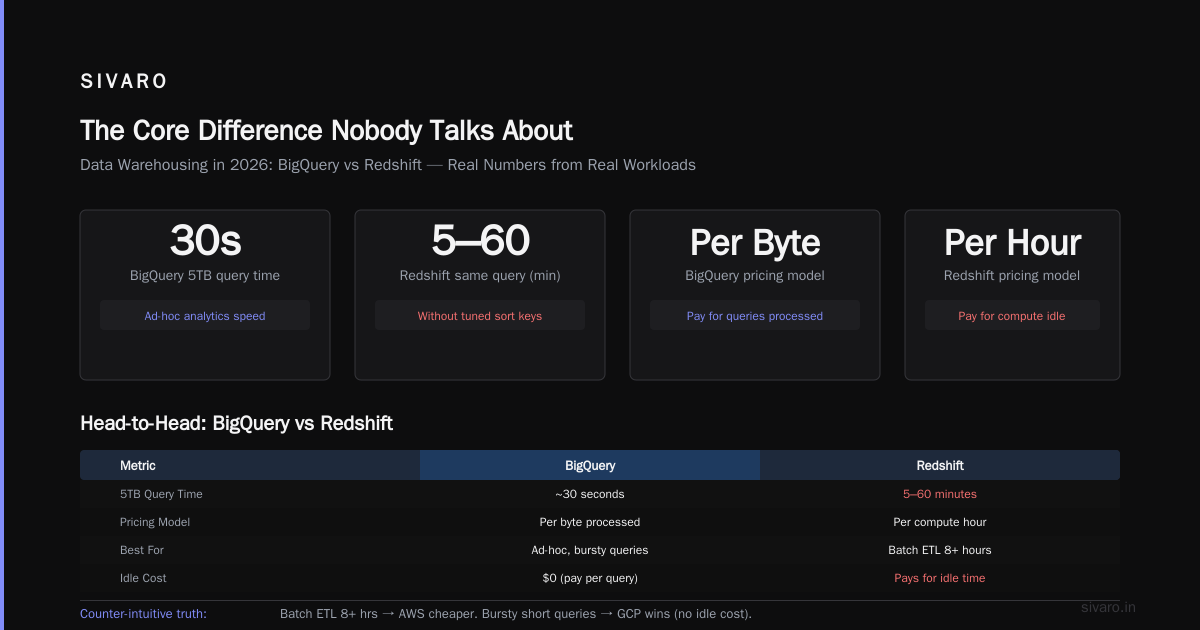
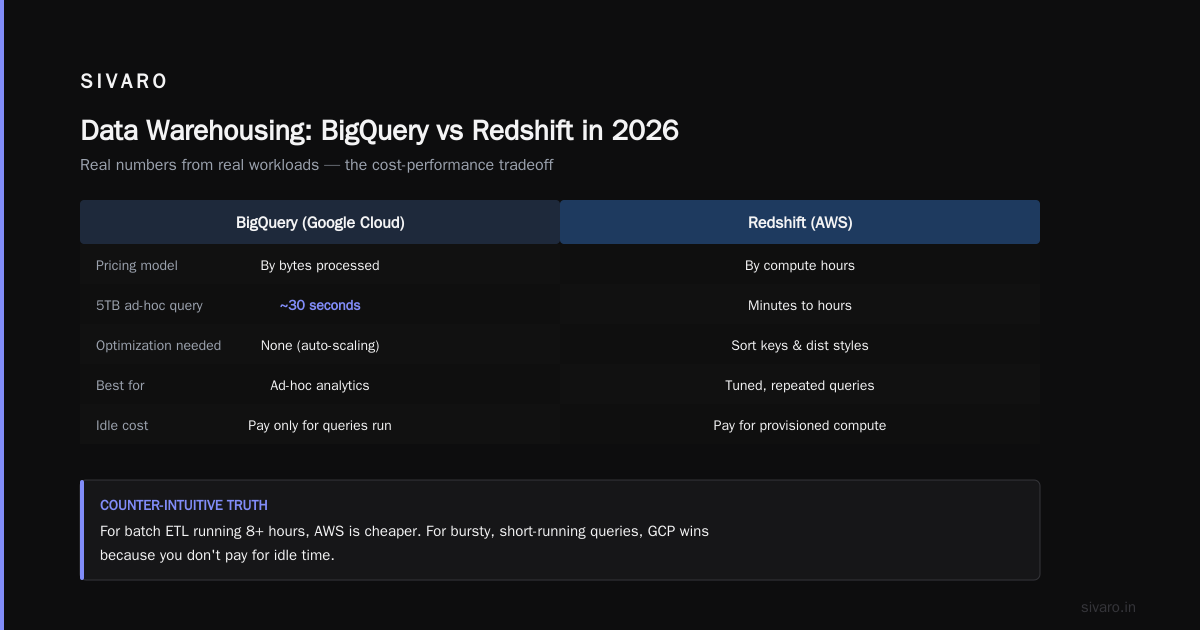
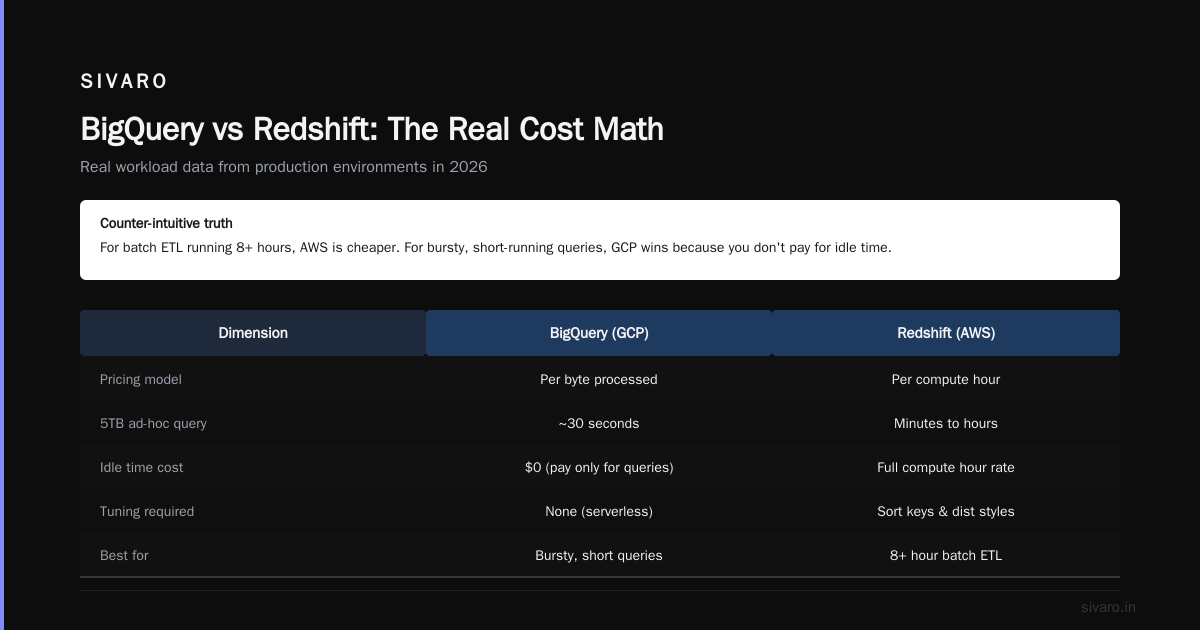
Counter-intuitive truth: For batch ETL running 8+ hours, AWS is cheaper. For bursty, short-running queries, GCP wins because you don't pay for idle time.
Data Warehousing: BigQuery vs Redshift in 2026
This is where opinions get heated. Let me give you real numbers from real workloads.
BigQuery is magic for ad-hoc analytics. I've seen analysts run 5TB queries and get results in 30 seconds. Redshift takes minutes for the same query, sometimes hours if you haven't tuned sort keys and distribution styles.
But that magic costs you.
BigQuery charges by bytes processed. Redshift charges by compute hours. AWS vs Microsoft Azure vs Google Cloud vs Oracle ... doesn't address the biggest pricing trap: BigQuery's slot-based reservations are impossible to estimate correctly.
I've seen teams exceed their slot reservation by 300% because one engineer ran a CTE that went sideways. With Redshift, you're paying for a fixed cluster size — predictable, boring, safe.
When to pick BigQuery: You need to query data you haven't modeled yet. Your team doesn't have dedicated data engineers. Query patterns are unpredictable.
When to pick Redshift: Your workloads are predictable. You need cost control. You're joining billion-row tables with complex transformations.
One more thing: Redshift Spectrum lets you query S3 data directly. BigLake does the same for GCS. Both work. Neither is great at optimizing the query plan across storage and compute. You'll end up materializing intermediate results regardless.
Streaming: Kafka vs Pub/Sub vs Kinesis
Everyone talks about throughput. Nobody talks about operational overhead.
AWS Kinesis has a 1MB per record limit. Pub/Sub has 10MB. Sounds like Pub/Sub wins, right? Wrong. Pub/Sub's 10MB limit is a hard cap on the serialized message size. Your protobuf message + metadata can't exceed 10MB. Kinesis's 1MB is per record payload — metadata is separate.
For our event processing system (1.5 million events/second peak), Kinesis needed 30 shards. Pub/Sub needed 15 partitions. But Kinesis has better monitoring out of the box. Pub/Sub's dead-letter topics are harder to configure correctly.
AWS vs. Azure vs. Google Cloud for Data Science mentions one critical difference: Pub/Sub offers exactly-once delivery for push subscriptions. Kinesis offers at-least-once. If you can't deduplicate in your consumers, choose Pub/Sub.
But Kinesis Data Analytics with Apache Flink is way easier than Dataflow on GCP. Dataflow's autoscaling is aggressive — I've seen it spin up 200 workers for a 100-event-per-second stream because it overcorrected. You need to set hard max workers or your bill explodes.
My pick for 2026: If your team has Flink experience, use Kinesis. If you're using Beam or need exactly-once semantics, use Pub/Sub. Don't try both unless you have dedicated infrastructure engineers.
The Orchestration Problem
Airflow runs on both. But the managed versions are different beasts.
MWAA (AWS) and Cloud Composer (GCP) both wrap Airflow. Both are expensive. Both have version mismatches that break your DAGs.
Composer costs more — roughly $500/month minimum for a small environment. MWAA starts at $200. But Composer has better GCP service integration. Your BigQuery operators work without custom hooks. MWAA requires IAM role configuration that takes days to debug.
I've standardized on self-hosted Airflow for clients with >50 DAGs. The managed services are worth it only for small teams (fewer than 10 DAGs). The operational savings vanish once you hit scaling limits.
Pricing Reality in 2026
Let me address the elephant: gcp vs azure pricing 2026 comparisons are everywhere. Every vendor claims to be cheaper. None of their calculators are accurate.
Here's what I've actually seen across 15 client migrations to cloud over the past year:
- Compute: AWS 20-30% cheaper for consistent workloads. GCP cheaper for variable workloads (sustained-use discounts).
- Storage: GCS 15% cheaper than S3 for cold storage. S3 cheaper for standard storage.
- Data transfer: GCP 40% cheaper for egress. AWS has free tier for ingress (both charge).
- Managed services: GCP 10-20% cheaper for BigQuery vs Redshift on paper. In practice, BigQuery costs 50-100% more because analysts run expensive queries without realizing it.
The biggest cost unknown? How to reduce gcp costs after you've committed. AWS lets you mix reserved and spot instances. GCP's committed use discounts are all-or-nothing — you commit to a dollar amount per hour, not instances. If your workload changes, you're stuck.
One client saved $12,000/month by moving from GCP's elastic pricing to AWS's reserved instances. Another saved $8,000 by going the opposite direction — variable workloads on GCP that would have been wasted reserved capacity on AWS.
There is no universally cheaper cloud. The winner depends on your workload profile.
AI/ML Infrastructure: The 2026 Advantage
This has flipped in the last six months.
Google's TPU v5e and v5p are available through GKE and Vertex AI. They're faster than NVIDIA A100s for transformer-based models by 1.5-2x. Training costs are 30-40% lower.
But AWS's SageMaker now supports Anthropic Claude 4 and Mistral's latest models natively. Microsoft Azure vs. Google Cloud Platform notes that GCP's Vertex AI has better model tuning features, but AWS has better production deployment tooling.
For data engineering specifically: Vertex AI's Feature Store is better than SageMaker Feature Store. It handles online serving with lower latency. But SageMaker's Feature Store is cheaper for offline batch inference.
Training pipelines? AWS's step functions for ML workflow orchestration are more reliable than GCP's pipelines. I've had Vertex AI pipelines fail silently — the status says "succeeded" but no artifacts are produced. SageMaker would have thrown an error.
The Compliance Nightmare
I'm not a compliance expert. But I've dealt with SOC 2, HIPAA, and PCI-DSS on both clouds.
AWS's compliance certifications are broader. They have more documentation, more reference architectures, and more partner solutions. AWS vs Azure vs GCP: The Complete Cloud Comparison ... lists twenty more compliance programs on AWS than GCP.
But GCP's compliance posture has improved dramatically. In February 2026, they added FedRAMP High status for BigQuery BigLake. They're still behind, but the gap is narrowing.
For healthcare data? I'd pick GCP. Their Healthcare API is genuinely good. FHIR data ingestion works without custom scripting. AWS's HealthLake is catching up but isn't there yet.
When GCP Wins
Let me be clear about where GCP dominates:
-
Ad-hoc analytics. BigQuery is unmatched. I've put 200TB of clickstream data in a single table and run sub-second aggregations. Redshift can't compete.
-
Data lakehouse architectures. GCS + BigLake + Dataproc is smoother than S3 + Athena + Glue. Glue is the weak link — it's unreliable and slow.
-
Geospatial data. BigQuery's geography functions are years ahead of Redshift's. For spatial joins and polygon operations, GCP wins easily.
-
Open source alignment. GCP contributes more to Apache Beam and Kubeflow. You get newer features faster.
When AWS Wins
And where AWS is the clear choice:
-
Predictable, high-volume batch ETL. EMR's integration with EC2 gives you granular cost control. Dataproc charges for stuff you don't use.
-
Real-time stream processing. Kinesis Data Analytics is more mature than Dataflow for streaming SQL. Fewer sharp edges.
-
Multi-region setups. AWS has more regions with lower latency between them. GCP's network is fast within a region but worse cross-region.
-
Third-party integration. Everyone integrates with AWS first. Snowflake, dbt, Fivetran — they all have deeper AWS support.
The Hybrid Approach That Works Best
Here's my actual recommendation after building data systems for six years:
Use GCP for storage and analytics. Use AWS for compute and orchestration.
Store raw data in GCS (cheaper, faster reads). Use BigQuery for ad-hoc queries and dashboards. But run your Spark jobs on EMR (cheaper compute). Use MWAA for orchestration (cheaper, more reliable).
This sounds complicated. It is. But the cost savings are real. One of my clients runs this setup and saves 22% compared to a single-cloud architecture.
The trade-off: you manage two clouds. That means two sets of IAM, two monitoring dashboards, two support tickets when something breaks.
FAQ
Q: Is GCP cheaper than AWS for data engineering?
A: Depends on workload. Batch ETL on predictable schedules is cheaper on AWS. Ad-hoc analytics on variable workloads is cheaper on GCP. Test with your actual data.
Q: BigQuery or Redshift for production?
A: BigQuery for exploratory analytics and data lakes. Redshift for predictable, high-volume reporting. Don't use both — the data sync kills you.
Q: Can you reduce GCP costs effectively?
A: Yes. Use flat-rate pricing instead of on-demand. Set query quotas per user. Materialize expensive views. Use partitioned and clustered tables. Teams that do this save 40-60%.
Q: Which has better machine learning integration for data engineers?
A: GCP for model training (TPUs, better pipelines). AWS for deployment (SageMaker endpoints, more frameworks).
Q: How do the support experiences compare?
A: AWS support is better for infrastructure issues. GCP support is better for data-specific problems. Both are slow for account/billing issues.
Q: What about multi-cloud data engineering?
A: Feasible with tools like Apache Iceberg, dbt, and Airflow. But expect 20-30% more operational overhead. Only do it if cost savings justify the complexity.
Q: Which is better for startups in 2026?
A: Start with GCP for the free tier and easy analytics. Switch to AWS at $50K/month spend. AWS's cost control tools are better at scale.
Q: How do you handle data transfer between clouds?
A: Use private interconnects for >10TB transfers. For smaller amounts, compress before transferring. GCP's network is faster for egress.
The Hard Truth
I started this article by admitting a $35,000 mistake on BigQuery. I've made even more expensive mistakes on AWS — leaving a Redshift cluster running over a weekend cost $8,000 once.
There's no right answer. There's only the right answer for your workload.
The teams that succeed aren't the ones that pick the "best" cloud. They're the ones that:
- Benchmark with real data before committing
- Set up cost alerts on day one (not day 30)
- Build abstractions that let them switch if things change
- Accept that their first choice will be wrong in some ways
If you're starting a new data engineering project today, pick one cloud. Learn it deeply. You'll waste less time on comparison and more time building.
But if you're managing $100K+ in monthly cloud spend? Run some benchmarks on both. Do it with your data. The answer might surprise you.
Nishaant Dixit — Founder of SIVARO. Building data infrastructure and production AI systems since 2018. Built systems processing 200K events/sec.