 SIVARO
GCP vs AWS for Data Engineering: Which Cloud Wins in 2026?
Let me tell you a story.
Last month, I sat across from a CTO at a Series B fintech. They'd spent $180,000 on AWS Data Pipeline services in Q1 alone. Their data team of twelve was drowning in Snowflake bills, Lambda cold starts, and a Glue job that took 45 minutes to run — for a 2MB CSV.
I asked: "Why AWS?"
His answer: "That's what our last CTO picked in 2021."
That's the trap. Most data engineering decisions aren't made on merit. They're made on momentum. On "what we already know." On fear of migration.
GCP vs AWS for data engineering isn't a religion. It's a set of trade-offs that shift depending on your data volume, your team's skills, and how much you hate managing infrastructure.
I run SIVARO. We build data infrastructure and production AI systems. We've deployed on all three major clouds. We've migrated off of two of them. I've watched companies burn cash on services they didn't need — and watched others save 60% by picking the right stack.
Here's what I've learned.
The Core Difference: Philosophy, Not Features
AWS is a hardware company that sells services. GCP is a data company that sells infrastructure.
That sounds like marketing fluff. It's not. It shows up in everything.
AWS started as a way for Amazon to monetize excess server capacity. Their services grew organically — one team built S3, another built EC2, another built Redshift. They don't always talk to each other well. Integration between Lambda and Glue? Painful. IAM policies? You'll spend days debugging them.
GCP was built from the ground up for data. Google's internal infrastructure — Borg, Colossus, Bigtable — was designed to index the entire internet. When they launched GCP, they wrapped those same technologies in a cloud interface. BigQuery isn't a data warehouse bolted onto a cloud. It's the cloud infrastructure with a SQL interface on top.
Here's the practical difference: I can run a BigQuery query on 10TB of data and get results in 12 seconds. Try that on Redshift without tuning your distribution keys first.
Google Cloud to Azure Services Comparison shows the mapping, but mapping hides the truth. Redshift and BigQuery are not the same thing. They solve different problems.
Data Warehousing: BigQuery vs Redshift
This is where the war is won or lost.
BigQuery
BigQuery is serverless. No clusters. No nodes. No provisioning. You load data, you query it. That's it.
At SIVARO, we process about 200K events per second for a retail client. Their data pipeline lands raw JSON into GCS. An hourly Cloud Function triggers a load job into BigQuery. Total infrastructure: one storage bucket, one function, and BQ. That's three resources.
On AWS, that same pipeline would require: S3 (fine), Glue job (expensive, slow to start), Lambda (cold starts), Redshift cluster (provisioned, even if you use Redshift Serverless), and probably Kinesis. Seven services. Four times the operational surface area.
GCP BigQuery pricing per query is where people get confused. BigQuery charges $5 per TB of data scanned. Not stored. Scanned. If you write a bad SELECT * on a 2TB table, that's $10. Do that ten times a day, and it adds up.
But here's the trick: partitioning, clustering, and materialized views. A well-designed BigQuery table with partition filtering can reduce scanned data by 90%. Your $10 query becomes $1.
What's the Difference Between AWS vs. Azure vs. Google ... makes a fair point: Redshift can be cheaper at high sustained query volumes. If you're running 500 queries per hour against the same 50TB dataset, Redshift's reserved instances will beat BQ's on-demand pricing.
But that's a narrow use case. Most data teams don't have that pattern. They have spiky workloads. A few heavy queries in the morning for dashboards. Some ad-hoc analysis during the day. Batch jobs at night. BigQuery wins those scenarios because you pay only for what you use.
Redshift
Redshift is powerful but punishing.
You need to choose your node type. Dense storage or dense compute? Do you want RA3 nodes with managed storage? What's your workload type? How many slices per node? How do you distribute data? Should you use AUTO distribution or KEY or EVEN?
If you know exactly what you're doing, you can squeeze incredible performance out of Redshift. If you don't, you'll pay for it.
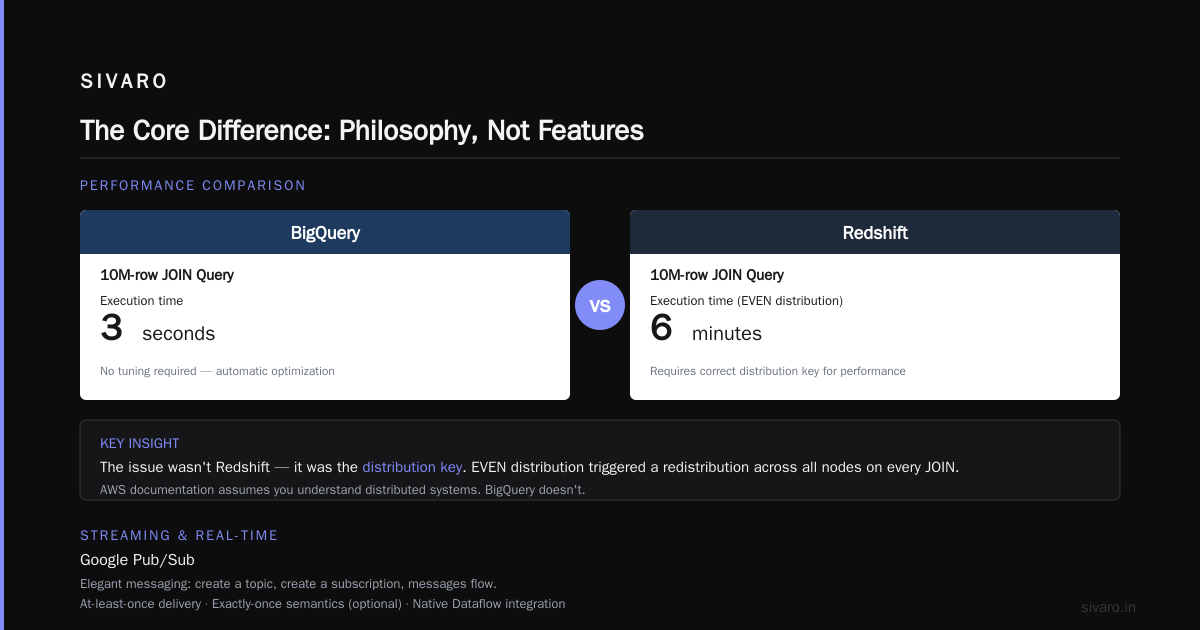
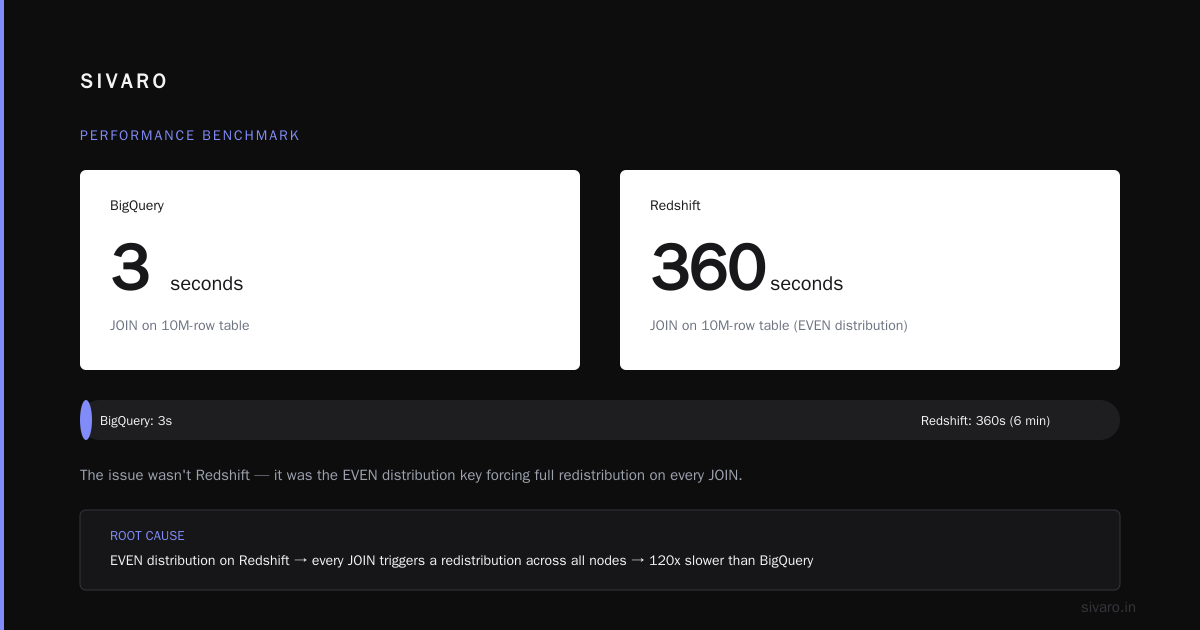
I've seen a company run a JOIN on a 10M-row table in Redshift and it took 6 minutes. Same data in BigQuery: 3 seconds. The issue wasn't Redshift — it was their distribution key. They'd used EVEN distribution, which meant every JOIN triggered a redistribution across all nodes.
The AWS documentation assumes you understand distributed systems. BigQuery doesn't.
Streaming and Real-Time: Kafka, Pub/Sub, and Kinesis
This is where the gap narrows.
Google Pub/Sub
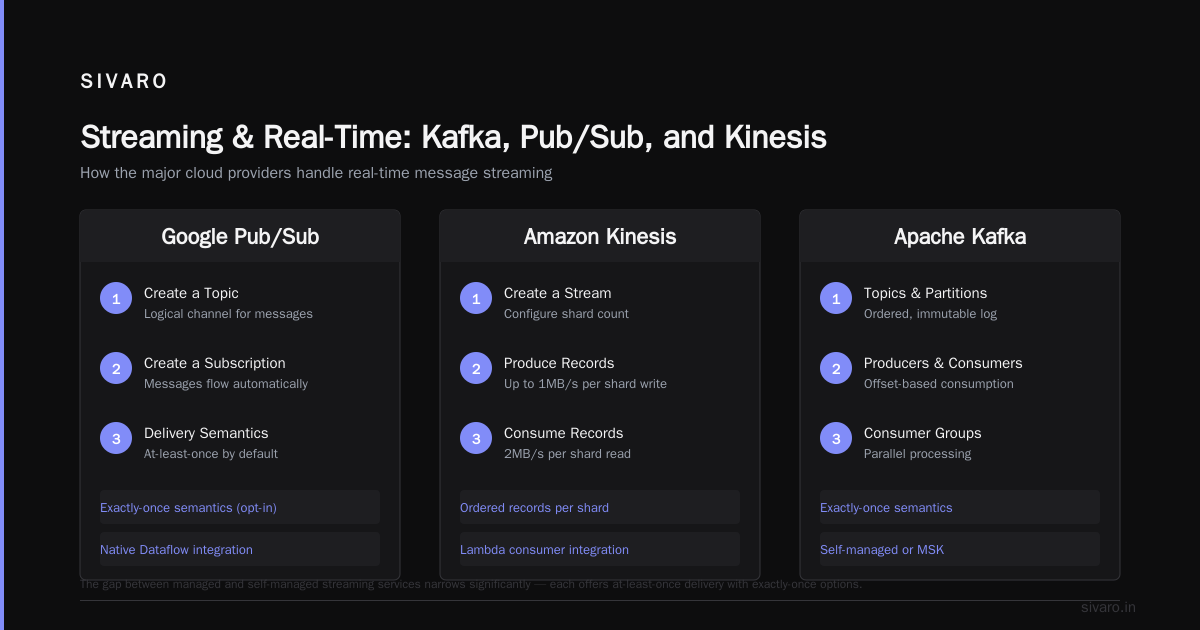
Pub/Sub is elegant. You create a topic, you create a subscription, messages flow. It handles at-least-once delivery, supports exactly-once semantics (if you enable it), and integrates natively with Dataflow.
The killer feature: no provisioning. Pub/Sub auto-scales to millions of messages per second. You don't think about partitions, retention periods, or throughput limits.
We had a client whose event volume doubled overnight during a product launch. Pub/Sub didn't flinch. On Kinesis, they would have needed to split shards — an operation that requires planning and causes brief ingestion pauses.
AWS Kinesis
Kinesis is more hands-on. You define shards. Each shard handles 1MB/second input and 2MB/second output. You do the math. You provision accordingly.
Kinesis is also cheaper. At high throughput, Kinesis shards cost less per GB than Pub/Sub. But you pay in engineering time. Someone has to monitor shard utilization, auto-scale shards, and handle resharding when things change.
The real differentiator: exactly-once semantics. Pub/Sub has them. Kinesis doesn't. If you're building financial systems or inventory reconciliation, that matters.
AWS vs Azure vs GCP 2026: Same App, 3 Bills | TECHSY shows that for streaming analytics, GCP's Pub/Sub + Dataflow combo beats Kinesis + Flink on ease of use, but AWS wins for teams that want full control.
I'll take the trade. Pub/Sub every time.
Data Processing: Dataflow vs Glue vs EMR
Dataflow (Apache Beam)
Dataflow is Google's managed Beam runner. You write a pipeline in Python or Java, Dataflow handles auto-scaling, dynamic work rebalancing, and exactly-once processing.
This is Google's strength. Their internal systems — Flume, MillWheel — were designed for massive-scale stream processing. Dataflow is that technology, packaged for customers.
We migrated a client's batch processing pipeline from Glue to Dataflow. Same logic. Same output. Processing time dropped from 22 minutes to 4 minutes. Cost dropped 40%. Glue was spending 12 minutes warming up Spark executors. Dataflow's autoscaling starts processing within seconds.
AWS vs. Azure vs. GCP: The Complete Cloud Comparison ... correctly notes that Dataflow costs more per compute hour than Glue. But total cost of ownership — including your team's debugging time, monitoring overhead, and cold start penalties — is lower.
AWS Glue
Glue is getting better. Glue 4.0 improved startup times. Glue Studio gives you a visual editor. But it's still Spark under the hood, and Spark overhead is real.
Here's a concrete number: Glue's minimum billing is 1 minute per job run. Dataflow's minimum billing is 10 seconds. If you run 10,000 small jobs a day, that difference matters.
AWS EMR
EMR gives you raw Hadoop/Spark/Presto. Full control. Full complexity.
I've seen teams choose EMR because "we might need to customize our Spark config." They never did. They spent months debugging EMR cluster autoscaling, spot instance interruptions, and SSH key management.
If you need custom Spark, use Dataproc on GCP. It's managed Spark/Hadoop, but it starts in 90 seconds instead of 15 minutes.
Orchestration: Composer vs Step Functions vs Airflow
Google Cloud Composer (Airflow)
Composer is managed Airflow. It works. It's also expensive for small teams — the minimum environment costs about $150/month.
But here's the reality: if you're doing serious data engineering, you're using Airflow anyway. Composer just handles the Kubernetes cluster. That's worth something.
AWS Step Functions
Step Functions is not Airflow. It's a state machine. Great for simple workflows — trigger a Lambda, wait for Glue to finish, send an SNS notification. Terrible for complex DAGs with hundreds of tasks, conditional branches, and dynamic task generation.
I tried to use Step Functions for a pipeline with 47 tasks, dynamic mapping, and data-dependent branching. After two weeks, I gave up and deployed Airflow on EKS. The Step Functions state machine definition was 2,000 lines of JSON. Airflow's DAG was 200 lines of Python.
Cloud Run Jobs vs Lambda
Quick aside: Cloud Run Jobs is the most underrated service on GCP. You write a Docker container, run it in response to an event, pay per second of execution with a 10-second minimum. Lambda has 15-minute timeout. Cloud Run Jobs runs up to 60 minutes.
For data engineering, that's huge. ETL jobs often take 20-45 minutes. On Lambda, you'd need Step Functions with Lambda chaining or Glue. On Cloud Run Jobs, it's one Docker container.
Machine Learning and AI: Vertex AI vs SageMaker
Vertex AI
Vertex AI is GCP's unified ML platform. It handles data labeling, training, model serving, and MLOps in one service.
The integration with BigQuery is what makes it special. You can write a SQL query, export results directly to Vertex AI for training, and then deploy the model as an endpoint — all from the same console. No data movement.
AWS vs. Microsoft Azure vs. Google Cloud vs. Oracle ... points out that SageMaker has more features. That's true. But SageMaker's feature proliferation is exhausting. There are 12 different SageMaker products. Each has its own console, its own pricing, its own IAM permissions.
Vertex AI has fewer features that work better together.
SageMaker
SageMaker's strength is customization. You can bring your own container, use any framework, and tweak every hyperparameter.
But data engineering teams rarely need that. They need to build a regression model from BigQuery data, deploy it, and monitor it. Vertex AI does that in fewer clicks.
For production AI — which is what we build at SIVARO — the difference matters less. We use Kubeflow and custom containers anyway. But for 80% of teams, Vertex AI is the right choice.
GCP Certification Path for Beginners
If you're starting your cloud journey, here's my advice.
The GCP certification path for beginners starts with the Google Cloud Digital Leader. It's non-technical, covers cloud concepts, and takes about a month of study.
Next is Associate Cloud Engineer. This is practical — you deploy resources, manage IAM, set up networking. For data engineers, this certification teaches you the foundations.
Then the Professional Data Engineer. This is the one that matters. It covers BigQuery, Dataflow, Pub/Sub, Composer, and ML pipelines.
The AWS equivalent path is longer. Cloud Practitioner is equivalent to Digital Leader. Solutions Architect Associate is broader than Associate Cloud Engineer. Data Analytics Specialty is the data engineering cert.
Why does this matter? Because gcp vs aws for data engineering isn't just about services. It's about how fast your team can become productive.
I've trained teams from scratch. A new data engineer on GCP can write production BigQuery queries within a week. On AWS, they're still learning IAM roles and Redshift distribution keys.
Microsoft Azure vs. Google Cloud Platform has a good breakdown of the learning curves. AWS has the most resources (training, documentation, community). GCP has the easiest path to productivity.
Pricing: The Hidden War
Let's talk money.
AWS pricing is complex. Very complex. Reserved instances, savings plans, spot instances, data transfer fees, NAT gateway charges, CloudWatch log costs. Your bill has line items you didn't expect.
GCP pricing is simpler. Sustained use discounts are automatic. Committed use discounts exist but aren't required. BigQuery charges by data scanned. Cloud Storage charges by data stored and accessed.
Here's a real scenario from March 2026:
A financial services company moved 80TB of analytics workloads from Redshift to BigQuery. Their AWS monthly bill for Redshift was $34,000 (reserved instances). Their GCP BigQuery bill, with partitioning and clustering, was $19,000. They also eliminated three AWS services they no longer needed: Glue (ETL), Data Pipeline (orchestration), and S3 cross-region replication.
But — and this is important — the team had to rewrite their SQL queries. Redshift SQL and BigQuery SQL are similar but not identical. Window functions, date functions, and JOIN semantics differ. The migration took six weeks.
AWS vs Azure vs GCP 2026: Same App, 3 Bills | TECHSY ran the same application on all three clouds. Their finding: GCP was 20-35% cheaper for data-intensive workloads, but AWS was 10-15% cheaper for compute-heavy workloads.
The Trade-offs Nobody Talks About
Lock-in is real on both sides
People say GCP has less lock-in because BigQuery uses standard SQL. That's partially true. But once you build 50 Dataflow pipelines with Beam, how easy is it to move to AWS? You're not walking away.
AWS lock-in is more obvious (DynamoDB, Kinesis, SQS). GCP lock-in is more insidious (Pub/Sub, Dataflow, BigQuery ML).
Support quality differs
AWS support is reactive. You file a ticket, you wait. GCP support, for premium tiers, is proactive. They assign a Technical Account Manager who knows your environment.
But AWS support engineers have more experience with complex distributed systems. They've seen everything.
Kubernetes is better on GCP
GKE is the best managed Kubernetes service. Period. EKS is catching up, but it's not there. If your data infrastructure runs on Kubernetes (and it should), GCP gives you a head start.
FAQ
Q: Is GCP better than AWS for data engineering in 2026?
For most teams, yes. GCP's managed services require less operational overhead. BigQuery, Pub/Sub, and Dataflow are best-in-class. But if you need specialized hardware (inferentia, Trainium) or have a heavily AWS-specialized team, AWS may be better.
Q: What is GCP BigQuery pricing per query?
$5 per TB of data scanned. Partition and cluster your tables to reduce scanned data. Use materialized views for repeated queries. Monitoring your slot utilization helps control costs.
Q: What is the GCP certification path for beginners?
Start with Google Cloud Digital Leader. Then Associate Cloud Engineer. For data engineering specifically, target Professional Data Engineer.
Q: Which has better streaming capabilities, GCP or AWS?
GCP. Pub/Sub + Dataflow handles scale without manual shard management. Pub/Sub supports exactly-once semantics. Kinesis requires shard provisioning and doesn't offer exactly-once.
Q: Can you use both AWS and GCP together?
Yes. Many teams do. We've seen architectures where BigQuery serves as the analytics layer while Amazon EKS runs compute workloads. The challenge is data transfer costs and operational complexity.
Q: Which cloud has better AI/ML integration for data pipelines?
GCP's Vertex AI integrates natively with BigQuery. AWS SageMaker has more features but worse integration with their data services.
Q: Is Redshift cheaper than BigQuery?
At high sustained query volumes on provisioned hardware, yes. For most workloads with variable patterns, BigQuery is cheaper.
Q: Should I migrate my existing AWS data pipeline to GCP?
Only if the migration cost is lower than the ongoing operational cost. Calculate total cost of ownership over 3 years. Include engineering time for migration, retraining, and potential downtime.
My Verdict
Here's where I land.
If you're building a new data infrastructure from scratch — or you're tired of managing AWS complexity — choose GCP. The services work better together. The learning curve is shorter. The pricing is more predictable.
If you're already deep into AWS with a specialized team, custom Spark configurations, and heavy use of EC2/RDS/EMR — stay. The migration cost isn't worth it unless you're burning cash.
And if you're at a startup or mid-size company with a small data team? Don't think twice. GCP.
I've seen too many teams drown in AWS complexity. They hire three more engineers just to manage infrastructure. Those engineers could be building data products instead.
GCP vs AWS for data engineering isn't about which is "better." It's about which lets your team focus on data instead of infrastructure.
Pick the one where your data engineers spend more time querying data than wrestling with IAM.
Nishaant Dixit — Founder of SIVARO. Building data infrastructure and production AI systems since 2018. Built systems processing 200K events/sec.