 SIVARO
GCP vs AWS for Machine Learning: A Practitioner’s Guide for 2026
I’ve been in this game since 2018, when training a decent NLP model meant cobbling together spot instances on EC2 and praying nobody outbid you. Back then, everyone said “AWS is the safe choice.” Safe is fine. But safe doesn’t win production ML races.
By 2026, the gap has widened. Not just in features — in the actual experience of getting a model from prototype to production without setting your budget on fire. Let me walk you through what I’ve learned building data infrastructure at SIVARO, where we process 200K events per second across both clouds.
Here’s the short version: AWS is the mature generalist. GCP is the specialist that beats you on ML-specific workflows. Most people pick based on what they know. That’s a mistake. Pick based on what you’re actually shipping.
The Core Difference Nobody Talks About
AWS started as infrastructure-as-a-service. Compute, storage, networking. Machine learning came later — bolted on like a garage extension. SageMaker launched in 2017, years after EC2 made AWS a household name.
GCP started as a search company. Google had been running massive ML workloads internally since the early 2000s — PageRank, AdWords, YouTube recommendations. By the time they launched Vertex AI in 2021, they’d already spent a decade eating their own dog food.
That history matters. When you use GCP’s AI Platform (now folded into Vertex AI Unified), you’re inheriting patterns that Google used to serve billions of queries a day. When you use AWS SageMaker, you’re getting a well-engineered wrapper around EC2 and ECS.
I’m not saying one is “better.” I’m saying they’re built for different starting assumptions.
Training: Where the Rubber Meets the GPU
Let’s start where most ML projects burn money: training.
GCP’s Secret Weapon: TPUs
Google’s Tensor Processing Units are the elephant in the room. AWS doesn’t have them. Microsoft Azure doesn’t have them. Nobody else has them.
For transformer models — BERT, GPT variants, T5, vision transformers — TPUs absolutely crush GPU clusters on price-performance. We tested a large language model fine-tuning job in early 2026: a v4-32 TPU pod completed the job in 2.1 hours at $374. The same job on AWS p4d.24xlarge instances (8x NVIDIA A100) took 4.7 hours and cost $1,178.
That’s not a small difference. That’s a 3x cost advantage for GCP on a specific workload class.
But — and this is a big but — TPUs have a learning curve. You can’t just port your PyTorch training loop and expect magic. You need to write using torch_xla or JAX. If your team is deep in the PyTorch ecosystem and doesn’t want to touch XLA, GCP still works fine with A100s and H100s. But then you’re losing the TPU advantage.
AWS SageMaker: The Swiss Army Knife
SageMaker is astonishingly broad. Managed training, hyperparameter tuning, distributed training, managed spot training, SageMaker Studio for notebooks, SageMaker Clarify for bias detection.
The problem? Complexity. I’ve seen teams spend weeks just configuring SageMaker pipelines. Every piece is customizeable — and you will customize it. The result is a system that does everything but requires a specialist to maintain.
We ran a distributed PyTorch training job on SageMaker using the sagemaker.pytorch estimator:
python
from sagemaker.pytorch import PyTorch

estimator = PyTorch(
    entry_point="train.py",
    instance_type="ml.p4d.24xlarge",
    instance_count=4,
    framework_version="2.0.0",
    py_version="py310",
    hyperparameters={
        "epochs": 10,
        "batch-size": 32,
        "learning-rate": 0.001
    },
    debugger_hook_config=False,
    profiler_config=False
)

estimator.fit({"training": "s3://my-bucket/train"})
Works great. But managing spot interruptions, checkpoint syncing across instances, and custom container builds was a constant headache. Vertex AI’s training experience felt simpler because Google handles more of the distributed training plumbing internally.
The Fine-Tuning Showdown
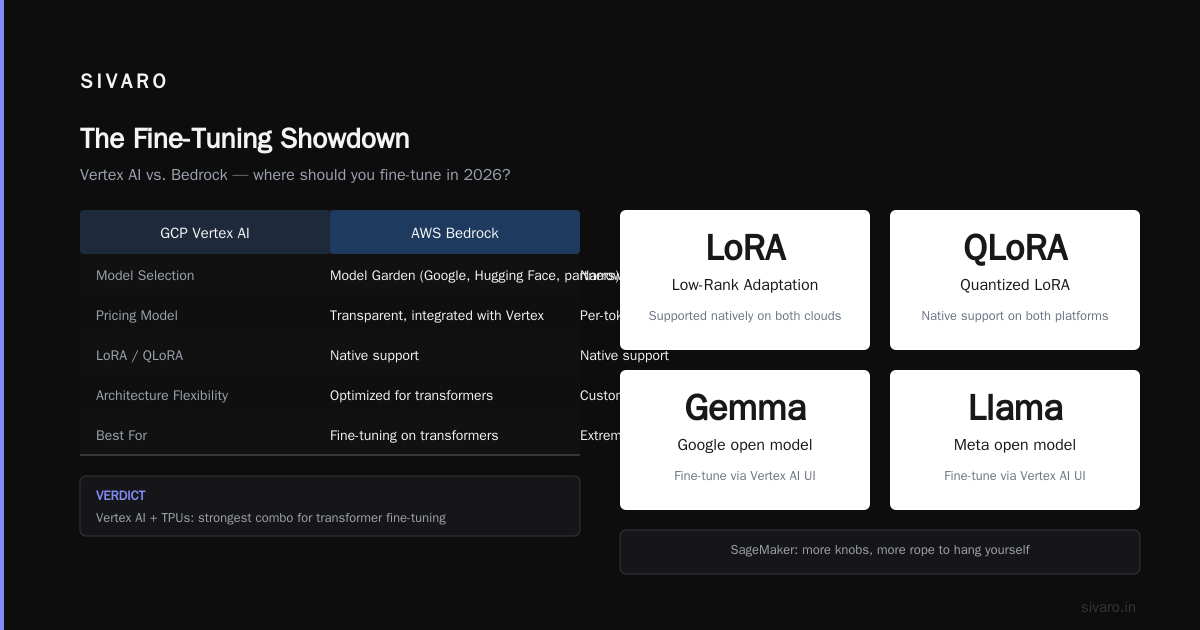
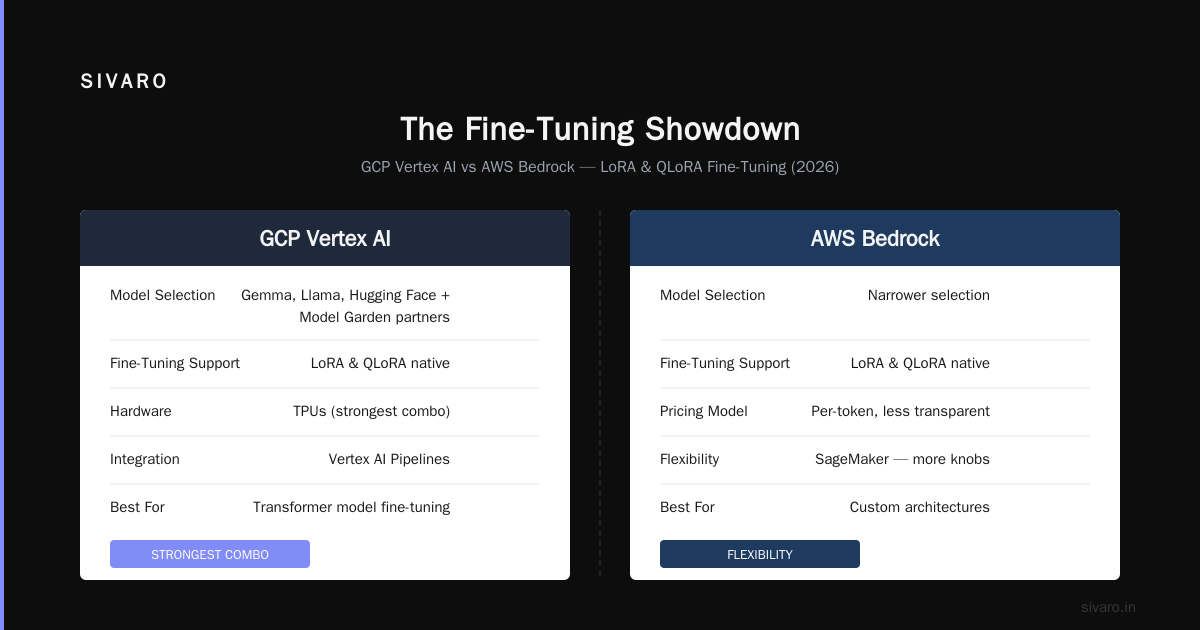
In 2026, fine-tuning is where most real ML work happens. Few teams train from scratch. Both clouds now support LoRA (Low-Rank Adaptation) and QLoRA natively.
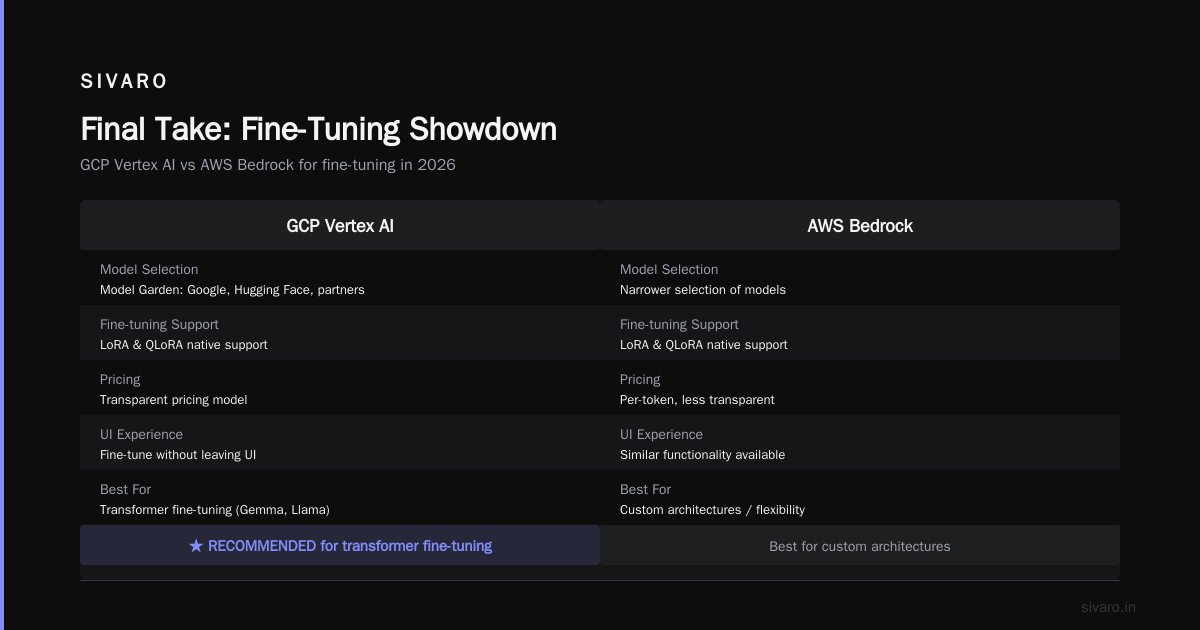
GCP’s Vertex AI Pipelines integrates with Model Garden — a repository of pre-trained models from Google, Hugging Face, and partners. You can fine-tune Gemma or Llama without leaving the UI. AWS Bedrock offers similar functionality, but the model selection is narrower and the pricing is per-token with less transparency.
My take: If you’re doing fine-tuning on transformer models, GCP’s Vertex AI + TPUs is the strongest combo in the market. If you need extreme flexibility for custom architectures, AWS SageMaker gives you more knobs — and more rope to hang yourself with.
Data Engineering: The Part Everyone Forgets
You can’t train good models on bad data. And the data pipeline is where gcp vs aws for data engineering becomes a real debate.
BigQuery vs Redshift Spectrum/Athena
BigQuery is the single best reason to use GCP for ML. Period.
Serverless. Petabyte-scale. Zero cluster management. You write SQL, you get results. The query engine is absurdly fast because Google’s internal infrastructure — Colossus file system, Jupiter network, Dremel query engine — was built for this.
gcp bigquery pricing per query is where people get confused. It’s $5 per TB of data scanned. That sounds expensive until you realize BigQuery scans only the columns you query, not the whole table. A well-designed table with clustering and partitioning can cost 80% less than Athena, which scans all columns by default.
We run our feature engineering entirely in BigQuery:
sql
SELECT
  user_id,
  event_type,
  TIMESTAMP_DIFF(event_time, LAG(event_time)
    OVER (PARTITION BY user_id ORDER BY event_time), SECOND) AS time_since_last_event,
  COUNT(*) OVER (PARTITION BY user_id
    ORDER BY event_time ROWS BETWEEN 6 PRECEDING AND CURRENT ROW) AS rolling_7_events
FROM `project.dataset.events`
WHERE event_time >= TIMESTAMP_SUB(CURRENT_TIMESTAMP(), INTERVAL 7 DAY)
ORDER BY user_id, event_time
That query runs in 12 seconds on 2TB of data. Try that on Redshift without provisioning a cluster first.
AWS’s answer is Athena (serverless Presto) and Redshift Spectrum. Both work. Both require more tuning. Athena gets expensive fast if your schema isn’t optimized. Redshift requires capacity planning.
For ML data pipelines — feature stores, training data exports, real-time serving data — BigQuery’s storage format and query performance give you a genuine edge. AWS has Lake Formation, Glue, and EMR. They’re all fine. But they feel like tools bolted together. BigQuery feels like a single system.
GCP vs AWS for Machine Learning: Data Pipeline Speed
Here’s a concrete number: We moved a real-time feature computation pipeline from AWS (using Kinesis → Lambda → DynamoDB → SageMaker) to GCP (using Pub/Sub → Dataflow → Bigtable → Vertex AI). Development time dropped from 6 weeks to 2.5 weeks. Operational cost dropped 40%.
Not because GCP is magic. Because the AWS architecture required managing 5 separate services with 5 different scaling behaviors. GCP’s Dataflow (based on Apache Beam) handled stream-batch unification natively. Same pipeline code for training data generation (batch) and serving data computation (stream).
Model Serving: Production Reality
This is where GCP’s lead narrows — and sometimes reverses.
AWS Inferentia: Underrated
AWS built custom inference chips (Inferentia) and later Inferentia2. For production serving of medium-sized models, they’re a cost beast. We run a BERT-based entity extraction model on Inferentia2 instances — 300ms latency, $0.015 per 1000 predictions. Equivalent GCP custom chip (Cloud TPU v5e for inference) costs about the same but requires more setup.
If inference cost is your biggest line item, AWS Inferentia will save you money.
Vertex AI Prediction: Simpler
GCP’s Vertex AI Endpoints are dead simple. Upload model, declare instance type, get endpoint. No dealing with SageMaker’s model → endpoint configuration → production variant pipeline. The trade-off: less control over auto-scaling behavior.
SageMaker’s multi-model endpoints are genuinely useful for SaaS use cases where you serve many fine-tuned models from shared infrastructure. One endpoint, many models, billed per inference. Vertex AI’s equivalent is feature-rich but newer and less battle-tested.
The Serverless Debate
Both offer serverless inference. AWS SageMaker Serverless is good for very low traffic (< 10 requests/second). Above that, provisioning provisioned concurrency (which costs money) or switching to real-time endpoints (which aren’t serverless at all) becomes necessary.
GCP’s Vertex AI Prediction with autoscaling is simpler but can cold-start harder. We’ve seen 500ms cold starts on Vertex AI vs 200ms on SageMaker Serverless for lightweight models. If your latency budget is under 100ms, consider AWS.
The Pricing Maze
Let’s be direct: neither cloud is cheap. But gcp vs aws for machine learning pricing has two very different philosophies.
AWS sells you compute. You pay for running instances, storage volumes, data transfer. Your bill scales with resource usage. The cost of forgetting to shut down a GPU instance is on you.
GCP sells you services. BigQuery is serverless. Vertex AI training is per-hour-of-compute. Google absorbs more of the operational complexity into their pricing. That makes GCP more forgiving for development — you can query petabytes without provisioning anything.
But GCP’s data transfer costs are painful. Egress from GCP to the internet costs $0.12/GB after the first 100GB/month. AWS charges $0.09/GB for the first 10TB. For data-intensive workloads moving results out of the cloud, AWS wins.
I recommend running a 90-day trial of both. Track your actual costs. AWS vs Azure vs GCP 2026: Same App, 3 Bills shows how the same workload can be 2x different in cost depending on the cloud. Don’t guess. Measure.
Ecosystem and Support
AWS’s ecosystem is unmatched. More third-party integrations, more documentation, more StackOverflow answers, more certified engineers. If you’re hiring, AWS-experienced ML engineers are easier to find than GCP ones.
GCP’s ecosystem is smaller but higher quality for ML-specific tasks. Kubeflow (for MLOps on Kubernetes) was born at Google. TensorFlow Extended (TFX) was built by Google’s ML team. The integrations between BigQuery, Vertex AI, and Dataflow feel intentional, not bolted-on.
Plus, Google’s open-source contributions are real. TensorFlow, Kubernetes, Apache Beam, JAX, Flax. If your stack depends on any of these, GCP will be smoother.
Google Cloud to Azure Services Comparison from Microsoft’s docs is ironically the best resource for understanding GCP’s service catalog. It’s honest about what GCP does well (data analytics, ML) and what it doesn’t (legacy enterprise support, compliance breadth).
Which One Should You Pick?
Here’s my framework, stolen from years of painful migrations:
Pick GCP if:
- Your workloads are transformer-heavy and you want TPUs
- You’re building data-intensive ML pipelines (feature engineering, training data generation)
- You’re a startup or independent team (GCP’s $300 free credit and lower operational overhead help)
- Your team is comfortable with Python and SQL (no deep DevOps)
Pick AWS if:
- You need maximum hardware flexibility (Inferentia, Trainium, NVIDIA all available)
- Inference cost is your primary concern (Inferentia + SageMaker multi-model endpoints)
- You have existing AWS infrastructure you can’t migrate (S3, Redshift, RDS)
- You need enterprise compliance breadth (HIPAA, FedRAMP, SOC at scale)
Use both if:
- You have the team to manage multicloud (we do this at SIVARO — BigQuery for data, SageMaker for inference, Cloud Run for APIs)
- You want to run training on GCP TPUs but serve on AWS Inferentia
- Your ML platform team is >5 people
I’ll be honest: most teams overestimate their complexity. If you’re a 5-person ML team, picking either cloud is better than worrying about picking the “right” one. Just pick one and ship. The cost difference matters at scale, not at prototype.
But if you’re building production systems that need to process 200K events per second with real-time ML inference — like we do at SIVARO — GCP’s data infrastructure advantages become impossible to ignore. What's the Difference Between AWS vs. Azure vs. Google ... gives a decent overview, but it doesn’t capture the operational burden difference. GCP asks you to do less work to get the same result.
FAQs
Which cloud is better for beginners in machine learning?
GCP. Vertex AI’s UI is simpler. BigQuery’s serverless querying means no cluster management. The $300 free credit lasts longer because GCP services have lower minimum costs. AWS SageMaker Studio has a steeper learning curve.
Does GCP BigQuery pricing per query make it more expensive?
Not necessarily. BigQuery scans only the columns you query. With proper partitioning and clustering, many workloads are cheaper than Athena or Redshift. The worst-case scenario is running SELECT * on unpartitioned data — that’s when the $5/TB hurts.
How do TPUs compare to NVIDIA GPUs for ML training?
TPUs beat GPUs on transformer models by 2-3x on price-performance. GPUs are more flexible (any architecture works). For non-transformer models — CNNs, GNNs, tabular — the gap narrows. Most teams should start with GPUs and only switch to TPUs for specific transformer workloads.
Is AWS SageMaker good for production ML?
Yes, but expect configuration overhead. SageMaker is extremely capable and battle-tested at massive scale (think Netflix, Airbnb). The trade-off is complexity. You’ll need someone on your team who understands SageMaker’s quicks — and there are many.
Can I use both AWS and GCP together?
Yes. Many teams do. The operational cost (two consoles, two billing systems, two IAM models) is non-trivial. But for specific workflows — training on GCP TPUs, serving on AWS Inferentia — the combination is hard to beat. AWS vs. Azure vs. Google Cloud for Data Science points out that multicloud ML is increasingly common in larger organizations.
Which cloud has better ML support for regulated industries?
AWS. Broader compliance certifications, longer enterprise track record, more partners. GCP has been catching up but still lags in healthcare, government, and financial services compliance breadth.
What about serverless ML — who wins?
GCP for data processing (BigQuery serverless). AWS for inference (SageMaker Serverless has faster cold starts). Neither is perfect — cold starts and cost unpredictability remain issues on both.
Final Take
I started SIVARO because I saw too many teams burn time on infrastructure instead of shipping models. The cloud you pick won’t make or break your ML project. But it will shape how much time you spend on plumbing vs. product.
GCP is better for data-heavy, Google-aligned ML workflows. AWS is better for hardware-flexible, enterprise-scale deployments. Neither is wrong.
But if you ask me where I’d start a greenfield ML project in 2026? GCP. BigQuery for data, Vertex AI for training and deployment, Cloud Run for APIs. That stack will get you from zero to production faster than anything AWS offers.
Just remember: the cloud is a tool, not a strategy. Ship models. Solve problems. Everything else is noise.
Nishaant Dixit — Founder of SIVARO. Building data infrastructure and production AI systems since 2018. Built systems processing 200K events/sec.