 SIVARO
GCP vs AWS for Startups: The 2026 Honest Guide
Three weeks ago, a founder I know took a $100,000 AWS credit package from a well-known accelerator. He told me he was excited about "getting the best deal." I asked him one question: "Have you looked at how that credit actually spends, month to month? With the discount structure, how much are you really paying for compute?"
He hadn't.
And that's the problem with this entire conversation. Most people argue about gcp vs aws for startups like it's a brand loyalty contest. It isn't. It's an infrastructure economics decision that will follow you for years. The credit offers are getting fatter every quarter — all three major clouds are handing out six-figure packages to seed-stage companies. But credits defer pain. They don't prevent it.
This guide is about what happens after the credits run out.
I've been building data infrastructure since 2018. I've run systems on both clouds, migrated workloads between them, and negotiated pricing with both sales teams. Let me tell you what the benchmarks don't.
The Default Should Be AWS — Here's Why That's a Problem
Most startups default to AWS because it's the "safe" choice. Enterprise lead engineers have AWS on their resume. Stack Overflow tutorials use AWS terms. The name recognition means there's always someone who can help you debug whatever breaks.
The 2026 comparison from Go Cloud shows AWS still holds roughly 30% market share against GCP's 12% — and that gap breeds a certain complacency. You'll find answers to any AWS problem on the first page of Google. You'll get half-answers on GCP forums even for basic questions. I've lived it. Our team spent two days debugging a GCP networking quirk that would have taken two hours to find an AWS Stack Overflow thread for.
But here's the thing: defaulting to AWS is a decision made on fear, not economics. The cloud is now the second-largest cost line item for most SaaS startups, after payroll. If you pick based on comfort, you're optimizing for the wrong metric.
GCP's Real Advantage: Data, AI, and Kubernetes
Here's the contrarian take I've earned through building real systems:
GCP is flat-out better for data-heavy workloads. Not marginally better. Significantly better.
I migrated a real-time event processing system to GCP in late 2025. We had been running Apache Kafka on AWS EC2, manually managing brokers like it was 2019. The move wasn't just about cost — it was about the fact that BigQuery isn't an alternative to Redshift, it's a different category entirely. The decentralized architecture means you don't think about clusters, or partitioning, or concurrency slots. You ask a question, it answers, and you pay for what you used. The NetApp analysis of GCP vs. AWS pricing makes this point well: the value you get from BigQuery isn't just the query engine, it's that you stop paying engineers to manage infrastructure around it.
Plus, Google's Kubernetes Engine (GKE) remains more mature than EKS. For production AI systems where you need GPUs with zero network drama, GCP wins almost every time. Google's TPU infrastructure has no real equivalent on AWS.
Here's a real cost breakdown from a client's e-commerce stack in 2026. They ran 24/7 on AWS, 3 environments, standard SAAS workload hitting 20M requests/month. I ran the numbers through the GCP Pricing Calculator and saved roughly 28% on list price for compute alone:
// A quick monthly terrace for the same workload
AWS:  6 x t3.xlarge     = 6 x $149/mo        = $894
GCP:  6 x e2-standard-4 = 6 x $131/mo        = $786

// Add managed database
AWS RDS (db.r6g.large)  = $554/mo
GCP Cloud SQL (n1-standard-2 + HA) = $487/mo

// Network egress (1 TB)
AWS  = $90
GCP  = $85
That's a real difference. LeanOps' cost comparison found similar numbers for steady workloads, with GCP pricing out AWS by 20-35% at list. But the bigger win is in committed use discounts.
Why Sustained Use Savings Beat Reserved Instances
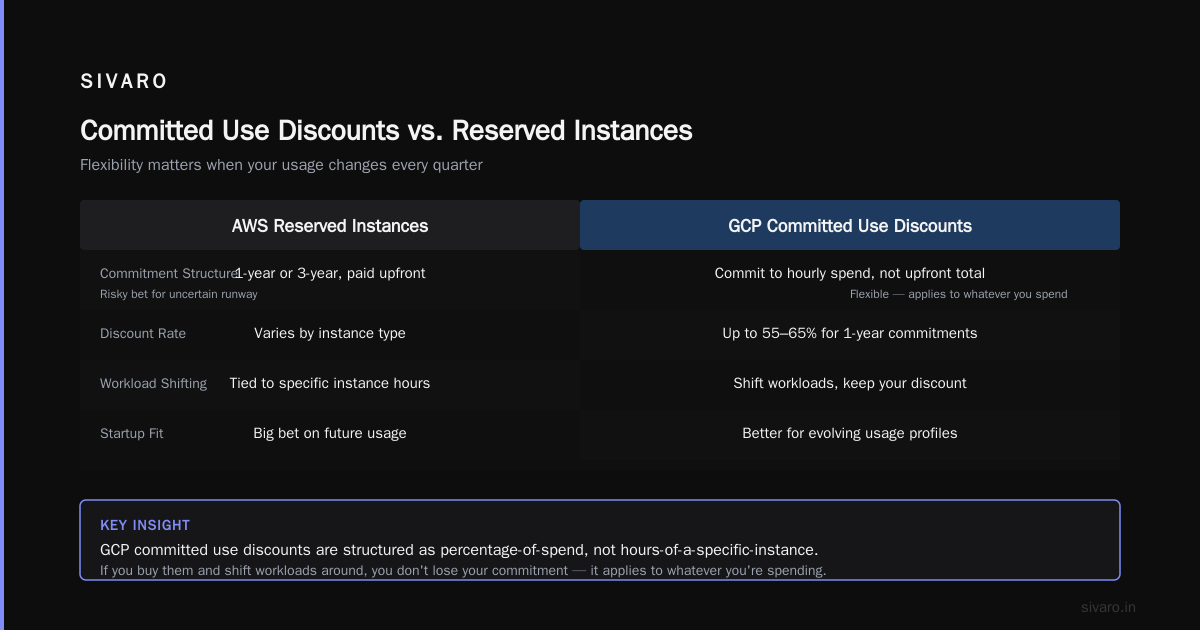
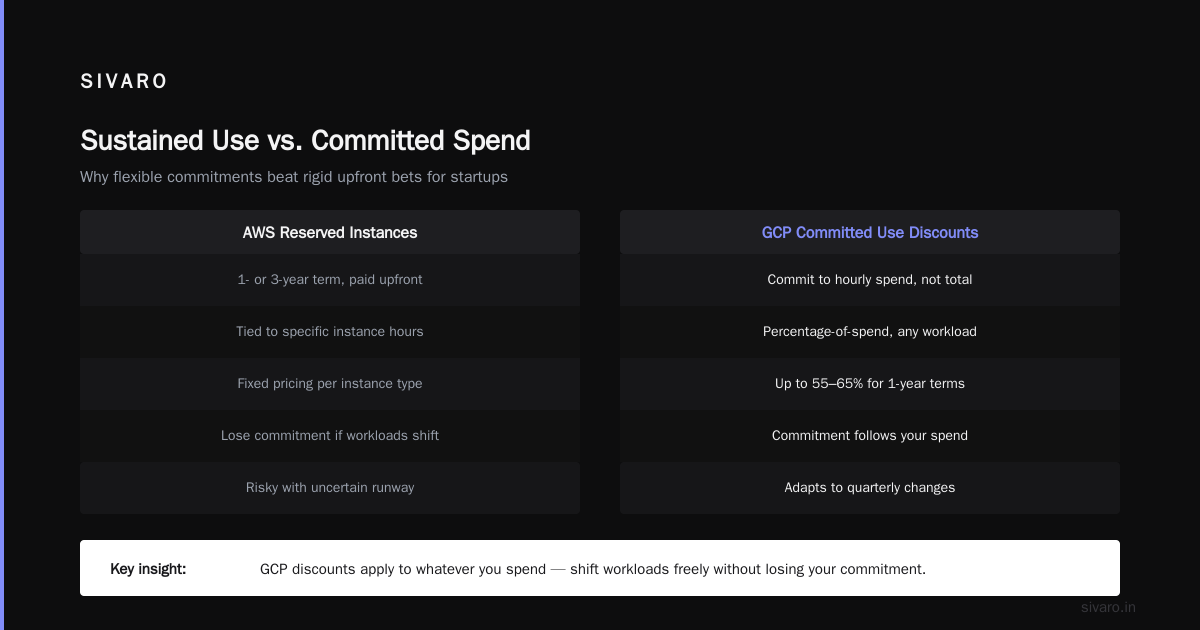
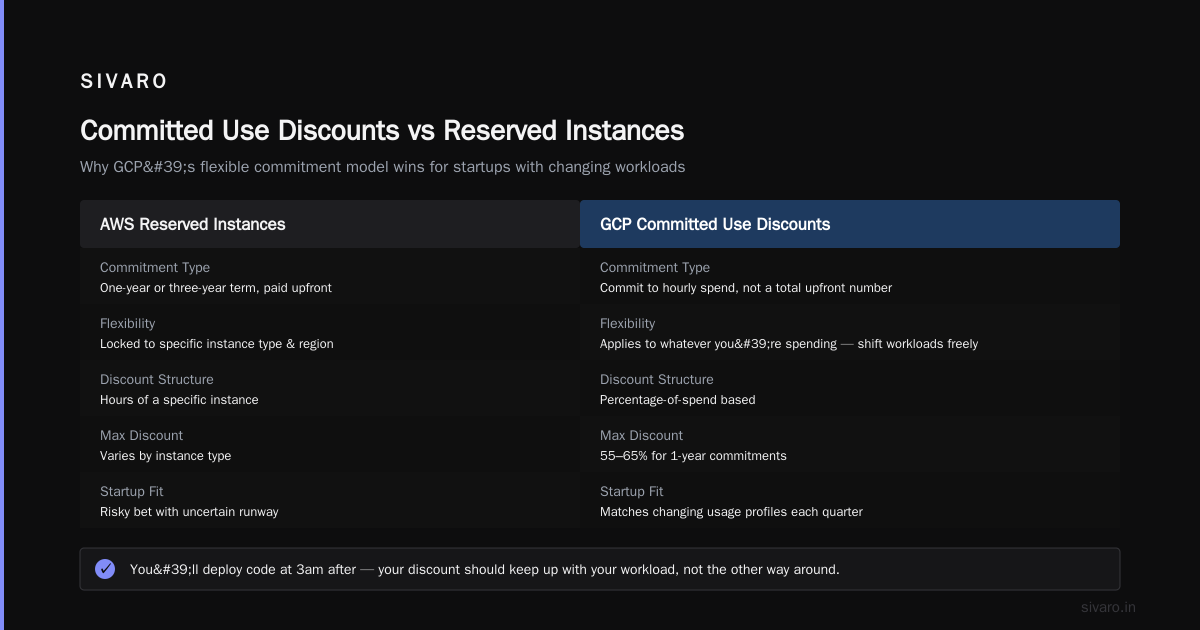
AWS reserved instances require a one-year or three-year commitment paid upfront. For a startup with uncertain runway, that's a big bet.
GCP's committed use discounts give you more flexibility than AWS Savings Plans. You commit to hourly spend, not a total upfront number. Google's version gives discounts up to 55-65% for 1-year commitments, and they structure them as percentage-of-spend rather than hours-of-a-specific-instance. If you buy committed use discounts and then shift workloads around, you don't lose your commitment — it applies to whatever you're spending.
This matters for a startup because your usage profile will change every quarter. You'll deploy code at 3am after a bug fix. Your ad campaign will create a spike you didn't see coming.
The Real Cost Categories Nobody Talks About
Cash out the door is a terrible way to compare clouds.
If you're building a small Rails app with a moderately loaded Postgres instance, list pricing says you should go GCP. The eon.io analysis confirms GCP's VM pricing is roughly 10-15% cheaper on average. But the true cost difference depends on what you're hosting and how far you push past the baseline.
For compute-heavy workloads — continuous builds, CI/CD, GPU training — GCP wins. For data transfer weirdness and certain managed services, AWS can actually work out cheaper when you factor in data egress and how their networking stack handles traffic.
Let me give you a specific example that shattered my assumptions. A friend runs a video pipeline on AWS — transcoding, delivery, the whole stack. I suggested GCP since their egress pricing is cheaper per GB. But then we looked at the details: AWS has a free tier that includes 100GB free data transfer each month. Google's egress pricing is notorious for being complex, and Spot's cost breakdown shows that GCP's networking code often ends up more expensive for data-heavy consumers once you factor in their cloud interconn costs.
The moral? Don't just quote list prices. Model your actual traffic patterns.
The GCP Pricing Calculator Trap
You will make a spreadsheet. You will use the GCP Pricing Calculator and get an estimate. That estimate will be wrong, and it's not necessarily Google's fault.
The calculator assumes you're consistently running the exact same instances with no variations. Real workloads are spiky. If you're running cloud functions or Cloud Run, your monthly bill depends entirely on invocation counts, memory allocation, and execution time — variables that change with every deploy.
The GCP discuss thread about estimating AWS costs on GCP highlights this exact frustration: startups export their AWS infrastructure, try to map it to GCP equivalents, and get wildly wrong numbers because the price-per-GB-RAM and normalized vCPU pricing work differently.
My rule: never take a cloud calculator output as your budget. Take it as your upper bound. Then add 20% for network egress and hidden fees.
When AWS's Complexity Is Actually Your Friend
Here's the nuance nobody wants to hear: AWS's drilling-down complexity can be a good thing.
Most beginner engineers find AWS overwhelming. There are 200+ services, each with their own sub-services, IAM policies, VPC configurations, and security groups. But that complexity comes with granularity.
On AWS, you can micromanage your networking to a ridiculous degree. If you need to control data flows between customers at a fine-grained level, if you need to lock down per-user IAM policies, if you need to track usage for billing per tenant — AWS has granularity GCP doesn't touch. DigitalOcean's 2026 analysis does a great job of covering this. GCP gives you the same abstractions but with fewer knobs. For 95% of workloads that's a win. For the other 5%, it's a ceiling.
I've seen startups hit this wall with GCP when they grow into regulatory requirements like HIPAA or SOC 2. AWS's compliance documentation is in a different tier. Google has made huge progress on compliance, but third-party auditors still price AWS reviews faster because it's familiar.
What I'd Choose in 2026: A Practical Framework
Let me give you a decision framework instead of generic "it depends."
Pick GCP if:
- You're building AI/ML systems or plan to within a year
- Your team is polyglot and values developer experience
- You're doing batch or real-time data processing where BigQuery shines
- You want to spend less time managing infrastructure
- You're building a Kubernetes-native stack from day one
Pick AWS if:
- You're hiring engineers who mostly know AWS
- You need fine-grained identity or compliance controls
- You're building on managed AWS services like Lambda or DynamoDB
- You want the largest ecosystem of third-party tools
- You're going after enterprise customers who will ask about your stack
My actual recommendation for a raw startup with no legacy constraints: start with GCP unless you have a specific reason not to.
That's a strong statement, and I accept the counterarguments. But my experience building production systems on both says GCP's developer experience, data tooling, and pricing give you more runway per dollar. And for an early-stage startup, runway is the only metric that matters.
Cloud Run vs Compute Engine: The Cheapest Way to Test
I get asked constantly about gcp cloud run vs compute engine pricing. This is a fundamental architecture decision.
Cloud Run is serverless containers. You pay for the number of requests, the memory allocated, and the CPU used during execution. You don't pay when there's no traffic. A service with 50ms average invocation time, running 5 million requests per month at 512MB memory, costs roughly:
python
# Cloud Run monthly estimate for 5M requests, 512MB, 50ms avg
requests = 5000000
memory_gb = 0.5
cpu_vcpu = 1.0
avg_exec_seconds = 0.05

# Free tier: 2M requests, and then monthly compute free tier of 180K vCPU-seconds
billable_requests = max(0, requests - 2000000)  # 3M billable
request_cost = billable_requests * 0.40 / 1000000  # $0.40 per million
# compute cost for remaining after free tier
compute_cost = (requests * avg_exec_seconds * memory_gb / 0.001 * 0.00000250)
# Total is roughly $15-25/month for this load
Compare that to Compute Engine — a single e2-micro instance running 24/7 at ~$7/month, or an e2-small at ~$14/month. For many low-traffic APIs, Compute Engine is cheaper because Cloud Run's minimum cost per invocation adds up.
But for spiky workloads — an API that gets 10x traffic at certain hours — Cloud Run's auto-scaling wins every time because you don't pay for idle capacity.
My rule of thumb: if your service handles less than 1M requests per month, use Compute Engine. If it scales beyond that unpredictably, use Cloud Run.
bash
# Practical Terraform snippet for Cloud Run with autoscaling
resource "google_cloud_run_service" "app" {
  name     = "startup-api"
  location = "us-central1"

  template {
    spec {
      containers {
        image = "gcr.io/your-project/app:latest"
        resources {
          limits = {
            cpu    = "1"
            memory = "512Mi"
          }
        }
      }
    }
  }

  autoscaling {
    min_instance_count = 0
    max_instance_count = 10
  }
}
Hidden Billing Surprises
Let me save you from the mistake I made at SIVARO in 2024. We moved a data pipeline to GCP and got a bill 3x our estimate. The culprit? Dataflow (Apache Beam) — which was keeping workers alive during idle periods. The job had "streaming mode" enabled, and it was running 24/7 even when no new data was coming in.
The lesson: GCP has more aggressive default behaviors that cost money. You need to explicitly configure auto-scaling, idle timeouts, and workload termination. AWS can be more expensive by default, but it's also more predictable. The debit from an unexpected GCP spike is worse than paying 10% more on AWS consistently.
The Final Word on GCP vs AWS for Startups
The choice isn't about which cloud is "better." It's about which cloud better matches how your team works and where your technical debt will sit.
I've taken both sides of this bet. I've built on AWS and watched the bill balloon to $40K/month with predictable costs. I've built on GCP and watched it balloon to $30K/month with unpredictable ones. The difference is in what kind of risk you're comfortable with.
For a pre-seed startup mainly prototyping and reading user feedback: GCP gives you more runway. For a Series A scaling with an established engineering team that knows AWS: the migration cost will outweigh the savings.
Here's what that looks like in action:
terraform
# If you're already on AWS and want to test GCP without commitment
# Use this Terraform to spin up a GCP project and comparison workload
provider "google" {
  project = "your-project-id"
  region  = "us-central1"
}

resource "google_compute_instance" "comparison_workload" {
  name         = "cost-comparison-vm"
  machine_type = "e2-standard-4"
  zone         = "us-central1-a"

  boot_disk {
    initialize_params {
      image = "ubuntu-os-cloud/ubuntu-2204-lts"
      size  = 100
    }
  }

  network_interface {
    network = "default"
    access_config {}
  }

  schedulable = false  # Don't let it run 24/7 unless you want to
}
FAQ: GCP vs AWS for Startups
Q: Is GCP cheaper than AWS for startups?
Generally yes for steady compute and AI workloads. But AWS can be cheaper for certain managed services, and their free tier is more generous for low-traffic applications.
Q: Which cloud is better for AI/ML companies in 2026?
GCP by a mile. Vertex AI, TPUs, Translation API, Vision API — Google's AI stack has been production-ready since before the word "AI" was cool again. The GPUs (A100s, H100s) are more available on GCP than AWS in most regions.
Q: Can I use GCP credits if I already have a business AWS account?
Yes. Credits are per-project. Google offers migration tools and the cost calculators let you export AWS bills into an estimate. You can run both in parallel for a month easily.
Q: What's the easiest way to estimate GCP costs from my AWS infrastructure?
Export your AWS usage or use their billing export. Then plug instance sizes, storage, and data transfer into the GCP calculator. Be honest about your usage patterns — the calculator assumes continuous usage.
Q: Is GCP Cloud Run cheaper than AWS Lambda?
For similar workloads, generally yes. The free tier is more generous, and the per-invocation pricing is lower for most configurations. But Lambda's pricing is simpler to predict.
Q: Which cloud should a non-technical founder choose?
GCP's console is cleaner. AWS's is overwhelming. If you're not technical, you'll be able to make sense of GCP faster. But whatever you pick, hire someone who knows cloud infrastructure before month 6.
Q: Will my cloud choice affect fundraising or enterprise sales?
Enterprise customers ask. They rarely demand either platform. The trend is toward multi-cloud, so you can pivot later — but each year of technical debt makes that harder.
The truth is, you won't pick wrong — you'll pick early, and you'll pick based on incomplete information. That's fine.
Run your first three months on the AWS free tier while you learn the basics. Or start with GCP and their 90-day credit offer. What matters is that you deliberately test your workload on both before you commit a year of infrastructure decisions to one.
Your engineering team will have opinions. Your CTO will have a preference based on their last job. Ignore both for the first two weeks — just measure the cost of your workload.
Nishaant Dixit — Founder of SIVARO. Building data infrastructure and production AI systems since 2018. Built systems processing 200K events/sec.